
Instagram Marketing
Instagram marketing: Update your strategy for 2026
Ready to grow your brand on Instagram? This comprehensive guide gives you a clear roadmap to connect with customers and elevate your strategy.
Want to put it into practice? Start your free 30-day trial of Sprout Social and see the difference.
Reading time 15 minutes
Published on July 22, 2026
Table of Contents
Summary
- Instagram marketing starts with defining your goals and target audience. Establish what you want to achieve with Instagram (brand awareness, sales, etc.) and identify who you want to reach (potential customers).
- For businesses new to Instagram marketing, it’s important to convert to a business profile, craft a compelling bio with a call to action and link and design an eye-catching profile picture.
- A successful marketing strategy includes creating high quality content, publishing consistently, growing your followers and tracking your results to adjust your strategy accordingly.
Instagram isn’t optional. It’s where 65% of social users live, according to our 2026 Social Media Content Strategy Report.
That level of attention demands a deliberate Instagram marketing strategy—one built on more than aesthetics. The brands winning on Instagram combine original short-form video, consistent engagement and data-driven decisions to turn followers into customers.
This guide breaks down every essential step to build or sharpen your Instagram marketing strategy in 2026—from defining your audience and understanding the algorithm to measuring what drives growth.
What is Instagram marketing?
Instagram marketing means using Instagram’s features—content, community tools, shopping integrations and analytics—to build brand awareness, grow an audience and drive measurable business results.
Instagram is the top social media platform for product discoverability, with 61% of social users turning to it to find their next purchase, according to the 2026 Social Media Content Strategy Report. And 60% of consumers engage with brand content on Instagram at least multiple times per week. That level of engagement makes Instagram a core driver of the customer journey, not just a content channel.
A strong Instagram marketing strategy covers:
- Content creation: Short-form video, Reels, carousels and static images tailored to what your audience engages with
- Community engagement: Responding to comments, DMs and mentions to build loyalty and trust
- Shopping and commerce: Using Instagram’s native shopping features to turn discovery into purchase
- Analytics and optimization: Tracking performance data to refine your approach and prove ROI
Done right, Instagram marketing turns your profile into a revenue-generating engine—connecting your brand to the exact right people, at the exact right moment.
Why use Instagram for marketing?
Instagram is the top social media platform for product discovery. Consumers use Instagram to follow brands, research products and inform their buying decisions. Again, according to Sprout Social data, 60% of consumers engage with brand content on Instagram at least multiple times per week.
The platform reaches across generations, giving brands a direct line to audiences who are already primed to engage and buy. In 2026, 41% of Gen Z consumers plan to use Instagram even more, which is the most of any network for this generation. That loyalty is why 70% of marketers plan to increase their investment in the platform.
How to create an Instagram business account
Creating an Instagram business account takes five steps and gives you immediate access to analytics, contact buttons and ad tools that personal profiles don’t offer. Here’s exactly how to do it.
- Step 1: Download the Instagram app on your smartphone. The platform is mobile-first and most setup tasks are fastest to complete in the app.
- Step 2: Enter your business email address and choose a password. Follow the prompts until your new profile is created. Instagram requires you to start with a personal account, which you’ll convert into a business profile in the next steps.
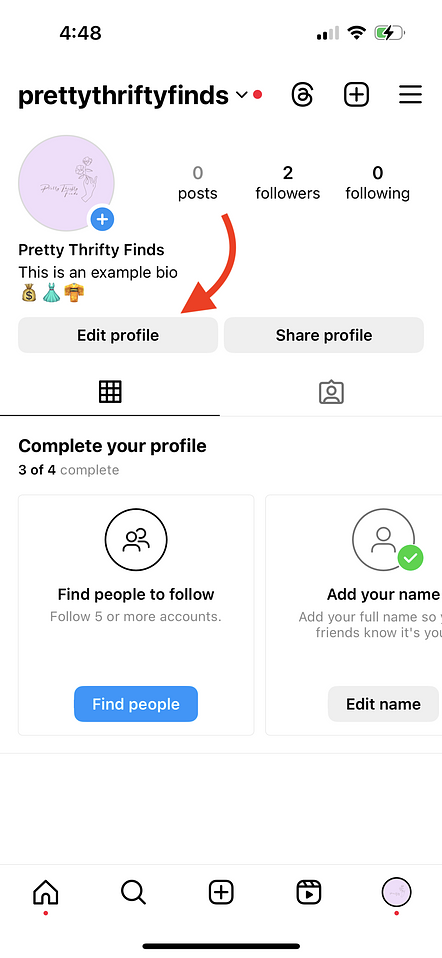
- Step 3: Tap the “Edit profile” button to build your visual brand. Upload a profile photo and fill in your business name, bio, profile link and CTA button.
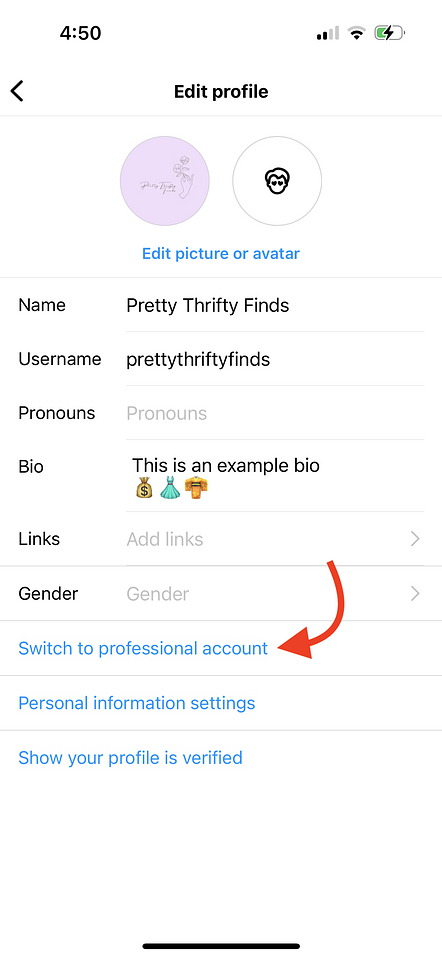
- Step 4: From the “Edit profile” page, tap “Switch to professional account” to begin converting your profile.
- Step 5: Select your business category and choose between a Business or Creator account. Review your contact information to finish the setup and decide whether to display that contact info publicly on your profile.
How is Instagram used for marketing?
Instagram gives brands a direct line to consumers across every stage of the customer journey, from discovery to purchase to customer care. With 60% of consumers interacting with brand content at least multiple times per week on Instagram, the platform demands a deliberate content mix that spans entertainment, product education and community engagement.
Brands use a range of native features to build that presence and drive measurable results:
- Carousel posts — Multi-image or multi-video formats that drive higher engagement through swipe interactions
- Instagram Stories — Ephemeral content that creates urgency and drives direct audience interaction
- Story highlights — Permanent collections that keep your best Stories discoverable beyond 24 hours
- Instagram Reels — Short-form video under 60 seconds, the format consumers are most likely to interact with on the platform
- Instagram Threads — Text-based conversation that extends brand voice into real-time dialogue
- Instagram Shopping — Native product tagging that turns content directly into a purchase path
- Paid partnerships for influencer marketing campaigns — Creator-driven content that builds trust and extends reach to new audiences
- Collab posts — Co-authored content that surfaces your brand to a partner account’s full audience
- Sponsored posts — Paid amplification through creators and influencers to accelerate reach and conversion
The most effective Instagram marketing strategies treat these features as a connected system, not isolated tactics. Short-form video and creator-driven content dominate consumer attention on the platform, which means brands that build original, episodic Reels alongside influencer partnerships are best positioned to win in 2026.
How to create an Instagram marketing strategy
A winning Instagram marketing strategy demands well-defined goals, an optimized profile and a content engine built for your specific audience. Here’s how to build one that drives real business results.
- Define your Instagram marketing goals — Anchor every decision to a measurable business outcome
- Optimize your Instagram profile — Turn your profile into a first impression that converts
- Pinpoint your Instagram target audience — Create content built for the people most likely to buy
- Understand the Instagram algorithm — Know how content gets ranked before you create it
- Create your Instagram content calendar — Build a repeatable content mix across every format that drives results
- Build your Instagram influencer strategy — Extend your reach through creator partnerships that earn trust
- Leverage Instagram Shopping and social commerce — Turn content directly into a purchase path
- Publish content consistently — Show up on a schedule your audience and the algorithm can count on
- Use social listening to shape your strategy — Stay ahead of what your audience wants before they tell you
- Grow your Instagram followers — Build an audience that compounds over time
- Measure Instagram performance — Track what moves the needle and cut what doesn’t
1. Define your Instagram marketing goals
Your goals dictate every decision you make on Instagram, from content formats to posting frequency to how you measure success. Are you there to generate leads, build a community or increase brand awareness?
Setting social media goals determines everything from your content strategy to how much time you invest in the platform. Your ROI from Instagram hinges on these goals.
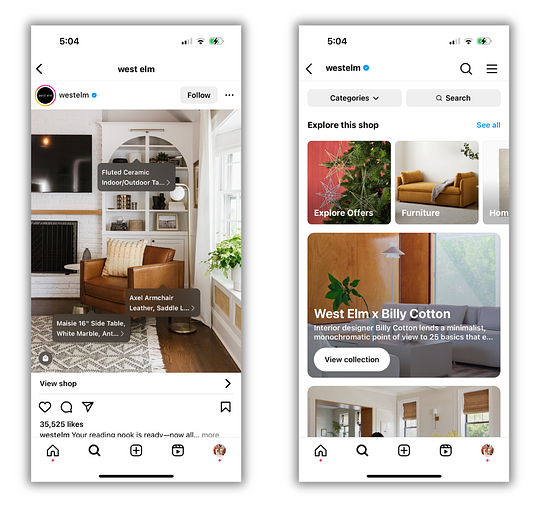
For example, West Elm centers its entire feed around social selling—shoppable posts, product highlights and a full Instagram storefront. Meanwhile, beauty brands focus on community building through constant back-and-forth with followers.
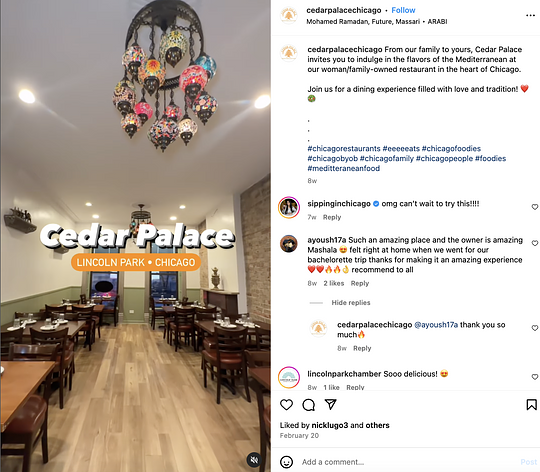
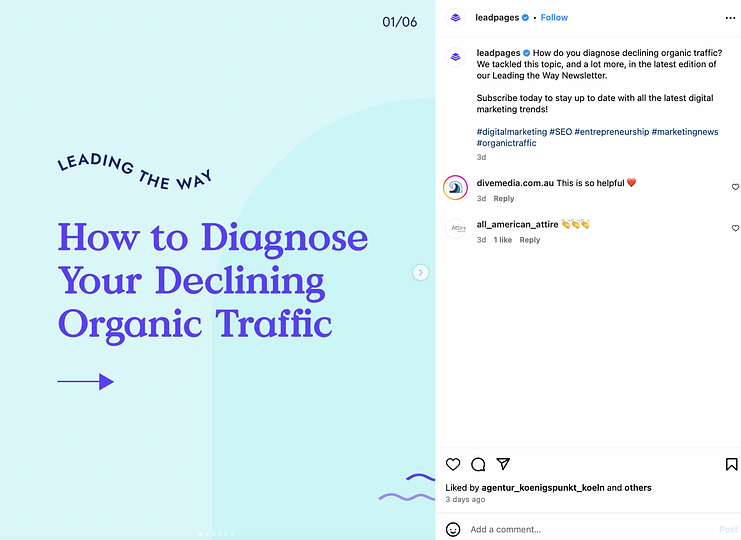
Local businesses use Instagram to promote offers and build relationships—like Cedar Palace Chicago, which responds to every comment while showcasing its menu. B2B brands like Leadpages use branded graphics to educate their audience.
Spend time on Instagram as a user by following your favorite brands and your competitors. Experiencing the platform firsthand is the fastest way to understand how brands and people interact. Common goals that drive a successful Instagram marketing strategy, which can be seen modeled by the best brands on Instagram, include:
- Increase brand awareness via followers and reach
- Generate engagement via comments and shares
- Improve website traffic via link-in-bio and Stories clicks
- Drive sales via clicks or social commerce
2. Optimize your Instagram profile
Your profile is your brand’s first impression, and it’s doing more work than you think. Before creating content, make sure these foundational elements are in place.
Switch to a business profile. Instagram business profiles give you access to analytics, paid partnerships, CTA buttons and more. You can also add your industry, location and contact info to your Instagram bio.
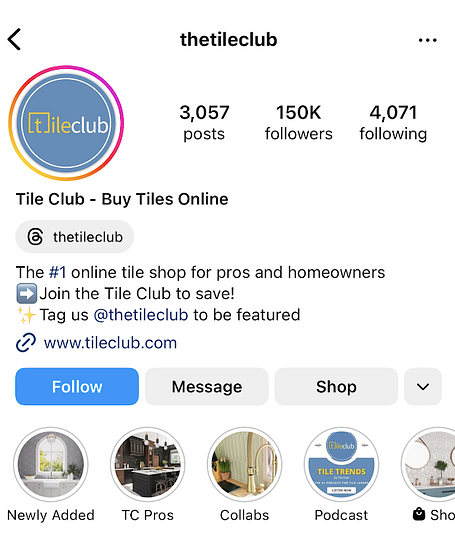
Business profiles unlock native analytics that show how followers interact with your account. Prove your ROI and see the full picture of your performance with Sprout Social’s Instagram analytics.
Your branded hashtag and bio are equally critical. Most hashtags are a brand name or a slight variation: #Topshop, #MyAnthropologie, #TargetFinds. They serve as a call-to-action that encourages customer photos and stories and including them in your bio drives even more usage.
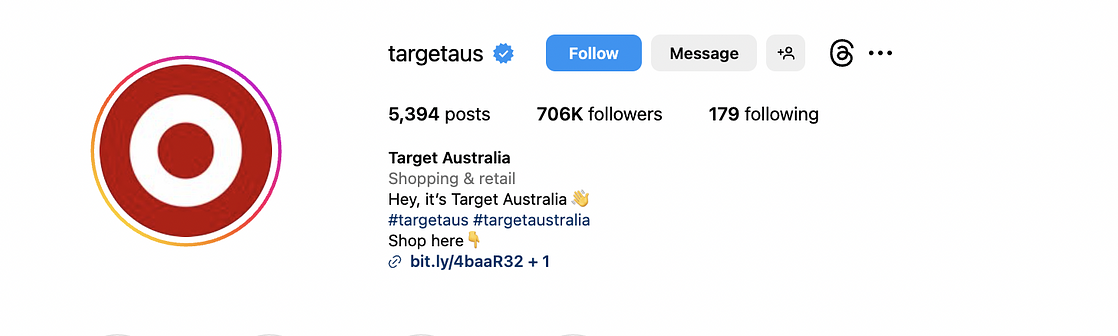
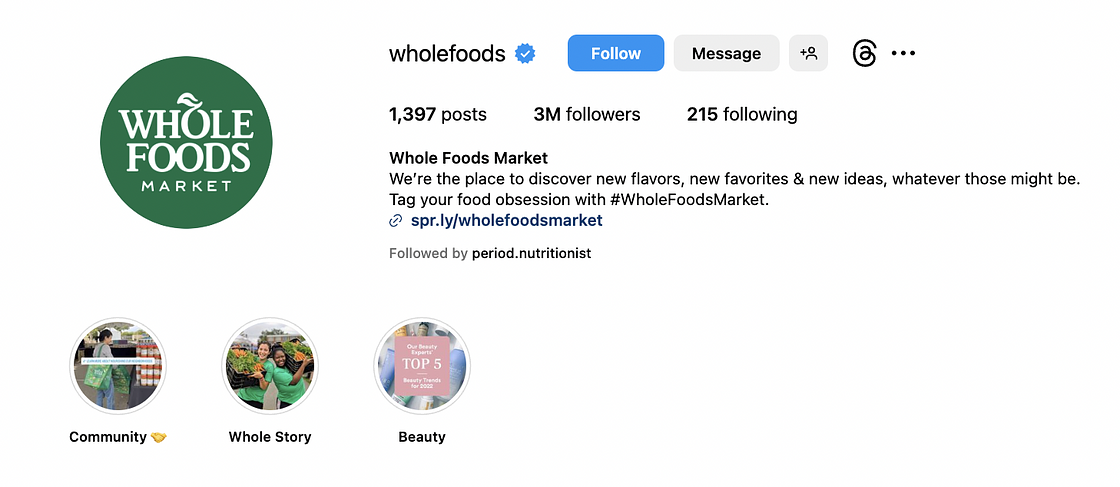
Your Instagram bio is only 150 characters, so make every one count. It’s the only place where you can funnel Instagram traffic to your website or promotions. A strong bio includes:
- A clear, concise description of what your business does
- Hashtag(s) related to your business
- A call-to-action
- A trackable link in bio to monitor Instagram traffic behavior
Whole Foods’ Instagram bio nails all four.
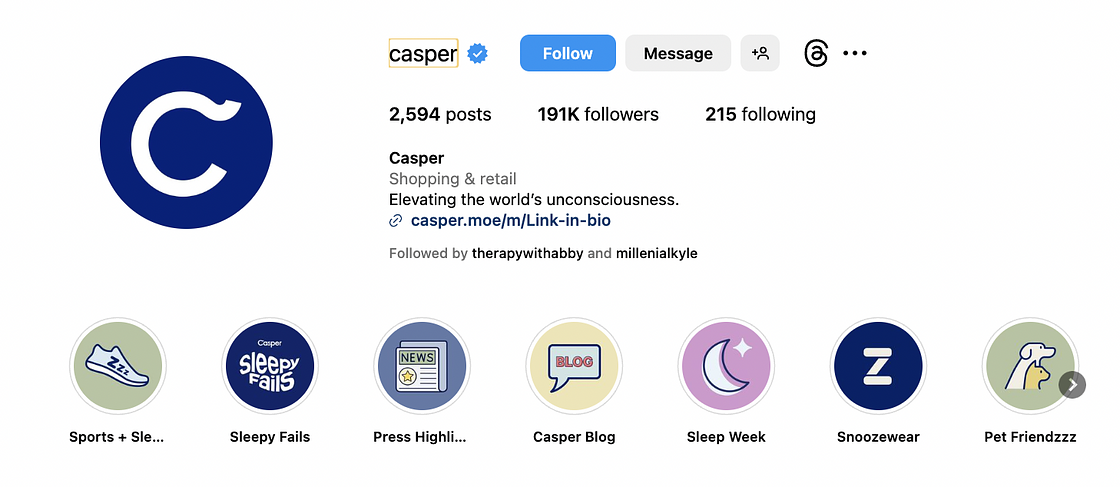
Your profile picture is only 110×110 pixels, so it needs to make an immediate impact. Use a high-resolution logo or a recognizable portion of it that reads clearly in a circular frame. Casper uses just the first letter of their stylized font.
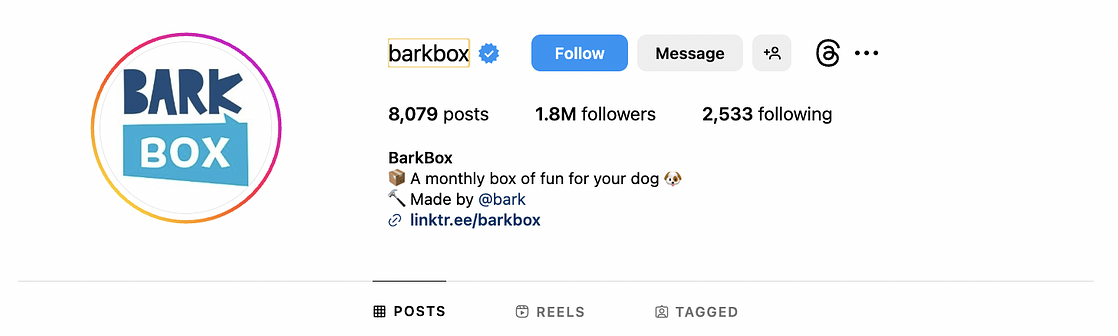
BarkBox fits its entire name with clean, legible text.
3. Pinpoint your Instagram target audience
Content without a defined audience is content without a purpose. Identify which customer segments are active on Instagram before you create a single post.
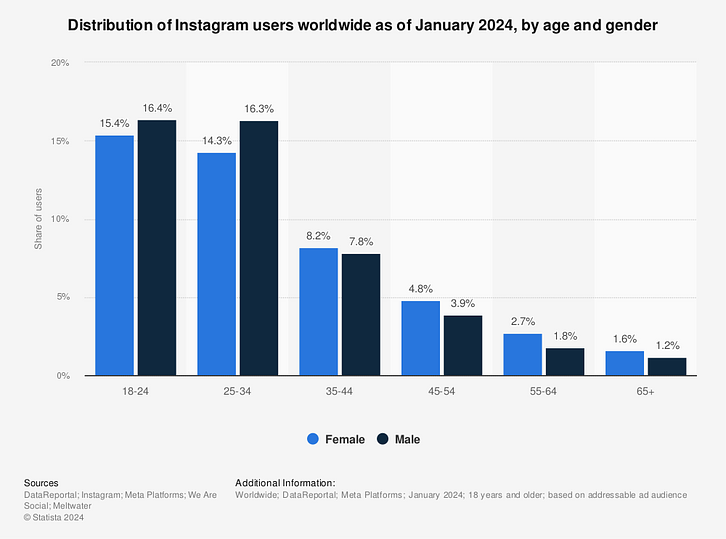
Study Instagram’s overall demographics and build a customer persona to ensure your content reaches the right people. According to the 2026 Social Media Content Strategy Report, 65% of social users have an Instagram profile, with Gen Z and Millennials as the primary audience, and 41% of Gen Z plan to use Instagram even more in 2026.
Use Sprout Social’s listening tools to capture audience conversations and surface the topics they care about. This keeps your content strategy agile, relevant and data-driven.
4. Understand the Instagram algorithm
Great content that the algorithm ignores is wasted effort. The Instagram algorithm ranks content based on post popularity, the creator and timing—then surfaces it to users most likely to engage based on their past behavior.
Understanding how the algorithm works before you build your content plan is the difference between a strategy that compounds and one that stalls. The algorithm rewards consistency, meaningful engagement and content that keeps people on the platform. Every signal matters: comments, saves, shares and watch time all feed into how widely your content gets distributed.
Post consistently and when your audience is most active. Encourage comments and respond to them because every interaction adds to your post’s popularity signals and increases its visibility in Feeds and Explore pages.
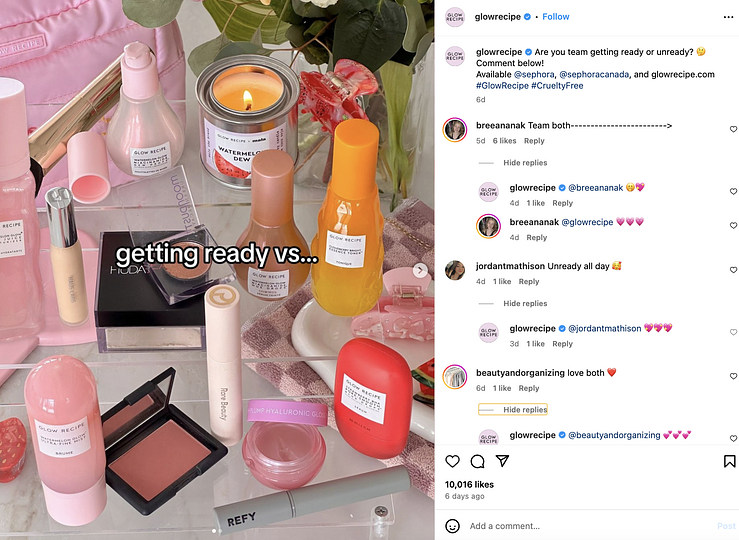
Reels and carousels have seen steady growth on Instagram, while single image posts have declined. The algorithm reflects this shift by prioritizing the formats that keep users engaged longest. Build your content plan around what the algorithm already rewards and you’ll spend less time fighting for reach.
5. Create your Instagram content calendar
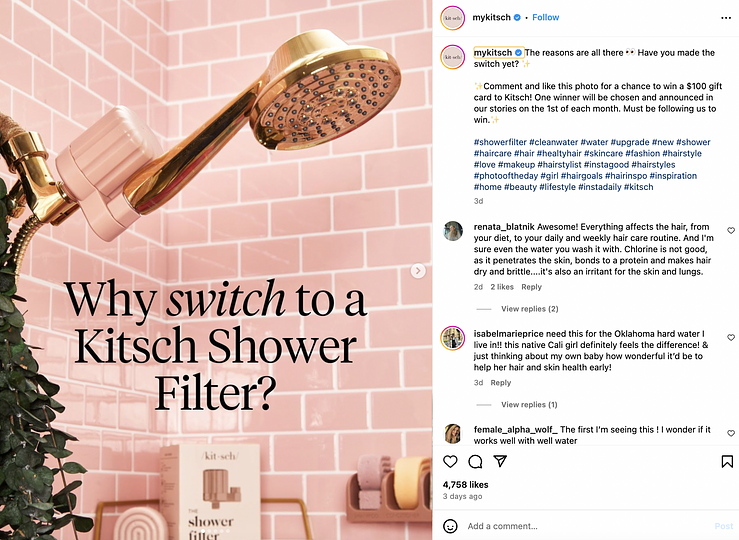
Content is the engine of your Instagram marketing strategy. These are the formats that consistently drive results.
Photos: Striking visuals with a clear creative point of view drive likes and comments. Most modern smartphones produce compelling images—and Instagram apps with filters and editing tools make it even easier to elevate your shots.
Quick tip: If you’re just starting out, learn the basic steps for how to post on Instagram before diving into content formats.
User-generated content: UGC is one of the most trusted content types on Instagram. Consumers buy when they see real people using your products. Sharing user-generated content places your brand in a real-world setting that no polished campaign can replicate. Source UGC from tags, mentions and reviews. Always ask for permission before reposting and set clear reuse guidelines so your team can move quickly. Mix UGC into Reels, Stories, carousels and product launches to keep your feed feeling authentic and community-driven.

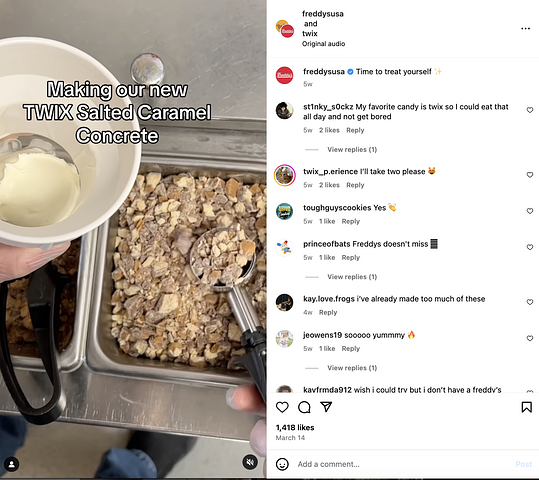
Video and Reels: According to the 2026 Social Media Content Strategy Report, consumers are most likely to interact with short-form video on Instagram—and 70% of marketers plan to increase their investment in the platform. Instagram Reels drive high engagement and expand your visibility. Behind-the-scenes content, product highlights and tutorials all perform well in this format.
Carousel posts: Carousels reward curiosity and drive deeper engagement through swipe interactions. Use them for education, storytelling, before-and-after examples and step-by-step guidance. Lead with a strong first slide that earns the swipe, sequence your content clearly and close with a focused takeaway or call-to-action. Carousels carry more substance than a single image without demanding full video production, making them one of the most efficient formats in your content mix.
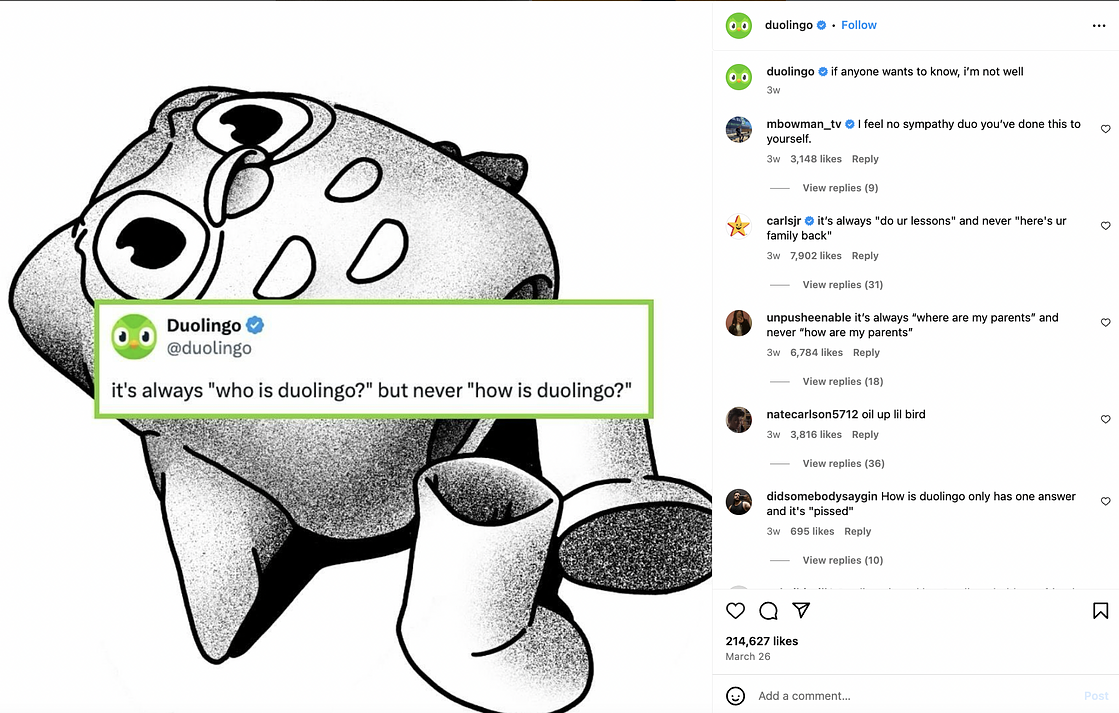
Memes and image macros: These break up your feed and engage with followers on a personal level. Use tools like Canva and Visme to create polished versions quickly.
Instagram Stories: Stories put your account at the front of your followers’ queue and tap into urgency. According to Meta, one in three of the most viewed Stories are from businesses and half of Instagram users have visited a website to buy a product or service after seeing it in Stories. Use Stories daily for deals, company updates and time-sensitive content.
6. Build your Instagram influencer strategy
Creator partnerships are no longer a nice-to-have; they’re a core strategy. The most sought-after content on Instagram feels native and creator-driven and brands that build influencer strategies into their overall approach reach new audiences faster and with more credibility than brand-only content can deliver.
Use influencer partnerships for awareness, product education, launches and community trust. The key is choosing creators based on audience fit, content style and brand alignment, not just follower count. A creator who consistently speaks about topics that align with your brand will drive more authentic connections than one who has a large platform.
Build a repeatable workflow for outreach, approvals, publishing rights and performance tracking so your influencer program scales without chaos. Repurpose creator content across Reels, Stories, carousels and ads to extend the value of every partnership beyond its original post.
Sprout Social Influencer Marketing brings precision to creator discovery through AI-powered natural language search and a Brand Fit Score that evaluates how closely a creator’s content, voice and niche match your brand’s goals. Instead of relying on demographics alone, the platform surfaces creators based on topical alignment, ensuring the audience has a predisposed interest in what you’re creating together. That’s the difference between a partnership that performs and one that just looks good on paper.
7. Leverage Instagram Shopping and social commerce
Instagram is the top platform for product discovery—in fact, 61% of social users turn to it to find their next purchase. The purchase journey increasingly happens without ever leaving the app. Brands that build social commerce into their Instagram strategy reduce friction between inspiration and transaction, and that directly impacts revenue.
Use product tagging, storefronts and shoppable content to make buying as easy as tapping a post. The content types that work best for commerce feel native to Instagram: product demos, tutorials, creator content and customer proof all outperform traditional ad creative because they show the product in action rather than just promoting it.
Connect your content planning to product launches, seasonal campaigns and retention pushes so your commerce content has strategic timing behind it. Commerce content should still feel native to Instagram: helpful first and promotional second. Audiences buy from brands they trust and trust is built through content that serves them before it sells to them.
Track which posts drive clicks, saves and downstream conversions so you know exactly which content formats and creators are moving product. Use Sprout Social’s Instagram analytics to connect content performance to commerce outcomes and build a clearer picture of your social ROI.
8. Publish content consistently
Consistency builds trust, and the algorithm rewards it. Before you publish your next post, nail these fundamentals.
Every caption is an opportunity. With 2,000+ characters available, you have creative freedom, but most high-performing brands keep it concise. Every caption should include:
- A call-to-action (a question, “check out our bio,” etc.)
- A touch of personality (emojis, conversational tone)
- Hashtags, including your branded hashtags
Need inspiration? Browse 400+ Instagram caption ideas to get started.
Timing and frequency directly impact engagement. Most brands publish daily or near-daily, but quality always comes before quantity. Use Sprout Social’s research on the best times to post on Instagram as your baseline.
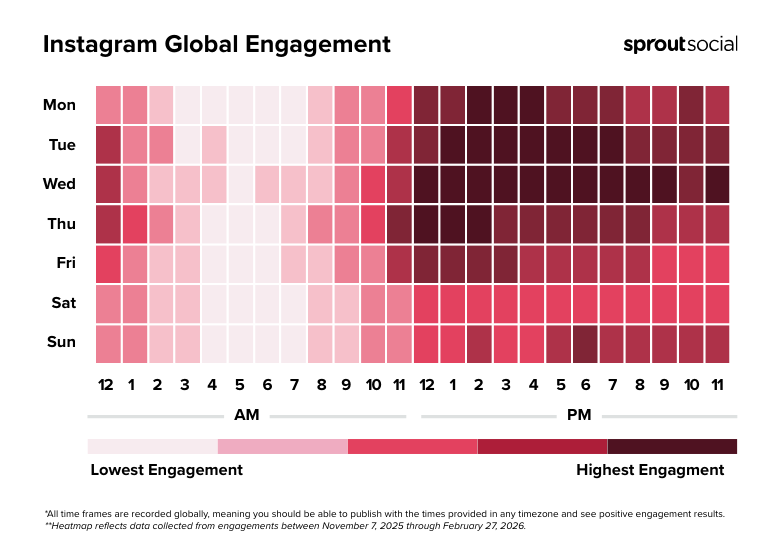
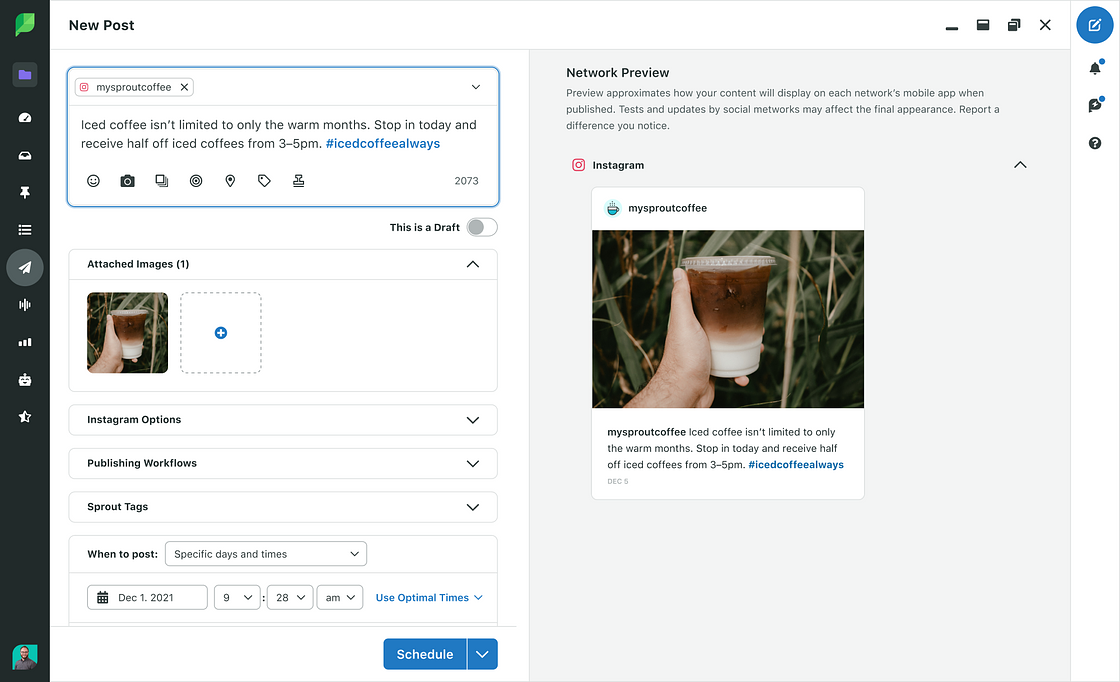
Posting in real-time is a constant challenge. Sprout Social’s patented ViralPost® feature analyzes your account’s unique engagement patterns and schedules content for optimal times—maximizing reach without the manual effort.
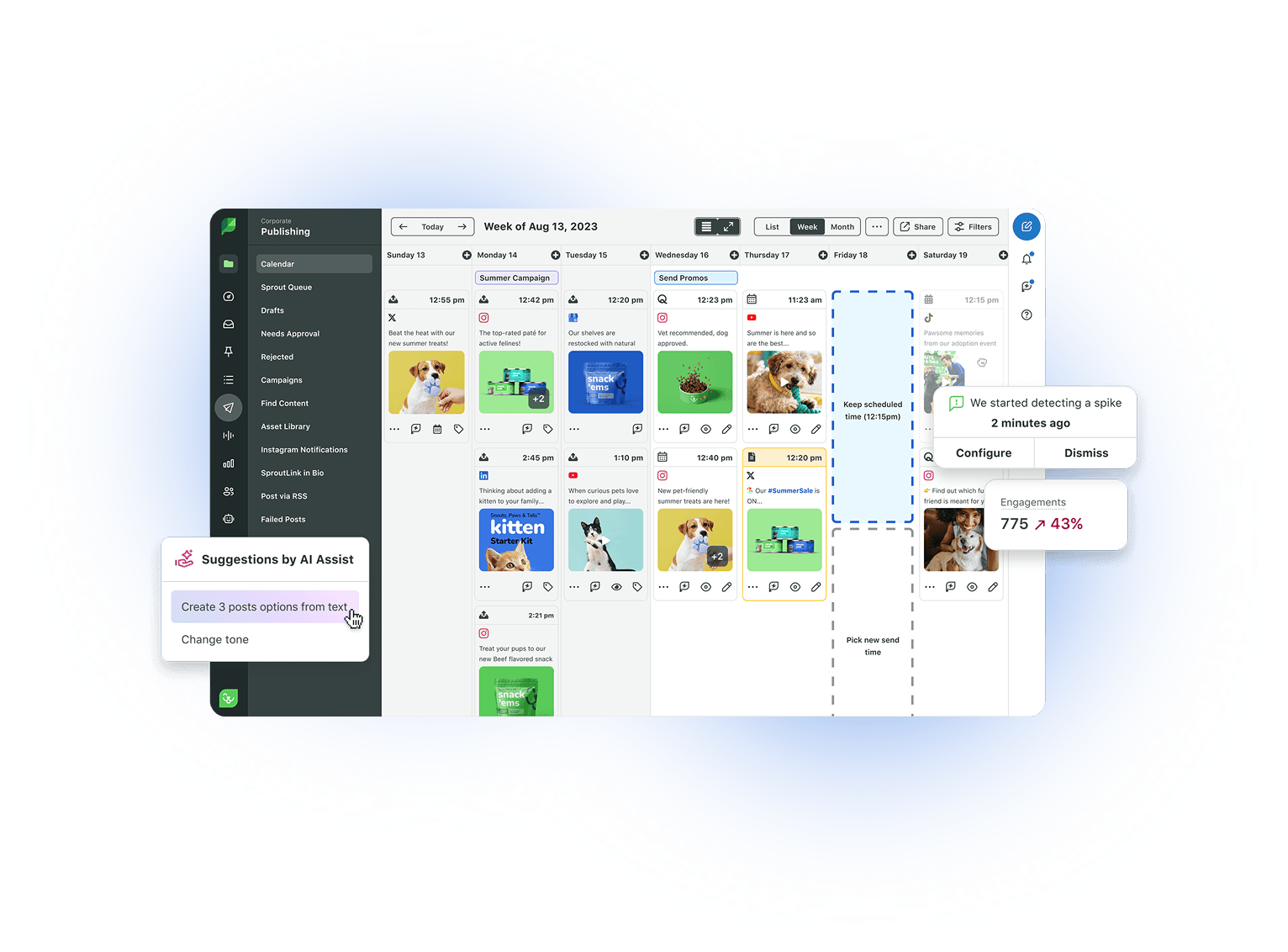
A missed post is a missed opportunity. Scheduling your Instagram posts in advance eliminates gaps, protects your consistency and frees up time for strategy. Scheduling also makes it easy to post at optimal times across different time zones. Use Sprout Social’s social media publishing tools to create, customize and schedule Instagram posts—or let ViralPost® automatically select the best time based on your audience’s behavior. Cross-post to Facebook, Pinterest and other platforms from Sprout Social, with per-platform editing to keep each post optimized.
Social media management that fits your budget
Are you a solo marketer or lean team building an Instagram presence? Sprout Social Essentials gives you the publishing, scheduling and reporting tools you need—starting at $79/month.
Plan your content, post at the perfect time with AI-powered Optimal Send Times and drive traffic with SproutLink (link in bio).
Start your 30-day free Essentials trial
9. Use social listening to shape your strategy
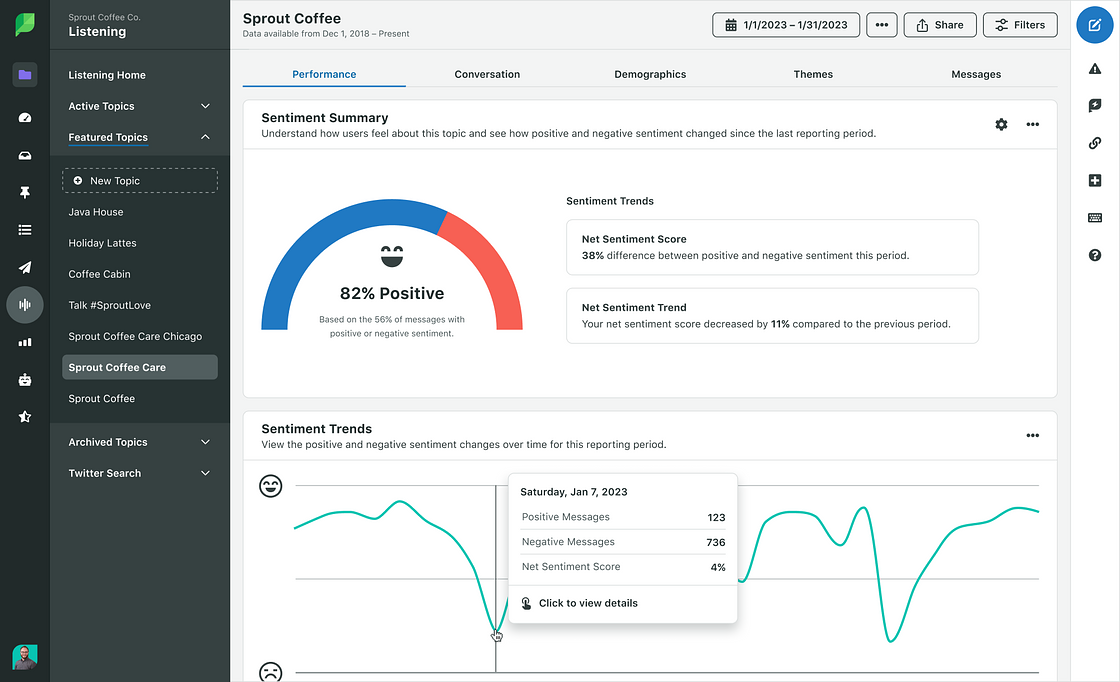
The brands winning on Instagram aren’t just publishing; they’re listening. Instagram listening surfaces the topics, hashtags and conversations that matter to your audience, so your content strategy stays ahead of the curve.
Listening insights reveal what your audience wants, which trends are gaining momentum and where customer service opportunities are hiding in negative comments. Sprout Social’s social media listening tool monitors relevant conversations across social media platforms, measures sentiment and delivers timely alerts so you can respond before a small issue becomes a big one.
10. Grow your Instagram followers
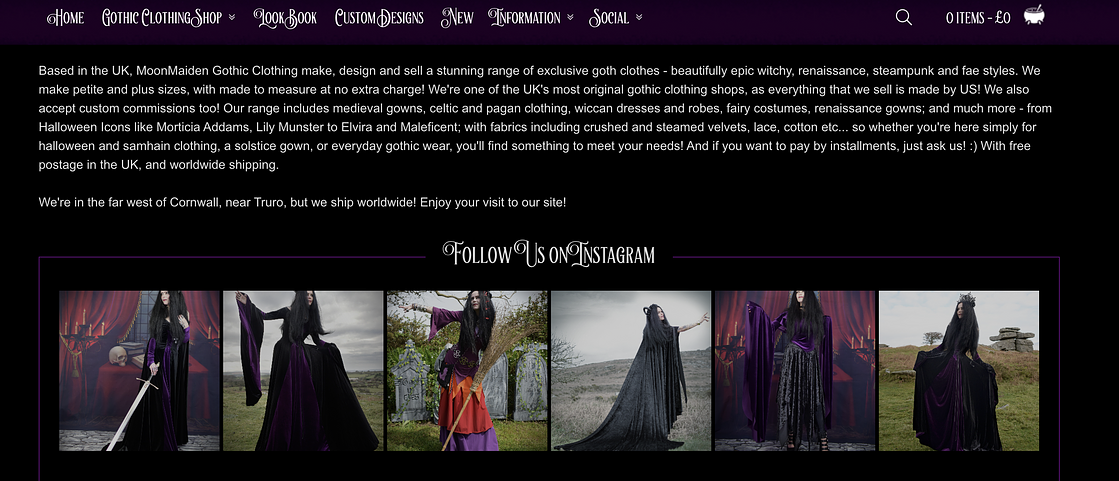
Followers don’t appear by accident. Growth requires deliberate promotion across every channel you own. Feature your Instagram prominently on your website through social buttons, a live feed of customer photos or a dedicated section that signals you’re active on the platform.
Show up every day. Respond to followers, engage with other accounts and treat Instagram as a two-way conversation. Every comment you answer and every DM you reply to strengthens the relationship and signals to the algorithm that your account drives meaningful interaction.
At scale, that volume of engagement becomes unmanageable without the right tools. Sprout Social’s Smart Inbox centralizes every Instagram comment, DM and mention in one place—so your team responds faster, assigns messages without duplication and never lets a high-priority conversation fall through the cracks. Replace guesswork with data-driven decisions that accelerate growth. Use Sprout’s in-depth analytics to enrich strategic decisions and tell a compelling story about ROI with data that executives can instantly understand.
11. Measure Instagram performance
Your own data is the most powerful input for your Instagram marketing strategy, but only if you track it consistently. Without measuring engagement, you’re investing time and resources in content that may not move the needle.
Connect every metric back to the goal you set in Step 1. Here’s the direct mapping:
| Your goal | Metrics to track |
|---|---|
| Increase brand awareness | Reach, impressions, follower growth rate, share of voice |
| Generate engagement | Engagement rate, comments, saves, shares |
| Improve website traffic | Link-in-bio clicks, Stories swipe-ups, profile visits |
| Drive sales | Conversions, product page clicks, Instagram Shopping revenue |
Use those insights to identify what’s resonating, cut what isn’t and continuously sharpen your strategy. Stop guessing what works. Use the Instagram Business Profiles Report to track your Instagram performance metrics down to the post level.
Instagram analytics and tools
Tracking performance is what separates a reactive Instagram presence from a strategy that compounds over time. Instagram’s native analytics give you a starting point, but a dedicated Instagram analytics tool gives you the full picture—across profiles, formats and campaigns.
Here’s a breakdown of tools worth adding to your Instagram marketing strategy:
| Tool | Best for | Standout feature |
|---|---|---|
| Sprout Social | Social media managers and enterprise teams who need a full-stack Instagram solution | Publishing, listening, Smart Inbox engagement management, cross-profile analytics and influencer marketing in one platform |
| Iconosquare | Agencies managing multiple brand profiles | Client-switching dashboard and free business profile audit |
| Bitly | Tracking bio link traffic and ROI | Link shortening with click tracking for Instagram bio links |
Sprout Social
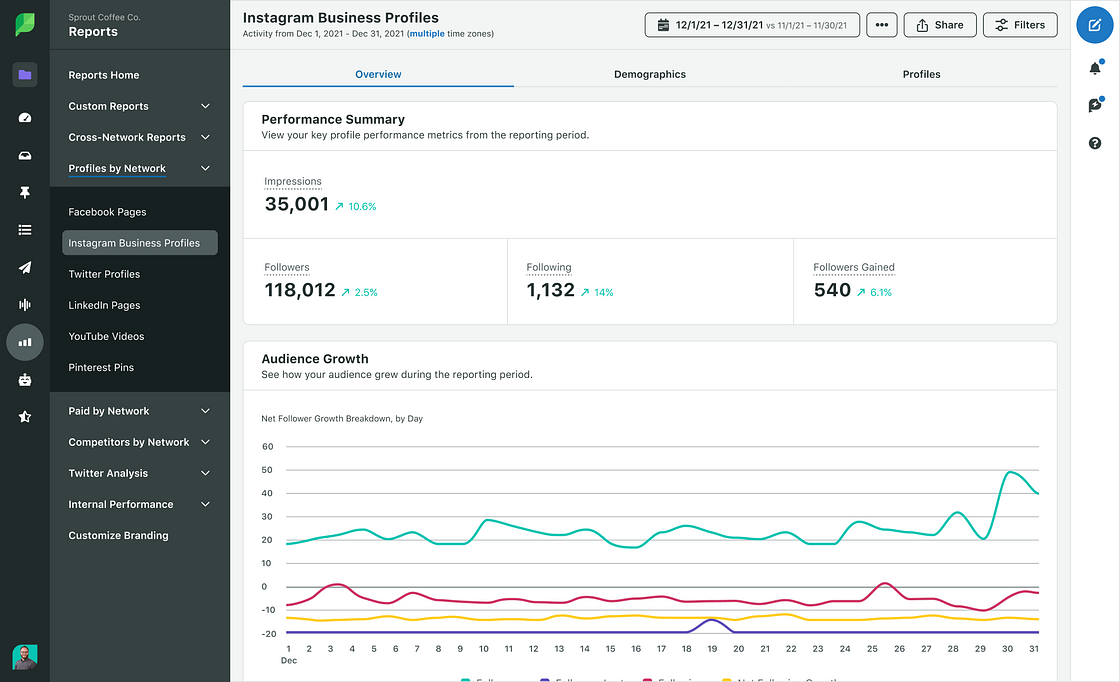
Sprout Social covers the full Instagram marketing workflow—publishing, listening, engagement management and analytics—in one platform. Connect your Instagram business profile to monitor impressions, likes, comments and more without manual calculations.
Sprout calculates engagement rate and average reach, then breaks performance down at the post level so you identify top-performing content fast and enrich strategic decisions. Cross-profile reporting lets you compare follower growth and engagements across multiple accounts in one view. The Smart Inbox centralizes every comment and DM so your team never misses a high-value conversation. And ViralPost® automatically schedules content at the times your specific audience is most active—no guesswork required.
Iconosquare
Iconosquare is built for agencies managing multiple brand profiles, with a dashboard that makes switching between clients fast and frictionless. It also offers a free business profile audit to surface gaps in your Instagram best practices.
Bitly
Bitly shortens links and tracks every click—making it the go-to tool for measuring how much traffic your Instagram bio link actually drives. It turns a single link into a clear ROI signal.
Build your Instagram marketing strategy with confidence
A winning Instagram marketing strategy runs on consistency, data-driven decisions and deep audience understanding, not guesswork. The brands that translate real-time Instagram insights into faster content decisions, sharper targeting and measurable business outcomes are the ones that compound their results over time.
That’s exactly what Sprout Social is built to do. Publishing, listening, engagement management and cross-profile analytics work together in one platform, so your team spends less time switching tools and more time acting on what drives growth.
Brands can’t afford to miss on social, where every interaction shapes their reputation and reach. Ready to turn your Instagram presence into a revenue engine? Start your free Sprout Social trial today and command your market with confidence.
FAQs about Instagram marketing
What is the 5-3-1 rule for Instagram?
The 5-3-1 rule is an engagement framework. For every one piece of your own promotional content, spend time interacting with five relevant posts and sharing support for three other voices in your space. It keeps your brand useful, visible and connected to the broader conversation.
What is the 5-3-2 rule on Instagram?
The 5-3-2 rule is a simple content mix. Out of every 10 posts: five should educate or entertain, three should highlight community or outside perspectives, and two should promote your brand. It helps you stay balanced instead of turning your feed into a nonstop ad.
What's the difference between Instagram Reels and Stories for marketing?
Reels are built for discovery. They help new audiences find you. Stories are built for connection. They help you stay top of mind with people who already know your brand through quick updates, behind-the-scenes content and direct interactions.
How do I prove Instagram ROI to my executive team?
Connect Instagram activity to business outcomes. Report on traffic, conversions, product interest, customer care impact and the content formats that move people to act. Then show what changed after specific campaigns, posting decisions or creative shifts.
Additional resources for Instagram Marketing
Instagram marketing: Update your strategy for 2026

47 Instagram hacks every marketer needs to know

Instagram Stories: The complete brand playbook

How to craft an impactful Instagram bio for business (+ 80 examples)

How to post on Instagram: A step‑by‑step guide for feed, Stories and reels

A guide to crafting seamless Instagram carousel posts

400+ Instagram captions and ideas to get you through every season in 2026

20 Instagram trends defining success in 2026
How to get more followers on Instagram: 10 strategies
Instagram marketing for small business: A strategic guide to sustainable growth

12 Instagram campaigns to inspire your brand in 2026

10 Instagram growth tools to grow your presence in 2026

Instagram Insights demystified: How to access and analyze your metrics

How to be successful on Instagram: From fundamentals to full-funnel

Instagram automation: Maximizing efficiency without losing the human touch

Instagram affiliate marketing: What works (and what doesn’t)

15 Instagram marketing tools for your brand in 2026

31 best Instagram Story ideas for brands and creators

Instagram best practices in 2026: Go from clicks to conversions

The complete guide to finding your Instagram target audience
22 Instagram apps for producing must-see content
How to optimize your video content strategy with Instagram Trial Reels

Your complete guide to creating a Reels strategy for Instagram and Facebook
How to use Instagram Threads in your brand strategy

20 Best Instagram tools to level up your presence

How to use Instagram for business: a complete guide

The complete list of Instagram features for marketing experts

How to use Instagram for B2B marketing

What IGTV’s rebranding means for you & how to make the most of your Instagram video strategy

Organic Instagram growth strategies to build your brand

How to strengthen your Instagram branding

How to promote your Instagram: 13 ways that actually work

The top 12 Instagram tips your brand needs to act on

Share