Social Media Listening
Social listening: Your launchpad to success on social media
Be honest: do you consider yourself to be a good listener? As individuals, we understand the importance of active listening and clear communication. But what about listening to your brand’s audience? With social listening, you can finally know exactly what your customers need without digging around endlessly for answers.
Reading time 20 minutes
Published on June 22, 2026
Table of Contents
Summary
- Social media listening and social monitoring are different concepts; listening tells you “why” something is trending, while monitoring tells you “what” is trending.
- Brands benefit from social listening by getting useful information from social conversations to create compelling content and better brand strategies that influence or generate more revenue.
- Social listening helps with brand health assessment, industry insights, competitive analysis, campaign analysis, event monitoring, crisis management and audience trends.
- To start social listening, businesses should choose a listening tool, set goals, find relevant data sources, create listening topics, gather data and measure results.
- Sprout Social is an AI-powered Social Intelligence platform that offers deep insights with social media listening.
In a fragmented and ever-evolving digital world, a brand’s greatest risk isn’t uncertainty—it’s making decisions based on incomplete truths. To stay competitive, brands must evolve beyond merely tracking noise and start converting social insights into strategic decisions that drive the entire business forward.
Social media listening offers a continuous stream of audience intelligence, from direct shout-outs to broader industry shifts that are happening across social. According to Sprout’s Q4 2025 Pulse Survey, 55% of global consumers feel businesses are effective at social listening but frequently miss the mark when it comes to acting on those findings.
Social media listening can’t operate on its own. It needs to serve as the foundation of social intelligence by turning raw data into a strategic asset. Using it to provide real-time context to business strategy helps brands bridge the gap between internal assumptions and the actual reality of the customer experience.
To truly engage and retain your audience, social media must be viewed as a vital portal to consumer insights. Key opportunities for learning include:
- Identifying the culture and trends your customers care about most
- Discovering ways to outperform your competition
- Uncovering customer pain points and challenges in real-time
- Pinpointing the marketing messages that truly resonate
- Revealing new avenues to strengthen your bottom line
By leveraging social listening, you can build an authentic brand identity, optimize your social media marketing strategy and use candid feedback to refine product development.
What is social media listening?
Social listening is the practice of collecting and analyzing social conversations across social media platforms to draw useful, actionable business insights. Unlike basic social monitoring that tracks mentions, social listening—and a broader social intelligence strategy—reveals the deeper context. This means understanding not just what people say about your brand, but why they’re saying it and how those insights drive strategic business decisions.
Social listening supports your deep-dive into social chatter so you proactively monitor mentions of your brand or your competitors. This information supports you in shaping better strategies for improving your products, marketing, advertising and customer experience.
Social media listening gives you near real-time perspective on social media audience insights such as:
- Who your audience is
- What your audience wants
- When your audience is engaging with you
- Where your audience is active and engaged
- Why your audience wants to talk about you
- How to better serve your audience
These answers ensure your content strategy is relevant and impactful. They also support you in navigating opportunities to find the right influencers and brand partners to increase your reach.
Ready to uncover industry trends and decode broader brand sentiment?
Request a custom demo of Sprout’s Social Listening
Social listening vs. social monitoring vs. social intelligence
While social monitoring tells you what is trending, Facebook listening explains why it is trending among your specific audience on the platform. Then social intelligence is the framework of using these insights to make cross-functional business decisions, serving as the trusted north star for the entire organization.
For example, a food brand’s monitoring involves tracking what customers are buzzing about, such as a trending flavor or ingredient. Listening uncovers the “why” behind that conversation—for instance, why customers are interested in this flavor or ingredient. Social intelligence builds upon those insights to make strategic business decisions, like whether to expand a product line or pivot the campaign strategy to align with that customer feedback.
Social listening
CAVA also uses interactions to draw conclusions about first-time customers, as in the example below. They responded to a first-time customer who loved their experience and wanted them to open a new store in her location.
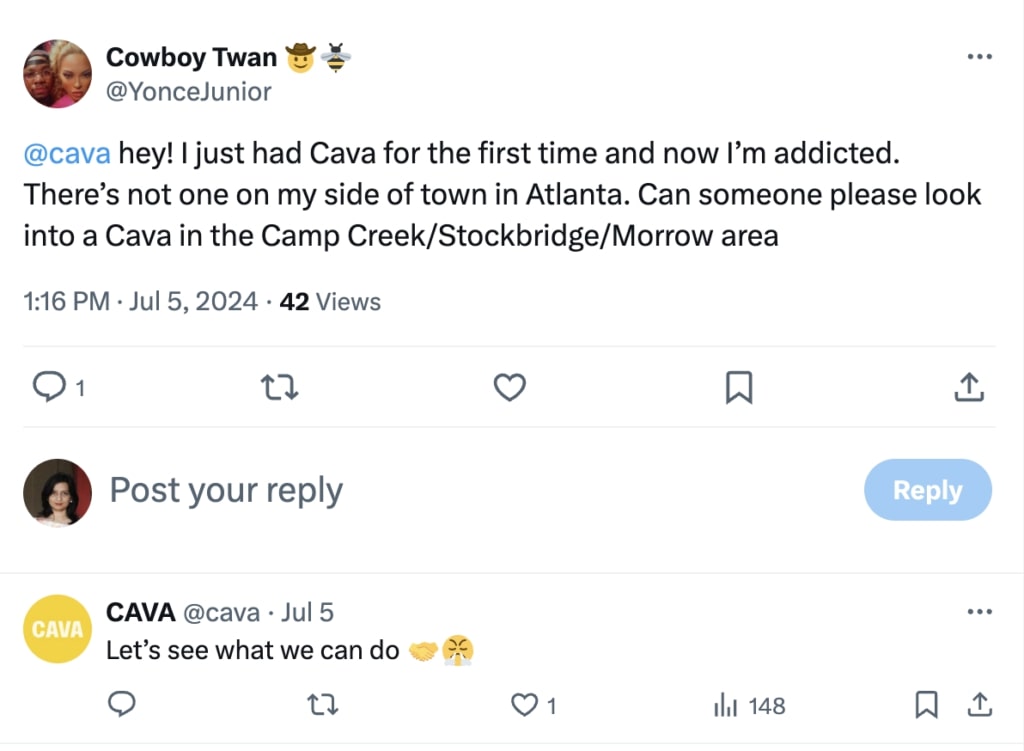
Listening is about understanding the bigger picture. Aggregating such social messages through social listening gives you a combined view of what the audience thinks and wants.
Social media monitoring
Social media monitoring involves tracking and responding to messages received about your brand. Here’s an example from CAVA.
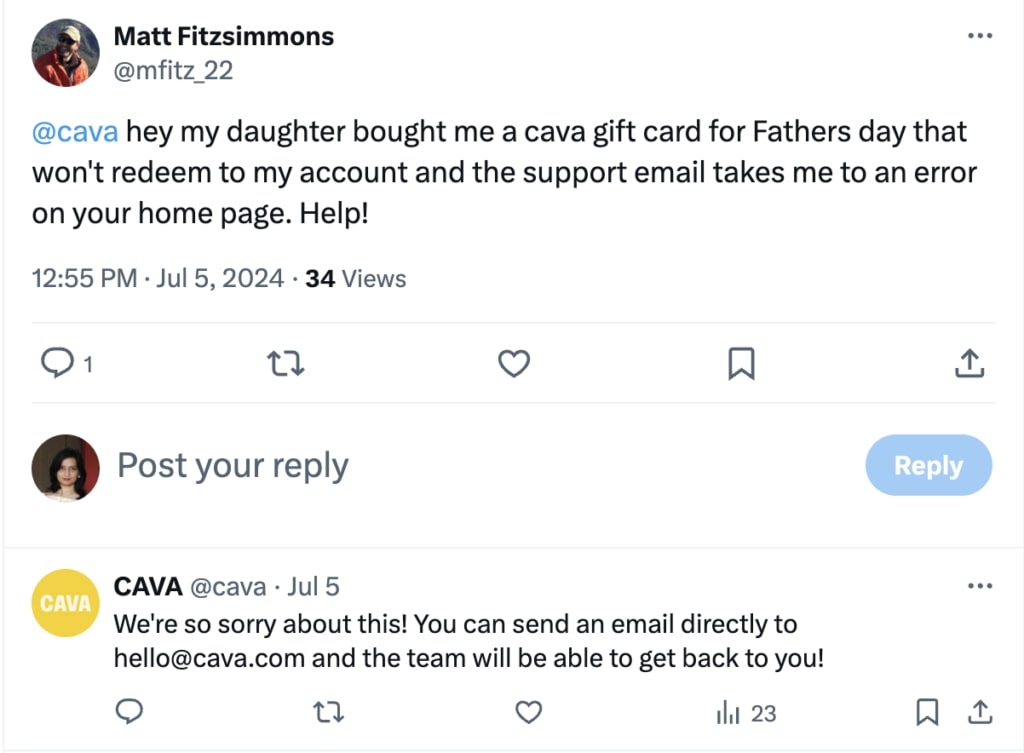
You see how CAVA engages with a customer and offers help, making the customer feel valued and appreciated.
Social intelligence
Social intelligence turns insights into decisive, real-time action. It represents the shift from monitoring and listening to executing—from pivoting campaign messaging and capturing emerging sentiment, to instantly capitalizing on viral trends or reallocating resources based on live audience behavior.
Oatly utilized social listening to identify strong audience demand for a matcha latte. By monitoring influencers on TikTok and listening to feedback across Reddit, X and Instagram, they gathered data for their innovation and R&D teams. This cross-functional collaboration, supported by social media market research, drove the new flavor launch. In this case, social intelligence successfully turned social data into a validated product reality.

This practice of applying what you’re learning about your audience is where the real value happens. It transforms social data from passive observations into a strategic engine, ensuring that every insight directly fuels a measurable business outcome.
Think of social listening, monitoring and intelligence as a hierarchy of data maturity: monitoring handles your day-to-day engagement and reactive needs, listening provides the “why” behind trends and social intelligence weaves those insights into your broader business strategy. Together, they form a connected ecosystem that helps your organization move from merely observing the market to actively leading it.
| Social monitoring | Social listening | Social intelligence |
|---|---|---|
| Reactive: Responds to mentions as they happen | Proactive: Analyzes trends and patterns over time | Strategic: Applies insights to business strategy |
| Focus: Individual messages and direct responses | Focus: Big picture insights and strategic intelligence | Focus: Influence cross-functional business decisions |
| Purpose: Customer service and reputation management | Purpose: Business strategy and competitive intelligence | Purpose: Aligning the entire organization around real-time insights |
| Outcome: Immediate issue resolution | Outcome: Long-term strategic decisions | Outcome: Sustained business growth and organizational alignment |
Benefits of social media listening
Done right, social listening helps you translate social conversations into better content and more revenue.
Imagine you work for a company like Netflix as a creative director. Chances are you have access to tons of data to inspire the direction of your next series. This includes viewership rates, popular genres and most-watched actors. But let’s say you don’t have this data readily available. Or you’re missing details that are holding you back from a suitable storyline that’d make your series more successful.
That’s when you can turn to social media listening to fill in the gaps. By bridging the gap between raw data and consumer behavior, these social listening insights help creative teams move from guesswork to high-impact storytelling.
Think about how much the average consumer loves to sound off on social channels like X (formerly known as Twitter) or Reddit. Social listening provides opportunities to translate these conversations into actionable business insights.
Here are the key social media listening use cases to use for actionable insights:
- Brand health: Gauge public perception of your brand or products
- Industry insights: Analyze discussions or hashtags within an industry.
- Competitive analysis: Analyze a competing brand or product.
- Campaign analysis: See how a campaign is performing.
- Event monitoring: Monitor audience response to a conference or event.
- Crisis management: Be aware of market sentiment and prepare for a crisis.
- Identify product or service gaps: Use social data to inform your offerings.
- Audience trends: Connect historical patterns with real-time results to anticipate behavioral shifts.
1. Brand health
Public perception is key. Tracking both praise and criticism helps you understand what’s working and what needs improvement. Social listening reveals real opinions from your audience and often challenges internal assumptions. These insights guide better messaging, product decisions and overall strategy. It answers questions like:
Key brand health insights include:
- Sentiment tracking: Monitor whether brand perception improves or declines over time
- Content performance: Identify which messages resonate most with your audience
- Audience alignment: Verify your social audience matches other platform demographics
- Issue identification: Surface common complaints before they become major problems
Consistent listening also surfaces common questions and demographics, keeping you in touch with your brand’s true health.

Pay attention to what customers love most and let that shape your campaigns and content strategy. At the same time, don’t ignore negative sentiments. Dig deeper to find out if it’s your content approach or something bigger like product quality or customer service.
Even when feedback is positive, listening reports offer a much-needed gut check to ensure your brand is headed in the right direction. Plus, you’ll also look at who’s engaging with you on social and use their traits to better target new audiences.

2. Industry trends and insights
Done right, social listening identifies industry trends before they even become trends. It sorts through the noise of industry hashtags and discussions, so you listen to the right conversations. This supports you in changing your plans or staying ahead of industry trends.
Here are ways to use social listening for industry insights:
- Keep an eye on disruptions to your space (think: new tech, competitors or legislation).
- Track political and social issues to weigh in on if they’re relevant to your brand.
- Find gaps in the industry that a new product, solution or workflow will solve
- Look for common questions to create content your audience needs
Many brands also use listening tools to identify influencers who are trend leaders in their own right. The boom of the creator economy speaks for itself.
With so many creators, finding a good fit requires some serious digging. Listening to specific terms or conversations can help you find influencers faster. This beats sifting through social bios or countless pieces of content.
- Find the top influencers already talking about your industry and brand and connect with them.
- Find influencers in your industry and create a list of people to collaborate with.
- Find your competitor’s top influencers and attempt to win them over.
- Figure out the best platforms for your strategy (ex: TikTok versus X)
Understanding the nuances of each platform is key, and that’s why many brands are now developing specific strategies for TikTok social listening.
3. Competitive analysis
Social media is competitive. That’s why social listening for competitive analysis is a game-changer.
Whether it’s new competition and consumer markets, or keeping up with your direct competitors, social listening lets you track conversations that matter to your brand. This includes:
- Determining your share of voice. This includes your volume of mentions and messages versus your competitors.
- Understanding your competitors‘ shortcomings. This is related to their product, service or messaging. Then, brainstorm how to create a better experience.
- Finding competitive content that outperforms your own. Then, analyze why it resonates with your shared audience.
- Identifying new products or solutions. Determine how people feel about new offerings in your space. Then, consider how you will pivot or reposition yourself to outshine them.
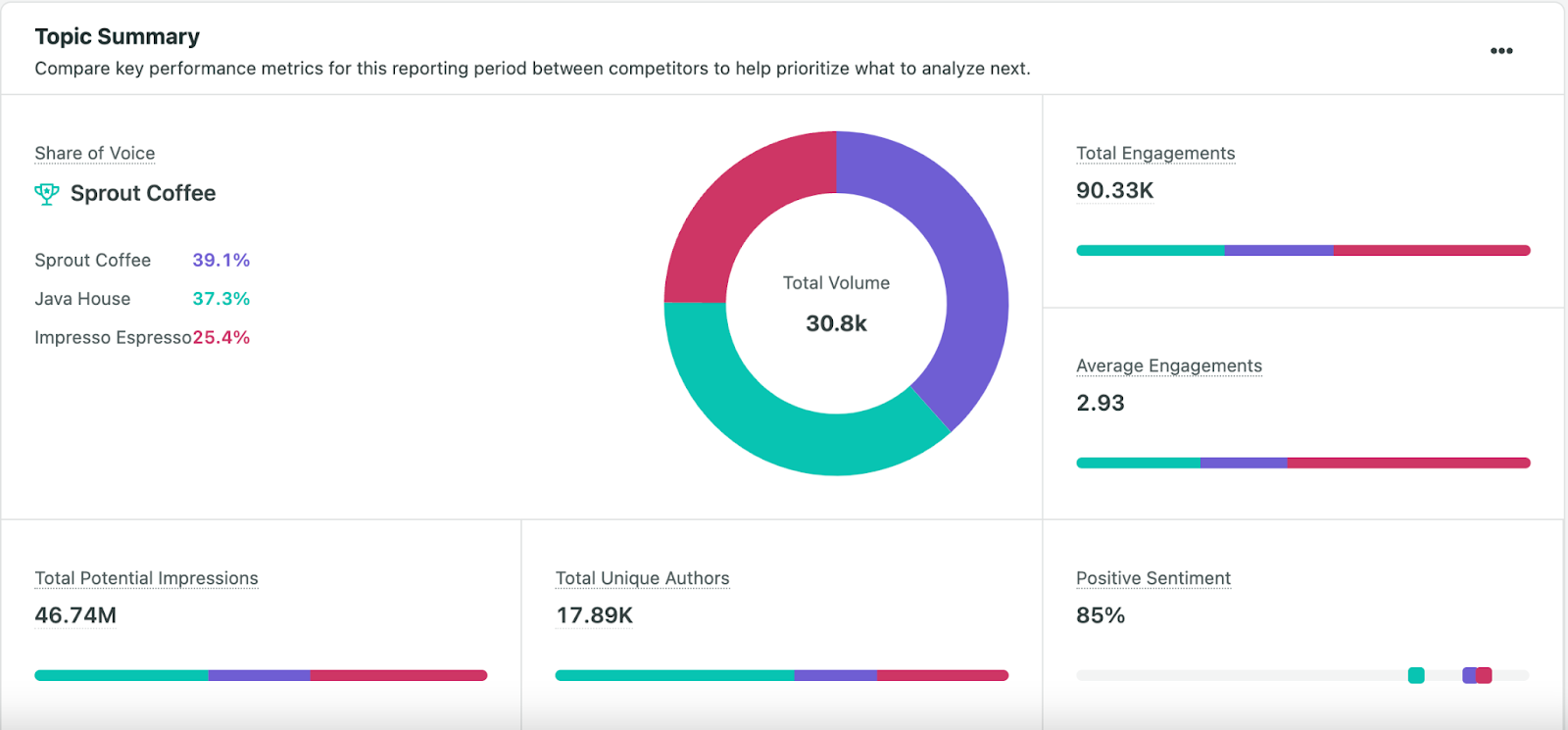
Competitive gaps aren’t always obvious. But social listening reveals them. This is useful when facing larger rivals and needing smart positioning over big budgets.
For example, in crowded markets like skincare, where terms like “acne-prone” or “k-beauty” dominate conversations, listening helps you understand how consumers compare brands.
Take for instance, the conversation in the example below, where a customer asks a question about Korean skincare brand CosRx while comparing it to the US brand Neogen, and a blogger responds by pointing them to a review of their page.

These insights reveal competitors’ strengths and weaknesses, often differing from how they see themselves.
4. Campaign analysis
Brands spend so much energy on fresh campaign ideas. But how do you say with confidence whether a campaign succeeded or not? You can’t repeat your positive results if you don’t know what’s working.
Listening tactics increase your campaign success. Think through the following capabilities for your next campaign:
- Track the impressions and engagements around your campaign posts.
- Quickly gather general sentiment around specific campaigns.
- Identify the top influencers discussing your campaigns.
- Understand which of your audience demographics the campaign resonates with.
- Figure out the key themes behind your campaigns
- Track collaborative campaigns from a single source of truth.
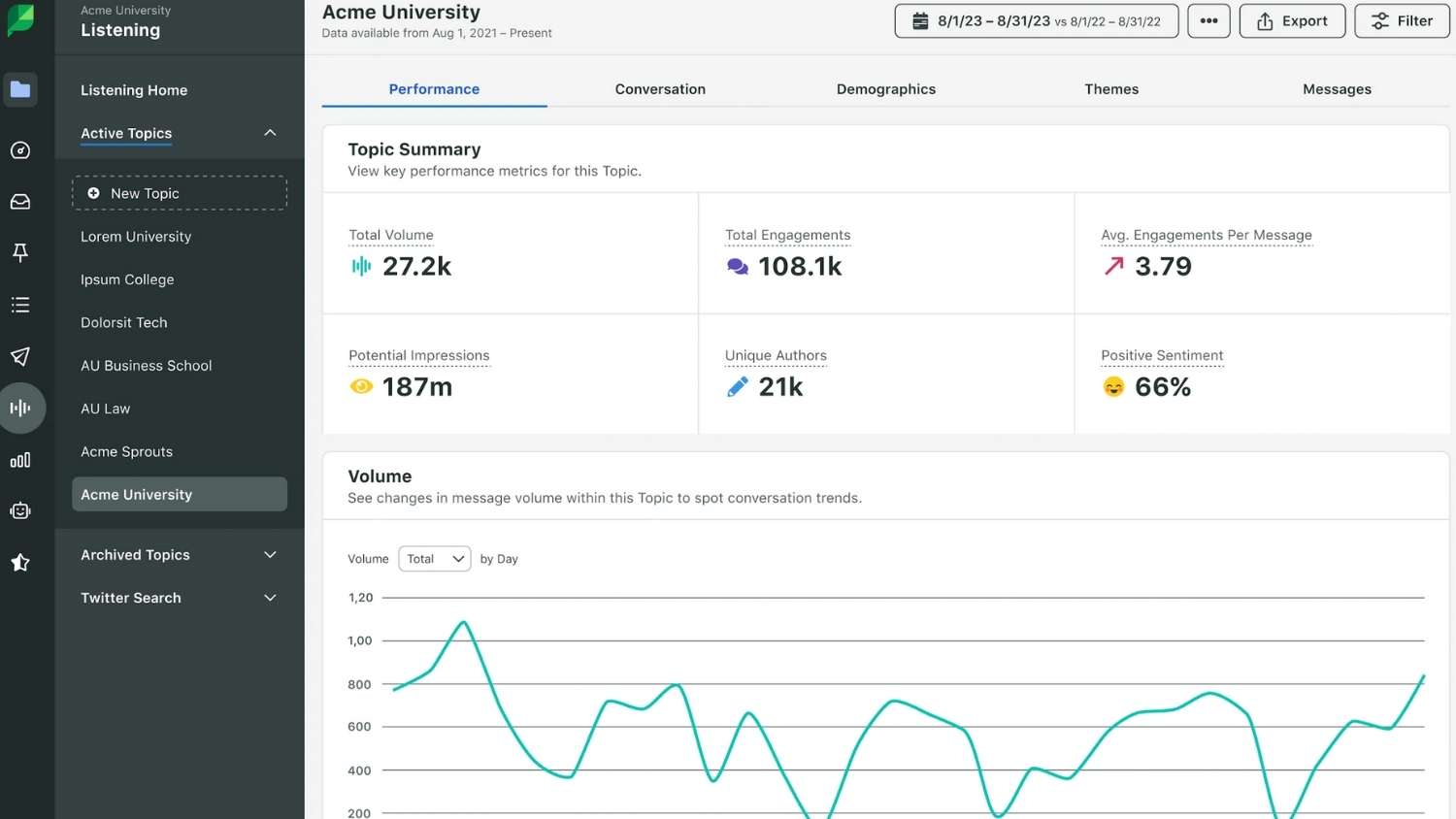
Social listening proves the value of your marketing campaigns. Start by crafting listening topics to capture the conversations around your campaign. Analyzing hashtags or handles can uncover countless metrics to clue you in. You can then break down all of these insights by network, content type, message type and sentiment, like in the Sprout Listening dashboard below.
5. Event monitoring
Social listening is a powerful tool for shaping events that truly resonate with your audience. By analyzing conversations around industry trends, past events or key topics, you uncover what people are excited about—and where others have missed the mark.
Uncover important themes, such as these, through social listening for a successful event:
- Challenges your audience wants addressed at events
- When your audience is most receptive to certain topics or formats
- What worked or flopped at rival events to refine your own
- What event structures and features people prefer
- Fresh speakers or niche influencers with audience pull
Post-event, social listening gives you a clear view of overall sentiment and audience takeaways, which is crucial for planning future events.
6. Crisis management
It takes years of careful planning to build a brand’s reputation. But in a time when it’s easy to provoke cancel culture, brands have to be very aware of the market and audience’s feelings to handle crises with care.
Social listening helps brands do this strategically by:
- Detecting issues early: Social listening tools detect disasters early. They find negative sentiment in social conversations related to your brand, so you intervene.
- Managing crisis response: Listening to people online supports your understanding of how they think about a situation. This information supports you in choosing the tone and content of your response to make sure it makes sense to the audience.
- Identifying key influencers: Analyzing social chatter around a crisis helps you find those accounts or influencers who are shaping trending discussions. This helps you engage with them directly to help manage and influence public opinion to reduce damage during a crisis.
- Monitoring impact: Listening to social media also helps you track how the crisis has affected people and your business, and how your plan is working to reduce it. You can track sentiment shifts and adjust your moves accordingly to manage the crisis lifecycle and avoid damage to your brand’s health in the future.
7. Identify product or service gaps for your brand
Social data has evolved far beyond likes and mentions—it now serves as a real-time barometer for how people think, feel and behave. When integrated across departments, it becomes a strategic asset that informs everything from marketing and customer service to R&D and executive decision-making.
Unlike traditional data sources, social data captures unsolicited, unfiltered feedback at scale. This makes it especially valuable for identifying shifts in sentiment, uncovering trends and understanding audience needs as they develop.
Within this broader data ecosystem, social listening plays a critical role in surfacing gaps in products or services that are not flagged through surveys or support tickets. Customers often voice frustrations, unmet needs or desired features publicly before ever reaching out to a brand directly.
By listening to these conversations, businesses spot opportunities to refine their offerings, prioritize improvements and even co-create solutions with their audience.
For example, Nike frequently makes product improvements or introduces new products based on customer feedback, as in the post below.

8. Audience trends
Audience trends go beyond simple metrics; they provide a roadmap for the future. By connecting historical trend data—such as long-term consumer sentiment and engagement benchmarks—to real-time social activity, brands can uncover hidden patterns. This deeper analysis enables you to identify early signals of emerging interests, so your team can proactively pivot content calendars and campaign strategies rather than just reacting to what’s already happened. By understanding the “why” behind historical shifts, your team can confidently navigate upcoming market changes and position the brand where your audience is heading next.
Understanding Sprout Social’s listening tools
Gathering and analyzing social data is straightforward. Turning that data into relevant insights is more complicated and requires additional context. Sprout Social is an AI-powered Social Intelligence solution that turns social data into relevant and actionable insights. We enable teams to scale from basic listening to deep intelligence, so you can move beyond reactive measures and strategically position your brand for sustainable growth.
Here’s how Sprout Social’s listening tools compare across key capabilities:
| Tool | Primary Function | Data Sources | AI Features | Team Collaboration |
|---|---|---|---|---|
| Social Listening | Consumer research & trend discovery | X, Facebook, Instagram, LinkedIn, Reddit, Tumblr and YouTube | Sentiment analysis, theme detection, spike alerts | Cross-department insights sharing |
| NewsWhip by Sprout Social | Predictive media monitoring | News sites, online communities and social networks | Trellis Monitoring Agent, predictive engagement forecasting, alerts, real-time anomaly detection | Real-time intelligent alerting, data visualization & sharing |
| Influencer Marketing | Creator discovery & management | Creator content across platforms | Natural language search, Brand Fit Score | Campaign tracking & recommendations |
Social listening
Sprout Listening goes beyond tracking brand health by enabling in-depth consumer research, trend discovery, campaign analysis and industry benchmarking. It supports you in identifying market gaps and understanding competitor strategies through side-by-side comparisons of key metrics like share of voice, engagement and impressions.
Sprout Listening enables you to pull data from a broad mix of networks like X (formerly Twitter), Facebook public pages, Instagram hashtags, TikTok, Blueksy and YouTube video titles and descriptions. You also get insights from LinkedIn mentions on owned pages, Reddit social listening and Tumblr.
Here’s a snapshot of what Sprout Listening does:
- Empower your organization. Sprout Social’s listening data takes your team’s impact beyond social media. You can offer actionable insights to strengthen other departments. Sales teams and customer service, in particular, can learn a lot from listening data.
- Cut time between insight and action. Learn and act at the speed of social media. Having your listening data alongside your publishing tools means hopping on trends faster. And Trellis, Sprout’s AI agent, provides contextual answers to inform your brand’s strategy so you don’t need to manually sift through the data.
- Organize your social presence in one platform. Streamline your workflow by eliminating jumps from point solution to point solution.
- Research with intention. We provide filtering options to help you get relevant answers fast. Doing so means cutting through the noise.
- Create targeted Topics with ease. The Topic Builder makes it simple to set up complex and relevant queries. You can then search and research these topics over and over again.
NewsWhip by Sprout Social
NewsWhip by Sprout Social provides predictive media monitoring that complements Sprout Listening by offering a real-time pulse across news and social media channels.
While Sprout Listening is optimized for historical context and deep analysis of past social conversations, NewsWhip delivers predictive engagement forecasting, identifying trending stories and emerging issues as they unfold.
To further protect brand reputation, the Trellis Monitoring Agent proactively surfaces signals before they become mainstream problems. When a narrative begins to break, teams can instantly spin up focused workspaces to investigate and monitor emerging issues as they unfold. By utilizing Active Memory, the agent remembers previously surfaced alerts and only interrupts when there is a meaningful new development. This significantly reduces alert fatigue while ensuring critical signals are never missed.
Crucially, NewsWhip’s media intelligence ensures your team can act with speed and confidence.
Sprout Social Influencer Marketing
Sprout Social Influencer Marketing is a platform that brings precision to both listening and influencer alignment through its topical alignment and influencer discovery tools. Instead of relying on demographics, Sprout Social’s influencer marketing tool focuses on what drives engagement: content themes, tone and audience resonance.
Our topical alignment tools enable you to understand what influencers talk about most, offering a clearer picture of how well they align with audience interests and brand values. Similarly, the Brand Fit Score simplifies this process by quickly evaluating how closely an influencer’s content, voice and niche match a brand’s goals.
Plus, AI-powered natural language search enables you to explore topics like “outdoor adventures” and instantly discover top-performing creators already sparking audience interest in that space. Thus, helping you listen to what’s working through the lens of influencer content.
This influencer listening, combined with search recommendations and history, streamlines ongoing discovery as your audience preferences shift. And so, you can ensure campaign success through authentic, data-driven partnerships by aligning influencers with real-time content trends and audience behavior.
AI-powered summary and analysis capabilities
Sprout Social’s AI tools enhance social listening by automatically surfacing key themes, sentiment shifts and emerging trends. This makes it faster and easier to turn raw conversations into actionable insights.
Here are some of the tools you can take advantage of:
- Trellis: Sprout’s AI agent automates social listening analysis by surfacing trends, crises and competitive insights. It provides contextual answers to guide brand strategy without requiring manual data sifting.
- Analyze by AI Assist: This tool gives you insights from your social listening topics by analyzing key metrics, hashtags, keywords, Smart Categories and emojis. You get reports in layman’s terms so it’s easy for all to understand and you’re able to improve your social listening strategy with ease.
- Queries by AI Assist: This capability enables you to use keywords to sift through the noise by extracting relevant, actionable information. Its keyword suggestions further help you narrow down your search so you get the granular information you need.
- Summarize by AI Assist: This feature enables you to summarize any text that exceeds 800 characters and quickly summarize the key messages and topics.
- Industry themes: This tool automatically marks Listening aspects for various industries so you’re attuned to what matters and can cut through the noise.
- Sentiment listening: With this tool you’re able to automatically classify messages as Positive, Negative, Neutral or Unclassified for deeper analysis
- Spike alerts: This AI-powered tool notifies you when there are changes in your Listening Topic volume, potential impressions, engagement or sentiment
How to create a social listening strategy
Here’s a walkthrough of how to create a strong social listening strategy that helps you drive meaningful brand engagement and improve your reputation.
Use this comprehensive social listening strategy checklist:
| Phase | Action Items | Success Metrics |
|---|---|---|
| Goal Setting | Define objectives, identify stakeholders and set timelines | Clear KPIs established |
| Tool Selection | Evaluate platforms, consider data sources, assess AI capabilities | Platform implemented |
| Topic Building | Create queries, set exclusions, test accuracy | Relevant data captured |
| Data Analysis | Monitor trends, track sentiment, identify opportunities | Actionable insights generated |
| Action & Reporting | Share insights, implement changes, measure impact | Business outcomes achieved |
Step 1: Determine your initial goals and desired outcomes
Having precise social media goals is key to achieving your marketing initiatives as they guide your strategy.
These goals could be:
- Run a deep analysis of your brand to understand what customers and prospects think.
- Monitor your industry or niche to keep a pulse on what’s new and what would make good content.
- Keep an eye on your competitors’ products, audiences and marketing tactics.
- Identify the best suitable content to share based on trends and data.
- Identify your key social media audiences to better inform your targeting strategy.
Step 2: Choose a social intelligence tool
Brands need more than just standard social listening tools to stay competitive and tapped in; they require a comprehensive social intelligence platform that integrates listening into a broader strategic framework. By selecting a tool that prioritizes social intelligence, you ensure that vital social data flows directly into the workflows and tools your teams already use daily. This integration creates a connected enterprise ecosystem where insights aren’t siloed but instead serve as a trusted source to guide cross-functional business decisions.
Step 3: Choose relevant data sources
Choosing your data sources depends on where you see the most engagement and where your audience is most active. Different platforms offer unique insights, so it’s important to listen where conversations naturally happen—even if your brand isn’t heavily present there.
For example, monitoring popular social media platforms like Instagram and Facebook reveals valuable customer opinions and trends to inform your strategy. Sprout Social pulls social data from a variety of sources, including X, LinkedIn, Reddit, Tumblr and YouTube video titles and descriptions.
Step 4: Build your topics and themes to listen to
Building your listening topics is the next key step to a successful strategy. Brainstorm specific queries relevant to your brand based on listening prompts for different industries, plus what you want to track vs. the noise you want to avoid.
What to query
- Keywords or phrases
- Hashtags
- Cashtags
- Mentions of user
- Mentions from user
- Mentions to user
And/or logic
Listening is about more than just hashtags and keywords. You can refine the logic of your search even more with additional parameters.
For example, say you want to track sentiment around Chicago-style pizza. Your query may end up looking more like below.

Now all sorts of variations will register:
- chicago pizza
- chi-town pizza
- chicago deep dish
- chi-town deep dish
- chicago pie
Exclusions
Consider that “Chicago pie” can mean either pizza or baked goods. This is an example where exclusions are supportive. For example, add pie flavors to ensure the scope of your search is limited to pizza.

Step 5: Gather data to inform your strategy
Once your topics are refined, begin collecting data to inform your strategies. For instance, analyzing frequently mentioned keywords from a query allows you to identify trends and craft relatable, data-backed content.
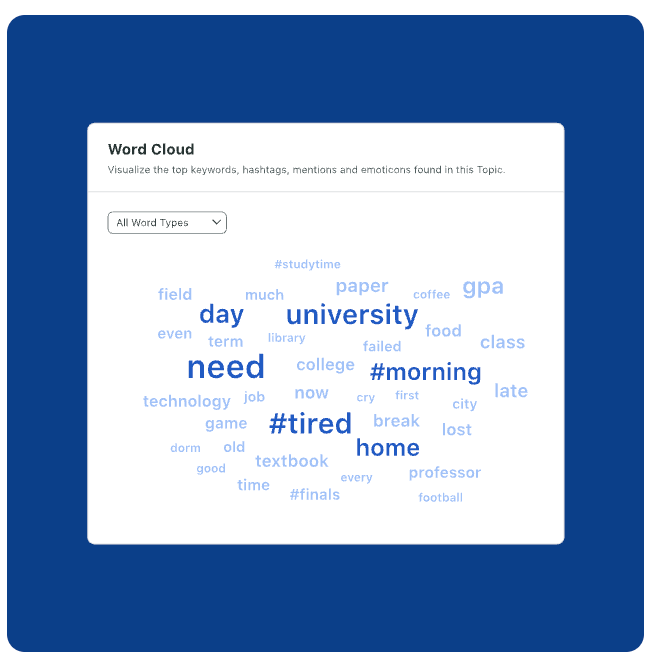
Within Sprout Listening’s word cloud, you can click on each keyword to get a better sense of what the messages mean. You might notice that a lot of the messages mention cold weather in Chicago. Use this information to your advantage and craft relatable content such as a playful, weather-themed promotion.
To deepen your analysis, Analyze Topics by AI Assist automatically surfaces conversation patterns and sentiment shifts to distill large listening datasets into clear, actionable insights.
Then use Trellis Studio to build personalized, custom AI agents tailored to your specific business workflows, enabling automated analysis and trend surfacing unique to your brand. This way you’re always keeping a pulse on what matters most to your brand and audience.
Step 6: Measure the results of your listening efforts relative to your goals
Tracking how well your strategy is working is an important step necessary to ensure your hard work is paying off. To measure the results of your social listening, consider zeroing in on priority social media metrics based on your campaign goals.
For example:
- Clicks
- Reach
- New followers
- Profile visits
- Engagement rates
- Engagement speed
These will give you an overarching view of how well your strategy is working and where you can adjust your efforts to optimize results. This video explains more.
Step 7: Report and act on insights
Once you’ve gathered your social listening insights, it’s time to share them with the relevant teams within your organization. This shared knowledge supports teams like product development, marketing and customer service in making smart choices that match consumer preferences and market conditions.
For example, insights showing that customers don’t like a product feature can help product development teams focus on improving the product. It can also help marketing and customer service teams create responses and campaigns to address concerns raised through social listening.
Acting on these insights is equally critical in driving tangible business outcomes, and refining products and services. This proactive approach, based on customer feedback, increases brand appeal and fosters stronger customer satisfaction and loyalty.
To streamline this process and present your findings effectively, use our Social Intelligence Template to build impactful, executive-ready reports.
Social listening examples: Use cases to inform your strategy
Use social listening and turn real-time conversations into actionable insights to inform your strategy. Here are some examples:
Trend detection:
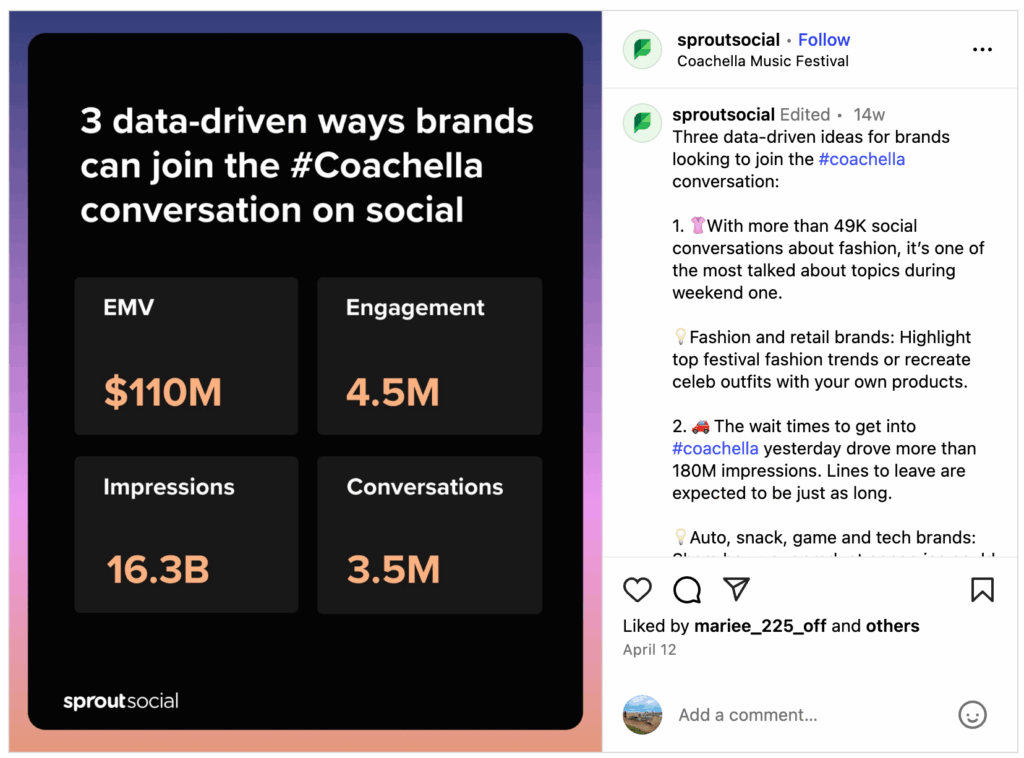
- Spot trends early:Track emerging topics, hashtags and keywords to stay ahead of what your audience cares about. In Sprout, Listening Topics surface fast-growing conversations in your space and other marketing trends. For example, we used Sprout Listening to get data-driven insights for brands from the trending #Coachella conversations.
- Identify viral content patterns in your industry
- Spot seasonal conversation shifts that impact demand
Influencer identification:
- Find the right influencers: According to The Influencer Marketing Report, 49% of consumers make purchases at least once a month because of influencer posts. Social listening helps you identify creators already engaging in relevant conversations and topics.
- Support campaign planning: Use listening data to time your campaigns around relevant cultural moments or shifts. This enables you to align messaging with audience mood and market sentiment so your campaigns are timely and resonate better with consumers.
- Capture unfiltered feedback: Unsolicited brand mentions and recurring themes can reveal true sentiment, pain points and user expectations that may not have been on your radar. These insights can be a valuable source to improve customer experience, products and services.
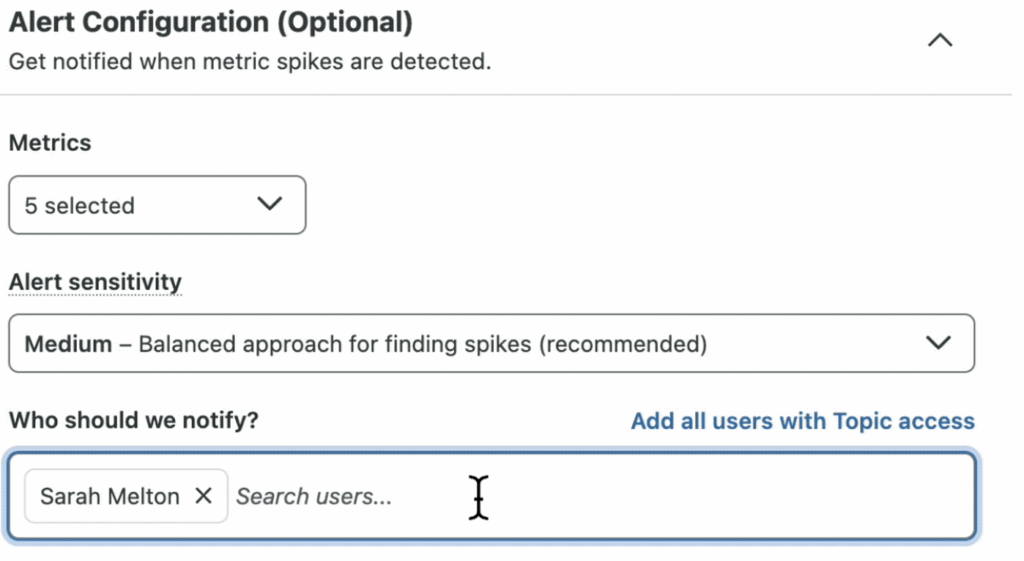
- Notify the right teams when in crisis: A spike in negative sentiment often signals an issue worth investigating early. Fast action can help you clarify issues and even contain a situation before it spreads. Alerts and sentiment tracking, like those available in tools like Sprout Listening, enable you to notify the right teams, so you can act quickly and manage your reputation.
According to The Influencer Marketing Report, 49% of consumers make purchases at least once a month because of influencer posts. Social listening helps you identify creators already engaging in relevant conversations and topics.
Campaign planning:
Use listening data to time your campaigns around relevant cultural moments or shifts. This enables you to align messaging with audience mood and market sentiment so your campaigns are timely and resonate better with consumers.
Unfiltered feedback:
Unsolicited brand mentions and recurring themes reveal true sentiment, pain points and user expectations that were not on your radar. These insights can be a valuable source to improve customer experience, products and services.
Crisis prevention:
- Predict narrative momentum to spot crises before they blow up
- Monitor sentiment and volume spikes that signal brewing issues
- Identify influential voices shaping negative conversations
- Implement rapid response protocols based on listening and media monitoring alerts
A spike in negative sentiment often signals an issue worth investigating early. Fast action can help you clarify issues and even contain a situation before it spreads.
Ready to start listening?
Social listening helps you understand and engage with your audience in a more proactive and meaningful way. This direct engagement also lets you find brand supporters, influencers and loyal customers who can help spread a good word about your brand.
Translate your customer conversations into actionable insights and thrive as a customer-centric brand that’s in tune with the market and its audience. Request a demo to explore Sprout Listening and NewsWhip capabilities and build an impactful listening strategy.
Frequently asked questions about social listening
What is the primary focus of social listening?
Social listening analyzes aggregate social data to inform proactive business strategy, interpreting the big picture rather than reacting to individual messages.
Is social listening a KPI or a business strategy?
Social listening is a strategic process that generates data for KPIs like sentiment and share of voice. The practice itself is the engine that produces business insights, not a metric.
How much does social listening cost?
Social listening costs scale with business needs, from basic monitoring tools to enterprise AI platforms. The right solution delivers ROI by uncovering revenue opportunities.
How do small businesses benefit from social listening?
Absolutely. Social listening gives small businesses a powerful advantage without a massive research budget. It helps them understand their niche audience, track local competitors and identify untapped growth opportunities to compete effectively in their market.
How often do I check my social listening data?
Your goals determine the frequency. For active campaigns or crisis management, you need real-time monitoring. For broader brand health, competitive analysis and trend-spotting, a weekly or monthly analysis provides the strategic oversight needed to make informed decisions.
Featured in Social Media Listening
- Read more about Best social media listening tools for your brand in 2026
- Read more about The difference between social media monitoring vs. social media listening
- Read more about Social media listening examples to help you unearth better insights
- Read more about Instagram social listening: Transform your brand’s strategy
- Read more about The complete guide to Twitter listening
- Read more about The complete guide to Facebook listening
Additional resources for Social Media Listening

The complete guide to Facebook listening
What is brand monitoring and why is it important? [+ tools]
Reddit social listening: What it is and strategies for using it
Social listening: Your launchpad to success on social media
What is social media monitoring: Creating a social media monitoring strategy

The difference between social media monitoring vs. social media listening

The 10 best social media monitoring tools for 2026

How to use social listening to find and connect with niche audiences on social media
Best social media listening tools for your brand in 2026
YouTube social listening: How to find actionable insights in a video-first world

LinkedIn social listening: Turn conversations into competitive advantage

9 key social media listening metrics every marketer needs to know in 2026
How to turn social listening insights into action and connect with your audience
Instagram social listening: Transform your brand’s strategy
How to audit your brand perception using social data

The complete guide to Twitter listening

How to use social listening tools to build a stronger business

TikTok social listening strategies every brand needs in 2026

Social media listening examples to help you unearth better insights
8 best brand monitoring software to grow your brand in 2026

How to get social audience insights: listening prompts for every industry

How to create better social listening queries


5 ways social media listening increases customer advocacy


Using social listening to surface trends to your audience


Social Spotlight: How Netflix uses social to create a brand experience


Share