Social Media Intelligence
The complete guide to social media intelligence (SOCMINT)
Social media is no longer just a broadcast channel. It’s the world’s biggest focus group, with social intelligence taking those insights and distributing them across the organization to improve customer care, product development, business strategy and more. In this comprehensive guide, we look at what social media intelligence is, examples of how it works and what to look for in the tools you use to power it.
Want to learn more about how social intelligence is helping organizations move at the speed of the customer and bring insights beyond the social team? Our 2026 Social Intelligence Report lays out data from social teams, and some key examples from companies already implementing social intelligence.
Reading time 14 minutes
Published on August 24, 2026
Table of Contents
Social media used to be straightforward. Brands posted content, reached their audiences and dealt with the occasional customer service issue. Customer feedback came through surveys and in-person conversations.
Not anymore.
One viral post can spike demand overnight or crater your stock price before lunch. One unresolved complaint can become a reputation crisis before your team knows it’s happening. Comment sections, creator reviews, Reddit threads and TikTok yaps shape perception more than any billboard or ad campaign ever will.
To keep up, brands must enter the era of social media intelligence. The brands that win aren’t just posting great content, they’re paying attention to what the market is saying and acting accordingly.
But most don’t have the capacity to do that yet. Only 10% of businesses have the operational agility to turn real-time insights into business action within hours, per our 2026 Social Intelligence Report.
Closing the gap between customer expectations and business action starts with social media listening, but it doesn’t end there. Listening tells you what your audience is saying and why. Social Intelligence is the step that turns those conversations into decisions your whole business can act on, whether that’s which product to build, when and how to respond to a crisis or which market to enter next.
What is social media intelligence (SOCMINT)?
Social media intelligence (SOCMINT) is the practice of collecting, verifying and analyzing public social media data to turn conversations, engagement, behaviors and trends into actionable takeaways that inform brand decisions.
It focuses on what people say, how they feel and how they behave on social networks to give real-time, unprompted signals. This real-time data gathering can then be turned into structured recommendations and acted on fast enough to matter, allowing mature social intelligence organizations to stay ahead of cultural shifts and consumer expectations.
Traditional business intelligence relies on structured, historical data, reflecting a past that might no longer hold the same value to the business. Social intelligence is predictive. It complements other data sets by adding a real-time dimension and turning billions of data points into a picture you can plan around.
What social media intelligence is not
Social media intelligence isn’t about tracking likes or mentions. It goes further than social monitoring and even social listening. Social intelligence is a part of business intelligence, as it applies social insights to business strategy—a philosophy that anchors how Sprout approaches social intelligence internally. It’s critical to every function, not just marketing.
- Social data: The raw, unstructured record of social activity—posts, likes, shares and comments.
- Social analytics: The analysis of social data to identify patterns of engagement. The output of social analytics is always a quantitative number.
- Social monitoring: The analysis of social media conversations to understand and quantify how people discuss specific topics. Focuses on the content of the information shared in conversation.
- Social listening: The gathering, analyzing and interpreting of conversations on social media.
- Social intelligence: The application of social insights to business strategy.
Most organizations try to piece together social insights using fragmented data or limited subsets of information. Without the infrastructure to connect social analysis to other data sources, you’re left with blind spots. And those blind spots lead to compromised decisions, reputation risk and missed growth opportunities.
Social media intelligence vs. social listening vs. social monitoring
People sometimes use these terms interchangeably, but there are important differences, though they all begin with the analysis of public data.
Open source intelligence (OSINT)
Open-source intelligence is the umbrella discipline from which social data analysis stems. OSINT gathers publicly available information from news, public records, forums and other public data to build a picture of the world.
SOCMINT is one branch of OSINT focused specifically on social platforms and audience behavior. It’s been adapted for commercial use and the goal is understanding customers, competitors and markets.
Social media monitoring
Social media monitoring is the micro-level, reactive tier, tracking what’s being said via direct (and sometimes indirect) mentions in real time, like replying to a customer complaint on X or being tagged by a creator.
Monitoring is an essential foundation, but reactive by nature. It only tells you what just happened to your brand, it’s the “what” without the “why”.
Social media listening
Social media listening is the “why” behind the “what”. It offers a macro-level view of broad conversations across networks to surface the context behind trends, audience needs, market shifts and brand health.
It goes broader than monitoring, finding patterns around individual mentions and helps you build a bigger picture about what’s being said about your brand or industry via message volume, sentiment or other pre-defined metrics.
Social media intelligence (SOCMINT)
SOCMINT is the strategic application of data you gather from monitoring and listening, combining the insights with the infrastructure to act.
It connects social data to other business intelligence and routes it to teams that can act on that data, whether that’s marketing, comms, care, revenue, product or the C-suite. It translates those insights into business recommendations that reach the right person at the right time.
Why your brand needs social media intelligence (SOCMINT)
Despite being a relatively new discipline, social intelligence already delivers business impact. According to the 2026 Social Media Intelligence Report, an overwhelming 98% of professionals say it has driven cross-functional business outcomes, and 67% say it’s either very important or mission-critical to their organization’s future growth.
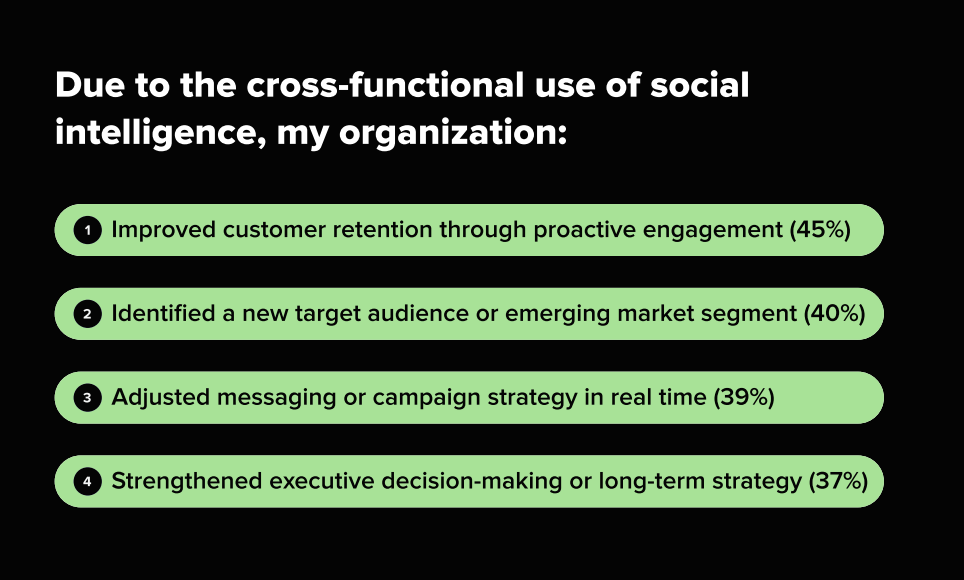
Here are some of the ways that impact shows up.
Improve your brand’s discoverability
SEO and SEM aren’t delivering like they used to. Social is the new front door for shopping, and brands need to position themselves accordingly. To win in the world of social search, you need to spot trends early, optimize content and publish at the right time. Social media intelligence helps with all three.

By tapping into social intelligence, you can identify rising hashtags, creators and search behaviors on networks like TikTok, Reddit and Instagram. You can even predict how content will perform before you publish. These insights enable your team to craft on-brand, search-optimized, social-first content that uses the right keywords, structure and social media audience insights to reach the right people.
Gain a competitive advantage
Your competitors are being discussed just as openly as your brand is. Social intelligence enables you to analyze those conversations at scale and learn from them without expensive primary research.
Exploring competitor sentiment shows you market gaps, what’s working for them and where customers might be frustrated. That might be a recurring complaint, pricing misalignment or praise for a feature you don’t offer.
The same data also surfaces opportunities for your brand. With data on conversation volumes from your target audience, you can see how demand forms in real time for evolving or new categories. Those findings can go straight into competitive analysis and strategic planning to reflect the current state of the market rather than how it showed up in last quarter’s reports.
Proactive crisis management and predictive media
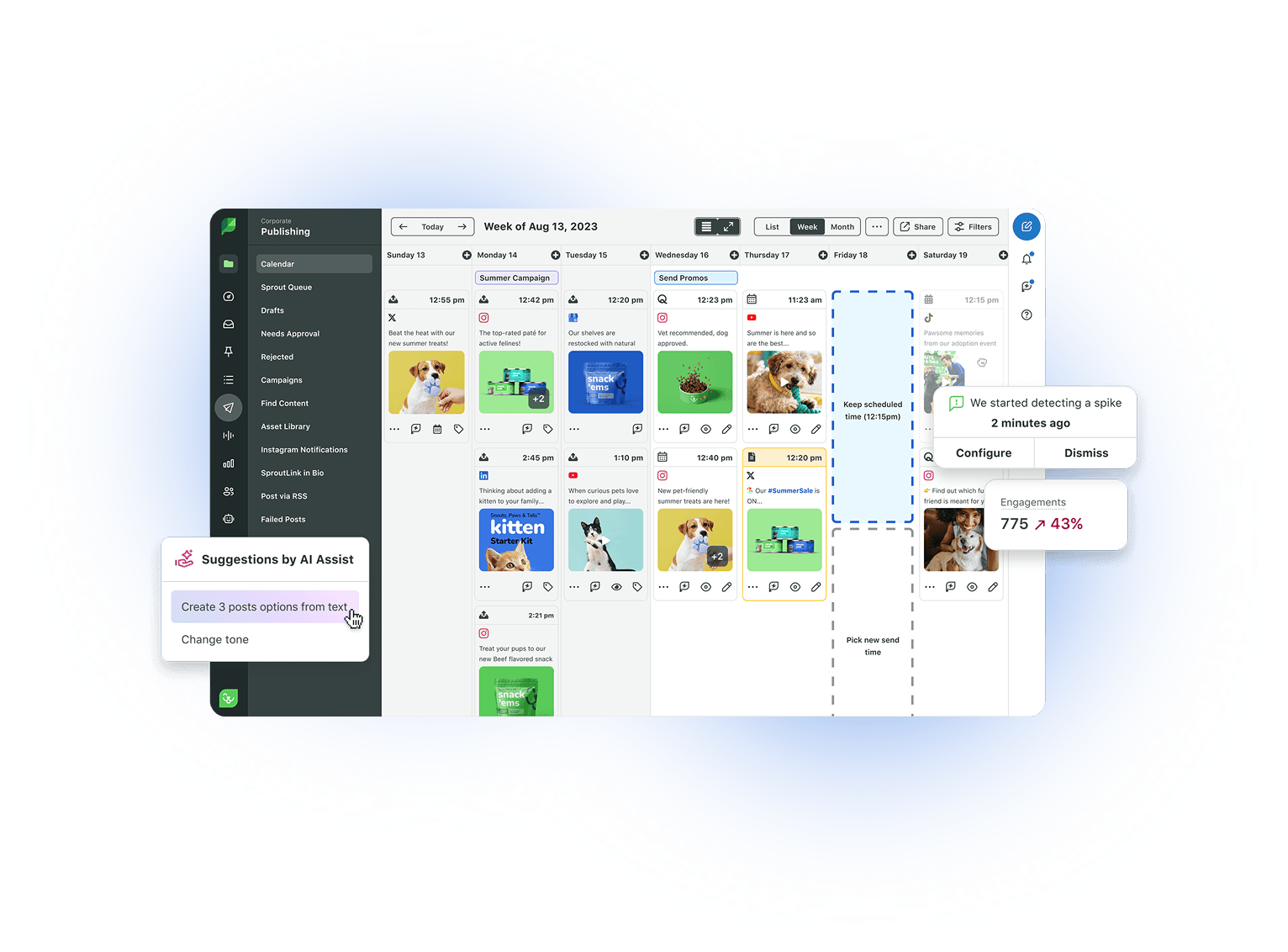
A single viral post can spark a torrent of discourse, and potentially lead to a brand crisis in a matter of hours, in more places than ever before. Social intelligence gives teams an early warning that a complaint or news story could spiral, through mention spikes, sudden sentiment dips or unusual engagement patterns.
With that information, you can act before the story snowballs. Social intelligence enables real-time detection, and uses predictive media intelligence to forecast the stories that will break into the mainstream before they do. Pairing those signals with a broader media intelligence strategy gives you a full picture of how the press and audiences are framing and perceiving your brand.
Being ahead of the curve enables you to spend more time on what your response actually looks like. Instead of scrambling to catch up, your team can spend time working from and adapting a crisis management plan to get the messaging right the first time.
Drive product and campaign innovation
Social intelligence doesn’t just inform how you go to market. Used strategically, it even informs what you’re taking to market in the first place.
The kind of unfiltered feedback that customers offer on social is among the most honest product research available. Customers post hacks and workarounds, complain about features and find uses you didn’t know existed. That feedback can shape the next product update, help you prioritize upgrades or develop whole new offerings.

The same unstructured feedback can also be used on the campaigns themselves. It’s easier to develop creative that resonates and find partners to amplify it when you can see what your audience is already searching for and what they’re engaging with.
Make your organization truly customer-first
Most companies say they’re customer-first. Far fewer have a shared, current view of what customers actually want.
Social intelligence creates one. When care, marketing, product and revenue teams work from the same live customer insight, decisions accelerate and marketing silos start to break down. Support stops being the only team that hears the complaints. Product stops relying on six-month-old research. Leadership gets a real-time read instead of a lagging indicator.
That alignment is what makes intelligent customer care possible at scale—anticipating volume spikes, routing issues before they escalate and giving every team the context to respond like they’ve been paying attention.
How SOCMINT works
Transforming raw social data into business intelligence requires a structured, continuous workflow. The value of Social Intelligence compounds over time. The more you leverage, the more ways you can make an impact, and bigger the results you can deliver.
Data collection and aggregation
The first step in SOCMINT is gathering the data at scale. That’s the public conversation on social that encompasses posts, comments, reviews, hashtags, forum threads, blogs and news coverage that overlap with the places your audience actually spends time.
Precision is the goal here, you want to be very specific about what you’re looking for using target Boolean searches, entity lists, specific networks and exclusions.
From there, you can clean the data further as needed and move to the analysis.
Data processing and AI analysis
Processing the data involves normalizing and enriching it, de-duping it to make sure you have the cleanest data set possible. Even once this is done, it’s impossible for any team to read and analyze billions of posts, which is where natural language processing and machine learning come in. They can do a first pass of the data, categorizing them into themes, recognizing named entities and flagging intent, sentiment shifts and recurring themes.
Beyond this initial analysis, AI Agents take it further. Rather than waiting for someone to run a report or ask a question, agents like Sprout Social’s Trellis surfaces reputation risks and recurring themes as soon as they emerge, and then explains what’s happening, why it matters and how it’s changing. Teams can delegate complex research to Trellis to free up time for them to work on strategy.
Activate and measure
Insights that stay in a dashboard do not move the business, and don’t contribute to social intelligence. To activate, you need to get the insights into the hands of the people that can act on them.
This means synthesizing takeaways into a clear, visual report for the stakeholders across the business, whether that’s a product team that needs feature feedback, a care team with a persistent issue or an exec team looking for strategic guidance.
Then measure what changed. Track outcomes against KPIs, looking at things like sentiment increase, share of voice, decreased response time or better feature adoption. These are concrete metrics you can use to encourage further usage of SOCMINT in the future.
Best practices for leveraging SOCMINT
Having the data isn’t the hard part; turning that data into intelligence your whole organization can access and act on is. Here’s a foundation for how to get started.
Align intelligence with clear business objectives
Start with the objective you’re working towards, not the data you’re able to collect. Misalignment at this stage will only create doubt in the quality of the dashboards, and if they’re not answering a direct question or business need, they’re less likely to be used.
Tie every program to a clear business goal and a KPI, like improved time to respond to customers or fewer PR escalations from spotting emerging incidents early.
Focus your data collection
You will get more volume from a broad query, but also more noise.
To avoid unnecessary data, build your queries with targeted keywords and specific entities that exclude irrelevant messages. Don’t let this be something you set and forget; constantly revisit and update it as slang, trends and themes shift to make sure you’re still getting the most relevant results.
Combine SOCMINT with first-party data
Social intelligence becomes a force multiplier when combined with other first-party data.
That means cross-referencing social signals with CRM records, website analytics, support tickets, survey responses and sales figures. Combined, they answer questions that each alone can’t answer. Social tells you the unprompted conversation, your CRM tells you what they bought, web analytics tells you the buyer journey.
Trendjack carefully
Just because it’s trending doesn’t mean your brand needs to be involved. There’s a fear of missing out when it comes to jumping on trends, as leadership always looks for the reason why another brand went viral instead of yours.
Social intelligence helps you be more discerning in when to act. Before joining a trend, check three things:
- Does it fit your brand and audience?
- Are the facts verified?
- Does the cultural context make participation appropriate?
If the answer to any of these is no, rethink the approach. But even if you get three yeses, timing also matters. Arriving after a trend has already saturated is more likely to have people rolling their eyes than applauding. The real-time nature of social intelligence gives you the early signal that enables you to move before it feels like you’re late to the party. Our guide to trendjacking gives a more in-depth playbook for how to evaluate this before jumping in.
Establish a cross-functional action plan
Insight without action is pointless. The most common organizational gap in social intelligence is good data not reaching the right person in time to have an impact.
Like any good planning, it needs to be done before you need it. For each signal, decide in advance who receives it and when, and what context they need to take action.
- Reputation risk alerts route to comms and leadership with a defined response window.
- Product feedback themes route to product owners on a recurring digest, not ad hoc.
- Service issues and volume spikes route to customer care with escalation paths already mapped.
- Competitive and market signals route to strategy and revenue teams tied to planning cycles.
- Trend opportunities route to creative teams with enough lead time to actually produce something.
Attach clear playbooks to each path so the recipient knows exactly what to do with the data, then close the circuit by measuring the output of any action taken after the dust has had time to settle.
Top features to look for in social media intelligence tools
The best social intelligence tools offer a unified, AI-powered system that can transform billions of unstructured conversations into something leaders can easily understand and act on. Here’s what to look out for.
AI-powered sentiment and visual analysis
AI is crucial in the analysis of billions of data points. You have to be able to trust your platform of choice to do the first step for you, quickly and accurately.
Look for AI that categorizes by topic, intent and sentiment at a deeper level, so sentences that contain both a positive and negative sentiment identify and flag that nuance rather than just categorizing the whole statement as neutral.
Trendspotting and predictive analysis
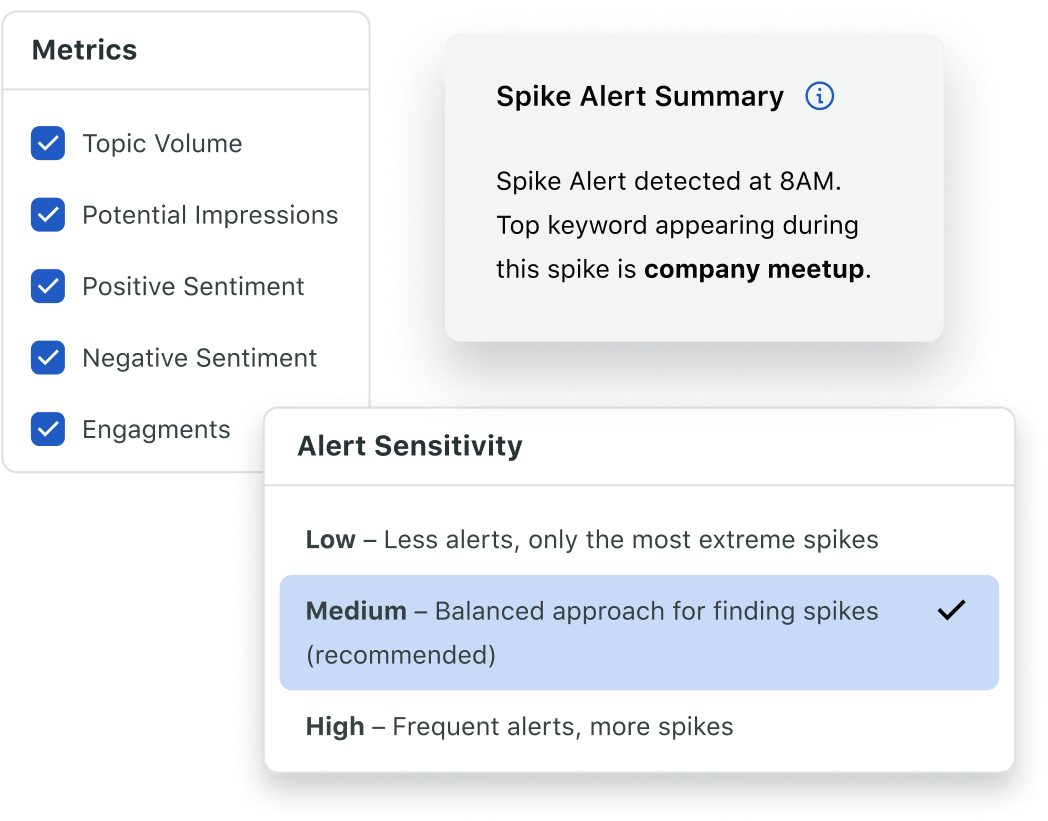
Due to their real-time nature, social signals have a short half-life, and the value of a trend signal drops the longer you wait to act on it. A good platform alerts you on patterns that are forming, not when a trend has already peaked.
NewsWhip by Sprout gives you the news before it becomes news through AI agents that deliver always-on monitoring combined with predictive engagement analytics. These are then delivered in a report that explains the what, why and how of any changes.
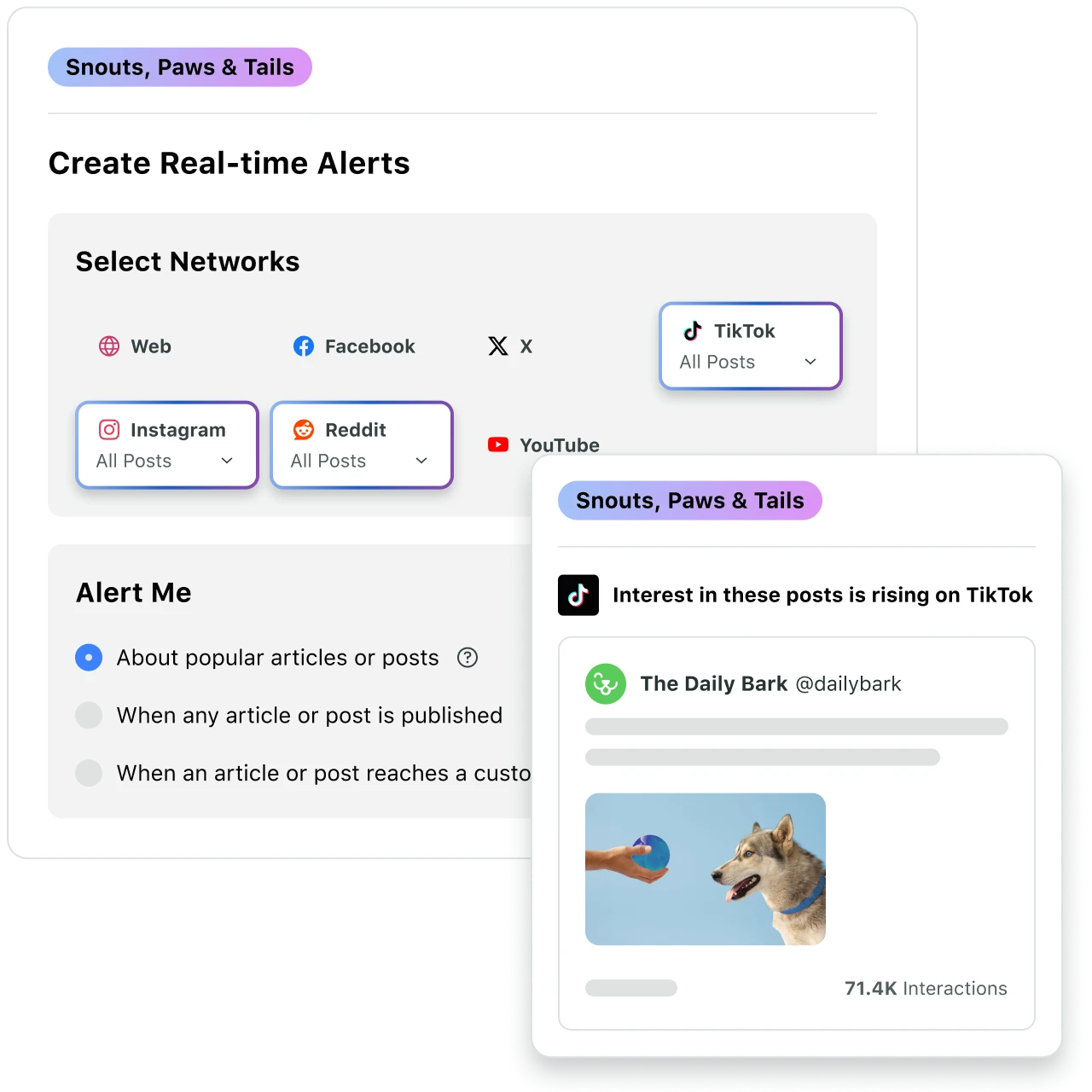
Sprout Listening tracks the longer-term impacts of trends and stories on your brand, and Trellis in Listening makes it easier than ever to answer specific leadership questions, run sentiment analysis, conduct competitor research and monitor the category-defining questions over time.
Authentic brand amplification levers
Social intelligence makes it possible to reach the right consumers and inspire trust in your brand at every step. Your team can source creator partners who spike sales and empower employees to become brand advocates, offsetting awareness spend in the process.
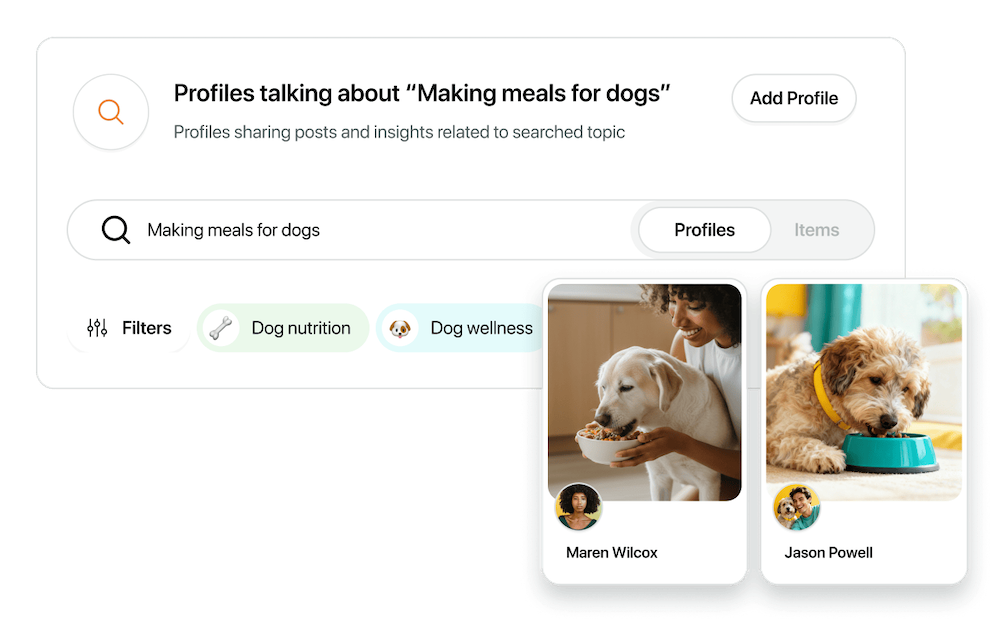
Sprout Social Influencer Marketing enables teams to quickly find creators who regularly post content that resonates with your audience. Using AI-powered, topic-led search, you can reach the right audience and foster authentic customer connections. The platform mirrors how social networks serve content, helping you find brand-safe creators based on topics your audience engages with most, so you get better results, faster.
Scalable social support
With social intelligence, you can move customers from frustration to genuine satisfaction at scale and in the moments that matter most. The right AI-powered solutions highlight critical messages, coordinate team workflows, and engage customers with safety and compliance workflows in place.
Sprout’s engagement tools eliminate manual tasks and strengthen customer relationships by handling large volumes of social messages through AI and automation. AI also highlights priority messages so your team can focus on the highest-impact interactions that require a human touch.
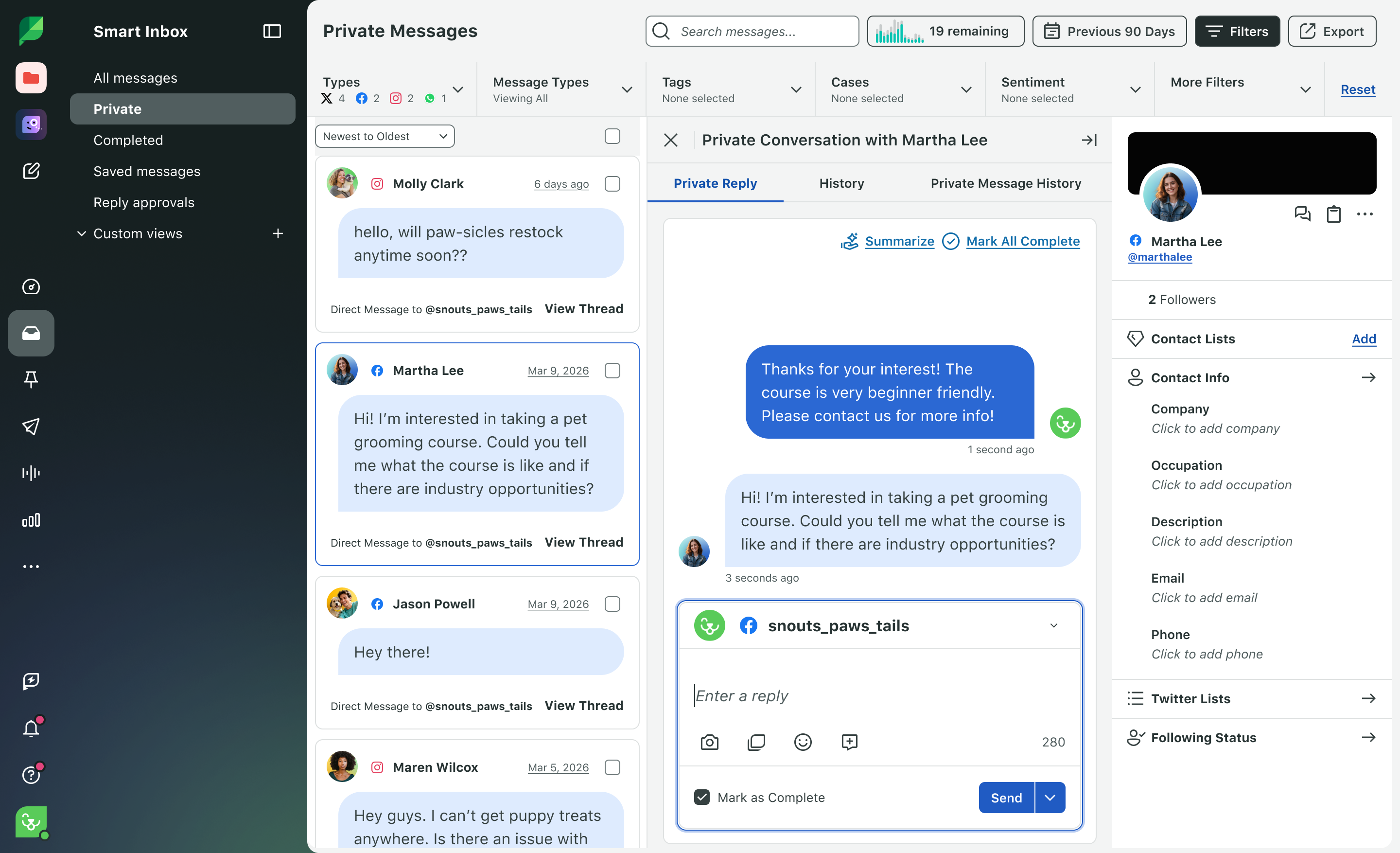
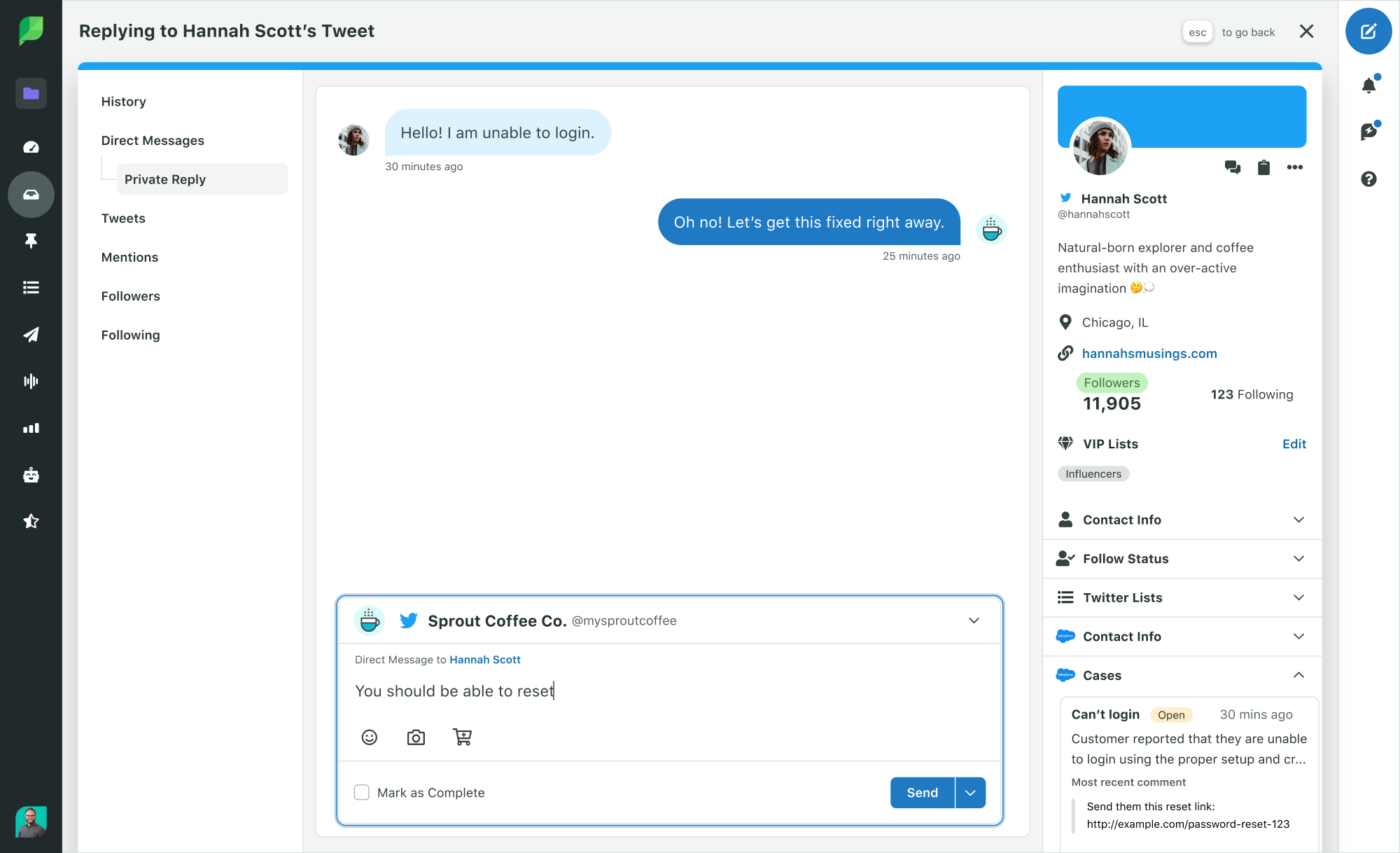
And Sprout Social Customer Care fuels the speed and efficiency your team needs to win in the era of outsized consumer expectations. You can coordinate across teams to tackle the most critical conversations, so every customer feels heard, supported and valued.
Comprehensive command center with integrations across your tech stack
Social intelligence can only become a true intelligence ecosystem if it flows across all of the systems your team and customers touch. Social data is too critical to live only in dashboards.
Teams need a deeply embedded ecosystem where social intelligence flows directly into the tools they already use. At Sprout, we enrich Salesforce cases with full social context for faster, empathetic service. We pipe sentiment into Tableau to reveal the “why” behind business data. We push critical trends into Slack for coordinated action.
Our platform also makes it possible to seamlessly move from a trend signal in Sprout to building a campaign brief in Asana to creating assets in Canva or Adobe Express, eliminating unnecessary friction.
Legal and ethical considerations of social media intelligence
Social intelligence is able to function because people speak openly in public. That access comes with ethical and legal obligations, and if you misstep could expose you to regulatory penalties, platform bans or reputational damage.
Here’s what to keep in mind.
Adhering to data privacy regulations
Global privacy laws like GDPR and CCPA govern how you collect, store and use personal information, including that which people share publicly. While these are the most cited, similar frameworks exist in one form or another across most major markets, and apply based on the customer’s location, not your office’s.
Work in aggregate to track anonymized, pattern-level data rather than building out profiles of named individuals. Collect only what serves a defined business purpose, set retention limits and know your process for deletion requests.
Respecting platform terms of service (ToS)
Every network sets rules for how other companies access its data. Unauthorized scrapers break those rules, and can result in revoked access, legal actions and failing datasets.
To avoid this, you should work through companies with official partnerships. Sprout is an official partner across major networks, so the data in your reports is legitimate and stable. If a vendor can’t or won’t tell you where its data comes from, you’ve already got your answer.
Transparency and the expectation of privacy
Public and private aren’t always obvious, but there are semi-public spaces where people have a reasonable expectation of privacy. An open profile is fair game, a private community or members-only forum is not, even if you can technically reach them. Never scrape gated communities or join one under a false identity to access that data, and never expose the individuals behind a mention in these spaces.
Verify before acting
We’ve talked a lot about the virtues of AI, but it has its downsides. Social data includes AI slop, bots, coordinated campaigns, spam and manipulated media. A sentiment spike can be a hundred real customers or one motivated actor attempting to manipulate a narrative via 100 accounts.
Build verification checks in before any insight travels to another team. Look for corroboration across platforms instead of trusting a single feed, and if in doubt, flag confidence levels.
Don’t just participate in the social intelligence era, lead it
Social media intelligence is a business imperative. It enables leaders and their teams to anticipate market shifts, align cross-functional decisions with real customer insight and transform fragmented data into enterprise-wide intelligence.
The brands that act now, embedding social intelligence into every layer of their strategy, technology and culture, will define the next era of business.
To start bridging the intelligence gap at your organization, download The 2026 Social Intelligence Report.
Social Media Intelligence FAQs
What is the meaning of SOCMINT?
SOCMINT stands for social media intelligence. It’s the practice of collecting, verifying and analyzing public social media data to turn conversations, behaviors and trends into insights that inform brand, customer and business decisions.
How does AI impact social media intelligence?
AI makes social intelligence possible at scale. No team can read billions of posts, but natural language processing and machine learning can classify topics, detect nuanced sentiment and identify purchase intent in minutes. AI agents go further by monitoring continuously and surfacing risks and recurring themes autonomously as soon as they emerge.
Is social media intelligence ethical?
Social media intelligence is ethical when practiced correctly and relying on public, anonymized and aggregated data accessed through platform APIs.
Is SOCMINT only for marketing?
No. While it fuels campaigns, SOCMINT is an enterprise-wide practice that supports customer care, product development, corporate communications, competitive intelligence and trust and safety teams.
What skills or tech are required for SOCMINT?
Effective social intelligence requires an intuitive platform equipped with Artificial Intelligence (specifically Natural Language Processing and Machine Learning) to parse massive datasets. It also needs workflow automation and human analysts to interpret the data contextually.
Additional resources for Social Media Intelligence

How to conduct a customer experience audit rooted in social intelligence
The complete guide to social media intelligence (SOCMINT)
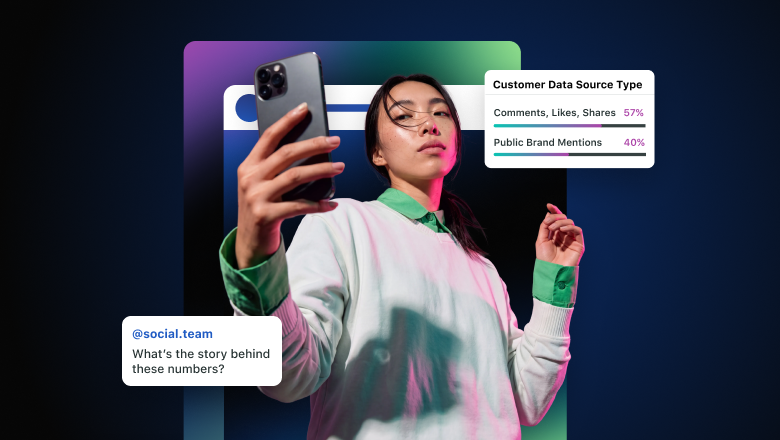


Why brands need a unified social and media intelligence strategy

How to predict market shifts with social data and audience intelligence

What is predictive media intelligence?
How Sprout Social approaches social intelligence
How social intelligence unlocks intelligent customer care
5 ways to implement social intelligence at your organization


Why your entire team needs access to social business intelligence

Share