How Sprout Social approaches social intelligence

Written by Benedict Nicholson
Published on June 16, 2026
Reading time 6 minutes

Table of Contents
The real value of social media data isn’t found in a retrospective report or a passive marketing dashboard. True social intelligence is defined by the action an organization takes based on those social insights. It means closing the gap between discovering a real-time audience signal and executing a core business decision in response, effectively transforming raw data into a forward-looking radar for the entire enterprise.
According to Sprout Social’s research, the boardroom increasingly views this capability as a foundational element of modern business strategy. The 2026 Social Intelligence Report reveals a clear consensus: 93% of professionals now see social intelligence as essential for future growth. Furthermore, 71% of directors predict that social data will become more influential than traditional market research in shaping core enterprise strategy by 2029.
To understand how this shift works in practice, we looked inward. At Sprout, we act as “Customer Zero” for our Social Intelligence platform. That means stress-testing workflows, modeling operational frameworks and proving how social insights can steer an entire organization.
We sat down with Olivia Jepson, Sprout’s Social Media Intelligence Manager, to dig into how we do this internally and get some advice on frameworks you can use. She gave us a look behind the scenes of her day-to-day workflow to see how Sprout operationalizes social intelligence from the ground up.
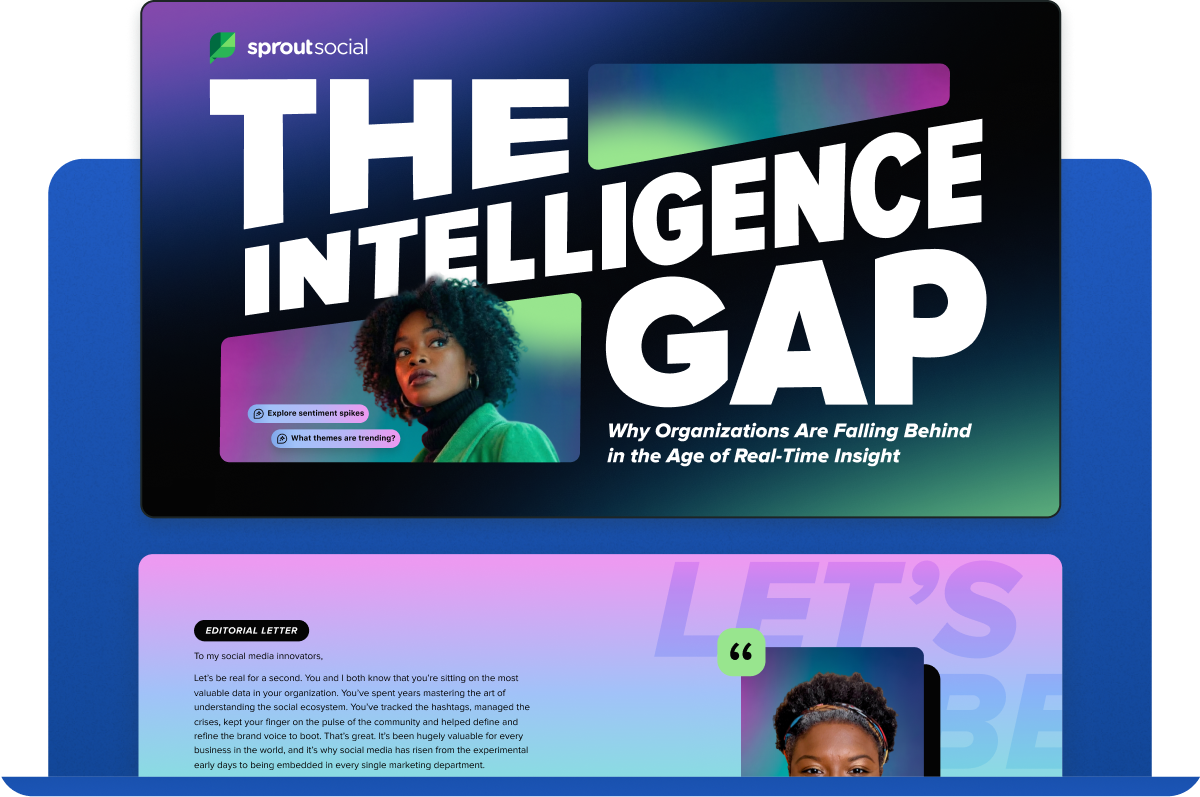
The 2026 Social Intelligence Report
The foundations of social intelligence
Acting as Customer Zero means living in the platform daily and experiencing it exactly the way our customers do. For Jepson, this responsibility centers on providing direct feedback, testing daily workflows and funneling raw user feedback and social insights back to internal stakeholders. She describes this ecosystem as a form of “reverse user research” where internal practitioners act simultaneously as day-to-day users and strategic contributors.
On a personal level, the role carries deep significance: Jepson originally pitched this social intelligence function as part of her own career vision. Seeing the enterprise invest heavily in the discipline is not only validating, but it creates a blueprint for operationalizing social intelligence company-wide.
Many organizations mistake social listening for social intelligence, but the shift from one to the other represents a fundamental evolution. Social listening serves as an accessible entry point because teams already know how to track topics and identify general themes. It answers the question: What are people saying?
Social intelligence, however, requires practitioners to move beyond basic trend identification and ask, “so what?” It is the deliberate process of translating raw conversation and unstructured metrics into deeper customer understanding. It turns broad themes into high-value signals and enables you to act on those signals with confidence. Unprompted and real-time, social data captures candid human feedback, effectively serving as the world’s largest unfiltered focus group.
At a practical level, Olivia’s work begins with listening, which involves dedicating focused blocks of time daily to scrolling and observing curated social feeds aligned with Sprout’s ideal customer profile (ICP). Rather than leaving these observations floating, she maps emerging ideas, patterns and qualitative observations in FigJam, which functions as a living knowledge map and reference system to easily validate or revisit patterns later.
From there, she leverages Sprout’s advanced tools and listeners to validate these initial hypotheses, quantify the trend volume and uncover broader market context. She does this by building platform-specific listeners to investigate cross-platform conversations or evaluate influencer marketing ROI.
Operationally, Jepson defines the baseline monitoring table stakes as:
- Inbox monitoring and customer sentiment tracking
- Continuous brand health checks
- Competitive benchmarking
- Industry pulse monitoring
- Signal validation through specialized listeners
“Before you can leverage social insights to guide complex strategic decisions, you have to establish a bulletproof operational foundation. Monitoring your brand health, keeping an eye on competitors and tracking real-time customer sentiment creates the baseline data stream that allows us to filter out the noise and find the high-value signals.”
This foundation works best when it’s connected to a unified social and media intelligence strategy, so signals from the newsroom and the timeline don’t stay siloed.
To turn these foundational insights into product improvements, Jepson increasingly partners directly with product and design teams. Through dedicated workshops and twice-yearly reporting, she gathers the open questions and knowledge gaps from product stakeholders, directly shaping future social research and discovery work.
Internal signal-sharing is considered table stakes for the program; she is currently rolling out recurring Slack updates to ensure audience conversations and emerging market dynamics circulate internally rather than staying trapped in siloed dashboards.
Building internal trust
Data only drives impact if people trust it, which means social intelligence programs must be built through relationships before systems. For practitioners looking to expand their internal influence, Jepson emphasizes the importance of building operational pathways that move social insights out of isolation. The playbook starts with finding collaborators across the business who are willing to engage, regardless of whether they are initially your primary stakeholder.
She recommends intentionally developing advocates across functions, including:
- Product
- Revenue/sales
- Marketing
- Market research
“Social intelligence will never move the needle if it stays confined to a social media team’s dashboard. You have to actively build bridges into other departments. By cultivating intentional advocates in product, sales, marketing and research, you embed social data directly into their workflows,” Jepson noted.
When it comes to market research, it’s important to view social intelligence as a complement to traditional research methods rather than competing with them. This prevents teams from feeling like they are receiving competing information. Traditional research excels at statistical validation and scale, while social insights contribute qualitative richness, immediate nuance and emotional context.
In Sprout’s process, social signals often come first, due to the real-time nature of the insights. Ongoing listening identifies recurring themes, and the team shares major themes with the market research team to directly inform survey design and broader exploration. Once the research is completed, the two datasets are compared and synthesized. Conversely, market research findings frequently prompt new social listening queries to dig deeper into a trend.
Ultimately, trust grows when social practitioners proactively bring value to others rather than asking busy teams to adopt entirely new processes. Sharing highly relevant market opportunities, competitor vulnerabilities or customer pain points directly via internal communication tools captures executive attention far more effectively than forcing stakeholders to log into a new tool.
Taking action on social intelligence
Insights without action are just operational noise. To drive real business value, social intelligence must move upstream to directly influence enterprise strategy and product development. At Sprout, our product teams serve as critical partners because brand experience and product experience are deeply intertwined.
When Jepson and her team share user feedback and validate customer demands early in the product discovery phase, they are able to act as strategic consultants guiding the business roadmap rather than reactively trying to justify it to the market.
When communicating this impact, Jepson is careful not to overstate the role of social intelligence as a standalone driver of business decisions. Instead, it functions as an increasingly critical strategic input alongside research, customer feedback and organizational priorities. As Customer Zero, our social intelligence function provides continuous input that shapes major business milestones and internal changes, including:
- Informing product conversations and core product roadmap discussions
- Validating customer asks and emerging customer needs early in the product discovery phase
- Providing strategic planning support and defining the core themes of major corporate milestones, like our Breaking Ground event
- Shaping event activations and high-level content strategy direction
- Influencing high-level brand and campaign messaging, including our company-wide conviction that “All Business is Social”
“Social intelligence rarely acts in isolation but increasingly helps validate, strengthen and guide strategic decisions.”
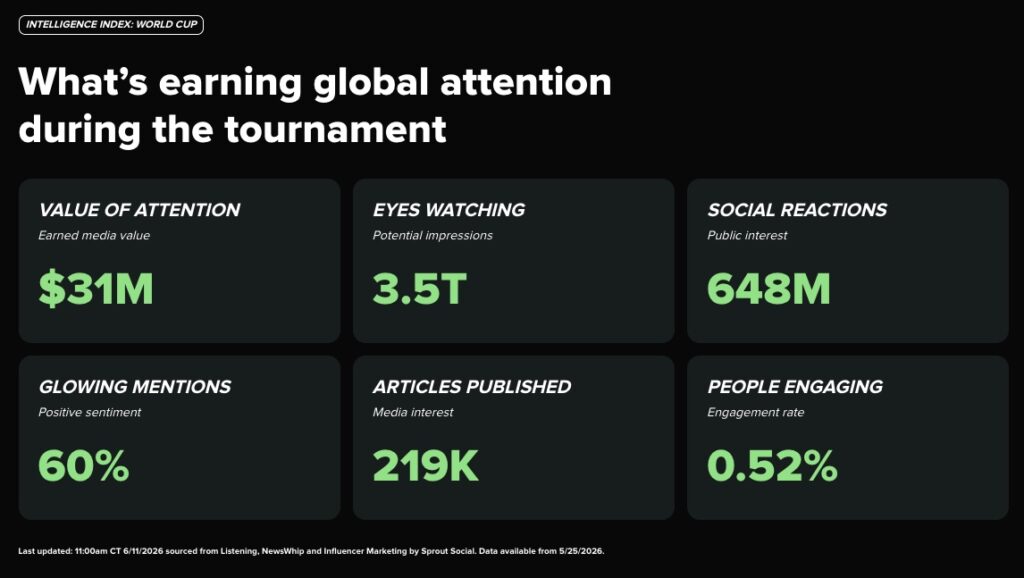
Beyond internal roadmaps, Sprout turns these insights into high-impact, external-facing content. We routinely build category thought leadership frameworks and trend-analysis landing pages centered around major cultural moments, like the Big Game or the World Cup. By feeding real-time social data directly into our go-to-market strategies, we ensure our brand stays completely synchronized with external reality.
Implementing social intelligence at your organization
Transitioning an organization from a reactive posture to a predictive one requires behavior change, self-advocacy, an unwavering focus on the customer and a robust predictive media intelligence strategy. Social practitioners are closer to the raw truth of customer conversations than anyone else in the enterprise, and they must proactively advocate for the strategic value of their discipline. Don’t wait for other departments to request data; instead, understand the specific challenges your stakeholders face and deliver insights that solve the problems that already matter to them.
Instead of forcing complex new processes on busy teams, seamlessly integrate social data into the systems, tools and meetings where business decisions are already being made. Once stakeholders experience that definitive “aha moment”—seeing firsthand how social intelligence removes strategic blind spots and improves their own outputs—organizational adoption scales organically.
Ready to bridge the intelligence gap and turn real-time social signals into your enterprise’s greatest competitive advantage? Olivia has developed a template for social intelligence metrics analysis that she uses in her own work. And you can download the Sprout Social intelligence metrics analysis template to start building your executive-ready narratives and operationalizing unprompted human truth across your organization today.
39 free social media strategy templates that will elevate your workflows
Published on August 20, 2026 Reading time 15 minutes






Share