How to predict market shifts with social data and audience intelligence

Written by Natalie O'Grady
Published on July 24, 2026
Reading time 9 minutes

Table of Contents
Some 86% of organizations in Sprout Social’s 2026 Social Intelligence Report admit they’ve missed critical business opportunities due to delayed, siloed or underused consumer insights.
They had the data they needed but lacked the infrastructure and strategy to take audience insights from passive information to a strategic, real-time action plan.
Brands have access to an overwhelming amount of social media data, but without the tools to tie that information to the motivations of their customers, opportunities slip by. Static reports and data that lags behind the current moment cause businesses to miss market shifts. And when you miss those indicators, you lose important ground building customer loyalty.
Forward-thinking brands are closing this gap by layering online culture and the present context over historical internal data. Pairing past campaign performance, sales data and previous social media engagement metrics with digital trends, consumption patterns and social listening builds robust customer personas that basic demographic data alone can’t. Organizations staying one step ahead are operationalizing their data into audience intelligence.
Audience intelligence is the practice of gathering and analyzing data on who your customers are and how they behave. It goes beyond simple categories like age and location, using social and market data to predict future consumer needs. Audience intelligence starts with deep target audience analysis and helps create an unbiased picture of consumer behavior: how they’re using social, what economic choices they make, what content they consume and what they value.
Why audience intelligence needs unfiltered human truth
Traditional marketing research tools like surveys and focus groups are prone to observer bias, and owned channel metrics only provide partial insights. Audience intelligence expands your understanding by integrating social media market research to more clearly map consumer behavior. Social media data gives a look at how today’s consumers are discovering, engaging with and sharing about products and brands. It also offers a competitive edge by capturing authentic, unprompted human truth.
The Q2 2026 Sprout Pulse Survey shows that search habits are fragmenting based on intent. Nearly a quarter (21%) of consumers now go to social media first to search for information. Consumers explicitly favor social over traditional search engines when looking for peer-led or experiential insights, such as researching restaurants and things to do (38%), product reviews (30%) and travel ideas (30%).
The 2026 Social Intelligence Report found that 67% of professionals agree that within the next three years, social intelligence will become more influential than traditional market research in shaping core business strategy. Current tools like CRMs track basic interactions across channels, but they lack real-time sentiment and emotional context. Audience intelligence fueled by social inserts this vital external layer, transforming basic data into multidimensional profiles.
| Traditional Research & CRMs | Social Intelligence | |
|---|---|---|
| Data integrity | Prone to observer bias | Captures unprompted, authentic human insight |
| Insight depth | Owned channels = partial insight | Basic data becomes multidimensional persona profiles |
| Contextual awareness | Tracks the “what” but lacks real-time sentiment | Creates external layer of real-time sentiment |
| Behavior framework | Gives you what people say when asked, in a structured setting | Provides what people share when communicating freely |
How to implement behavioral and interest-based segmentation
With social media intelligence, your customers become more than a data set in a report. Modern brands should prioritize behavioral signals and shared interests over traditional demographic categories. These detailed insights can highlight buried opportunities and untapped audiences.
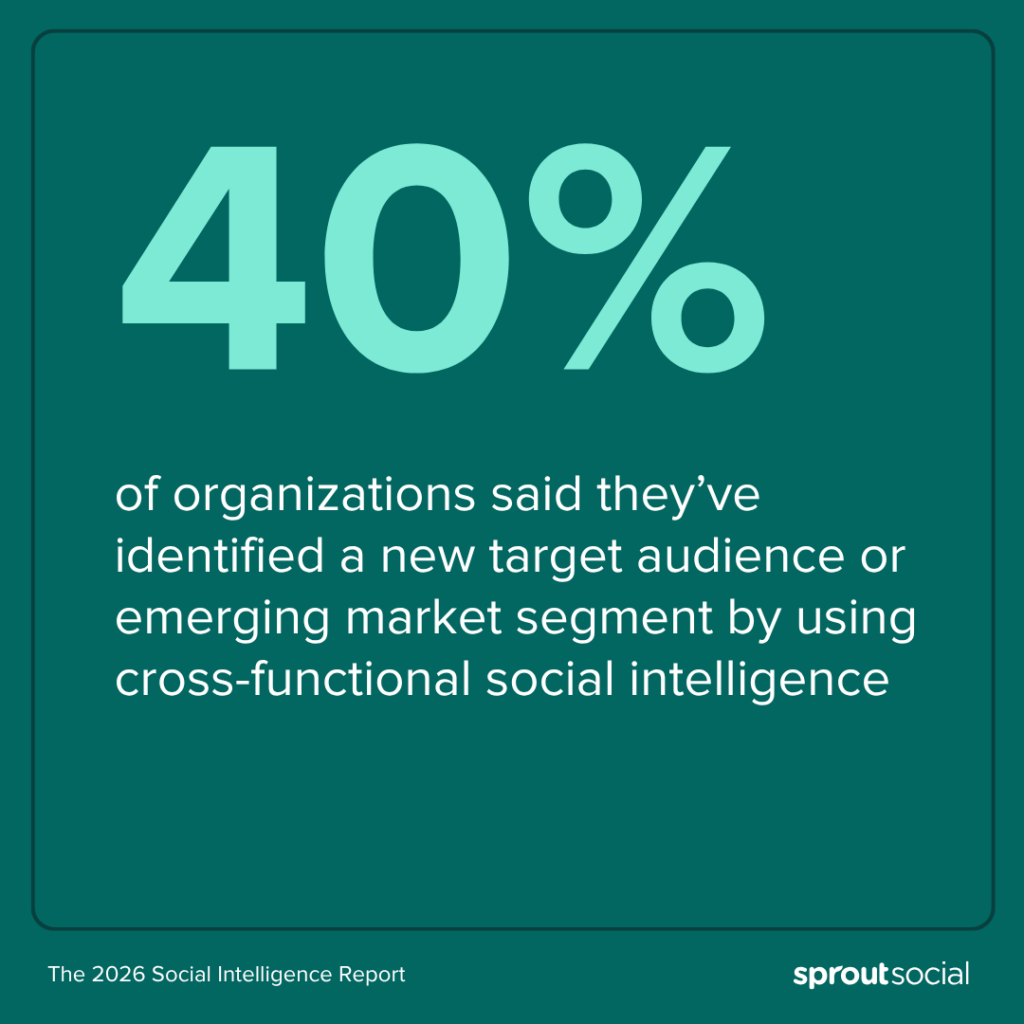
In the 2026 Social Intelligence Report, 40% of organizations said they have successfully identified a new target audience or emerging market segment specifically by using cross-functional social intelligence. Other departments can benefit from what you uncover, and social marketing data can bolster enterprise strategy. Here’s how to segment data to support every team from social to sales to customer care.
Map the raw signals
Raw social data like posts, likes, shares, clicks and conversions show patterns on their own, but often serve as vanity metrics. Turning these into structured social analytics like quantitative patterns of engagement help you identify actual behaviors and how your consumers interact with your brand.
Track sentiment and intent to move from assumed behaviors to real-world use cases. These data sets show you the “why” behind those vanity likes and shares, giving context to what prompts a consumer to share your content, follow you or comment on your post.
Tools like Sprout Social flesh these insights out for you, and set you up to actually implement social intelligence. These platforms gather data from your social presence and competitors’, analyzing it via automated reports and AI agents. AI-supported tools make connections and solidify the “why” behind the “what” in ways that are challenging and tedious with manual analysis. Raw data becomes both quantitative and qualitative insight.
Identify interest-based cohorts
Your consumers have a multitude of interests outside their purchases and interactions with you. Many of these may relate to your brand in obvious and hidden ways. The best avenue for unearthing a clearer picture of your customer is a modern version of a foundational communication skill: social listening.
Social listening gives you a constant stream of audience intelligence, tracking direct and indirect discussions around your brand. The content of organic conversations helps you identify micro-communities and niche audiences among your customers. Social listening tools and influencer marketing platforms like Sprout sift through millions of conversations to extract interests related to your audience, industry and brand. Those interests align with specific passion networks of consumers.
Specific affinities and cohorts might not have an overt connection to your product, but they are important to your audience and what drives them.
Break down data siloes
The conversations on social media have proven impacts on business functions well beyond marketing. A viral comment on Instagram can directly affect public perception, the news cycle and stock prices. Social insights can’t stay trapped in the marketing department. Behavioral segmentations must be accessible across teams to eliminate business blind spots and build a truly connected enterprise.
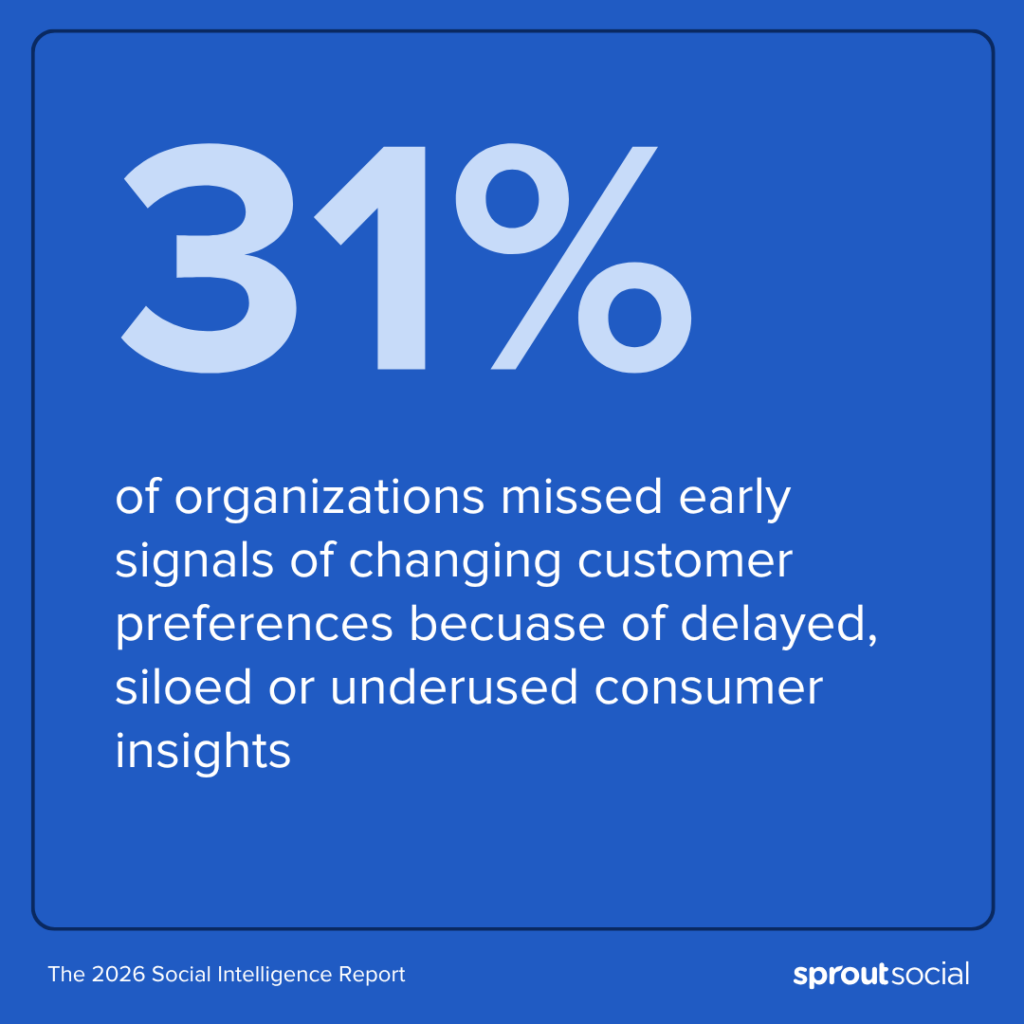
Stepping outside the marketing silo to integrate social intelligence with the broader enterprise story is critical for modern brands. Connect your social data to other sources like CRMs and business intelligence tools to get a full picture and strengthen data integrity. Among respondents to the 2026 Social Intelligence Report, 31% admitted that siloing their insights caused them to completely miss early signals of changing customer preferences.
Without additional context from other data sources in the enterprise, your marketing data could already be out of date. When audience intelligence and consumer behavior data is integrated in workflows across departments, new layers of the story are visible, including where your audience is going next.
Move from audience tracking to predictive strategy
Brands must evolve their social data approach to maximize the value of audience intelligence. Both reactive and proactive approaches have their place. Quality data helps you react to current needs and trends as they happen, but evolving to an audience intelligence approach lets you predict future ones.
With foresight, your brand can drive product development and business strategy, catch emerging market segments and inform executive decision making.
Use real-time social data to inform immediate pivots, understand the “why” behind trends and forecast what will grab attention next. Mapping current trend data to your historical social and marketing data uncovers patterns and shifts that show what’s coming up. This context enables you to prioritize actions and predict shifts in narratives before they happen. You’ll be a step ahead of competitors, and in prime position to become a trend-defining brand instead of a trend-adopting one.
A critical piece of moving from simple tracking to predictive media intelligence is investing in quality tools that take the burden out of data collection and analysis using AI to surface insights faster to inform your next steps.
Operationalizing audience insights with Sprout Social
In the 2026 Social Intelligence Report, only 10% of organizations said they possess the operational agility needed to translate a meaningful social insight into tangible business action. Ideally, brands need to apply social insight within hours given the speed of trends and change on social media. That’s difficult, if not impossible to do manually, so you’ll need a platform powered by AI that can handle routine tasks and major analysis.
The right tool for the job will keep the data flowing while making recommendations and surfacing patterns of behavior. Sprout Social is an enterprise social intelligence platform offering a suite of features that support your entire organization with deep, integrated audience insights that you can take action on.
Automate data curation with Trellis
More than 80% of individual contributors in our 2026 Social Intelligence Report say they spend more than half their time on operational execution (including publishing, routine monitoring and manual reporting). This leaves little time for strategic insight work or planning for what comes next.
Sprout automates the most time consuming portions of the intelligence process: data collection and reporting. Our agentic AI agent, Trellis, manages data curation and analysis across public feeds, media coverage and social care interactions that happen within Sprout and NewsWhip by Sprout Social. Trellis helps your team operate smarter and faster, offering scalable filtering and comprehensive data visualization. Trellis Studio handles the repetitive, analysis tasks you perform every day using customizable skill templates.
With Trellis, analysts, marketing specialists and communications teams get their strategic time back instead of suffering from manual reporting burnout. Reports are ready to go when you need them, without the manual work historically required. Your team will have more time to look ahead and interpret important audience signals.
Surface the signals and interpret meaning with Sprout Listening
Sprout Social Listening moves you from tracking basic engagement data points like comments and shares to interpreting the meaning underneath conversation patterns in your audience. Features like the Query Builder and themes isolate specific topics to analyze and understand sentiment across messages, posts and other content. You can configure how sentiment is classified across networks and prioritize–or ignore–certain keywords.
Sprout Listening helps map complex, unstructured data into clean, actionable behavioral segments through filters and AI assistance. You can use pre-built templates for use cases like crisis management, brand health tracking, competitive insights and industry market analysis, each with unique topic focus and readily available insights.
The same customer conversation can have different connotations for different lines of business. Social media posts may reference brand interactions or stories from other functions like customer service or news media. Sprout helps you explore all angles, integrating insights across mediums.
Predict narrative momentum with NewsWhip by Sprout Social
Social media and the news cycle reflect each other, feeding hot topics in each direction. What happens on TikTok and Instagram is relevant to news sources and the general public, because these networks feature real life experiences of users. The always-on nature of social media means your brand’s every move can be dissected; both what you post and what consumers say about your brand fuels public perception and the news cycle. Sprout Social research shows that social media is the number one place consumers hear about brand controversies first.
To stay on top of what media stories are resonating and impact your audience, NewsWhip’s monitoring tool brings together fragmented media sources to detect and act on trending stories as they happen.
NewsWhip enables comms and marketing teams to catch crises early, monitor campaign roll out and understand what news matters to their audience. As part of an audience and media intelligence strategy, NewsWhip adds context to ongoing narratives and helps forecast if stories will catch fire or die out .
Alerts in NewsWhip can notify you the moment your brand might be at risk and assist in tracking stories that are lurking below the surface. Insight from NewsWhip adds a cross-platform framework around what outlets, influencers and figures drive conversations that matter to your audience.
Discover highly-relevant creators with Sprout Social Influencer Marketing
When you’ve gained insight into the interests and motivations of your audience, you have critical information about what type of marketing they respond to best. Influencer marketing shaped by audience intelligence builds resonance and authenticity into your marketing approach.
Sprout Influencer Marketing guides your team to quality influencers the same way consumers discover their content: via topics, themes and conversation. Any interest-based affinity groups you’ve pinpointed via audience analysis are a strong indicator of what types of influencers may work well for your brand.
You can create parameters for the type of influencers you want to work with and what values matter to your brand and customers. Sprout then filters potential partners who already connect with your audience and are trusted, brand safe voices. Sprout, informed by insights from your audience intelligence practice, can generate a healthy pipeline of quality, creative partners for your marketing campaigns. When selected based on social and business data from across the organization, influencer partnerships bring measurable business impact.
Take immediate action with Sprout’s integrations
With Sprout, your audience segments and intelligence research don’t just sit in a dashboard waiting to be applied. Teams in various departments can act on them instantly within Sprout’s workflows thanks to key network integrations.
Social data from Sprout feeds into your existing business intelligence and CRM infrastructure, including platforms like Salesforce and Tableau. You won’t need to manually transfer data or reports and do analyses by hand. Sprout closes the gap between insight and action, synchronizing business data with real-world context. Individual data points become signals for important business decisions at every level of the enterprise.
To explore how Sprout can connect with tools already in your stack, schedule a personalized demo.
Don’t chase your audience, evolve with them
True audience intelligence turns a passive trend forecast into an active, enterprise-wide strategy. When you embed predictive customer insights across every department, organizations execute with clarity. Brands can lead their category instead of chasing competitors and trends by living exactly where their customers do. The next market shift is already visible in your data, and you can catch it first with audience intelligence.
Dig into our 2026 Social Intelligence Report for more on insights on closing the intelligence gap.
What is audience intelligence?
Audience intelligence is the practice of gathering and analyzing data on who your customers are and how they behave. It goes beyond simple categories like age and location, using social and market data to uncover motivations and predict future consumer needs.
What is the best audience intelligence tool?
A quality audience intelligence tool is often made up of several platforms that offer features like social listening, AI-powered analysis, integration with business intelligence platforms and support for influencer and creator marketing. Ideally, your tools will weave together insights from social, media, business, sales and other sources. Sprout Social offers each of these capabilities including an intentionally designed AI tool, Trellis, and media monitoring with NewsWhip.
39 free social media strategy templates that will elevate your workflows
Published on August 20, 2026 Reading time 15 minutes







Share