
Learning course on how to craft compelling, data-driven ROI narratives and showcase your team's profound impact.
Learning course on how to craft compelling, data-driven ROI narratives and showcase your team's profound impact.
Read moreSocial media ROI doesn’t have to be a mystery. With the right tools and reporting infrastructure, you can showcase your strategy’s impact in a way that resonates with business leaders. We’ve compiled our best social media ROI insights to create a guide to refine your approach to proving social ROI.

Social media ROI is about proving how social media contributes meaningfully to an organization's success. Metrics like views, engagement rate and impressions can seem too vague to link directly to the outcomes leaders care about: revenue, retention and reputation.
While leaders believe that social drives acquisition, customer loyalty and the bottom line, they aren’t confident in their team’s ability to tie social to those outcomes. Many blame their tech stack, but are also disappointed by the metrics reported on, per The Impact of Social Media Marketing Report.
And lackluster reporting leads to withheld budget. According to The Sprout Social Index™, the top factor for securing investment is proving how campaigns align with business goals.
The C-suite also wants to see how effectively teams turn the pulse of the market into actionable intelligence. In fact, according to The Social Intelligence Report, 71% of directors predict social data will become more influential than traditional market research by 2029. Yet, only 10% of businesses have the operational agility to turn real-time insights into action within hours, and 33% of marketers report reacting too slowly to a cultural or market shift because of underutilized social consumer insights.
Consult our social media ROI calculator to identify the value of your current social media publishing strategy.

This ROI calculator identifies the value of your social publishing efforts, but what about all of the other aspects of social media marketing? Is there an easy way to identify the value of social media intelligence across publishing, listening, engagement, customer care and analytics all at once?
Until we build that calculator, the short answer is:
Social media ROI = [(Earnings – Costs) ÷ Costs] x 100
In this formula:
The long answer? That’s where you’ll figure out your unique social media ROI. Let’s break it down:
Let’s be clear. Social media ROI isn’t some sort of one-size-fits-all affair.
When we think of “ROI,” we often default to thinking about revenue. Yet, there’s value in social media beyond direct sales. For example, raising brand awareness is a perfectly good reason to invest in social media.
At the same time, other brands may focus on social media marketing to generate leads or provide omnichannel customer service. You could even do all of the above. Many brands juggle multiple objectives, making social media a versatile but complex tool.
That’s why defining your approach to social media ROI starts with understanding your company’s unique goals. What role does social play in achieving your business’s key objectives? This is the perfect opportunity to collaborate with senior leadership to ensure alignment on priorities.
To guide those conversations, consider asking:
Securing leadership buy-in ensures your goals align with what matters most to your C-suite, laying the groundwork for the cross-team collaboration essential to proving ROI. With their support, overcoming internal bottlenecks becomes much simpler.
Accurately calculating ROI might begin with granular insights into a specific campaign's performance. A campaign is a focused effort with specific goals and measurable outcomes.
Below are some common yet specific goals for any given brand’s social campaigns:
Once you’ve zeroed in on the goal of your campaign, diligent UTM tracking is essential. With Sprout Social, you can set up tracking rules to automatically append UTM parameters to the links in your posts. This ensures consistency and accuracy, so you don’t have to rely on memory to get it right.

UTMs not only allow you to analyze data at the campaign level but also enable precise revenue attribution in your reporting.
From there, you can begin applying ROI measurement to campaigns and social efforts more broadly.
According to the Index, social media teams measure success largely through production efficiency. But marketing leaders believe that social drives awareness, acquisition, loyalty, revenue, R&D and decision making, according to The Impact of Social Report. Leaders want to see these metrics reflected in your reporting, and hear how social led to innovation and brand relevance.

To craft a compelling narrative about your impact, you first need to speak your leadership team’s language. That starts with mapping your goals to metrics that demonstrate return.
Here are the key numbers to track when proving ROI:
Metrics that track revenue attribution from social
You 100% can measure direct revenue impacted by your social efforts. While social media is a long-term game, the revenue impact may surprise you. For example, when Sprout’s social team switched from last-touch to multi-touch attribution, they uncovered a staggering 4800% increase in pipeline impacted by social efforts.
With multi-touch attribution, you can see how social contributes throughout the customer journey through pipeline generation, sales, customer lifetime value and more.

Metrics that track social-driven conversions
Social often influences potential customers at different stages of the funnel. Tracking down-funnel metrics—like Clickthrough Rate (CTR), Return on Ad Spend (ROAS) and leads—shows how your social efforts drive actions that align with broader business goals.

Metrics that track owned media value
You’ve heard the saying, “A dollar saved is a dollar earned.” Metrics that calculate how much you’d spend on paid channels to achieve the same results can highlight the value of your organic strategies. These insights demonstrate the cost-effectiveness of your social efforts.

To measure social’s impact across the customer lifecycle, your social media management platform must connect seamlessly with the other business intelligence tools tracking customer activity. To create a social intelligence ecosystem and demonstrate complete impact, you need social data to flow into your existing marketing tech stack.
Start by identifying where your priority ROI metrics currently live. These data sources might include:
Collaborate with your marketing analytics team, or the team members responsible for broader marketing reporting, to integrate these systems effectively and establish a reporting infrastructure as your source of truth. With this setup, you’ll always have access to the actionable insights you need to prove ROI and drive decisions.
To figure out whether you’re getting a positive or negative ROI for social media campaigns, you’ll have to measure how much you’re spending. That spend doesn’t just involve money, though. Here’s what to include in your ROI expense calculations.
After factoring in all your expenses, you can use the social media ROI formula above to make your calculation for each campaign and your strategy more broadly.
Your social media performance shouldn’t be left to speak for itself—context is key to shaping a compelling impact narrative. It’s up to you to ensure your reports tell the right story.
Establish a reporting cadence that aligns with your team’s structure and goals, and share performance updates with leadership regularly. Need visual support? Our social media scorecard template has you covered. It includes slides to highlight what’s driving your efforts, what’s impacting results and how your performance stacks up against industry competitors.
And to bridge the gap between what's happening on social and how your company should use that intel to inform their next strategic move, check out our social intelligence template. These slides provide a framework to understand online conversation at scale and share key insights.
Proactively share these updates with senior leaders and stakeholders. They may not realize the value of these insights until they see the actionable, company-wide impact social data can provide.
On that note, let’s quickly cover some additional pointers for stepping up your social media marketing ROI.
With social feeds increasingly saturated and algorithms changing the way content is served up, it’s easy for brands to get lost in a sea of new posts. That means your target audience might not see your content at the rate they once did. No engagements equals no returns on your social media investment.
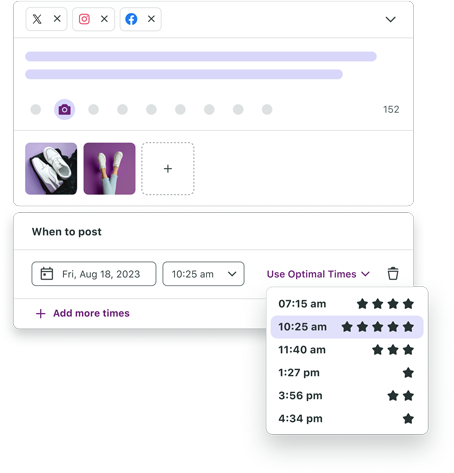
So you need to post new search optimized content regularly to ramp up your visibility. Ideally, you should post multiple times a day to get your content in front of the right audience. Not sure how often to post on social media? According to the 2025 Content Benchmarks Report, the industry average stands at a whopping 9.5 posts per day (total across all networks).
Don’t just stick to these industry norms, though. We recommend testing different posting frequencies to see what works best for you.
Boosting your posting frequency doesn’t just help with social media algorithms. But it even shows your audience that you’re active and you’re worth following. No one wants to follow a brand that only posts every other week.
Consider using a social media scheduling tool like Sprout Social to automatically send out your posts based on the schedule that makes the most sense for your audience. The AI-powered platform reaches the right audiences at just the right time to create lasting impact.
Engagement is the gateway to conversion activities. Someone who engages with your product promotion post is more likely to show interest in the product than someone who just scrolls past it. They might take a closer look at the product, click on the link and eventually buy the item.
So you need to get those engagement metrics up if you want to boost your social media ROI. Use strategies to boost your social media engagement. This might include posting at the right time, using eye-catching visuals and creating compelling copy.
Most importantly, make sure you’re creating content that resonates with your audience. Use Sprout’s analytics to keep a close eye on your engagement metrics. Use AI-guided performance insights to spot patterns over time, connecting historical trends to real-time results to predict what will drive impact next. These engagement trends can also inform decisions that boost customer satisfaction and move your business forward.

Measuring your social media ROI is about both the metrics you pull and the social intelligence that provides wider business impact.
For example, which types of content are your top performers? When are you getting the most engagement? What's the sentiment surrounding your brand and competitors? These data points can be make-or-break for paid and organic campaigns alike. The more data you have on hand, the easier it is to maximize your reach and get a better ROI for your efforts.
Using agentic AI can reveal hidden patterns in social data that enables leaders to make faster, more informed decisions. Our new AI Agent, Trellis, is a strategic teammate that automates tedious tasks and surfaces real-time insights to drive better, faster decisions across every department. Teams can delegate complex research to Trellis and get custom, clear answers to pressing business questions with a simple, conversational query. With Trellis, you can:

Marketers today have to run a variety of campaigns, paid or otherwise. And not all of those campaigns will pay off. Before going all-in on a particular campaign or ad type, save yourself time and money by running a test first.
This is especially important for paid ads like those on Facebook that can quickly blow out your budget if you aren’t careful. Check out our comprehensive guide on testing on social media to learn more about what it takes to run an effective test.
Social commerce has exploded in popularity over the past few years. It has helped to seamlessly bridge the gap between researching products on social and actually making a purchase, and that ease of use makes a real difference. 2025 Index data shows that the majority of consumers search for new products and services on social media when they need to make a purchase within the next month.

Conducting commerce on social media makes your ROI much more evident by tying social engagement to retail success. Use Sprout’s social commerce features to connect your Shopify and Facebook Shops product catalog to the platform. That way, you can focus more on ways to drive sales through social and less on managing different tools for product links or customer history.
To see how these calculations play out with real-world data and across different platforms, these social media marketing ROI statistics can offer valuable insights.
When consumers want to make purchases, they’re not going directly to your website for reviews anymore. Instead, they’re turning to their favorite influencers.
According to Sprout’s Influencer Marketing Report, 49% of consumers make purchases at least once a month because of influencer posts. The majority of consumers (86%) make a purchase inspired by an influencer at least once a year.
An influencer partnership can drive the down-funnel conversions needed to boost your social media ROI—especially if you’re strategic about your partnerships. Nano-influencers with a strong presence in a niche related to your product can be a cost-effective way to reach engaged, loyal audiences. Sprout Influencer Marketing enables you to build real trust by finding creators who truly fit your brand. AI helps surface the best matches through topic-based search, so campaigns feel genuine and resonate with your desired audience.
Your marketing tech stack can make or break your ability to prove ROI. Social data must flow seamlessly into the intelligence tools you already use.
The tools you choose depend on your organization and goals. At Sprout, we use core Sprout Social, Listening, NewsWhip by Sprout Social, Employee Advocacy, Google Analytics, Salesforce and Tableau to measure brand discoverability, message resonance and revenue impact.
We use Sprout’s My Reports—a premium add-on that highlights the metrics most aligned with business priorities. This helps us evaluate campaign performance and identify what resonates with our target audience.

By integrating with Salesforce, we connect social media and employee advocacy efforts directly to revenue. Multi-touch attribution tracks the impact of social, influencer marketing and advocacy across the sales funnel, giving us a clear view of pipeline contribution.
With some foundational reporting work, you can reach a similar state of measurement and insight. While achieving this requires effort, tools like Sprout make the process smoother, helping you quickly connect the dots between social efforts and business outcomes.
Knowing the impact of your social media efforts doesn’t have to be a mystery.
To ensure efficiency and accountability, businesses must define and measure social ROI. This helps align campaigns with goals and ensures resources are being used effectively and gives greater visibility into industry defining social insights.
When it’s time to share your results with leadership, use our organic social media ROI toolkit to present your ROI story clearly and effectively.