
Instagram marketing: The complete guide for brands
Instagram marketing: The complete guide for brands
Read moreInstagram marketing ROI is how leaders prove impact, defend budgets and optimize strategy. According to the 2025 Sprout Social Index, 65% of marketing leaders want a clear link between social campaigns and business outcomes. This puts Instagram marketing ROI center stage. Learn how to create a strong Instagram ROI framework that delivers that proof by connecting spend, attribution and outcomes across paid, organic and creator content to demonstrate lasting impact.

Instagram marketing ROI measures the value your accounts generate compared to the resources you invest—from ad spend and creative production costs to influencer fees and your team’s time.
What counts as “return” is entirely dependent on your campaign’s focus and your wider business goals. For example:
Paid ads focus on driving revenue or lead value.
Organic content builds long-term engagement and brand perception.
Influencer partnership can prioritize conversions and audience growth rate.
Instagram marketing ROI also comes from the rich social data these campaigns generate, which unlocks insights that extend beyond digital marketing. And because goals and outcomes shift, staying flexible is critical to capturing Instagram ROI’s full impact.
Most marketers express Instagram marketing ROI as a percentage and calculate it using this formula:
When measuring investment, account for all the costs of your Instagram marketing initiatives, including the following:
Value received includes business outcomes like these:
Remember that value can also be less direct but still highly meaningful. A recruitment campaign tracks the pipeline impact of qualified applicants. A retention push measures the revenue generated from re-engaged customers. Influencer partnerships might highlight affiliate revenue or growth within high-value audience segments. Beyond these measurable outcomes, the social data itself is invaluable, strengthening areas like market research, brand reputation and competitive strategy.
To capture full journeys, teams track this data with UTM parameters and Google Analytics 4 (GA4). Multi-touch attribution goes further by connecting social investments to concrete business outcomes like conversions and sales. This provides a complete, honest view of how your marketing campaigns create value.

Calculating ROI by capturing both direct and indirect value ties your metrics to your campaign’s true intent and provides the data you need to confidently defend your budget and strategy.
Even with the right formula, the technical hurdles, business silos, privacy rules and complex buyer journeys continue to cloud the ROI picture. It’s no surprise that only 44% of marketing leaders rate their social teams as experts at measuring social’s business impact, while 83% rate their content strategy expertise highly.
Here are the key challenges that stand in the way of proving Instagram ROI:
Instagram rarely works in isolation. For example, a customer sees a boosted Reel, searches for your brand on Google, clicks a retargeting ad a week later, sees an email promo and then converts.
This kind of multi-touch journey highlights why attribution is so tricky. Relying only on last-click attribution completely undervalues Instagram’s true role. While GA4 improves path analysis, it still can’t account for all the actions users take on social, such as link shares in DMs or private group chats. These are the blind spots that make it hard to credit Instagram for its full share of ROI with traditional tracking models.
Privacy updates and data restrictions have narrowed the view into customer activity. These include Apple’s App Tracking Transparency framework, Meta’s aggregated event measurement and the long-standing restrictions around third-party cookies. Global regulations like GDPR and CCPA have further pushed the industry toward first-party data strategies.
The result is a noticeable signal loss that clouds targeting and reporting. For instance, conversions that once showed up clearly in dashboards are now harder to attribute. Additionally, campaigns often rely on modeled data rather than direct tracking, introducing uncertainty and limiting precision. These obstacles make proving Instagram’s true ROI a heavier lift, even with high-impact campaigns.
Not all Instagram campaigns chase the same goal. An awareness campaign prioritizes reach or brand lift, while a conversion campaign focuses on sales or sign-ups.
Measuring ROI across such different objectives is challenging, especially when campaigns mix paid ads, organic posts and influencer content. Without a clear framework that accounts for these differences, your performance reports risk comparing apples to oranges.
Value from Instagram marketing spans multiple teams: paid media, organic social, customer care and influencer partnerships. Each often has its own KPIs, tools and reporting formats. Without shared metrics and integrated data, teams can’t see the full picture.
When ROI reflects only slices of performance, rather than the combined effect of everything happening on Instagram, it becomes unclear or misleading. Closing those gaps starts with focusing on the Instagram metrics that connect most directly to core business value.
Instagram offers dozens of social media metrics, but not all of them connect to business value. It’s crucial to focus on metrics that ground your ROI in measurable impact, not vanity figures.
Because paid, influencer and organic efforts play different roles, they require different tracking. Here’s your breakdown:
When running paid Instagram ads, the clearest metrics come after the click. These key measures show how efficiently your ads drive traffic, conversions and revenue:
Evaluating spend data alongside post-click performance gives you a sharper view of ROI and helps you continuously optimize your ad spend.
Influencer marketing on Instagram blends sales with brand awareness, which makes measurement complex. To cut through that complexity, use affiliate revenue, promo code redemptions and tracked link clicks for a clear line to conversions. Other metrics—like audience growth, engagement rate on sponsored posts or reach into a new target audience—quantify the indirect, brand-building value.
Pairing these with your attribution model ensures that influencer ROI calculations account for both quick wins and longer-term brand lift.
Organic posts rarely spark immediate sales, but they are essential for building a strong foundation. Metrics like engagement rate, reach and share of voice gauge whether your content resonates. Customer service interactions offer a further layer of value. Faster response times and higher resolution rates directly strengthen satisfaction and retention, making them meaningful indicators of ROI.
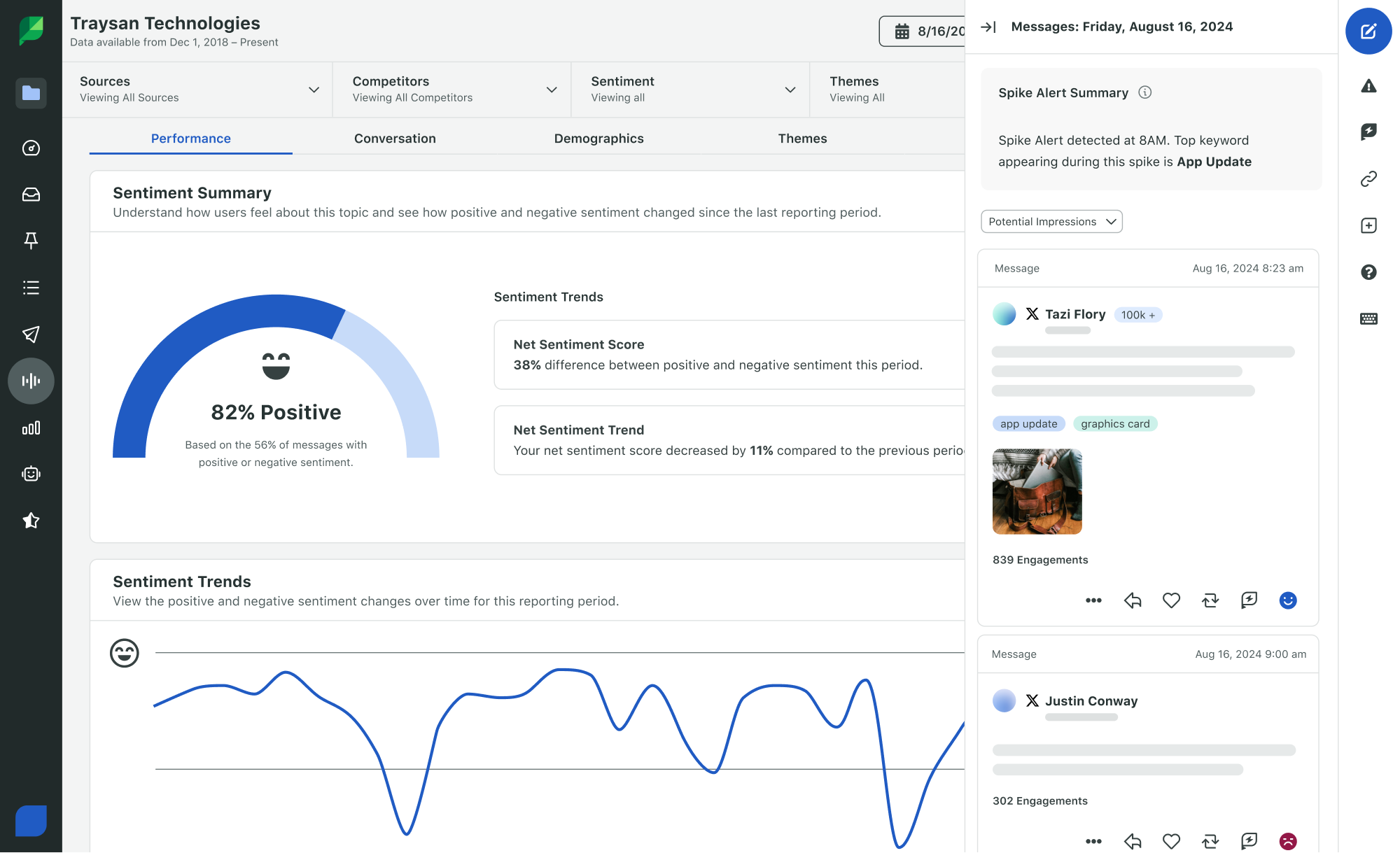
Beyond engagement, organic performance shows up in how people talk about your brand. Sentiment analysis uncovers shifts in brand perception, while traffic from posts to your website or blog serves as a proxy for mid-funnel influence.
To deepen attribution, track performance with targeted hashtags using tools like social listening and sentiment reporting. This makes it easier to connect these signals and tie your organic efforts back to larger marketing goals.
Paid, influencer and organic campaigns each tell part of the story Together, they reveal Instagram’s true, full-funnel role in driving ROI.
Driving stronger ROI on Instagram means improving individual campaign performance and optimizing the foundational systems behind your measurement.
These four strategies will help you align your objectives, tighten your measurement and make confident, data-driven decisions.
Every Instagram campaign should start with a clear purpose that matches audience behavior. For example, awareness campaigns benefit from metrics like reach or brand lift, while conversion campaigns require a focus on measurable sales or lead gen outcomes.
Framing goals around the customer journey ensures each campaign aligns with where your audience is and what they’re ready to do. This strategic alignment strengthens performance and gives attribution models a clearer view of Instagram’s role.
ROI loses impact when paid, organic and influencer teams measure success with separate KPIs, which loses sight of Instagram’s cumulative effect.
Defining shared KPIs like Customer Acquisition Cost (CAC), LTV (Lifetime Value) and revenue helps you unify measurement. Use reporting and analytics dashboards to pull data from every social effort into one place, making it easier to present Instagram’s complete contribution to business outcomes.
Even strong campaigns produce misleading ROI if reporting pipelines have blind spots. Common issues include over-reliance on native Instagram metrics, inconsistent UTM tagging and ignored data from earlier touchpoints.
Regular audits uncover these gaps by showing whether attribution models reflect the full customer journey and whether tracking captures direct and indirect outcomes. Adjusting workflows is the first step to improving accuracy.
ROI gains come from small, iterative improvements that surface when you experiment. Test variations in CTAs, creative formats, timing or influencer partnerships to see what truly moves the needle.
To further support experimentation, A/B test everything—from comparing Reels to carousel posts to testing different audience segments. Sprout’s social media analytics dashboards and campaign tagging tools centralize results, helping you turn scattered insights into actionable decisions so you know what’s working and can act quickly.
Together, these strategies set the stage for a clear, unified view of your Instagram performance.
Proving ROI comes from connecting Instagram’s performance to the bigger business picture. You need tools that pull data together, surface patterns quickly and plug directly into your existing analytics stack.
Sprout Social brings every ad, post and partnership into a single performance view, with AI listening and reporting to flag trends, sentiment shifts and emerging opportunities. And because Sprout integrates with tools like Tableau and Salesforce, social data flows directly into your business intelligence and CRM systems, giving you an end-to-end view of ROI.
Here’s how Sprout connects the dots to turn fragmented reporting into a complete, actionable view of ROI:
Sprout’s tagging and campaign tracking tools link paid, organic and UGC content to their results in a unified dataset. Instead of pulling separate reports, you see at a glance how each post type performs against campaign objectives.
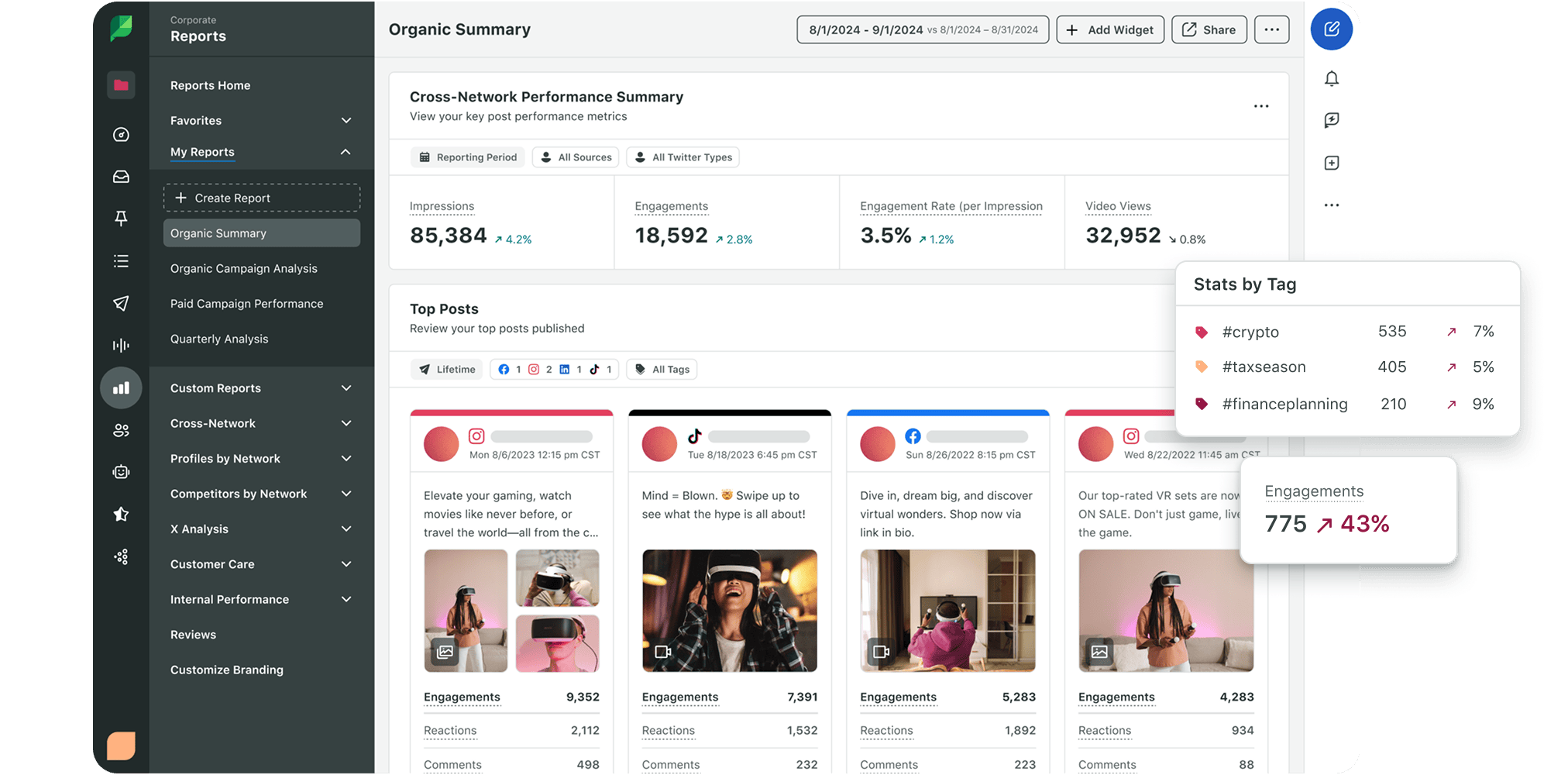
This approach helps teams move from vanity metrics to actionable insights, especially when you’re facing the complexity of measuring Instagram ads and organic content.
Unified dashboards combine content, ad and customer care data into a single performance view. Whether you’re showing an awareness campaign’s reach, a retargeting ad’s impact or how quickly your team resolves inquiries, you can filter by format, audience or objective.
This visibility simplifies measuring ROI across all social media networks and marketing channels—a top priority for marketing teams in 2025.
Premium Analytics, an add-on capability in Sprout’s Reporting suite and Sprout Listening empowers you to track clicks and conversions, as well as crucial sentiment shifts and share of voice. The data reveals patterns in customer behavior while highlighting the brand-building impact of organic storytelling and tying ad campaigns to measurable results. Together, these perspectives create the complete ROI picture you need.
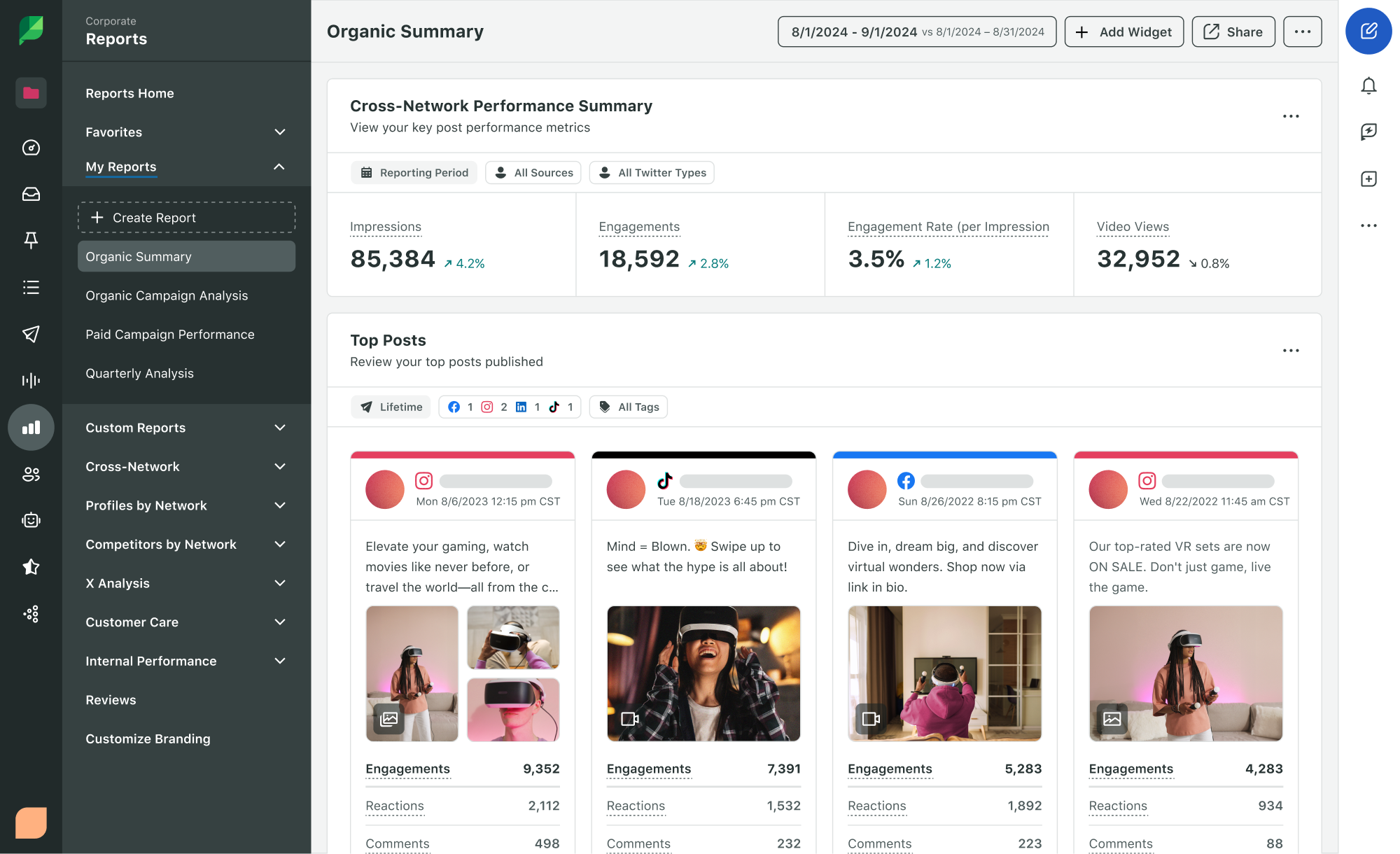
Sprout simplifies one of the hardest parts of ROI measurement: reporting. Its automated, customizable dashboards cut down on manual work while improving accuracy and transparency. The result? More time to act on your data, optimize what works and reallocate budget away from what doesn’t.
By tying every post to performance, surfacing a full-funnel view and capturing direct and indirect impact, Sprout replaces fragmented reporting with one reliable, transparent view. This capability saves teams hours each week, builds trust in your insights and unlocks the visibility you need to make faster, more effective decisions.
Ready to build an ROI profile that will stand up in any budget conversation? Schedule a demo with Sprout today.