17 of the best social media analytics tools for your brand in 2026

Written by Anam Ahmed
Published on August 3, 2026
Reading time 16 minutes

Table of Contents
A passive brand presence on social isn’t enough anymore. Brands face a seismic shift toward community-led growth, social commerce and social search. For social media professionals, the right social media analytics tools don’t just provide an advantage—they are a strategic imperative.
Native platform insights offer a glimpse into performance, but they lack the holistic, actionable intelligence required for social media analytics. You need a robust, third-party social media analytics tool to navigate behavioral shifts, prove ROI and identify emerging trends.
Advanced social media analytics platforms aggregate disparate data, providing a unified lens that translates numbers into strategic narratives. Beyond standard metrics like reach and engagement, the best tools offer capabilities like sentiment analysis and competitive benchmarking—crucial for optimizing spend and achieving measurable business outcomes.
This article explores 17 leading social media analytics tools empowering marketers to master the complex social landscape in 2026.
What are social media analytics tools?
Social media analytics tools are specialized software platforms that collect, track and analyze data from social media channels to evaluate performance and audience engagement. Data from social media analytics software lets you better understand your audience and how they interact with your content. With these tools, you can get insights into trends and patterns that’ll enable you to better connect with your audience, optimize engagement and improve conversion rates.
Some social analytics tools provide additional functionality, like monitoring and analyzing competitor behavior. Advanced tools will also help you customize reports to your brand’s needs and drill into the metrics that help you prove social’s impact to your leadership team.
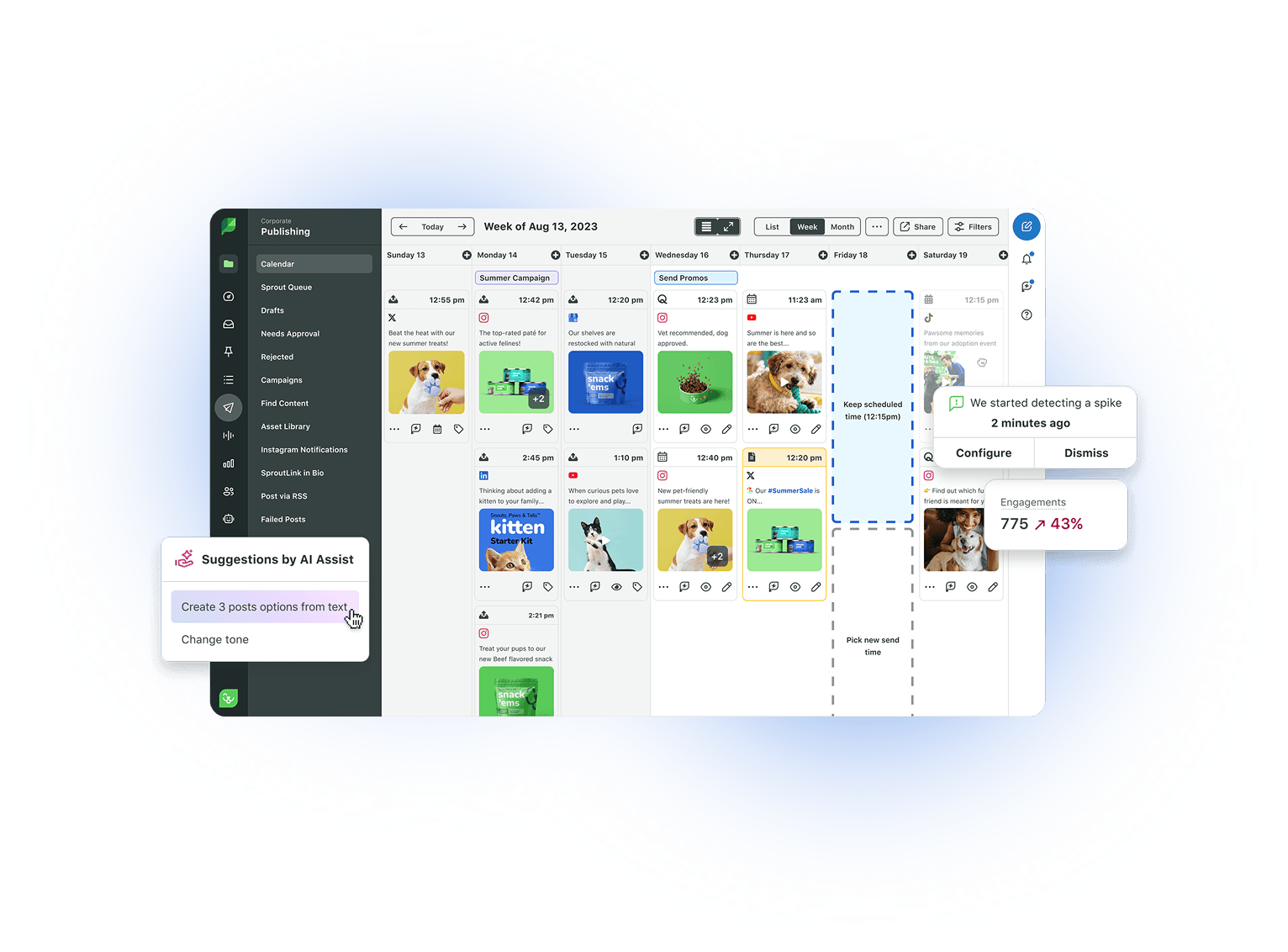
Using social media analysis tools for monitoring and insights is a way to optimize your social media strategy—and strengthen your market position with business intelligence. This is why many top brands rely on Sprout Social’s analytics platform to achieve these strategic advantages.
Take it a step further with Sprout’s premium offerings:
- Premium Analytics and Custom Reporting: Use Premium Analytics to create custom reports tailored to your organization’s KPIs. As a premier social media reporting tool, Sprout’s My Reports lets you combine various reports, add text annotations and include widgets to filter data for different stakeholder audiences.
- Advanced Social Listening: Sprout’s Listening tool surfaces valuable data surrounding audience demographics, industry influencers, campaign performance, share of voice and consumer sentiment.
- AI-Powered Insights: Surface trends instantly and automate executive summaries with embedded AI.
- Tableau BI Connector: Combine the power of social data with other business metrics for a 360-degree view of the customer journey.

Discover the right influencers and measure campaign ROI with Sprout Social Influencer Marketing:
- Influencer discovery: Find ideal influencer partners based on topical alignment and key social metrics, like engagement, using Sprout’s Influencer Marketing Discovery tools.
- Brand Safety reports: Assess and mitigate partnership risks, ensuring your influencer partners are aligned with your brand values.
- Earned media value (EMV): Measure the EMV of brand collaboration posts so you understand the financial impact and ROI of your influencer partnerships.
- Competitor activity tracking: Get visibility into competitor influencer partnerships and share of voice to understand your brand’s impact compared to the market landscape.

No matter your social media analysis and reporting needs, Sprout is built to give you a fast, user-friendly way to display social insights.
2. Sendible
Sendible is a social media management tool for agencies, with comprehensive analysis and reporting features. It’s known to be a social media reporting tool tailored for agency use cases. It works with Facebook, Instagram, LinkedIn, YouTube, TikTok and X. With it, you can better understand how your social posts perform in order to optimize your social media strategy. Sendible offers automated reports with customized branding and 200 analytics modules to choose from.

Sendible also offers social media management features, like content customization, image editing, direct scheduling and client collaboration. It also has audience engagement capability so you can respond to audience comments, DMs and mentions from one inbox.
A key differentiator for Sendible is that it can be white-labeled, so it works well for social media agencies that want to use the software under their brand for their clients.
Key features:
- White-labeling: Customize reports and dashboards with your own agency’s branding.
- Automated reporting: Choose from over 200 analytics modules to build and schedule client reports.
- Unified engagement: Manage responses to comments, DMs and mentions from a single inbox.
3. Keyhole
Keyhole is a real-time social media analysis tool for X, Instagram, Facebook, YouTube, LinkedIn and TikTok. Its products monitor what followers say about your brand, track competitor behavior, find leading social media influencers, spot upcoming trends and more.

Keyhole aggregates your analytics for each social media profile across your accounts so you can monitor everything through a single platform. Plus, it shows your social media performance over time to help you better understand how your strategy is working—so you can optimize it to reach your goals.
This platform works for agencies, B2C brands, nonprofits and several industries such as media and entertainment.
Key features:
- Real-time monitoring: Track brand mentions and competitor behavior as it happens.
- Influencer tracking: Identify leading influencers and monitor the impact of their campaigns.
- Trend identification: Spot upcoming industry trends based on social conversations.
4. IZEA
The boom of influencer marketing has created a need for social media tools tailored for influencer campaigns.
Enter IZEA, an analytics platform which removes many of the what-ifs related to influencer marketing. This includes metrics such as reach, engagement rate and the potential price tag behind any given influencer.
IZEA’s Flex software also enables brands to get a look into potential influencers’ audience demographics, influencer campaign performance, conversion rates and so much more.

Influencer campaigns shouldn’t be an ROI mystery. Using a tool like IZEA to not only find but track influencer partnerships is a good way to monitor success. Using a tool like IZEA to find and track influencer partnerships ensures you can monitor success.
Key features:
- Influencer discovery: Evaluate potential partners based on reach, engagement rate and price.
- Audience demographics: Gain deep insights into the audiences of potential influencers.
- Campaign tracking: Monitor performance metrics and conversion rates for active influencer campaigns.
5. BuzzSumo
Although not strictly a social tool, BuzzSumo is a resource for analyzing the social engagement of any given piece of content.
If you want to see how many shares your latest blog post received on Facebook, X (formerly known as Twitter) or Pinterest, BuzzSumo can provide you with that data. You can also monitor the performance of content competing for relevant industry keywords, allowing you to see how your content marketing campaigns are stacking up against the competition.

Social media remains one of the top distribution channels for content. By analyzing social shares, you can see which types of posts receive the most engagement and use that data to inform your content strategy. BuzzSumo can also help you understand variables in top-performing content such as length, publish date and headline type.
Key features:
- Content engagement analysis: See how many shares specific blog posts or articles receive across networks.
- Competitor content tracking: Monitor the performance of competing content for industry keywords.
- Performance variables: Analyze top-performing content by length, publish date and headline type.
6. Google Analytics (GA4)
While it’s not solely a social media analytics tool, Google Analytics 4 (GA4) is a way to track social media campaigns driving to your website and even help you measure social ROI.
You likely use GA4 to monitor traffic, but you can also leverage it for dedicated social tracking.

For instance, you can see how much traffic comes to your website from each social network, or use UTM parameters to track specific social media campaigns within GA4’s event-based tracking and conversion attribution models.
Key features:
- Traffic acquisition: Track how much website traffic comes from each social network.
- Event-based tracking: Use UTM parameters to monitor specific social media campaigns.
- Conversion attribution: Tie social media traffic to website conversions and ROI.
7. Followerwonk
Followerwonk is an X-specific analytics tool that can help brands search relevant X bios to find users to engage with, compare users, analyze accounts, track followers and more. Users can get access to valuable insights and help with their X strategy using a completely free Followerwonk account.

Followerwonk was acquired by Fedica, which is adding new AI-powered tools to help automate more social media management workflows.
Key features:
- X (Twitter) bio search: Search relevant bios to find and connect with target users.
- Account analysis: Compare users, track follower growth and analyze account performance.
- AI-powered workflows: Leverage new automation tools for streamlined social media management.
8. Rival IQ
Rival IQ is a social media analytics tool that can help businesses track their success across a number of channels—YouTube included. With features like competitor analysis, basic social analytics, social listening, reporting and social media audits, Rival IQ works for businesses with a widespread online presence. It can also be a huge help for agencies working with multiple clients, making it a strong contender for those evaluating agency vs. in-house use cases.

Build out custom dashboards for each client based on their specific goals with social media marketing. Then download reports to share in a number of formats, like PPT, PDF, PNG or CSV. Rival IQ also offers influencer tracking and hashtag analytics to help you monitor influencer campaigns and choose the best hashtags for your content.
Key features:
- Competitor analysis: Benchmark your performance against competitors across multiple channels.
- Custom client dashboards: Build tailored views based on specific social media marketing goals.
- Hashtag and influencer tracking: Choose hashtags and monitor influencer campaigns.
9. Iconosquare
Iconosquare started as a basic Instagram analytics tool years before the platform started offering built-in insights. At the time, this tool was one of the only ways to monitor your Instagram efforts. As platforms adapt and change, analytics tools must do the same.
Now, Iconosquare is a social media analytics tool that lets users monitor 100+ different metrics across various social media platforms. Supported social media platforms include Instagram, Facebook, X, LinkedIn and TikTok, with support for short-form video metrics across Reels and TikTok to understand viewer retention.

Create custom dashboards that allow you to see your most important metrics at a glance, like follower growth, audience demographics, post engagement, reach and more. Iconosquare also offers publishing capabilities, collaborative content creation and approval, social listening and community management.
Key features:
- Custom analytics dashboards: Track over 100 metrics at a glance, including follower growth and reach.
- Short-form video metrics: Understand viewer retention across Instagram Reels and TikTok.
- Publishing and approval: Collaborate on content creation, scheduling and approvals in one place.
10. Tailwind
Tailwind is another social media analytics tool that has changed and evolved over the years. What started as a Pinterest scheduling tool called Pin League has evolved into a social media management and analytics tool.
Tailwind supports a limited number of social networks. While users can connect their Facebook, Instagram and Pinterest accounts, Tailwind’s features are catered to visual content performance, such as Pinterest and Instagram.

Get Pinterest and Instagram insights, create and schedule posts, find the best hashtags, access a seamless link-in-bio tool and more with Tailwind. Brands can track the performance of their visual social media profiles with this platform’s appealing and easy-to-use dashboard.
Key features:
- Visual network focus: Optimized for Pinterest, Instagram and Facebook analytics.
- Smart scheduling: Publish content at the most optimal times for engagement.
- Design integration: Built-in tools to help create and optimize visual content.
11. Audiense
Audiense is an audience-building tool that helps brands track their performance across multiple social media platforms. Audiense is also a very X-minded tool, so it works well for brands who put a major emphasis on their X audience and performance.

With Audiense, brands can easily create customer personas based on their target audience demographics, gather sources of influence that their audience likes to get content from, find the best influencers to work with and more. Audiense’s X marketing tools enable brands to also get a deep dive into their X (Twitter) analytics.
Key features:
- Audience segmentation: Identify and segment unique audience groups based on shared interests, behaviors and affinities.
- Cultural insights: Understand the psychographics and cultural drivers of your target audience to tailor your messaging.
- Influencer identification: Discover the niche creators and macro-influencers that your specific audience segments trust and engage with.
12. SparkToro
SparkToro is similar to Audiense in that it’s also an audience intelligence platform. While this tool doesn’t provide you with data and analytics from your own social media performance, it gives brands insight into their audience, competitors and other profiles within their networks.

Use SparkToro for social media intelligence on where your customers spend their time online (so you know where to advertise to them), uncover audience demographics (so you can improve your ad targeting), pinpoint what your audience is talking about right now (so you can create catered content) and even get insight into your own account’s influence and authority online.
Key features:
- Audience discovery: Uncover where your target audience spends their time online.
- Content ideation: Pinpoint what your audience is talking about to create content.
- Authority tracking: Gain insights into your own account’s online influence and authority.
13. Agorapulse
While many tools focus on top-of-funnel reach, Agorapulse is designed for social media managers who need to tie their efforts to the bottom line. It offers a robust suite of analytics that covers the basics of engagement and growth, but its standout feature is the Social Media ROI dashboard.
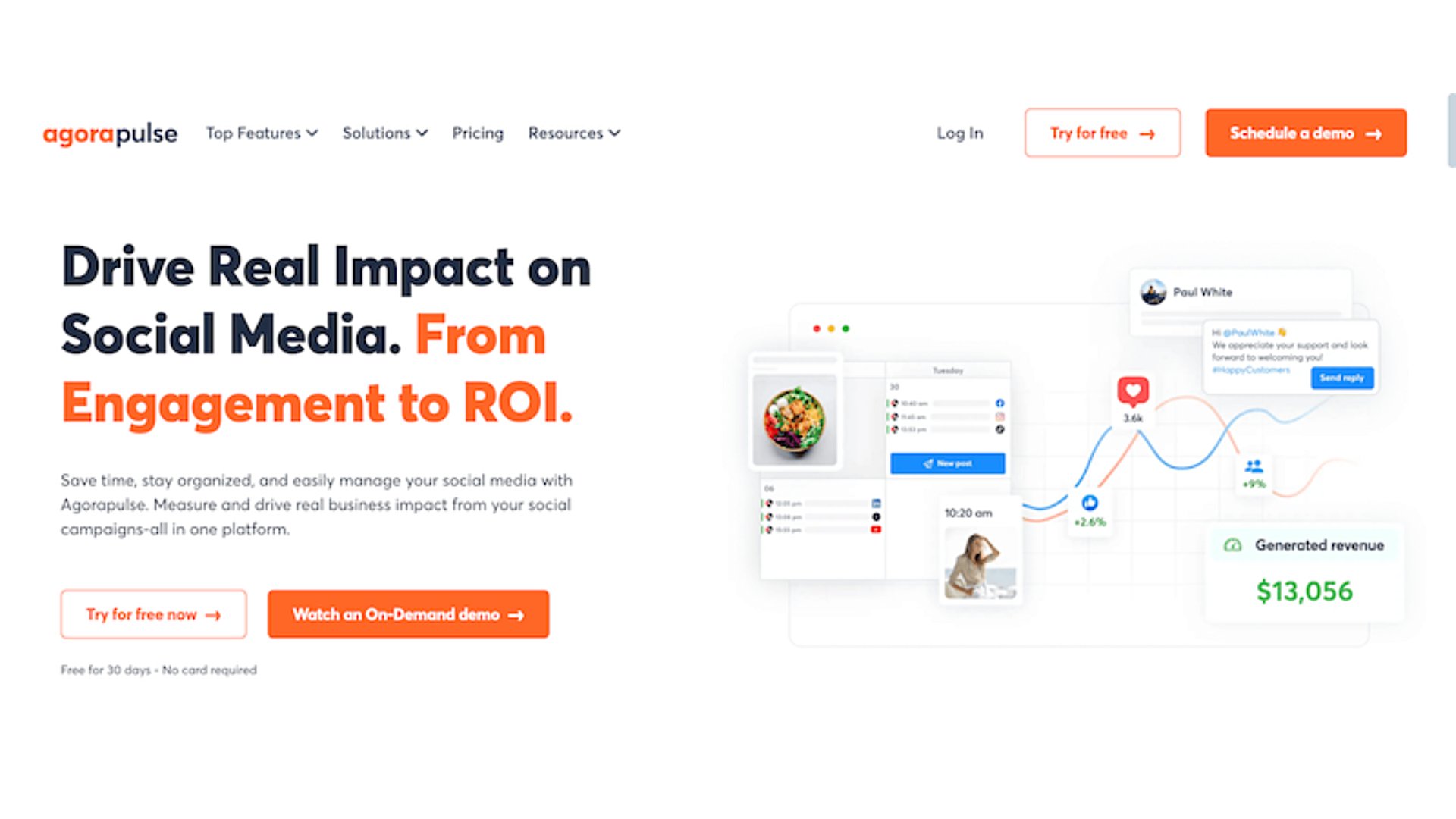
By integrating with Google Analytics, Agorapulse allows brands to track how many leads and sales are generated from specific social posts and conversations. This makes it a powerful ally for agencies and internal teams who need to prove the financial impact of their social strategy to stakeholders, positioning it as an effective social media reporting tool.
Key features:
- Social ROI reporting: Track website traffic, leads and sales generated from your social channels.
- Team performance metrics: Gain visibility into your team’s efficiency with reports on response times and message volume.
- Unified analytics dashboard: View cross-network performance for Facebook, Instagram, LinkedIn, X, TikTok and YouTube in one place.
14. Brandwatch
For enterprise-level brands that need to look beyond their own profiles, Brandwatch offers some of the most sophisticated consumer intelligence and social listening capabilities on the market. It doesn’t just track mentions; it uses AI to analyze the “why” behind consumer behavior across the broader web. It’s recommended for large, in-house enterprise teams requiring deep, complex data over traditional agency reporting.
Brandwatch is useful for sentiment analysis and trend forecasting. By monitoring billions of conversations across social media, blogs and forums, it helps brands identify emerging market shifts before they become mainstream. This allows marketing teams to move from reactive posting to proactive, data-driven storytelling.
Key features:
- Deep sentiment analysis: Use AI to categorize the emotional tone of conversations surrounding your brand or industry.
- Competitive benchmarking: Compare your share of voice against competitors to identify market gaps and opportunities.
- Consumer research: Access historical data to understand long-term trends and audience demographic shifts over time.
15. Metricool
Metricool built a following as an all-in-one scheduling and analytics tool, and its 2026 reporting expansion makes it worth a look for teams juggling multiple accounts. Metricool provides consolidated analytics across Facebook, Instagram, X (Twitter), LinkedIn, TikTok, YouTube, and Pinterest plus web and ad account data. The platform lets you schedule content, track performance, analyze competitors, and generate reports — all in one dashboard.
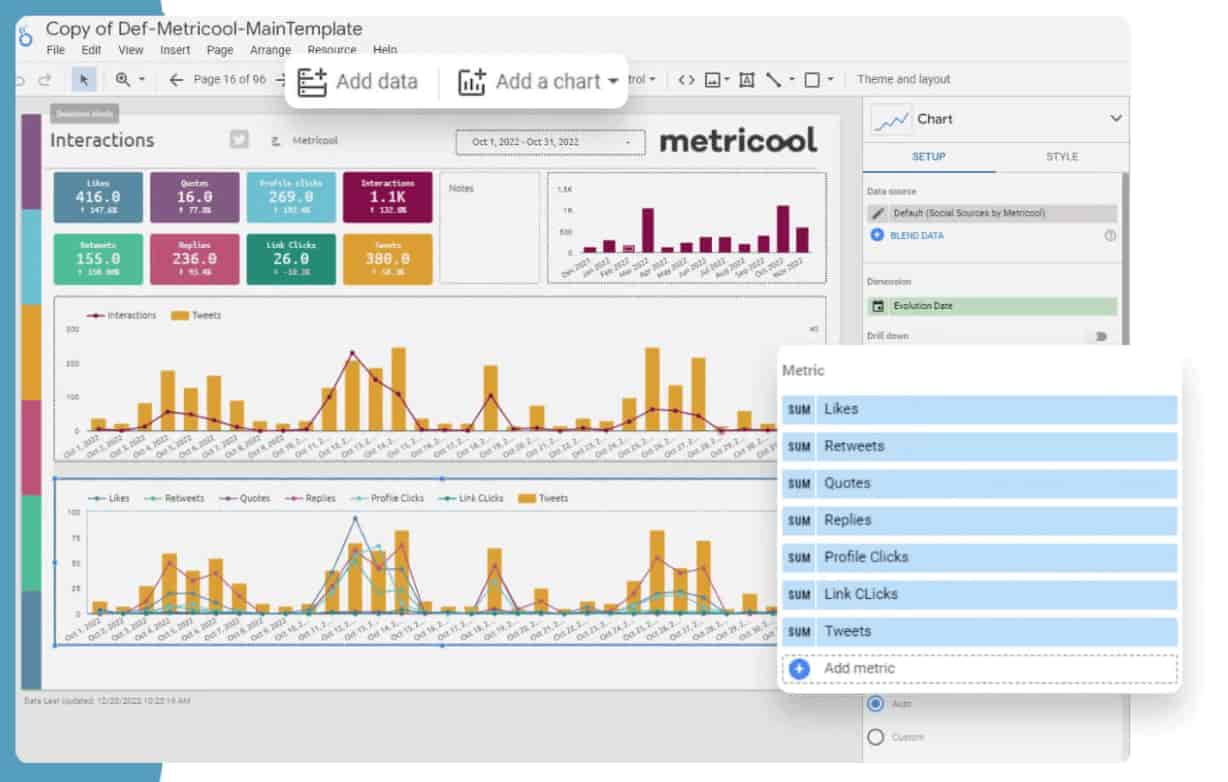
Metricool’s biggest 2026 upgrade targets agency workflows. Metricool Studio, an AI-powered reporting tool, replaces manual report-building: describe what you need in plain language, compare two brands over a quarter, summarize a campaign’s performance or break down top posts by format, and Studio generates the chart for you. For teams that need more control, the Looker Studio connector, available on Advanced plans, allows entirely custom report builds and cross-brand views.
Key features:
- Multi-network analytics: Consolidate performance data across seven major social platforms plus paid ad accounts.
- AI-generated reporting: Ask for a report in plain language and get a built chart back.
- Looker Studio connector: Build fully custom, cross-brand dashboards on advanced plans.
16. Emplifi
Emplifi positions itself as a customer engagement platform for large retail and CPG brands that need analytics tied directly to customer experience. Emplifi offers a platform for managing multiple social media accounts such as Facebook, Instagram, Twitter, and LinkedIn from one centralized interface. Its analytics provide deep insights into metrics like audience growth, engagement rates, sentiment, and campaign impact, empowering marketers to make data-driven decisions.

Where Emplifi differentiates: real-time social listening and monitoring keeps teams aware of sentiment, competitor activity, and industry trends, enabling timely, authentic engagement and strategic improvements that positively impact business outcomes. The platform’s analytics chops earned it recognition — Emplifi was named “Best Social Media Analytics Platform” in the 8th annual MarTech Breakthrough Awards.
Key features:
- Unified Analytics: Preset, no-build-required dashboards across every connected profile.
- AI-driven sentiment and trend monitoring: Track competitor activity and industry shifts in real time.
- Customer experience tie-in: Connect social performance data to the broader customer journey.
17. Brand 24
Brand24 earns its spot for brands that need listening depth beyond standard social mention tracking. It gathers insights from 25 million online sources, tracked in real-time, and uses advanced sentiment analysis to segment positive, negative, or neutral mentions.
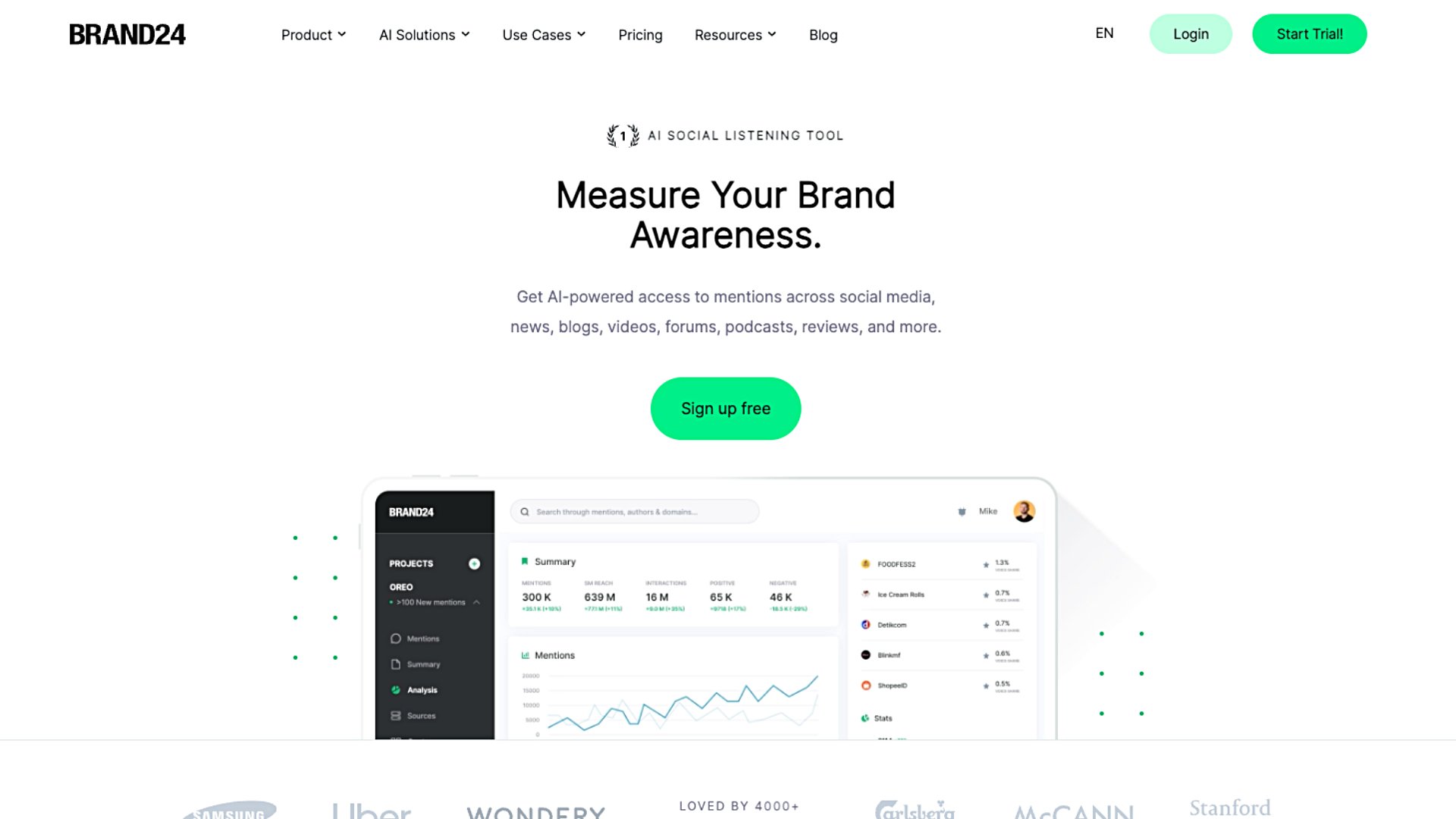
Brand24’s newest differentiator points at where search is heading: its Chatbeat tool measures your visibility inside LLM responses like ChatGPT and Perplexity. That makes it one of the few tools on this list tracking brand presence in AI answer engines, not just social feeds. For crisis response, real-time alerts for negative mentions help teams get ahead of a story before it spreads.
Sprout Social is an all-in-one social media management suite, while Brand24 is a dedicated social listening and web analysis tool that tracks a much broader part of the web and includes AI search visibility tracking — a solid complement rather than a head-to-head replacement.
Key features:
- Broad-web listening: Monitor mentions across social, news, blogs, forums and podcasts.
- Chatbeat: Track your brand’s visibility inside AI chatbot responses.
- Real-time crisis alerts: Get flagged the moment negative sentiment spikes.
Frequently Asked Questions
What can social media analytics tools help you measure?
Social media analytics tools enable businesses to track and measure important key performance indicators (KPIs) such as engagement rates, reach, and impressions.
What are the benefits of social media analytics tools for business?
Social media analytics tools provide businesses with valuable insights into their performance across major social media networks, allowing them to track their progress, measure the effectiveness of their campaigns and optimize their strategies.
In addition, these tools enable businesses to understand their audience better, gain competitive intelligence, and make data-driven decisions. Ultimately, social media analytics tools can help achieve better results and stay ahead of the competition.


Share