The ultimate glossary of 120+ social media acronyms and abbreviations

Written by Jacqueline Zote
Published on December 15, 2025
Reading time 13 minutes
Table of Contents
Social media language evolves at the speed of light. What was trending last year (remember “Cheugy”?) is already ancient history, replaced by new terms like “Mewing” or “Brainrot.”
For social media managers, staying current isn’t just about trying to look cool—it’s about clarity, brevity and connecting with audiences authentically. Whether you are deciphering a report on ROI or trying to understand a Gen Z comment on TikTok, mastering social media acronyms is essential for executing a successful social media marketing strategy.
This guide covers everything you need to know, from professional marketing metrics to the latest viral slang, categorized for easy reference.
Why you need to know social media acronyms
Before we dive into the definitions, here is why fluency in social media abbreviations matters for your career:
- Efficiency: On platforms like X (formerly Twitter), character counts are currency. Acronyms speed up internal communication and allow you to say more with less.
- Community connection: Using the right slang—in the right context—signals that your brand is “in the know” and culturally relevant.
- Professionalism: While slang is fun, knowing the difference between a KPI (Key Performance Indicator) and an API (Application Programming Interface) is vital for reporting, strategy and proving your value to stakeholders.
Want to ensure your whole team is speaking the same language?
Once you have mastered the definitions, you must decide if internet slang is right for your brand strategy.
Network-specific acronyms
Every platform has its own dialect. These social media abbreviations are specific to the infrastructure and culture of major networks.
Platform Shorthand
Before diving into features, knowing how to abbreviate the networks themselves is step one.
| Acronym | Definition | Context |
| FB | Common in Groups and community management. | |
| IG | Universal shorthand. | |
| LI | Professional shorthand. | |
| SC | Snapchat | Used in messaging and creator spaces. |
| TT | TikTok | Used in creator communities and reporting. |
| WA | Common in global markets and customer care. | |
| X | X (Twitter) | Many still use “TW” colloquially. |
| YT | YouTube | Widely used among creators. |
Twitter (X)
Despite the rebrand to X, legacy terminology remains prevalent alongside new features.
| Acronym | Definition | Context |
| DFT | Don’t Feed the Trolls | A warning not to engage with users posting inflammatory comments just to get a reaction |
| DM | Direct Message | Private conversations between users. Essential for customer care. |
| HT | Hat Tip | Acknowledging the original source of an idea or content. |
| MT | Modified Tweet | Indicates a retweet (or repost) that has been altered for brevity. |
| RT | Retweet | Sharing another user’s post to your timeline. |
| Ratioed | (Not an acronym) | When a post gets more replies (usually negative) than likes. |
| Subtweet | (Not an acronym) | Criticizing someone without tagging them directly (@ing them). |
| Thread | (Not an acronym) | A series of connected posts used to bypass character limits. |
Instagram and TikTok
Visual platforms drive the majority of modern social media slang.
| Acronym | Definition | Context |
| DC | Dance Credits | Used on TikTok to credit the choreographer of a viral dance. |
| FYP | For You Page | The main algorithmic feed on TikTok. Getting on the FYP is the goal for virality. |
| GRWM | Get Ready With Me | A video format showing the creator preparing for an event. |
| HMB | Hit My Bio | Used to direct users to the link in your bio (e.g., “HMB for the discount code.” |
| Ib | Inspired by | Used in captions to credit the original creator of a trend. |
| Link In Bio | (Not an acronym; a CTA) | Workaround for platforms that don’t allow links in captions. |
| OOTD | Outfit of the Day | Showcasing fashion choices. |
| POV | Point of View | A content format where the viewer is placed in a specific scenario. |
| UGC | User-Generated Content | Content created by fans/customers rather than the brand. |
While Facebook is more “mainstream,” it still relies on specific shorthand in Groups and Marketplace.
| Acronym | Definition | Context |
| Bump | Bring Up My Post | Commenting on a post to move it back to the top of a Group feed. This is a legacy behavior. Algorithms replace the need for manual bumping, since commenting on a post can move it up naturally. |
| ISO | In Search Of | Highly common in Facebook Marketplace and Buy/Sell/Trade groups. |
| L4L | Like for Like | A common tag used to request engagement (often considered spammy by modern standards). |
| PM | Private Message | While “DM” is used on X/IG, Facebook users traditionally refer to Messenger chats as “PMs.” |
The professional network uses acronyms centered around networking status and job hunting.
| Acronym | Definition | Context |
| 1st / 2nd / 3rd | Degree of Connection | Indicates how close you are to another user (1st is direct, 2nd is a friend of a friend). |
| CB | Connection Back | A request for a mutual connection. |
| EBITDA | Earnings Before Interest, Taxes, Depreciation, and Amortization | A finance metric frequently discussed in B2B LinkedIn content. |
| LION | LinkedIn Open Networker | A user who accepts all connection requests, regardless of whether they know the person. |
YouTube
YouTube terminology is heavily focused on video metrics and creator economy terms.
| Acronym | Definition | Context |
| APV | Average Percentage Viewed | Similar to CR, this determines how likely YouTube is to recommend your video. |
| CC | Closed Captions | Subtitles for accessibility and sound-off viewing. |
| CR | Completion Rate | The percentage of the video watched. A vital metric for the YouTube algorithm. |
| LS | Livestream | Broadcasting live video to an audience. |
| Sub | Subscriber | A user who follows your channel. |
| VOD | Video On Demand | Refers to uploaded video content (as opposed to Live streams). |
| YT | YouTube | The platform itself. |
Reddit and forums
With the rise of community-driven platforms, knowing Reddit slang is increasingly important.
| Acronym | Definition | Context |
| AITA | Am I The A**hole? | A popular format for asking community judgment on a personal conflict. |
| AMA | Ask Me Anything | A Q&A format popular on Reddit and IG Stories. |
| ELI5 | Explain Like I’m 5 | Often used in forums like Reddit when people are requesting (or providing) a very simple explanation of a complex topic. |
| OP | Original Poster | The person who started the thread or discussions. |
| TIL | Today I Learned | Used when sharing a new, interesting fact. |
| TL;DR | Too Long; Didn’t Read | A summary provided at the start or end of a long post. |
Essential business and marketing acronyms and terms
These “money terms” are essential for demonstrating the business impact of your social media efforts, frequently appearing in reports, paid media strategies, and stakeholder meetings. The following acronyms are also common in business and marketing communications and are valuable in social media contexts, especially within relevant niches.
Performance metrics & strategy
Use these terms when reporting on campaign success or optimizing your budget.
| Acronym | Definition | Context |
| CPA | Cost Per Acquisition | The aggregate cost to acquire one paying customer or lead. |
| CPM | Cost Per Mille (Thousand) | The cost of 1,000 advertisement impressions. Crucial for measuring brand awareness campaigns where visibility matters more than clicks. |
| CPC | Cost Per Click | The actual price you pay for each click in a paid marketing campaign. Vital for performance budgeting. |
| CTR | Click-Through Rate | The percentage of people who saw your post and clicked on it. A high CTR indicates highly relevant content. |
| CR | Conversion Rate | The percentage of users who take a desired action (purchasing, downloading, subscribing) after clicking. |
| CRO | Conversion Rate Optimization | The systematic process of increasing the percentage of visitors who take a desired action (e.g., A/B testing landing pages). |
| CTA | Call to Action | The instruction you give your audience to provoke an immediate response (e.g., “Sign Up Now,” “Link in Bio”). |
| EMV | Earned Media Value | The monetary value of organic mentions and engagement. |
| KPI | Key Performance Indicator | A specific, quantifiable metric used to track progress toward a business goal (e.g., “Our KPI for Q1 is 10k new followers”). |
| PPC | Pay-Per-Click | A model of digital marketing in which advertisers pay a fee each time one of their ads is clicked. |
| ROI | Return on Investment | The ultimate measure of success/profitability. Formula: (Net Profit / Total Cost) x 100. |
| SOSEO | Social Search Engine Optimization | The practice of optimizing social content (captions, alt text, file names) so it ranks in search results on platforms like TikTok and Google. |
| UV / PV | Unique Views / Page View | The number of distinct individuals who viewed your content. Unlike Page Views (which counts total views), UV tells you exactly how many people you’ve reached. |
Business models & roles
These terms define who you are selling to and who is doing the selling.
| Acronym | Definition | Context |
| B2B | Business to Business | Companies that sell to other companies (e.g., Sprout Social, Salesforce). Marketing here is often more educational and logical. |
| B2C | Business to Consumer | Companies that sell directly to individuals (e.g., Wendy’s, Nike). Marketing here is often more emotional and trend-driven. |
| SMB | Small and Midsize Business | Businesses with limited personnel and resources compared to Enterprise organizations. |
| CMGR | Community Manager | The pro responsible for advocating for the brand on social networks and creating a social persona. Not to be confused with a social media manager. |
| SMM | Social Media Marketing | The holistic practice of using social networks to achieve marketing goals. |
| SMO | Social Media Optimization | The process of optimizing your website and profiles to encourage sharing (e.g., adding social share buttons to a blog). |
| SMP | Social Media Platform | The networks themselves (e.g., Facebook, LinkedIn, TikTok). |
| SRP | Social Relationship Platform | A centralized software (like Sprout Social) used to publish, monitor, and analyze content across multiple SMPs. |
| SoLoMo | Social, Local, Mobile | The convergence of these three platforms in marketing strategy (e.g., a mobile check-in on Facebook at a local coffee shop). |
| TOS | Terms of Service | The legal rules users must agree to in order to use a platform. Violating TOS can result in account suspension. |
Draft, approve and publish messages with Sprout Social’s collaborative workflow
Take the confusion out of figuring out what types of acronyms, hashtags and trends suit your brand’s voice.
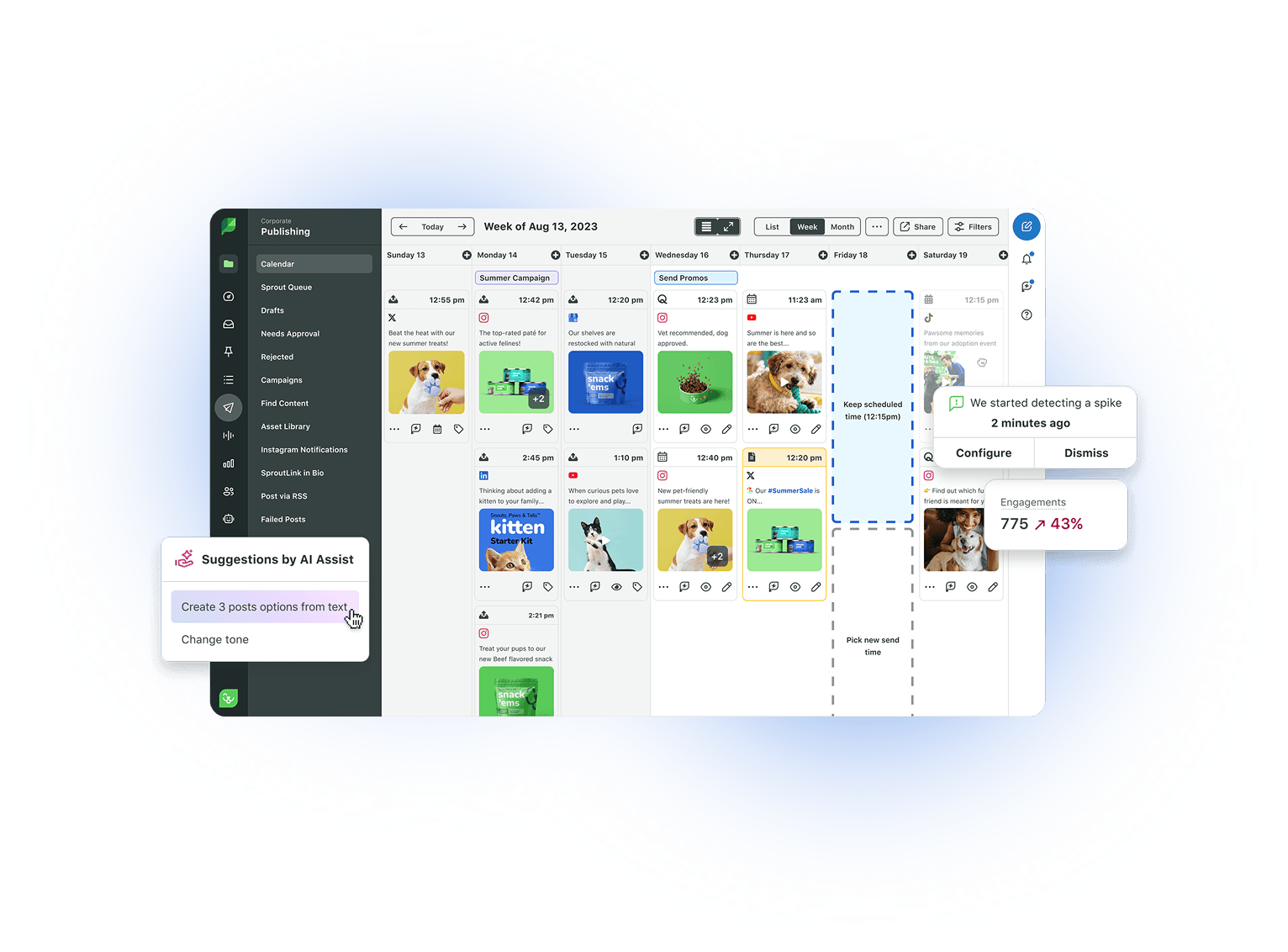
You can empower your team to be creative and draft in Sprout Social’s compose window, while setting up an approval flow so every message gets a final review.
Sprout Social makes it easy for teams of any size to collaborate in one intuitive platform. Start your free trial today to try out these features and more.
Technical terms for social pros
You don’t need to be a developer, but you do need to speak the language of your product and IT teams. Understanding these terms helps you advocate for the tools you need (like Sprout) and understand how your content is delivered.
| Acronym | Definition | Context |
| API | Application Programming Interface | The “bridge” that allows two applications to talk to each other. For example, Sprout Social uses the Twitter API to pull your messages into the Smart Inbox. |
| CX | Customer Experience | Social is often the front line of CX. It refers to the holistic impression a customer has of your brand, including how you handle complaints in DMs. |
| ESP | Email Service Provider | The software used to manage email marketing lists (e.g., Mailchimp). |
| GA4 | Google Analytics 4 | The current standard for web analytics. Social managers use this to track traffic sources from social campaigns. |
| RSS | Really Simple Syndication | A web feed format used to publish frequently updated works—such as blog entries or news headlines—in a standardized format. |
| SaaS | Software as a Service | Software licensed on a subscription basis and hosted in the cloud (e.g., Sprout Social, Salesforce, Slack). |
| SEM | Search Engine Marketing | The practice of increasing visibility on search engines through paid ads (PPC). |
| SEO | Search Engine Optimization | The practice of increasing traffic through organic search engine results. |
| SOV | Share of Voice | A measure of the market your brand owns compared to your competitors.
SOV = (Brand Mentions / Total Market Mentions) x 100 |
| UI | User Interface | The visual elements of a digital product (buttons, screens, icons). UI is what you see; UX is how it works. |
| UTM | Urchin Tracking Module | Snippets of code added to the end of a URL to track the source, medium, and campaign name of incoming traffic.
Pro tip: Sprout’s URL shortener automatically adds UTMs so you can track which specific post drove a sale. |
| UX | User Experience | How a person feels when interacting with a system. Good UX on your landing pages is vital for social conversion. |
Conversational and texting abbreviations and slang
These are the “evergreen” social media acronyms. They have been around since the days of AOL Instant Messenger and are widely understood across generations (Millennials, Gen X and Boomers).
Engagement drivers & prompts
Use these to spark conversation in captions or shorten your copy.
| Acronym | Definition | Context |
| AMA | Ask Me Anything | Popularized by Reddit; great for Q&A sessions on Instagram Stories or X. |
| BTS | Behind The Scenes | Shows the “making of” your content or a behind the scenes look at what your brand is doing. |
| DYK | Did You Know | Effective for introducing facts or stats. |
| FBF | Flashback Friday | Similar to TBT, but for Fridays. |
| FOMO | Fear Of Missing Out | Anxiety that an exciting or interesting event may currently be happening elsewhere, often aroused by posts seen on a social media website. |
| FTFY | Fixed That For You | Used to correct a previous statement (often used sarcastically or humorously to “fix” someone else’s opinion). |
| FWIW | For What It’s Worth | Minimizes assertiveness in a statement. |
| ICYMI | In Case You Missed It | Perfect for resharing older content or weekly roundups. |
| IMO / IMHO | In My [Humble] Opinion | Softens a statement or critique. |
| IYKYK | If You Know You Know | Signals an inside joke or shared community context. |
| IRL | In Real Life | Distinguishes offline events from online. |
| MFW / TFW | My Face When / That Feeling When | Used to describe a specific reaction or emotion, usually paired with a relatable image, GIF or meme. |
| NSFW | Not Safe For Work | Warning: Content contains nudity, violence or strong language. |
| OTP | One True Pairing | Common in fandom culture. Refers to a user’s favorite couple (fictional or real) that they support. |
| SMH | Shaking My Head | Expresses disappointment. |
| TBH | To Be Honest | Often used to preface a confession or unpopular opinion. |
| TMI | Too Much Information | Used when someone shares details that are too personal, graphic or awkward for a public setting. |
| TBT | Throwback Thursday | Posting nostalgic content on Thursdays. |
| TGIF | Thank God It’s Friday | A universal celebration of the weekend, often used to boost Friday engagement. |
| WBW | Way Back Wednesday | A mid-week alternative to Throwback Thursday (TBT) for sharing nostalgic photos. |
| W / L | Win / Loss | Comment in comments, e.g., Common Sprout W. |
Gen Z and viral social slang
Internet culture moves fast.
Gone are the days of “YOLO,” “On Fleek” and “Cray.” If you use those today, you risk sounding out of touch.
Below are terms trending in 2025—largely driven by TikTok. Brands should use these cautiously. If it doesn’t align with your voice, skip it.
| Acronym/Slang | Definition | Context |
| Ate | Did perfectly | “She ate that look.” (Often followed by “and left no crumbs”). |
| Beige Flag | Odd trait | Not a red flag (bad) or green flag (good), just a weird/boring quirk. |
| Bet | Yes or Agreed | A confirmation. “Want to grab lunch?” “Bet.” |
| Cap / No Cap | Lie / No Lie | No cap means “For real.” It’s used to emphasize honesty. (e.g., “This burger is the best, no cap.”) However, “that’s cap” means that is a lie. |
| Delulu | Delusional | Used positively or ironically. “Staying delulu is the solulu (solution)” implies optimism in the face of impossible odds. |
| Ick | Turn-off | A sudden feeling of repulsion toward someone you were previously attracted to. |
| Mewing | Jawline posture | A viral trend about tongue posture, often used ironically to signal “I can’t talk, I’m looksmaxxing.” |
| Mid | Mediocre | Labeling something average or below expectations. “The movie was mid.” |
| NPC | Non-Playable Character | Someone who acts repetitively or lacks independent thought, like a background video game character. |
| Rizz | Charisma | The ability to charm or flirt. (e.g., “They have unspoken rizz.”) |
| Sus | Suspicious | Originated from the game Among Us. Something that seems shady or untrustworthy. |
| Simp | (Verb/Noun) | Someone who does way too much for a person they like. |
| Vibe Check | Assessing the energy/mood | A quick evaluation of someone’s mood or the general atmosphere of a situation. (e.g., “Passed the vibe check.”) |
Tone check: Brands should use these cautiously. Jumping on a slang trend late (or using it incorrectly) is a fast track to being labeled “cringe.” When in doubt, stick to your authentic brand voice.
Deprecated or risky slang to avoid
To maintain professionalism, skip slang that reads dated or “cringe.”
- YOLO: You Only Live Once
- On Fleek: Perfect
- Cray: Crazy
- Lit: Exciting (borderline outdated)
How social media acronyms vary by generation
Different generations use distinct social media languages that impact your engagement rates.
Key generational differences in social media acronyms:
- Gen Z: Creates new slang rapidly on TikTok and Instagram, favors visual communication and evolving terminology
- Millennials: Uses established internet acronyms like LOL, FOMO and platform-specific terms
- Gen X: Prefers formal abbreviations and business acronyms on professional platforms
- Boomers: Sticks to basic acronyms and traditional communication styles
Data from our 2025 Sprout Social Index™ shows 93% of consumers agree it’s important for brands to keep up with online culture. Gen Z is most likely to have Instagram (89%), YouTube (84%) and TikTok (82%) profiles, while older generations lean toward Facebook, Instagram and YouTube.
| Generation | Primary Platforms | Preferred Acronym Style | Communication Approach |
| Gen Z | TikTok, Instagram, Snapchat | Evolving slang, emoji-heavy | Authentic, visual |
| Millennials | Instagram, Facebook, Twitter | Established internet language (LOL, FOMO) | Casual but clear |
| Gen X | Facebook, LinkedIn, Twitter | Professional abbreviations | Direct, informative |
| Boomers | Facebook, email | Basic, universal acronyms | Formal, explanatory |
Our data also shows that 51% of global social media users plan to spend more time on community-driven platforms like Reddit over the next six months, where each community develops its own linguistic identity. We found that 94% of consumers affirm that most brands’ social content does a good job keeping up with online culture. But that success requires understanding how language evolves across age groups.
Best practices on using social media slang and acronyms
Knowing social media acronyms transforms your communication—but strategic implementation determines your success. Follow these practices to ensure they strengthen your brand voice:
- Maintain your brand voice: Regardless of how well you understand the lingo, use it only if it aligns with your brand voice. Successful brands maintain consistency between their established voice and social media language.
- Know when to use the right slang or acronym: Assess the situation. A customer coming to you with a complaint may not appreciate it if you asked them to “hit you up.”
- Don’t try too hard or overdo it: Forcing slang to stay relevant can backfire. If a sentence requires a decoder ring to understand, rewrite it. Clarity is paramount.
- Know what slang your audience is using. Don’t guess what is trending globally; identify the specific acronyms your unique audience uses in their posts and comments.
Using Sprout Social to track and understand acronym trends
Social media language evolves at lightning speed. Don’t guess what slang your audience is using—know for sure.
Sprout Social’s Social Listening tools monitor millions of conversations across social media platforms, empowering you to move beyond just defining acronyms and start using them strategically.
- Monitor keywords: Track specific acronyms to see if they are rising or falling in popularity.
- Analyze sentiment: Understand if a slang term is being used positively (brand affinity) or negatively (complaints).
- Audience segmentation: Discover which acronyms resonate with specific demographics and generations.
- Competitive insights: Reveal the language strategies driving results in your industry.
Additionally, Sprout’s Smart Inbox helps you decode incoming messages. Whether a customer sends a DM with “TMI” or comments “W” (Win) on your post, you can manage all cross-network communication from a single stream.
Turn definitions into strategy
Whether you are using technical acronyms to report to your boss or viral slang to bond with your community, understanding the lexicon of social media is non-negotiable for modern marketers.
But knowing the definitions is just the start. The power comes from applying that knowledge to your strategy.
Ready to streamline your social strategy? Start a free trial of Sprout Social today to listen, publish, and engage with your audience using the tools the pros use.
FAQs about Social Media Acronyms
Should my brand use trending slang and acronyms?
That depends entirely on your brand voice and audience. Using slang that doesn’t fit your brand’s identity feels inauthentic and damages trust.
Use social listening to understand your audience’s language. If it’s a natural fit, using their terms builds a genuine connection. If it’s not, you’re better off communicating clearly in your established voice.
How often do social media acronyms change?
Social media language evolves constantly. Core business and technical acronyms like B2B, ROI and SEO are stable. But conversational slang changes quickly and is often driven by trends on platforms like TikTok.
How do I know which acronyms are appropriate for my brand voice?
Use social listening to analyze the language your specific audience uses, then test different terms in your content and measure engagement to see what resonates. Sprout Social’s approval workflows ensure every message is reviewed for brand voice consistency before it goes live.
Do different generations use different social media acronyms?
Yes, Gen Z often creates and popularizes new slang on platforms like TikTok, while Millennials and other generations tend to use more established acronyms. A successful strategy adapts its language based on the platform and the specific audience segment you’re targeting.
How do I stay updated on new social media acronyms and trends?
Use social listening tools like Sprout Social to monitor keywords and conversations and identify emerging slang terms before your competitors do.
37 free social media strategy templates that will elevate your workflows
Published on December 5, 2025 Reading time 15 minutes







Share