LinkedIn Marketing
LinkedIn marketing guide for businesses: How to reach your audience and drive results
Ready to scale your brand on LinkedIn? This comprehensive guide delivers a clear roadmap to engage decision-makers and elevate your B2B strategy.
Want to put it into practice? Start your free 30-day trial of Sprout Social and see the difference.
Reading time 10 minutes
Published on December 1, 2025
Table of Contents
Summary
- LinkedIn marketing helps to build brand awareness and establish trust for businesses and individuals alike.
- Share relevant, valuable content regularly on your LinkedIn page to establish thought leadership and connect with your audience.
- LinkedIn marketing success requires having a solid understanding of your target audience and the types of content they want to see.
As the number one platform for B2B marketing, LinkedIn is a great place to source leads. In fact, the latest LinkedIn stats show that the platform produces leads for 62% of B2B marketers. Not to mention the 2x higher conversion rate and 33% increase in purchase intent. But these numbers don’t just happen on their own–you need effective LinkedIn marketing as part of your broader social media marketing strategy to experience them.
In this post, we provide you with an in-depth guide on developing a LinkedIn strategy to market your business. Let’s get started.
What is LinkedIn marketing?
LinkedIn marketing is the strategic use of LinkedIn’s professional platform to build brand awareness, generate B2B leads and establish industry authority through organic content, paid advertising and professional networking. This approach combines content publishing, employee advocacy, targeted advertising and community engagement to reach decision-makers and drive business outcomes. LinkedIn marketing delivers measurable ROI through its precision targeting capabilities, with 62% of B2B marketers successfully generating leads on the platform.
Benefits of LinkedIn marketing
LinkedIn delivers unmatched B2B marketing power through its professional user base and advanced targeting capabilities. The platform’s ROI stems from its ability to connect you directly with decision-makers and industry leaders.
Here are the core benefits your business gains from LinkedIn marketing:
- Massive professional reach: Access to 1.2 billion professionals worldwide
- Higher conversion rates: Two times better conversion rates compared to other platforms
- Increased purchase intent: 33% increase in buyer readiness
- Cost-effective lead generation: 28% lower cost per lead than traditional advertising
Don’t let those 2x higher conversion rates slip away—centralize your LinkedIn strategy today.
Increased brand awareness
There are 900+ million members on LinkedIn. That’s millions of people you’ll reach with the right LinkedIn content marketing strategy.
Also, a user’s interactions with public profiles are visible to their connections.
So your content will show up in the feeds of people who aren’t even following you.

This makes LinkedIn an ideal platform to increase brand awareness and get your brand in front of the right audience.
Authority building
LinkedIn has exploded as a distribution platform for B2B content. Specifically, content that helps brands position themselves as industry authorities. A strong LinkedIn strategy establishes your brand as industry thought leaders.
Networking opportunities
Being the world’s largest professional network, LinkedIn allows you to build valuable connections. It creates opportunities to grow your network and foster mutually beneficial relationships. The platform connects you with prospective clients, industry leaders and prospective hires alike.
Beyond public content, direct outreach through effective LinkedIn messaging is crucial for nurturing leads and building strong professional connections.
Lead generation
LinkedIn is a leading platform for B2B lead generation. 89% of B2B marketers use the platform to generate leads. Also, 40% of B2B marketers consider it the most effective platform for attracting high-quality leads.
On top of this, the cost of LinkedIn lead generation is comparatively low. It boasts a 28% lower cost per lead compared to Google AdWords.
How to build a LinkedIn marketing strategy
For those just starting, it’s essential to understand how to use LinkedIn to build a presence that gets results, from setting up your profile to launching a content strategy.
But there’s no “right” way to use LinkedIn for business. Some companies see the platform as a branding tool. Others use it as a hiring hub.
That said, there are a few essential steps that will set you up for success on the platform. Use our LinkedIn for Business Strategy template along with the steps outlined below to build a successful LinkedIn marketing strategy.
1. Define your objectives
Start with a well-defined set of objectives you want to achieve through LinkedIn. These objectives will align with your other social media goals, such as increasing brand awareness or generating leads.
When you have your objectives firmly laid out, you have a solid foundation to build the rest of your LinkedIn strategy. For instance, if your goal is to generate leads, your strategy will comprise tools like lead ads, lead magnets and lead forms.
The following ad from Pcloudy promotes the company’s trends report as a lead magnet. This ad contributes to the brand’s lead generation goals.

2. Optimize your LinkedIn business page
A well-optimized LinkedIn business page sets you up for LinkedIn marketing success. It positively represents your brand and increases your credibility.
And it increases your LinkedIn SEO—within the platform and on search engines.
Your LinkedIn business page is where people go when they want to learn more about your brand.
So, go beyond providing the basic organizational information. Make sure to showcase what life is like at your organization and the people behind your brand. This will give people a deeper understanding of your brand’s values and identity.

Use the “Product” tab to highlight key details about your product, such as pricing and top features. That way, prospects learn more about your product offering without leaving LinkedIn.

3. Develop a content strategy
Squeezing more out of their content strategies is a plus for B2B brands.
And with the type of engagement LinkedIn generates, it’s a great addition to your social media content strategy. Have a solid strategy in place for the types of content to create and how to distribute them on the platform.
“Thought leadership” content drives B2B engagement on LinkedIn. Here’s your comprehensive content framework:
| Content Type | Purpose | Best Format | Posting Frequency |
|---|---|---|---|
| Thought Leadership | Establish authority | Text posts with insights | 2-3 times per week |
| Industry News | Show expertise | Curated content with commentary | Daily |
| Behind-the-Scenes | Humanize brand | Photos and videos | 1-2 times per week |
| Educational Content | Provide value | Carousels and native documents | 2-3 times per week |
| Company Updates | Share milestones | Mixed media posts | As needed |
Ever notice how every viral LinkedIn post comes from a personal account?
That’s no coincidence. Personal stories and anecdotes are among the platform’s most compelling content. So make sure this type of content is a staple to your LinkedIn strategy.
But that doesn’t mean thought leadership content is all you should post. Keep it diverse with blog posts, infographics, original reports, case studies and testimonials.
Besides these, native documents typically see higher impression rates compared with other post types. Sprout Social regularly shares original reports and trend predictions as native documents.

By monitoring your LinkedIn engagement rate across these different formats, you can objectively determine what content type your audience prefers.
Formats and content types aside, make sure to create content that addresses your audience’s needs and pain points. Answer their questions, teach them how to do something and share insights that inform their strategies.
Consider using LinkedIn automation tools to assist in scheduling and publishing content efficiently.
4. Use employee advocacy
Although the platform is all about business, personal accounts are even more valuable on LinkedIn. This rings true whether you’re an employee, solo business owner or someone at the C-level.
Beyond that, personal accounts can act as an extension of business accounts for the sake of promotion.
That’s why employee advocacy is such a critical element of LinkedIn marketing.
For starters, have your employees share your brand’s content to give it a boost. Doing so means that exponentially more people see your content. Also, this means that employees can spice up their posts and give their captions a personal touch.
At Sprout, our internal team regularly shares new content and product updates via LinkedIn.

Also, employee content supports your hiring and recruiting efforts on LinkedIn.
Employees serve as a brand’s biggest cheerleaders.
Use Sprout Social’s Employee Advocacy solutions to simplify the process of curating brand content for your employees to share.
Include pre-approved message ideas so your team stays on-brand.

5. Continuously measure and improve
Your LinkedIn strategy isn’t going to be perfect the first time around. The content you share and the way you speak to your audience need constant adjustment.
So make sure to closely track your efforts and measure your performance. See how your page is growing and how certain posts are performing. Understand how people are engaging with certain posts and what your top-performing posts have in common. You can also compare your page’s performance against industry-wide LinkedIn stats, and you can unearth actionable insights to continuously improve your strategy.
This will support you in uncovering insights to continuously improve your strategy.
LinkedIn advertising and paid promotion
While a strong organic strategy builds your foundation, LinkedIn Ads accelerate your results. Paid promotion on LinkedIn allows you to target specific audiences with precision, ensuring your message reaches the professionals who matter most to your business goals.
A comprehensive LinkedIn marketing strategy balances organic content with paid campaigns to maximize reach and impact.
What are LinkedIn ads?
LinkedIn advertising expands your reach beyond organic followers. The platform’s targeting capabilities let you engage decision-makers based on job title, company size, industry, seniority and more. This precision targeting makes LinkedIn ads particularly effective for B2B marketing campaigns.
Types of LinkedIn ads
LinkedIn offers several ad formats, each designed for different objectives. Choosing the right one depends on what you want to achieve.
- Sponsored Content: This is native advertising that appears directly in the LinkedIn feed. Use it to promote your best-performing content, increase brand awareness and generate leads with a seamless user experience.
- Sponsored Messaging: Deliver personalized messages directly to your audience’s LinkedIn inbox. This format is perfect for sending targeted event invitations, product demos or other high-value offers.
- Dynamic Ads: These ads use LinkedIn profile data—like photo, company name and job title—to personalize the creative. They’re highly effective for increasing follower growth and promoting job openings.
- Text Ads: Simple and straightforward Text Ads appear on the top or right-hand side of the LinkedIn feed. They’re a powerful, budget-friendly option for driving traffic with a strong call-to-action.
If you’re ready to go deeper, take a look at this practical guide to LinkedIn ads—it breaks down targeting, formats and best practices in a really approachable way.
LinkedIn advertising costs
LinkedIn advertising operates on an auction-based system where you control your budget. Set daily or lifetime budgets and choose from different bidding strategies based on your campaign objectives.
The platform offers three primary pricing models:
| Pricing Model | Best For | How It Works | Typical Range |
|---|---|---|---|
| CPC (Cost Per Click) | Traffic generation | Pay when someone clicks | $2-$7 per click |
| CPM (Cost Per Impression) | Brand awareness | Pay per 1,000 views | $6-$15 per 1,000 impressions |
| CPS (Cost Per Send) | Direct outreach | Pay per message delivered | $0.30-$1 per send |
While LinkedIn’s advertising costs tend to be higher than other platforms, the platform’s professional audience and superior targeting capabilities often deliver a stronger ROI on LinkedIn for B2B campaigns. The key is testing different ad formats and targeting parameters to find what works best for your budget and goals and objectives.
5 LinkedIn marketing tips to strengthen your strategy
LinkedIn is apples and oranges vs. other social platforms.
And so finding your footing on the platform requires some trial and error.
Now that you’ve learned the steps to building a LinkedIn marketing strategy, let’s walk through some tips for putting that strategy into action.
1. Know your target audience
If you’re going to stand out on LinkedIn, you need content that resonates with your audience. This requires having a solid understanding of your target audience and the types of content they want to see.
You need to understand their needs and pain points to develop content that’s relevant to them.
The first thing you can do is look at the profiles of your current customers to identify common characteristics. Look for patterns in their job roles and industries as well as the solutions they’re seeking.
You can even join relevant LinkedIn Groups to see what types of conversations they’re having. Discussions within these groups support your understanding of the needs and preferences of your target audience.
Polling your audience is another way to understand them better. This is particularly effective as you get to ask them questions directly instead of making assumptions. Ask them about the types of content they want to see and the challenges they face.
2. Use a social media marketing tool
Professional LinkedIn marketing requires comprehensive social media marketing tools that streamline your workflow and deliver actionable insights.
Essential LinkedIn marketing tool capabilities include:
- Smart Inbox: Centralized LinkedIn message management with keyword filters and team assignment
- Publishing Calendar: Bulk scheduling and content planning across multiple LinkedIn profiles
- Advanced Analytics: Performance tracking beyond native LinkedIn metrics and dashboards
- Asset Library: Organized storage for approved LinkedIn content and templates
- Employee Advocacy: Streamlined content sharing across team members
Sprout Social’s social media marketing suite comes with all of the tools you need to manage your LinkedIn marketing. You’ll even access premium features to support you with social listening and influencer marketing.

3. Learn the best times to post on LinkedIn
Frequency and consistency matter on LinkedIn just as they do on any other platform.
For brand accounts, we don’t typically see multiple posts per day(or even daily). Those that do post regularly tend to see the most engagement during the weekday mornings and early afternoons.
Getting those times right supports engagement with your audience when they’re most active.
The best times to post on LinkedIn for businesses are Tuesdays from 11 a.m.–5 p.m., Wednesdays from 11 a.m.–4 p.m. and Thursdays from 1–5 p.m.
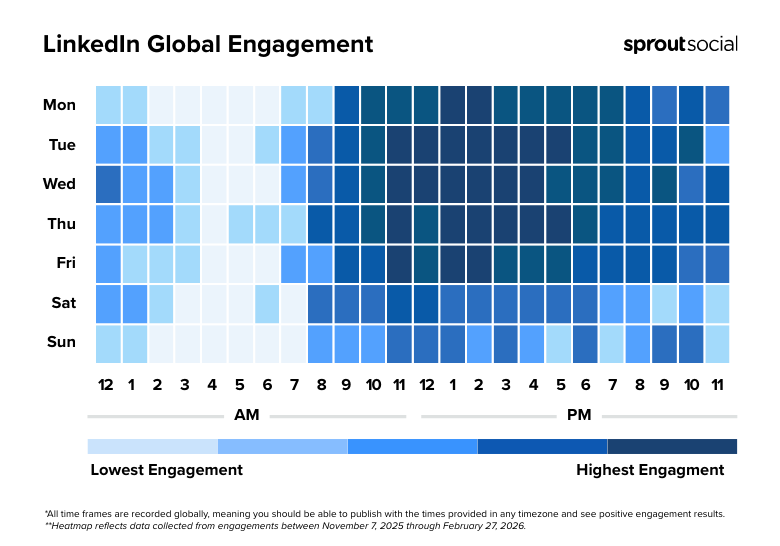
Personal and Company Pages accounts excel with multiple daily posts. Test different frequencies to discover your optimal posting schedule and audience engagement patterns.
4. Measure your progress with LinkedIn analytics
Because LinkedIn offers so much creative freedom, you’re spoiled for choice in terms of what you can post.
Looking at your LinkedIn analytics, you’ll understand by the numbers:
- Which types of posts earn the most engagement
- Whether there’s a time or frequency that impacts performance
- How your employees and personal accounts impact your brand’s reach
- Whether your LinkedIn content is generating traffic and leads
Beyond the platform’s native analytics, LinkedIn marketing tools like Sprout provide significant support in answering all of the above.

5. Use LinkedIn hashtags
The right LinkedIn hashtags add visibility to your posts and profile. This makes them a great addition to your LinkedIn marketing strategy. Make sure to optimize your posts with hashtags relevant to the topic. This gets your content in front of people who are interested in the topic.
Also, add relevant industry hashtags to your page to increase its visibility in relevant searches.
Also, get inspiration from trending hashtags to identify popular topics on the platform.
Ready to excel at LinkedIn marketing?
LinkedIn marketing success demands strategic execution, not random activity. The platform rewards brands that consistently deliver value while leveraging data-driven insights.
Your winning strategy balances organic authority-building with precision advertising, employee advocacy with executive thought leadership, and creative testing with performance optimization. As LinkedIn continues expanding its professional services and AI-powered targeting, brands that master this balance now position themselves for exponential growth.
The brands winning on LinkedIn share one thing in common: they treat the platform as a strategic business asset, not an afterthought. They invest in understanding their audience, creating valuable content and measuring what matters.
Ready to take your LinkedIn marketing to the next level? Start a free trial to see how Sprout Social’s LinkedIn marketing tools power your strategy and deliver measurable business impact.
LinkedIn Marketing FAQs
What is LinkedIn marketing?
LinkedIn marketing is the process of promoting your brand through LinkedIn. It involves using the platform to share valuable content and expand your network.
What is the 3-2-1 rule on LinkedIn?
The 3-2-1 rule is an engagement strategy designed to maintain consistent visibility on LinkedIn without overwhelming your audience. It recommends that for every one piece of content you post, you should engage with three other posts and leave thoughtful comments on two of them.
How much does LinkedIn marketing cost?
LinkedIn marketing costs vary significantly based on your approach. Organic LinkedIn marketing is free. You can create a Company Page, post content and engage with your audience at no cost. LinkedIn advertising operates on an auction system where you control your budget through daily or lifetime caps.
What's the difference between organic and paid LinkedIn marketing?
Organic LinkedIn marketing involves publishing free content to your Company Page and engaging with your network to build long-term brand authority and community. Paid LinkedIn marketing uses advertising to guarantee your content reaches a specific, targeted audience and achieve immediate business goals like lead generation, event registration or website traffic.
How long does it take to see results from LinkedIn marketing?
Organic LinkedIn marketing is a long-term investment. You’ll see follower growth and engagement build steadily over several months as you establish consistency and authority. Paid advertising delivers immediate results in terms of traffic, impressions and lead generation, but optimizing campaigns for quality leads and ROI takes ongoing testing and refinement.
Additional resources for LinkedIn Marketing

15 Inspiring LinkedIn post ideas and examples for your LinkedIn Page
Your definitive guide to LinkedIn engagement rate
15 LinkedIn post ideas for Australian brands
LinkedIn marketing guide for businesses: How to reach your audience and drive results
How to Use LinkedIn: A guide for marketers, brands and teams
15 high-performing LinkedIn post ideas for UK brands

How to repost on LinkedIn to amplify your brand in 2026

The ultimate guide to LinkedIn ads: Mastering your B2B marketing
How to jumpstart your LinkedIn lead generation strategy
How to manage your LinkedIn DMs with Sprout
A blueprint to add LinkedIn video to your social strategy
LinkedIn best practices for marketing professionals

10 LinkedIn marketing tools for your business in 2026

Mastering LinkedIn content marketing: Strategies and examples
LinkedIn carousel posts and ads: A complete guide
LinkedIn SEO: 7 tips to optimize your company page

How to create an effective LinkedIn Business Page in 6 steps

Share