How to create a social media budget for 2027

Written by Jasmine Williams
Published on October 30, 2026
Reading time 12 minutes

Table of Contents
Social media budgets have more ground to cover than ever. From customer engagement to business intelligence, social’s expanding role is giving marketing teams new priorities to budget for.
According to The 2025 Impact of Social Media Marketing report, 87% of marketing leaders plan to increase their paid social spend, while more than 80% plan to invest more in influencer marketing and organic social.
Much of that investment is coming from existing budgets. In fact, 81% of marketers are reallocating funds from traditional SEO to organic social, paid social and influencer marketing.
But where that money goes matters just as much as how much brands spend. According to Sprout Social’s Social Intelligence Report, 93% of professionals agree that social intelligence is important for future growth. Yet 86% say their organizations have missed significant business opportunities in the past two years because insights were delayed, siloed or underused.
For marketing teams planning their 2027 budgets, that means making room for social intelligence alongside their core marketing activities. In this guide, we’ll cover how to create a social media budget, what to include and how to make a compelling case for leadership approval.
What is a social media budget?
A social media budget is a list of funds you allocate to social media marketing activities over a specific period.
Social media budgets vary based on your company’s size, industry, goals and other factors. These can include:
- Content creation (total amount and separate amounts for each network)
- Paid ads (total amount and separate amounts for each network)
- Social media tools
- Agencies or contractors
- Influencer marketing campaigns
- Internal social marketing team salaries
- Social media intelligence
Some of these items will be more or less important depending on your strategy and available resources.
For instance, The 2026 Social Intelligence Report found that organizations prioritizing social insights are allocating more funds to technology, integrations and headcount.
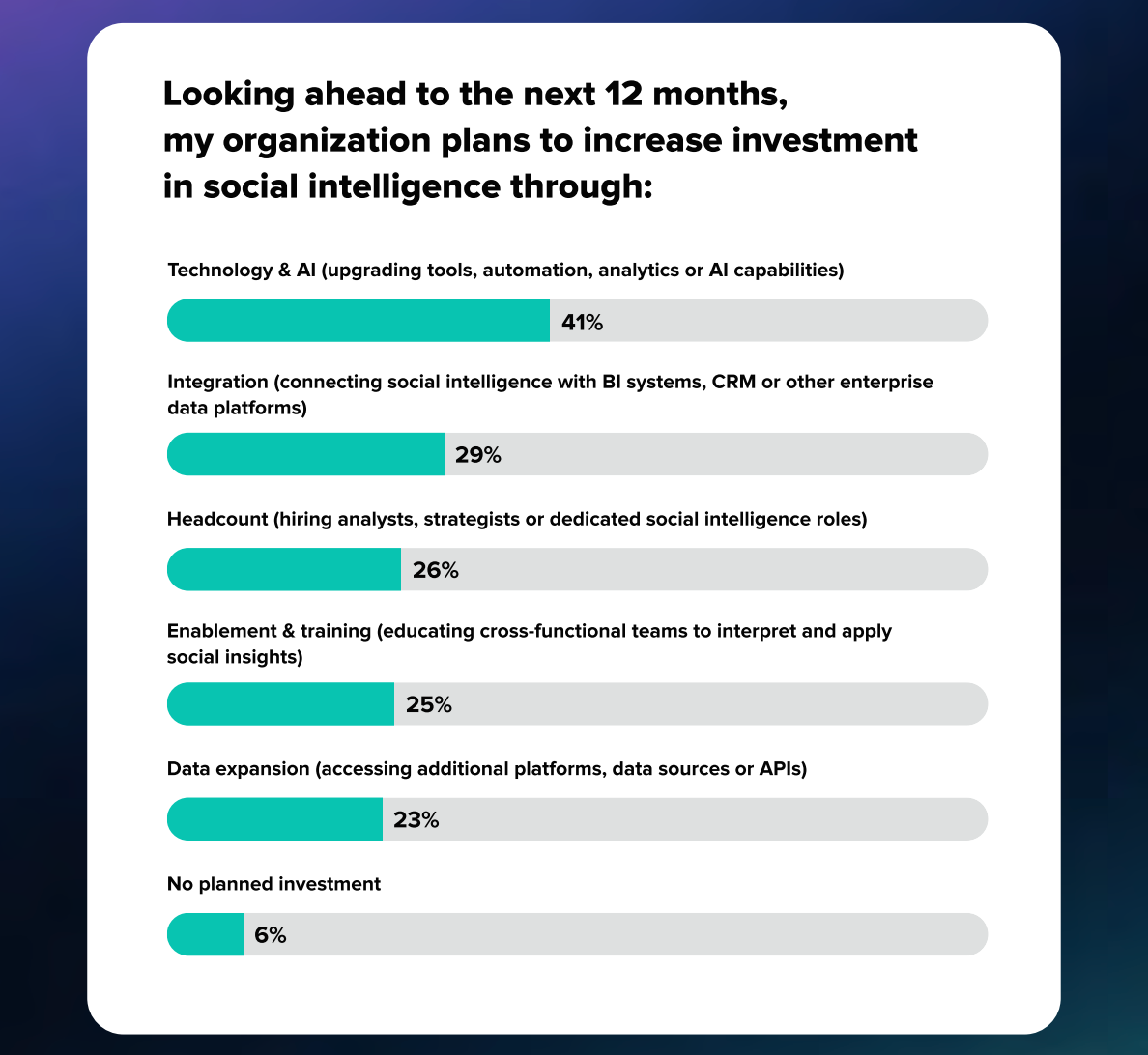
How to create a social media budget
Here’s a step-by-step guide to creating your social media budget. Build your team’s budget on insights from your existing social data and strategy.
Use goals as your foundation
An effective social budget should be goal-driven. You won’t know how to allocate your budget until you know your overarching social media goals. For example, if you want more conversions, you might invest more heavily in paid lead-generating campaigns and less into awareness efforts.
To help you set goals, ask yourself questions like:
- What are your organization’s priorities for 2027?
- How can social help your organization meet those priorities?
- Which strategies worked last year, and which didn’t?
- What does social intelligence tell you about how your audience wants to interact with your brand?
Your goals need to align with your audience. Otherwise, the disconnect may lead to poor engagement.
Understand your team’s needs and historical data
Review your social budgets, strategies and performance data from the past two to three years to establish a baseline for 2027.
Your previous year’s budget is a useful starting point, but it shouldn’t be the only factor guiding your decisions.
Here are a few more factors to consider:
- Past performance: Compare paid and organic campaign results to identify which strategies delivered the strongest returns. Factor in changes to platform costs and the resources you need to repeat or scale successful campaigns.
- Social network distribution: Sprout’s Q3 2026 Pulse Survey found that 35% of consumers would choose Facebook if they could only use one social network, followed by Instagram (17%) and TikTok (14%). Compare these preferences with your audience demographics and channel performance to determine where to invest.
- Internal skills and expertise: Assess whether your team has the skills and capacity to execute your 2027 strategy or whether you’ll need additional hires, training or external support.
- Existing tools and technology: Review your current subscriptions to identify underused tools and opportunities to consolidate spending. Consider whether your team needs capabilities your existing tools don’t offer.
- Experimentation: Set aside funds to test new content formats, platforms or campaign approaches. Account for production costs and performance tracking before scaling successful experiments.
- Contingency plan: Reserve part of your budget for unexpected costs, such as rising ad prices or platform changes.
Take into account current economic conditions
Marketing budgets remain tight heading into 2027. According to Gartner’s 2026 CMO Spend Survey, 56% of CMOs say they don’t have enough budget to execute their marketing strategy.
Keep these external factors in mind when allocating your social media budget:
- Economic outlook: Monitor inflation, consumer confidence and other economic conditions that could affect your organization’s spending priorities. Build flexibility into your budget so you can adjust as conditions change.
- Industry trends: Use social listening tools to track changing audience preferences and emerging trends in your industry. Look for opportunities to refine your social strategy based on what you learn.
- Competitive landscape: Analyze your competitors’ social with tools like Sprout Social Listening to benchmark performance. Look for gaps where additional investment could strengthen your competitive position.
What should a budget for social media marketing include?
Your social media marketing budget should account for everything from employee salaries to content production and software. Costs vary based on your team size and the complexity of your strategy. For example, basic social media management tools can cost between $500 and $5,000 per month, according to Sprout Social’s 2026 pricing guide.
Beyond your core expenses, leave room for costs that are easy to miss during budget planning:
- Creator usage rights: Additional fees to reuse influencer content in paid ads or across other marketing channels.
- Software integration fees: Costs to connect new tools to your existing systems or set up custom integrations.
- Emergency PR and paid boosting: Funds for crisis communications support or additional paid promotion when unexpected situations arise.
Here’s a breakdown of the key expenses to include in your budget.
Employees and training
As social media takes on a bigger role across businesses, teams need the right people and skills to keep up. AI is also changing the skills social marketers need, increasing demand for expertise in areas like social intelligence, data storytelling and creative direction.
Account for salaries, recruitment and onboarding costs when budgeting for new hires. As a benchmark, the average social media manager in the US earns approximately $74,000 annually, according to Sprout’s 2026 salary guide.
But hiring isn’t the only way to strengthen your team. Invest in ongoing training that supports employees’ professional growth and gives them room to develop creatively.
In Sprout’s webinar on burnout and career growth, DoorDash’s Head of Social, Zaria Parvez, discusses the pressures of being constantly online and the importance of prioritizing career development alongside brand success.
Content creation and production
AI has made it easier to produce social content at scale, but audiences are increasingly wary of low-effort, repetitive posts. According to Sprout’s Q1 2026 Pulse Survey, 28% of consumers want brands to stop posting unlabeled AI-generated content. Half of Gen Z consumers and 44% of millennials have even unfollowed, muted or blocked a brand or creator because their content felt like AI slop.
These findings reinforce the value of investing in original, human-centered content. Budget for creative talent and production resources to develop content that resonates with your audience, whether that’s employee-led videos, behind-the-scenes footage or original storytelling.
Video production costs vary by project, but Clutch’s 2026 pricing guide says most agencies charge $100-$149 per hour. Factor in editing and other post-production expenses when estimating your total costs.
Your content strategy will also affect your spend. Brands with more ambitious publishing schedules may need larger production budgets, but more posts don’t necessarily mean better results.
To stretch your budget, incorporate user-generated content into your calendar and repurpose existing assets across channels. For example, a longer video could become a series of short clips tailored to different platforms.
Software, subscriptions and AI tools
Social media teams rely on management and analytics tools to manage their workflows, track performance and collaborate across departments. These platforms often come with recurring subscription costs you need to budget for annually.
As AI becomes standard in social media tools, look beyond basic features like scheduling and reporting. AI-powered capabilities can automate repetitive tasks, surface relevant insights and streamline customer care, so your team has more time to focus on strategy and content creation.
For example, Sprout’s social team uses AI-powered workflows to simplify reporting and prioritize incoming customer messages. These efficiencies have saved the team 72 hours per quarter on reporting alone.
Depending on your team’s needs, these are a few tools worth budgeting for:
- Content research and creation: Google Trends, Feedly and Canva for researching trends and creating social assets.
- Social media management: Sprout Social for AI-powered publishing, analytics and community management.
- Influencer marketing: Sprout Social Influencer Marketing to find creators and manage partnerships.
- Social intelligence: Sprout’s Premium Analytics and Listening solutions for performance insights and audience research.
- Predictive media intelligence: NewsWhip by Sprout Social to identify emerging trends and reputation risks before they escalate.
- Campaign tracking: Bitly, Google Analytics and Sprout’s free UTM builder for link management and attribution.
- Content storage and editing: Dropbox and Grammarly to manage creative assets and refine copy.
Advertising and paid campaigns
Paid advertising is another major expense in social media budgets. For brands running multichannel campaigns, spending should reflect each platform’s performance and your campaign goals.
Advertising costs also vary by industry and campaign objective. According to WordStream’s 2026 Facebook Ads Benchmarks, the average cost per click for Facebook traffic campaigns is $0.60, compared to $1.80 for lead-generation campaigns.
Meta Ads Manager lets marketers manage Instagram ads alongside Facebook campaigns, making it easier to coordinate campaigns and track spending across both networks.
If you’re new to social media advertising, start with a smaller test budget to evaluate different platforms and targeting approaches before increasing your investment. Remember to account for creative production costs, particularly for native advertising formats that require platform-specific assets.
Influencer and creator partnerships
Partnering with influencers and creators can significantly impact your social media marketing. According to Sprout’s 2026 Influencer Marketing Report, only 17% of consumers check a creator’s follower count before deciding to engage with their content. Instead, audiences prioritize content relevance and style.
It’s no wonder that brand collaborations are everywhere on social media. They can increase your brand’s visibility and introduce new customers to your business, but costs vary based on the creator’s reach and the campaign’s scope.
When working with content creators, research which channels and content types to prioritize before allocating your budget. An influencer rate card can also help you estimate partnership costs.
Authenticity also plays an important role in the success of influencer partnerships. According to Sprout’s Q2 2026 Pulse Survey, 81% of consumers say it matters whether an influencer has actually used the product they promote. Giving creators firsthand experience with your products makes their recommendations more credible.
Whether you’re working with a celebrity or a smaller creator, research potential partners to maximize ROI. Partnership costs vary by content type and platform, so make sure your contracts reflect those differences. Include a mutually agreed-upon reporting plan so both parties can track performance.
If you’re unsure how much of your budget to dedicate to influencers, try this handy influencer marketing budget template. Use it to allocate resources to high-value partnerships and control costs by setting clear spending limits.
Social customer care
Budgeting for customer care should be a priority for any brand, as strong customer support builds stronger customer relationships. According to Sprout’s Q3 2026 Pulse Survey, 70% of consumers expect brands to respond to social media customer care inquiries within the same day, including 38% who expect a response within two hours.
Investing in customer care tools like Sprout Social Customer Care can reduce manual work and streamline social inbox management. Depending on your team’s capacity, you may also need dedicated customer care staff to handle inquiries and meet response time expectations.
Agencies and contractors
Investing in agencies or contractors gives your internal team access to specialized expertise while freeing up time for other priorities. External partners can also bring fresh ideas to your content strategy and support expansion into new formats or platforms. Sprout’s 2025 Impact of Social Media Report found that 71% of leaders have upped their investments in agencies and contractors since adopting AI.
To set your outsourcing budget, identify gaps in your team’s capabilities and compare contractor rates with the cost of handling that work internally.
Building long-term relationships with trusted partners can also reduce recruitment costs and help them develop a deeper understanding of your brand.
What do social media management tools cost, and are they worth it?
Social media management software costs vary depending on your team’s size and the features you need. Basic tools focus on scheduling and publishing, while more advanced platforms offer AI-powered workflows, social listening and analytics. For reference, Sprout Social’s plans start at $79 per seat per month with annual billing, with enterprise pricing available on request.
But subscription costs only tell part of the story. According to Sprout’s 2026 Social Intelligence Report, 80% of individual contributors spend more than half their time on operational tasks instead of insight-driven work.
More sophisticated platforms address this challenge. AI-powered automation reduces the time spent on routine reporting and administrative tasks, while social intelligence capabilities help teams uncover emerging trends and customer insights. That’s why marketing leaders say investing in better technology is the top factor in accelerating an organization’s social intelligence maturity.
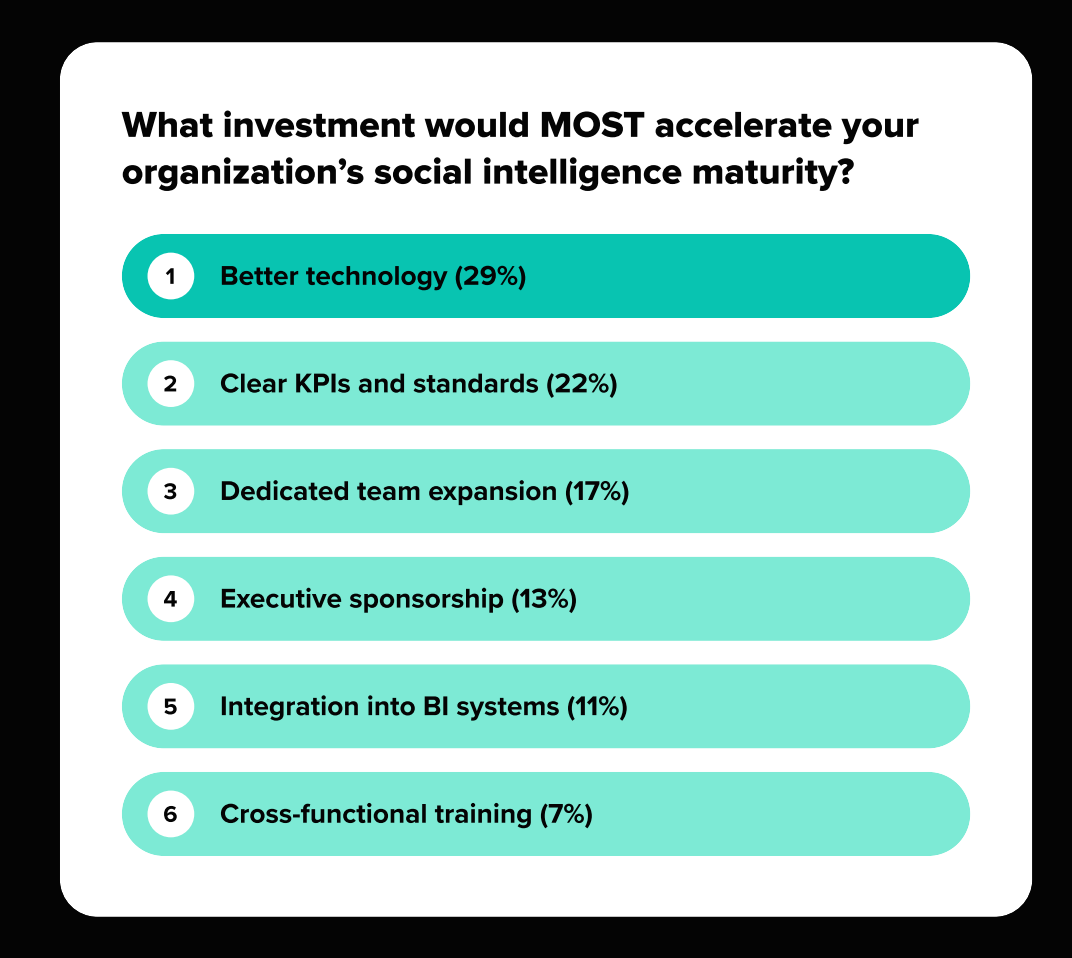
When evaluating software, weigh the subscription cost against the time saved and the value of the insights it provides. A platform that supports both day-to-day management and broader business decisions may justify a higher upfront investment.
Tips to get leadership to sign off on your social media marketing budget
You’ve just finalized your new social media budget. Now what? The next step: get it signed off by your internal leaders.
Here’s guidance on getting approval and encouraging stakeholders to actively support your social strategies to boost your ROI even further.
Connect performance to ROI (return on investment)
Measuring social media ROI is one of the best ways to prove your efforts are working.
To calculate social ROI, compare the value your social media efforts generate against the total cost of content creation, paid ads and tools. Calculate ROI across individual platforms and your overall strategy to identify what’s working and explain why you’re prioritizing certain channels.
For example, Sprout’s social team used multi-touch attribution to demonstrate a 529% ROI from the Sprout Social platform, factoring in efficiency gains, social lead generation and earned media value. These findings helped the team secure additional budget for growth and expanded influencer marketing efforts.
Connect every proposal in your budget to an ROI calculation, and then explain why you need a budget increase (or decrease) based on this calculation.
This clearly shows C-suite leaders what you plan to achieve with your budget. It also gives you trackable metrics to see whether your budget is working and to refine it over time.
Align your social media goals to business impact
Alongside ROI, link your social media goals to wider business objectives. This might include:
- Recruitment and employee retention increases
- Increased lead gen
- Increased press coverage
- Stronger brand reputation
- Increased product or service sales
- Expansion into different regional markets
Your business objectives will vary significantly by company. Social media doesn’t operate in a vacuum. Everything you do on social should positively impact your business online and off. Link your budget proposal to key business outcomes to show senior leaders how your budget directly impacts the future of the company.
Demonstrate the value of social intelligence
Social media intelligence turns social media data into detailed, actionable insights into your customers and their expectations. It’s a uniquely powerful process, and you need to communicate its value to your stakeholders.
Tools like social listening let you collect social intelligence, which you can’t do without investing in social media reach. Show leaders how you can use this information to refine sales conversations, audience segmentation, product feature updates and more.
By connecting social intelligence to other departments, you can show how improvements to your social strategy benefit the entire company. This can help justify budget increases or any planned experimentation across your channels.
Highlight competitive gaps and benchmarks
Social insights can reveal competitive gaps to use to your advantage. Identify exactly what your competitors are doing online and benchmark your performance against theirs.
This reveals industry-wide insights into what’s working and what isn’t, as well as what your competitors’ social presence looks like. Use this data to find ways to outperform them.
Visualize your benchmark data so leaders can clearly see performance figures. Explain that by continuing to invest in your social media, you can obtain even more detailed information on your competition over time. This can further improve your social output, guide companywide objectives and support differentiation strategies.
Create a new social media marketing budget to set your team up for success
Evaluate social media budgets regularly. At a minimum, aim to review your social media budget annually. This will help you adapt to new trends, platforms and content types, and give you plenty of data to learn from across your prior performance.
With the right tools, your team can track performance, make informed budget decisions and demonstrate the business value of social. Try Sprout Social to see how its analytics and social intelligence capabilities support smarter investments.
Social media marketing budget FAQs
How do you choose the advertising budget for social media ads?
Your goals and KPIs, the platforms you’re using, and the size of your overall marketing budget should guide your social media advertising budget. Use past campaign performance to decide where to allocate funds and adjust spending over time.
Which tools help track the effectiveness of a social media budget and identify areas to increase investment?
Sprout Social provides performance insights across social networks, down to individual posts, to inform budget allocation. Sprout’s reporting tools also highlight which areas of your social strategy are performing well and which need reworking.
What steps should I follow to set up a competitive social media budget for a new product launch?
First, determine your launch goals and target audience. Then, identify the best social channels to reach them and develop a content strategy to guide how you allocate your budget. Conduct a competitive analysis to benchmark your plans against similar brands.
What is the 70/20/10 rule for social media?
The 70/20/10 rule is a framework for dividing your social media budget: 70% goes toward proven strategies that consistently deliver results, 20% supports growth opportunities and 10% funds experimentation with new approaches. This balance helps maintain performance while leaving room to test ideas and discover new opportunities.





Share