What are AI agents and why do marketers need them now

Written by McCall Lanman
Published on April 3, 2026
Reading time 10 minutes

Table of Contents
AI agents are autonomous systems that don’t just generate text. They plan, execute and adapt to complete complex tasks from start to finish. For social media marketers managing content calendars, customer conversations and performance reporting across multiple platforms, that distinction changes everything.
This technology is at the forefront of AI marketing, helping brands keep pace with rapid media shifts helping brands stay ahead of rapid media shifts by surfacing emerging trends, early signals and competitive insights in real time. This guide breaks down what AI agents are, how they work and where they fit into your social strategy, so you can move from reactive workflows to systems that actually work for you.
What are AI agents?
An AI agent is an autonomous software system that perceives its environment, makes decisions and takes actions to achieve a goal with minimal human supervision. This means it doesn’t just answer questions. It plans, executes and adjusts until the job is done.
The key difference from basic AI is autonomy. A standard AI model waits for your next prompt. An AI agent works through a multi-step task on its own, using tools like APIs, databases and external platforms to get there.
For a social team, this means moving beyond simple generative AI to “agentic” intelligence that acts as a strategic teammate, capable of mining countless data points to deliver instant business intelligence.
Building your AI teammate with Trellis
The challenge isn’t access to data—it’s turning fragmented insights into fast, confident decisions that actually move the business forward. Trellis, Sprout Social’s strategic AI Agent, helps teams turn complex social data into clear, actionable insights that drive business impact.
Trellis reduces the operational burden of manual analysis by transforming large volumes of social data into intuitive, conversational insights. Trellis goes beyond reporting metrics by surfacing patterns, trends and context, helping teams quickly understand what’s happening and what actions to take next.
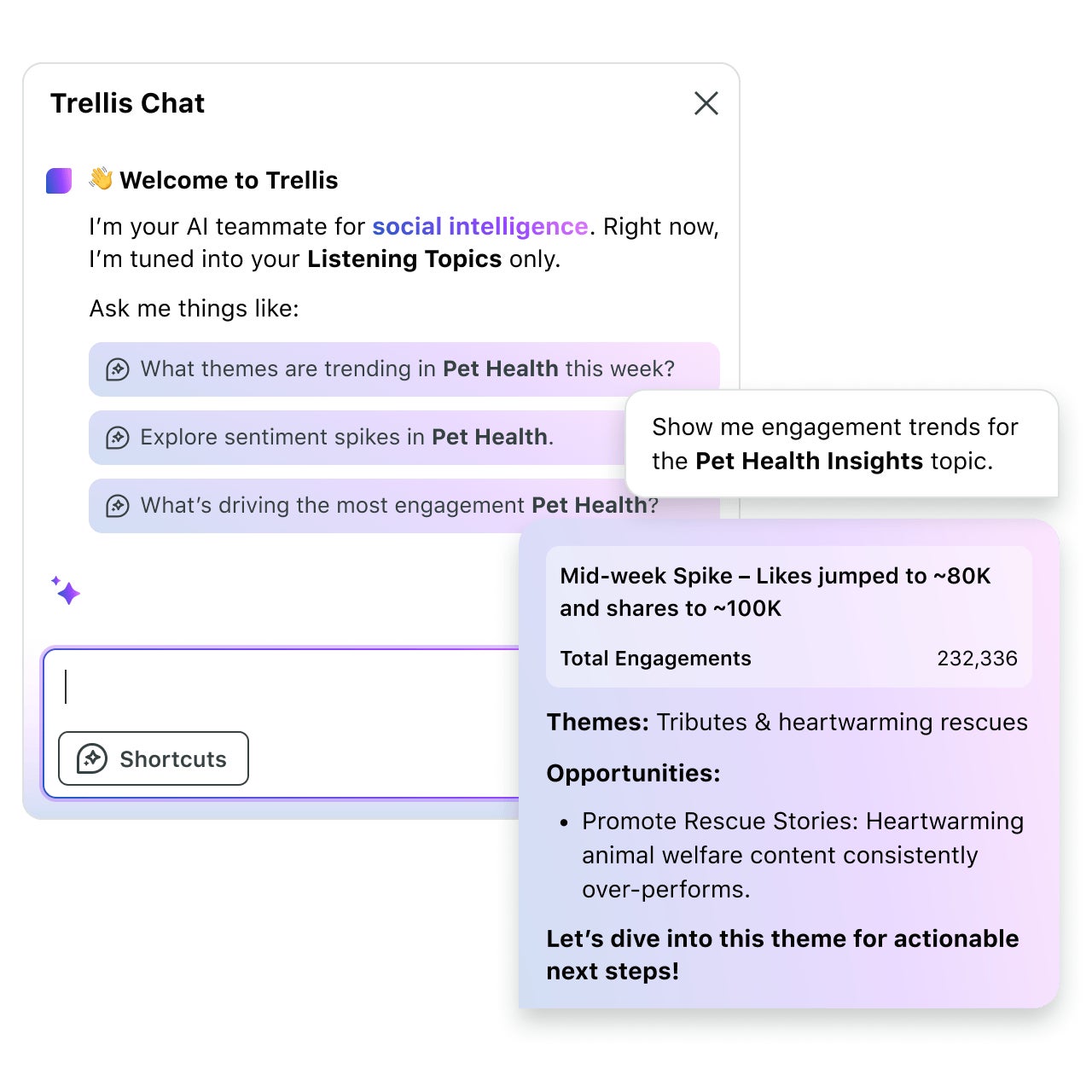
Instead of manually analyzing competitor activity, you can ask Trellis questions about emerging themes, audience sentiment or content performance and get tailored, actionable recommendations in seconds.
By streamlining workflows like market research, trend analysis and competitive monitoring, Trellis helps teams move from reactive reporting to more proactive, insight-driven decision making. With faster access to insights and clearer context, teams can spend less time on manual analysis and more time driving strategic decisions.
Stop sifting. Start leading. Request a demo now to see Trellis in action.
Benefits of AI agents for marketing and customer care
According to The 2025 Sprout Social Index™, 93% of social practitioners now believe AI is a crucial tool to help alleviate creative fatigue, the benefits of agents extend far beyond simple automation.
Increase efficiency
While agents represent the next generation of automation, they are part of a broader ecosystem of social media AI tools designed to handle the repetitive work that eats up your team’s day:
- Responding to common customer inquiries
- Scheduling and publishing content
- Generating performance reports
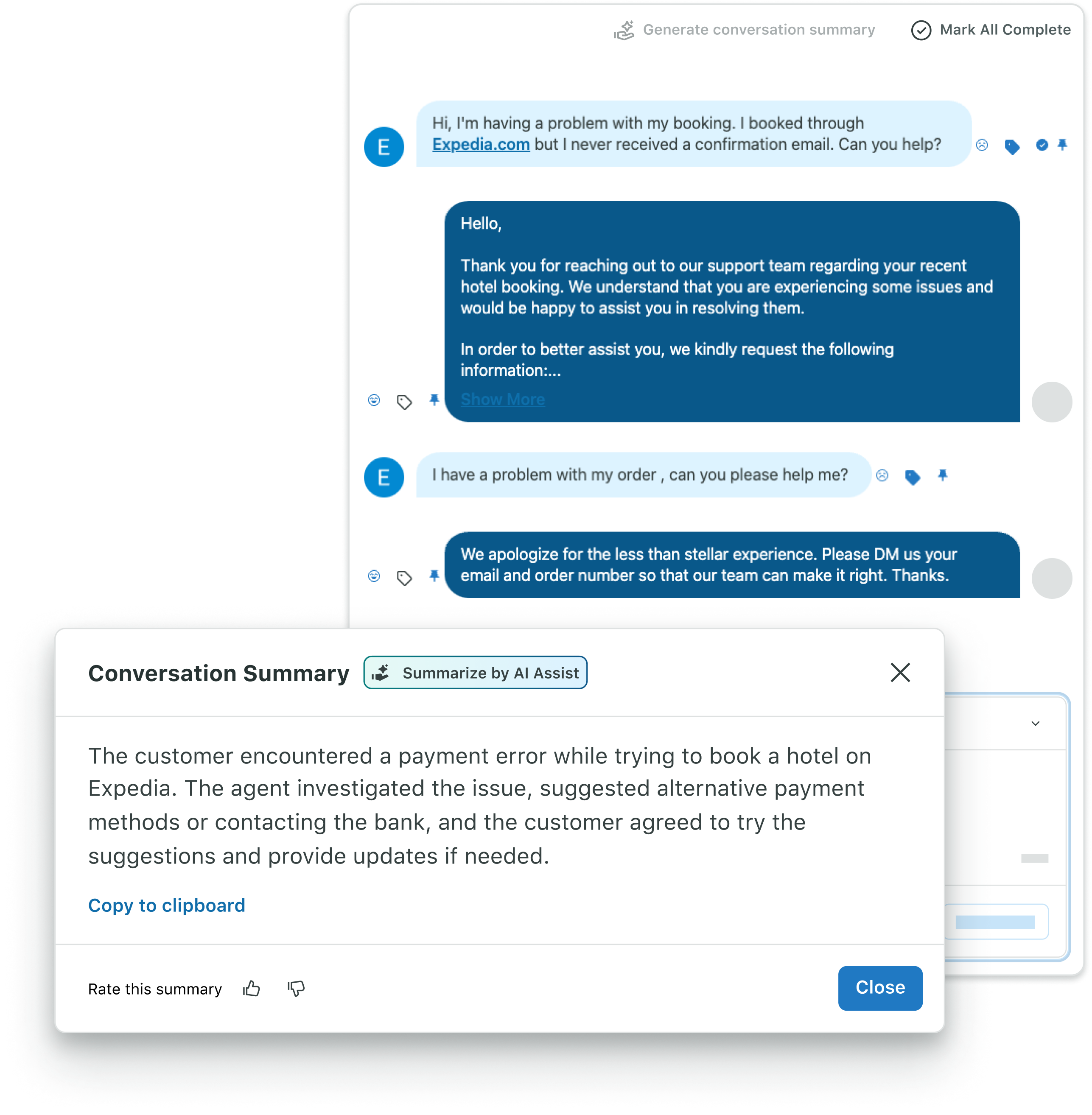
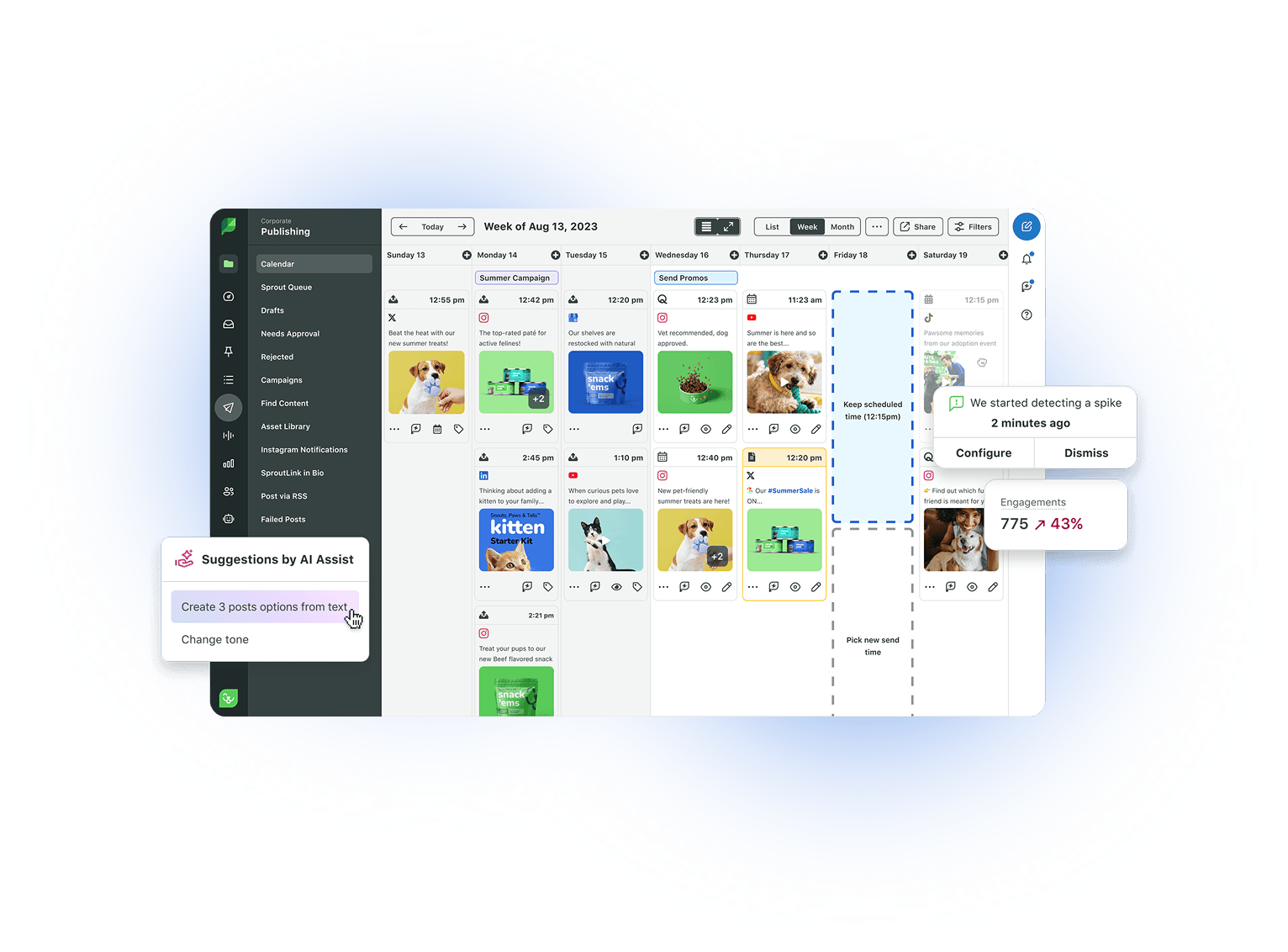
Sprout Social’s Smart Inbox combines AI-powered message classification with automated rules to prioritize, tag and route incoming messages, helping teams focus on conversations that need a human response.
Improve decision making
Agents process large volumes of data and surface what matters. While marketers currently focus AI use on content creation, the real potential lies in analysis to garner timely audience insights. For social teams, that means:
- Identifying trending topics through social listening
- Detecting sentiment shifts in customer conversations
- Recommending optimal posting times based on audience behavior
The transition to these agents allows for more strategic focus, signaling a major shift in the future of AI in marketing where humans manage outcomes rather than manual tasks.
Personalize engagement
Agents make personalization scalable. They tailor responses based on customer history, adjust content recommendations to match user preferences and update campaign messaging based on live engagement signals.
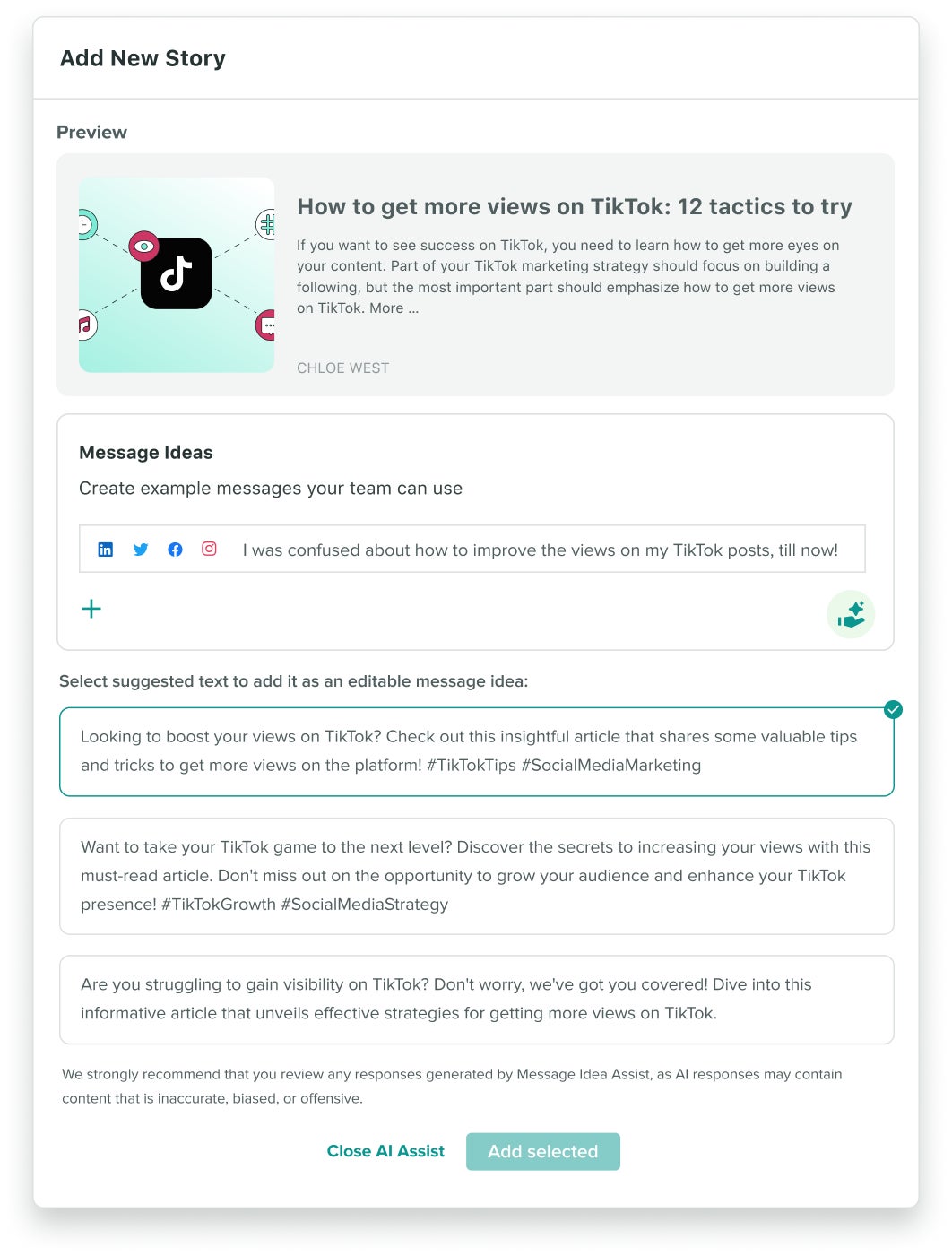
For example, Sprout Social uses AI Assist to help generate on-brand content and recommendations, making it easier for teams to scale employee advocacy while maintaining a consistent voice.
Provide 24/7 coverage
Agents don’t clock out. They monitor conversations, flag urgent issues and respond to customers around the clock. Consumers are highly receptive to this: According to Sprout Social’s Q4 2025 Pulse Survey, 69% of social media users are comfortable with companies using AI to deliver faster customer service
For global brands managing multiple time zones, always-on coverage isn’t a luxury, it’s a requirement.
AI agents vs AI assistants vs chatbots
| Feature | Chatbots | AI assistants | AI agents |
|---|---|---|---|
| Autonomy | Low—responds to queries | Medium—handles tasks with guidance | High—works independently |
| Complexity | Simple Q&A | Multi-turn conversations | Complex workflows |
| Learning | Rule-based | Limited adaptation | Continuous improvement |
| Tool use | Minimal | Some integrations | Extensive tool access |
Autonomy and control
Chatbots are reactive. Assistants are interactive. Agents are proactive. A chatbot waits for your question. An assistant walks you through a task. An agent completes the task without being asked twice.
Task complexity
- Chatbots: Single-turn responses and FAQs
- Assistants: Multi-step tasks with user guidance at each stage
- Agents: End-to-end workflow automation with no hand-holding required
Learning and adaptation
Chatbots run on static rules that need manual updates. Assistants adapt slightly based on immediate feedback. Agents use continuous learning—every completed task makes the next one better.
Use cases for social teams
Audience insight agents
These agents scan social conversations to surface what your audience cares about. They monitor brand mentions and sentiment, identify emerging trends and track competitor activity—continuously, without manual effort.
The transition to these agents allows for more strategic focus.
The 2025 Sprout Social Index™ found that 54% of marketing leaders believe AI will empower them to grow their teams by shifting roles away from administrative tasks toward highly specialized work.
Customer care agents
Customer care agents triage incoming messages, route them to the right team and respond instantly to common questions. Complex issues escalate automatically to a human agent. This keeps response times fast and service quality consistent, even during high-volume periods.
Content and campaign agents
These agents support the full content lifecycle. They generate ideas based on trending topics, optimize posting schedules and run A/B tests on content variations.
Sprout Social’s ViralPost® capability applies this logic to timing. It automatically publishes content when your specific audience is most active, rather than relying on generic best-practice windows.
Measurement and analytics agents
Analytics agents compile cross-channel performance data, generate automated reports and alert your team when a metric moves significantly. Instead of pulling numbers manually, you get a clear picture of what’s working—delivered to you.
What defines an AI agent?
Autonomy and goal orientation
Agents operate independently. You give them a goal, not a script, and they figure out how to reach it. They adapt when obstacles arise, making decisions based on context rather than waiting for instructions at every step.
Reasoning and planning
Many agents break complex goals into smaller tasks using planning or intermediate reasoning steps, working through them in a structured sequence. Think of it like a project manager who maps out every step before touching a single deliverable.
Memory and context
Agents hold onto context across a conversation or task. Short-term memory tracks what’s happening right now. Long-term memory stores past interactions and learned preferences. This is what allows an agent to give you a relevant response on day 30 that reflects what it learned on day one.
Tools and action
Agents connect to external tools to take real-world action. That includes:
- Searching the web or querying databases
- Calling APIs to retrieve or send data
- Generating and publishing content
- Triggering workflows in other platforms
How do AI agents work?
Every agent follows a continuous loop from input to outcome:
- Perceive environment: Gather information from inputs, data sources and connected tools.
- Set objectives: Translate the user’s goal into specific, actionable targets.
- Create plan: Map out the sequence of steps needed to reach those targets.
- Execute actions: Use available tools to complete each step.
- Monitor progress: Track results and adjust the plan if something isn’t working.
Define goals and plan
The agent starts by interpreting your request and turning it into a concrete objective. From there, it builds a task plan, a sequence of actions ordered by dependency. Depending on the architecture, agents may either plan upfront or iteratively adjust their approach as they execute.
Use tools and act
Once the plan is ready, the agent selects the right tool for each step. It accesses a database, calls an API, generates a draft or triggers a workflow—whatever the task requires. Action execution is where the plan becomes a result.
Learn and reflect
After completing a task, the agent evaluates what worked. Feedback loops feed that learning back into future runs, making the agent more accurate and efficient over time.
ReAct and tool loops
The ReAct framework—short for Reasoning and Acting—has agents alternate between thinking and doing. The agent reasons about the next step, takes an action, observes the result and reasons again. This creates transparent, traceable behavior you can audit.
ReWOO and upfront planning
ReWOO stands for Reasoning Without Observation. Instead of thinking step by step, the agent plans the entire workflow upfront before executing anything. This approach is faster for predictable tasks because it batches actions together rather than pausing to evaluate after each one.
Core components of an AI agent
Model and prompts
The foundation model—usually a large language model (LLM)—is the brain of the agent. System prompts define its behavior: what it’s allowed to do, how it should respond and what constraints it operates within. Prompt engineering is the practice of designing those instructions to keep the agent focused and on-brand.
Memory systems
- Short-term memory: Holds the current task context and conversation history.
- Long-term memory: Stores past interactions and user preferences in a vector database for future retrieval.
- Episodic memory: Recalls specific past events and their outcomes to inform current decisions.
Tool and API access
Agents need access to external resources to act. Common tool categories include:
- Data retrieval and analysis tools
- Content generation and editing tools
- Communication and messaging APIs
- Workflow automation platforms
Planning and orchestration
An orchestration layer coordinates all the moving parts. It schedules tasks, manages dependencies and ensures actions run in the right order. Without orchestration, a multi-step agent workflow falls apart.
Guardrails and supervision
Safety constraints keep agents from going off-script. Key safeguards include:
- Output validation: Checks responses against rules before the agent acts.
- Permission systems: Limits what the agent is allowed to do.
- Human oversight: Requires manual approval for high-stakes decisions.
Types of AI agents
Simple reflex agents
A simple reflex agent responds to a specific input with a predetermined action. This is rule-based automation—if X happens, do Y. It’s the foundation of auto-replies and keyword-triggered responses.
Model-based reflex agents
These agents maintain an internal model of their environment. They track how the world changes over time, which helps them make better decisions than a simple reflex agent that only sees the current moment.
Goal-based agents
A goal-based agent evaluates multiple possible actions and chooses the one that moves it closest to its objective. It’s not just reacting—it’s strategizing.
Utility-based agents
These agents go further by weighing trade-offs. Instead of just reaching a goal, they maximize overall value—balancing speed, cost and quality to find the most efficient path for scaling AI in business operations.
Learning agents
A learning agent improves through experience. It uses reinforcement learning and model training to adapt to new situations, getting better at its job the more it runs.
Multi-agent systems
Multi-agent systems are networks of agents working together. Each agent handles a specialized task, and they coordinate to solve problems too complex for a single agent. In marketing, this looks like one agent monitoring brand mentions while another drafts responses and a third routes escalations.
Risks, governance and the human element
Automation doesn’t mean abandonment. Marketers must remain vigilant against “AI slop.” According to the Sprout Social Q1 2026 Pulse Survey, low-quality, mass-produced content has led 56% of users to report seeing it often and 50% of Gen Z users to actively unfollow or block brands.
Protect data privacy
Agents access sensitive customer data, which means governance starts with data minimization—only giving the agent access to what it needs. Beyond that:
- Encryption: Secure all data in transit and at rest.
- Compliance: Ensure your agent setup meets GDPR and regional privacy laws.
Keep a human in the loop
The most effective agent deployments include approval workflows for critical decisions, regular performance reviews and clear escalation paths to human team members when the agent hits its limits.
Ultimately, Sprout’s Q3 2025 Consumer Pulse Survey data showed that 55% of consumers say they are more likely to trust brands committed to publishing content created by humans.
Reduce bias and ethical risk
Agents learn from training data, and biased data produces biased outputs. Governance is also a matter of brand trust. Sprout’s Q3 2025 Consumer Pulse Survey showed that 52% of global consumers cite undisclosed AI-generated content and the mishandling of personal data as their top two concerns.
Furthermore, in Sprout’s Q1 2026 Pulse Survey, 28% of users say posting unlabeled AI content is the #1 thing they wish brands would stop doing in 2026.
To protect your brand, focus on being upfront with your audience. Clearly labeling AI-assisted interactions isn’t just about following rules. It’s a way to build the “human-led” trust that today’s consumers crave.
Make it a habit to regularly review your agent’s work to ensure its responses stay helpful, inclusive and aligned with your brand’s actual voice.
Prevent tool loops and failure
Three technical risks to plan for:
- Infinite loops: Agents stuck repeating the same action without progress.
- Cascading failures: One error triggering a chain of downstream failures.
- Resource exhaustion: Excessive API calls consuming compute or hitting rate limits.
Build failsafe mechanisms and resource limits into every deployment.
Start using AI agents for your social media strategy
The rise of agents marks a significant evolution in the application of AI in social media, changing how marketing and customer care teams operate by moving from reactive workflows to systems that plan, act and improve on their own. Rather than eliminating jobs, The 2025 Sprout Social Index™ reveals that 54% of marketing leaders believe AI adoption will empower them to grow their teams and add new, highly specialized roles. The teams that understand how agents work, where they fit and how to govern them will move faster and make smarter decisions.
How is your team currently balancing AI efficiency with the need for authentic, human-led creative strategy? Request a demo to explore how Sprout Social and Trellis can elevate your strategy.
AI agents FAQs
What is the difference between an AI agent and a large language model?
A large language model (LLM) is the AI brain that generates text. An AI agent is a system built around that brain—adding memory, tools and a planning layer so it takes action, not just produces output.
Can AI agents make mistakes without human oversight?
Yes. Without guardrails, agents can loop, hallucinate or take unintended actions. That’s why approval workflows and output validation are essential parts of any production deployment.
How do multi-agent systems divide work between agents?
Each agent in a multi-agent system handles a specialized role. An orchestration layer assigns tasks based on each agent’s capabilities and manages the handoffs between them.
What is the difference between ReAct and ReWOO frameworks?
ReAct has the agent alternate between reasoning and acting one step at a time, observing results before moving forward. ReWOO plans the entire workflow upfront before executing any actions, which is faster for predictable, structured tasks.
How do AI agents handle tasks they weren't trained for?
Agents use their foundation model’s general reasoning to handle novel situations, but performance degrades outside their training scope. Well-designed agents include escalation paths that route unfamiliar tasks to a human rather than guessing.
37 free social media strategy templates that will elevate your workflows
Published on December 5, 2025 Reading time 15 minutes






Share