The role of artificial intelligence in business

Written by Tamara Franklin
Published on May 8, 2026
Reading time 19 minutes

Table of Contents
Artificial intelligence in business is no longer a future concept—it’s the operating system behind smarter marketing, faster decisions and deeper customer understanding. From social media management to product development, AI transforms how teams work and how brands grow.
The shift is already underway. Marketing leaders are accelerating AI adoption across every function, and the teams that move fastest are the ones setting the pace for their categories.
This article breaks down the specific roles AI plays across business functions, including marketing, operations, product development, human resources, customer support and security and what each means for your bottom line.
- AI in business covers technologies including machine learning, natural language processing, deep learning and automation, each serving distinct functions across marketing, sales, HR, operations and security.
- The most measurable business benefits of AI include increased efficiency, customer personalization at scale, faster data-driven decisions, competitive foresight and improved ROI.
- Common misconceptions about AI, including the belief that it replaces strategy, only serves large enterprises or removes the need for human judgment, prevent organizations from deploying it effectively.
- Real-world AI applications in business range from predictive media intelligence to fraud detection, inventory management and recruitment automation.
- Getting started with AI in business requires identifying high-friction workflows first, deploying targeted solutions and tracking measurable outcomes to build an internal business case.
- Agentic AI systems, multimodal models and real-time adaptive learning define the next phase of AI in business, and the gap between adopters and non-adopters is widening fast.
What is AI in business?
AI in business means applying artificial intelligence technologies like machine learning, deep learning, natural language processing and more to automate tasks, analyze data and make smarter decisions at scale across every function of an organization. Businesses use AI to streamline marketing campaigns, personalize customer experiences and extract actionable insights from social media conversations, tasks that traditionally required extensive manual effort.
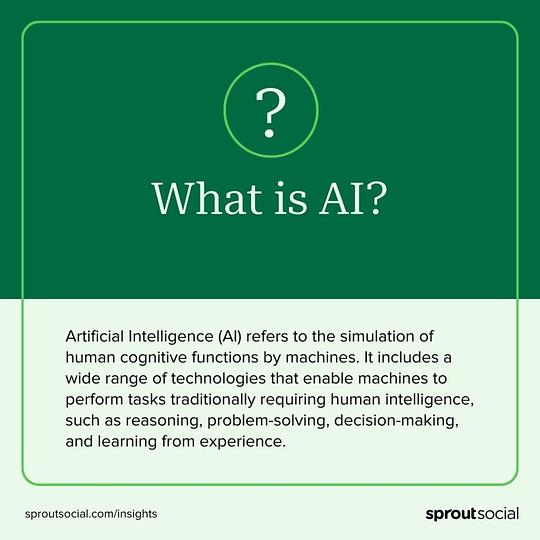
AI is an umbrella term covering several distinct subfields, each with a specific function:
- Machine learning: Systems that improve performance by learning from data without explicit programming.
- Deep learning: Neural networks that process complex patterns across large datasets.
- Natural language processing (NLP): Technology that enables machines to understand, interpret and generate human language.
For social media marketers, AI in business delivers its greatest impact when it processes data across every major network simultaneously. Sprout Social’s embedded AI analyzes conversations across Facebook, Instagram, TikTok, X (formerly known as Twitter), LinkedIn and Pinterest—surfacing unified insights that single-platform tools miss entirely.
The rise of AI in business
AI in business has moved from experiment to expectation. It now shapes how teams work, how leaders make decisions and how brands compete—and there’s no going back.
The pressure is real. Businesses face tighter timelines, higher customer expectations and relentless demand to prove results. AI gives teams the ability to keep pace without adding more manual work.
- AI is embedded in everyday workflows. From marketing and customer care to analytics and operations, AI now powers decisions that used to take days to make.
- The competitive gap is widening. Brands that use AI well move faster, spot changes sooner and adapt with more confidence than those still relying on manual processes.
- Intention separates leaders from followers. Adopting AI isn’t enough. Knowing where to apply it and why is what drives real business impact.
According to the 2025 Sprout Social Index™, half of marketing leaders say they’ll spend 2026 maximizing the AI tools they’ve already purchased, while 48% are keen to invest in even more. The brands pulling ahead aren’t just buying AI—they’re deploying it with purpose across every workflow that touches the customer.
The brands pulling ahead aren’t waiting for AI to become standard practice. They’re already deploying it with intention. The rest of this article breaks down exactly where to apply it and what the results look like when you do.
Common misconceptions about AI in business
AI in business works best when it strengthens human decision-making, not when it operates without it. Before exploring what AI delivers, clear up what it doesn’t do alone.
AI is not a replacement for strategy
AI surfaces patterns, generates options and automates routine work. But your team still sets direction, makes judgment calls and protects brand trust.
No algorithm decides what your brand stands for. AI gives you better inputs; your team owns the output.
AI is not only for large enterprise teams
Businesses of every size use AI to solve practical, everyday problems—especially when it’s built directly into the tools they already rely on. When AI is embedded in your existing workflows, you don’t need a dedicated data science team to benefit.
You need the right platform. That’s it.
AI is not valuable without a clear objective
AI without a goal is noise. The value comes from applying it against a real business objective, whether that’s saving time, improving customer care or making faster decisions with better data.
Teams that see the strongest results connect AI directly to outcomes that matter to the business, not to standalone experiments.
AI does not remove the need for human oversight
Strong inputs, review processes and human context still matter. The smartest teams use AI with guardrails, not because they distrust the technology, but because they understand its limits.
AI amplifies what your team brings to it. The brands winning with AI right now pair it with clear processes and human judgment at every critical step.
Which functions of AI are used in business?
Businesses deploy four core AI technologies—machine learning, NER and semantic search, NLP and sentiment analysis and deep learning—each serving distinct purposes that work in combination to transform operations and decision-making.
| AI Technology | What It Does | Business Applications |
|---|---|---|
| Machine Learning (ML) | Analyzes data, identifies patterns and makes predictions independently as it processes information | Predictive analytics, customer behavior forecasting, personalized recommendations |
| Natural Language Processing (NLP) & Sentiment Analysis | Understands and interprets human language to analyze customer feedback and social media content | Social listening, customer support automation, brand sentiment tracking |
| Named Entity Recognition (NER) & Semantic Search | Identifies important entities (brands, locations, people) and provides contextual understanding of queries | Social media monitoring, content categorization, competitive intelligence |
| Deep Learning (DL) | Uses neural networks to learn and adapt to new patterns with minimal human intervention | Image and speech recognition, complex data analysis automation, fraud detection |
Machine learning (ML)
Machine learning algorithms analyze data, identify patterns and make predictions. They power AI tools that give businesses valuable insights from disparate data sources. ML models learn independently as they process data and can also be updated manually based on your specific needs.
NER and semantic search
Named Entity Recognition (NER) identifies entities defined in the ML model as important to a business—geographic locations, brand names, notable people and more. Semantic search adds contextual understanding to user queries. Together, they improve search accuracy, automate data processing and extract meaningful insights from large volumes of unstructured data.
NLP and sentiment analysis
Natural Language Processing (NLP) and sentiment analysis give businesses the ability to understand and interpret human language at scale. These technologies are essential for analyzing customer feedback, social media content and other textual data while automating report generation.
Deep learning (DL) for AI automation
Deep learning uses neural networks to learn and adapt to new patterns with little to no human input, going further than standard machine learning, which requires human intervention to correct errors. It automates complex tasks including image and speech recognition, streamlining operations across the business.
The most forward-looking application of deep learning is the rise of AI agents. Unlike rigid if-then automation, these agents reason through tasks, adapt to new information and make independent decisions to reach a specific business goal.
| AI function | Core capability | Primary business application |
|---|---|---|
| Machine learning (ML) | Pattern recognition and prediction | Data-driven decision-making and insights |
| NER and semantic search | Entity identification and contextual query understanding | Search accuracy and automated data processing |
| NLP and sentiment analysis | Human language interpretation | Customer feedback analysis and report automation |
| Deep learning (DL) | Neural network-based autonomous learning | Complex automation, AI agents and operational efficiency |
Benefits of AI in business
AI in business delivers five core benefits: greater efficiency, personalized customer experiences at scale, faster decision-making, competitive foresight and measurable ROI. Organizations that embed AI across their workflows don’t just cut costs—they build capabilities that compound over time.
- Efficiency and productivity: Automate reporting and data analysis to free your team for strategic work
- Customer personalization at scale: Deliver hyper-personalized experiences to millions of customers simultaneously
- Data-driven decision–making: Process billions of data points to surface patterns no human analyst can match
- Competitive foresight: Identify trends before they peak and manage brand health proactively
- Measurable ROI: Reduce operational costs while driving higher engagement and revenue
Increased efficiency and productivity
Manual reporting drains your team’s bandwidth and crowds out strategic thinking. AI automates these repetitive tasks so your people focus on decisions, not data collection. Organizations using Sprout Social see a 75% decrease in time spent on reporting, according to a 2023 Forrester study.
Enhanced customer personalization at scale
Customers expect brands to know them, and AI makes that expectation achievable at any volume. Sprout Social’s Enhance by AI Assist analyzes incoming message tone in real time and tailors responses to match, so every interaction feels human and relevant. The result is faster, more consistent customer care without adding headcount.
Data-driven decision-making
Gut instinct doesn’t scale. Sprout Social’s platform processes over 1 billion daily social messages, surfacing real-time insights that give leaders the hard data they need to act with confidence. When the signal is clear, decisions accelerate.
Competitive advantage
Speed is the new moat. Teams using AI identify trends before they peak, monitor brand sentiment in real time and respond to market shifts before competitors even notice them. According to the 2025 Impact of Social Media Report, 44% of marketing leaders rate their teams as “expert” at measuring business impact—and AI-powered tools are the common thread.
Improved ROI and cost reduction
AI delivers financial impact you can put in front of a CFO. A 2023 Forrester study found organizations using Sprout Social’s platform achieve a 233% return on investment, driven by automated workflows and optimized content performance. That’s not efficiency—that’s a business case.
How Sprout Social delivers AI benefits
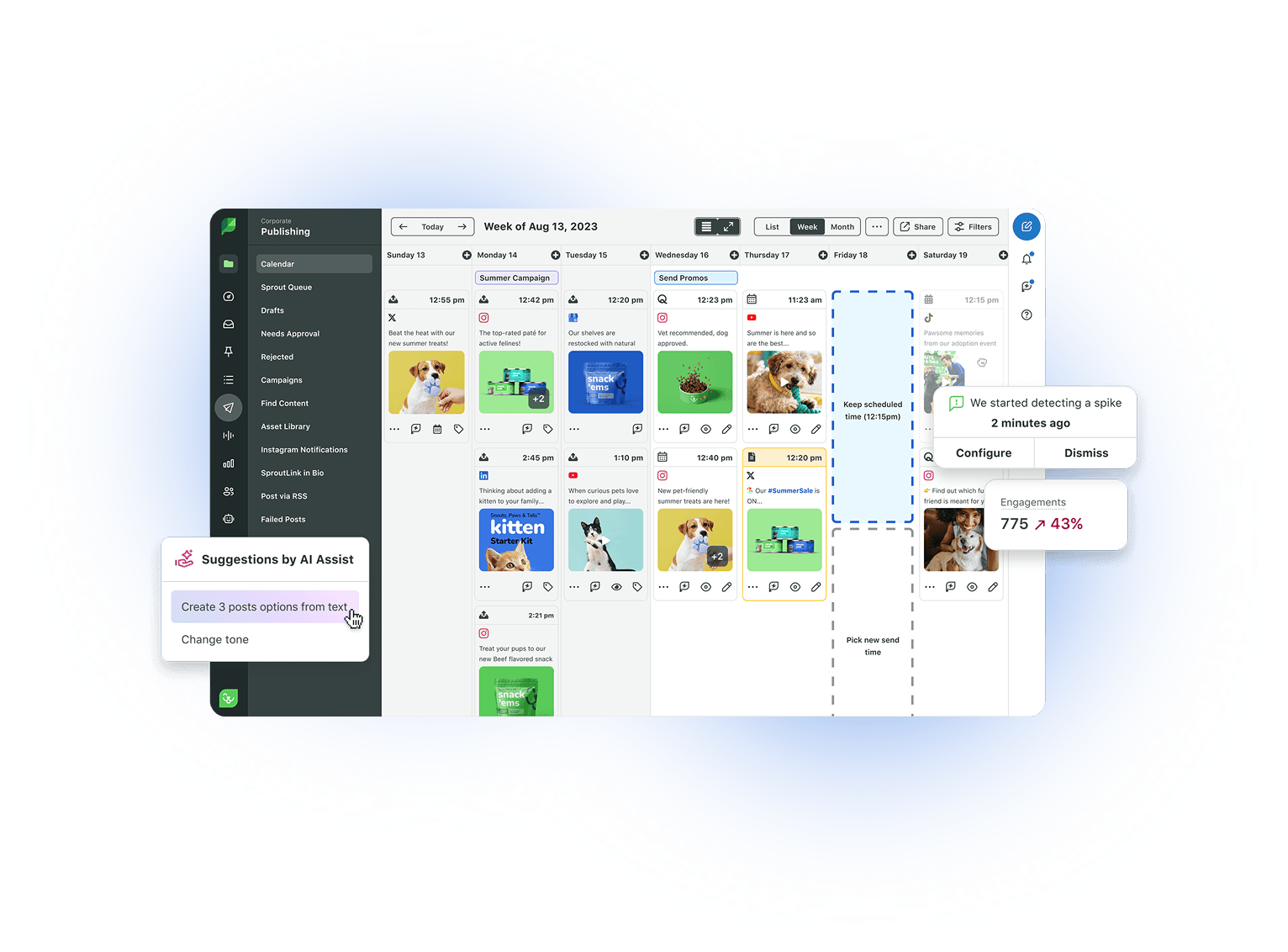
Sprout Social’s AI-powered platform integrates these benefits across every workflow—publishing, engagement, listening, analytics and influencer marketing—eliminating the need for disconnected point solutions. Every team works from the same real-time social intelligence, so insight and action happen in the same place.
| AI Capability | Sprout Social Feature | Business Impact |
|---|---|---|
| Social Listening & Sentiment Analysis | AI-powered Listening with sentiment tracking across 1B+ daily messages | Identify trends before they peak; monitor brand health in real-time |
| Content Personalization | Enhance by AI Assist for tone-matched customer responses | Scale personalized engagement without sacrificing authenticity |
| Content Generation | Message Ideas by AI Assist for on-brand content suggestions | Accelerate content creation while maintaining brand voice |
| Competitive Intelligence | AI-driven competitor analysis across networks | Benchmark performance; identify content gaps and opportunities |
| Customer Support Automation | Smart Inbox with intelligent routing and tagging | Reduce response time by 75% while improving satisfaction |
| Analytics & Reporting | AI-assisted report generation with automated insights | 75% reduction in reporting time; faster strategic decisions |
Ready to see the results for yourself? Start your free trial or schedule a personalized demo to see how AI transforms your specific workflows.
How artificial intelligence supports business functions
AI transforms core business functions, including marketing, product development, sales, customer support, HR, operations and security by automating routine work, surfacing real-time insights and enabling faster, smarter decisions. Teams that embed AI into their workflows move faster, engage customers more effectively and build a measurable competitive advantage.
Bonus Resource: Get our top five AI social media marketing resources in one convenient toolkit. Download it for customizable templates and tips to drive smart AI adoption in your role and across your organization.
Artificial intelligence in marketing
AI reshapes how brands engage customers and prove ROI. Marketing teams apply AI across nine critical areas:
- Social listening: Monitor brand sentiment and market trends in realtime
- Content personalization: Tailor messaging to individual customer preferences at scale
- Marketresearch: Extract insights from massive datasets to inform strategy
- Content generation: Accelerate creation with AI-powered suggestions
- Competitor analysis: Benchmark performance and identify competitive gaps
- International marketing: Analyze sentiment across multiple languages
- Predictive analytics: Forecast customer behavior and trends
- Targeting decisions: Identify high-value audience segments
- Media buying: Optimize ad placement and channel selection
AI-powered social media management platforms like Sprout Social integrate AI into social media conversations, translating vast amounts of data into actionable insights. You understand customer sentiment in real time, monitor brand health and respond swiftly to market trends, building stronger customer relationships and brand loyalty in the process.
AI personalizes content based on customer behavior, preferences and demographics. Sprout Social’sEnhance by AI Assist tailors responses based on the tone of incoming messages, ensuring replies resonate with the customer’s emotional state and deliver personalized experiences at scale.

AI dissects large datasets, revealing market trends, customer preferences and competitive landscapes so businesses make data-driven decisions with confidence. Sprout Social’s Message Ideas by AI Assist generates engaging content suggestions, helping marketers craft messages that align with their brand voice and audience interests without slowing down production.
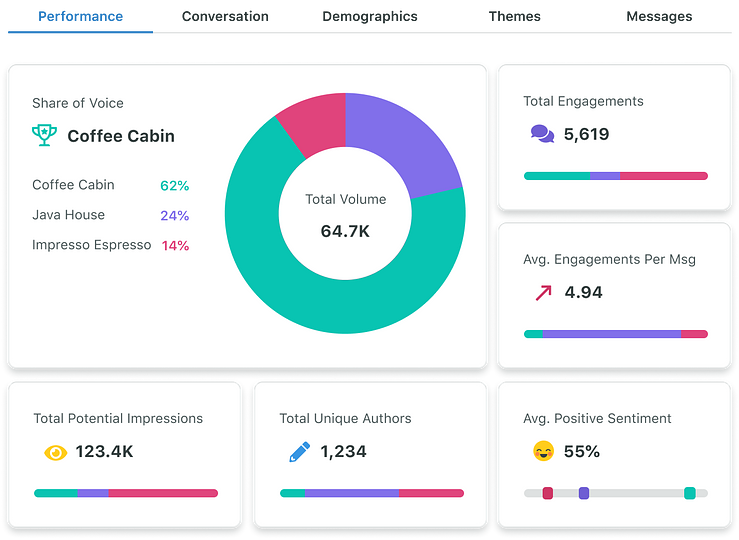
Competitor analysis powered by AI delivers detailed insights into competitors’ strategies and customer perceptions. By tracking audience growth, engagement, post volume, share of voice, sentiment and impressions across networks, you identify exactly where your brand leads and where it needs to close the gap.
AI’s ability to analyze multilingual sentiment helps businesses navigate international marketing by providing language support, cultural adaptation and market analysis. This produces more effective, targeted strategies for diverse global audiences.
Predictive analytics forecast future customer behavior by analyzing existing data to identify trends and preferences. This foresight ensures marketing strategies stay relevant and timely, catering to evolving customer needs before competitors catch on.
AI refines targeting decisions by identifying patterns and preferences within customer interactions, focusing marketing efforts on the audiences most likely to convert. Companies like Volkswagen use AI to determine the most effective channels and placements for advertising, improving campaign performance and revealing consumer behavior insights that manual analysis would miss.
Artificial intelligence in product development
AI moves product development beyond guesswork by analyzing market trends, customer feedback and historical data to produce products that meet current and future market needs. AI prompts guide designers toward innovations that satisfy demand and anticipate what customers will want next.
In project management, AI automates routine tasks, optimizes resource allocation and provides real-time progress insights. By analyzing historical project data, AI strengthens risk assessment and mitigation, producing faster, more proficient project delivery.
AI’s role in predictive maintenance uses data-driven analysis to identify patterns and anomalies and generate proactive maintenance recommendations, significantly reducing downtime and maintenance costs.
Artificial intelligence in sales
AI creates a new standard for sales efficiency and customer engagement. From email campaigns and lead scoring to proposal writing, AI improves both the sales process and its outcomes.
AI-driven analytics optimize email strategies by analyzing customer data and behavior to craft engaging, contextual content. It automates the drafting and sending of personalized emails at scale, ensuring each communication matches the recipient’s interests and needs.
In lead scoring, AI processes large volumes of customer data, including website behavior, demographics, firmographics, job title, purchase history and social media engagement to rank leads by conversion likelihood and streamline the sales process.
AI generates personalized, evidence-based sales proposals by helping sales teams create compelling visuals, presentation slides and copy that directly address customer needs, increasing the probability of closing deals.
Artificial intelligence in customer support
AI transforms customer support by enabling businesses to deliver more personalized, efficient service at scale. AI customizes customer interactions, automates ticketing and surfaces trend analysis to reveal deeper insights into customer preferences and behaviors.
AI analyzes customer data and interaction history to power personalized support experiences and recommendations. Customer Care by SproutSocial equips teams to build authentic customer connections at scale—using AI-powered sentiment analysis to turn every interaction into insightful data that fine-tunes care strategies and content.
AI streamlines the ticketing process by routing customer queries to the right agent or department, providing standardized responses for common queries and offering self-service portals so customers resolve issues independently. AI analytics tools then gather and examine customer data to surface insights into behaviors, preferences and trends—keeping service strategies aligned with what customers actually need.
Artificial intelligence in human resources
AI transforms HR by streamlining recruitment, strengthening employee engagement and surfacing workforce sentiment at scale. It analyzes employee feedback from surveys, performance reviews and social media to give businesses a clear, real-time picture of workforce needs.
AI automates resume screening, candidate sourcing and interview scheduling, saving time and increasing recruitment efficiency. Unilever uses AI to screen video interviews and analyze candidates’ body language, tone of voice and word choice, resulting in a significant increase in new hires from diverse gender, racial and socioeconomic backgrounds.
AI tools gather and analyze employee data to surface insights into behavior, preferences and trends, supporting the refinement of HR strategies and fostering a more satisfied, productive workforce.
Artificial intelligence in operations
AI increases operational efficiency and drives innovation through automated processes and optimized asset management. Intelligent automation combines AI with robotic process automation (RPA) to strengthen decision-making and streamline workflows—enabling companies to proactively refine processes before problems surface.
AI-powered automation is critical for Business Process Management (BPM), which automatically analyzes optimal methods at different stages and creates replicable models. In procurement, for example, BPM automates the entire purchasing process, increasing profitability, accountability and productivity while reducing errors.
AI transforms inventory management by forecasting demand with precision and maintaining optimal stock levels. Heineken uses machine learning algorithms to predict demand patterns and maintain optimal inventory, lowering storage costs and increasing customer satisfaction by ensuring products are available when needed.
Artificial intelligence in fraud detection and security
AI proactively detects, counters and minimizes security risks by processing extensive data in real time to spot patterns and anomalies that signal breaches or fraudulent activity. Organizations across industries now treat AI-powered threat detection as a core operational requirement, not an optional upgrade.
Monitoring media threats:AI continuously scans digital spaces for potential security threats to brands—a critical capability as threats emerge across an expanding range of online channels.
Identifying physical anomalies: AI algorithms detect unusual patterns in sectors like retail, banking and public safety, enabling swift recognition and response to physical threats. Mastercard uses AI to help banks predict scams in real time—before any money leaves a victim’s account—thwarting fraudulent attempts and minimizing damage.
Real-world examples of AI in business
AI in business delivers its most measurable impact where teams do their daily work, cutting decision time, surfacing signals faster and eliminating tasks that drain human potential. These aren’t abstract case studies. They’re the kinds of results already showing up across marketing, sales, operations and beyond.
Here’s where that impact shows up most clearly.
Marketing
Marketing teams use AI to act on what matters, not what’s loudest. AI surfaces audience signals, content patterns and emerging trends before teams even know to look for them.
- Social listening tools powered by AI detect shifts in audience sentiment before they peak, giving teams time to lead the response rather than chase it.
- AI analyzes past content performance to recommend the right message, format and timing for each audience segment.
- Companies like Volkswagen use AI to determine the most effective channels and placements for advertising—improving campaign performance and revealing consumer behavior insights that manual analysis would miss.
The result is a marketing team that executes with confidence instead of guessing with data.
Customer care
Speed and personalization define great customer care, and AI makes both possible at scale. According to the 2025 Sprout Social Index™, 73% of social media users expect brands to respond within 24 hours.
- Incoming messages are automatically routed to the right team based on topic, urgency and sentiment.
- AI flags high-priority conversations so agents focus on interactions that need immediate attention.
- Response suggestions help teams reply faster without sacrificing the human tone customers expect.
AI handles the triage. Your team handles the relationship. That balance is what keeps customers loyal.
Sales
Sales teams win when they focus on the right opportunities at the right time. AI makes that focus precise.
- Lead scoring models identify which prospects are most likely to convert, so reps direct their energy accordingly.
- AI analyzes engagement signals to recommend the best moment for outreach.
- Automated follow-up sequences keep deals moving without requiring manual effort at every step.
The strongest sales teams use AI to remove friction from the process, not to replace the human judgment that closes deals.
Operations
Operational efficiency is where AI delivers its quietest but most significant wins.
- Repetitive, rules-based tasks get automated, freeing teams to focus on work that requires critical thinking.
- AI-powered forecasting gives leaders earlier visibility into demand shifts, resource gaps and potential bottlenecks.
- Heineken uses machine learning algorithms to predict demand patterns and maintain optimal inventory, lowering storage costs and increasing customer satisfaction by ensuring products are available when needed.
When operations run on better data and faster signals, the entire business moves with more precision.
Human resources
Building the right team starts with finding the right people. AI removes the guesswork from recruitment and workforce planning.
- Unilever uses AI to screen video interviews and analyze candidates’ body language, tone of voice and word choice—resulting in a significant increase in new hires from diverse gender, racial and socioeconomic backgrounds.
- AI tools gather and analyze employee data to surface insights into behavior, preferences and trends, supporting the refinement of HR strategies and fostering a more satisfied, productive workforce.
Fraud detection and security
AI proactively detects and minimizes security risks before they escalate.
- Mastercard uses AI to help banks predict scams in real time—before any money leaves a victim’s account—thwarting fraudulent attempts and minimizing damage.
- AI continuously scans digital spaces for potential brand threats, enabling swift recognition and response across an expanding range of online channels.
The strongest examples of AI in business aren’t flashy. They solve real problems, save meaningful time and help teams make decisions they can stand behind.
What AI in business means for different stakeholders
AI in business affects every stakeholder differently, and understanding those differences is how leaders make smarter decisions about adoption, communication and strategy.
For employees
AI removes repetitive, time-consuming tasks from employees’ plates: data entry, report generation and routine customer queries. That shift moves strategic thinking, creative judgment and relationship-building to the center of every role.
The result isn’t replacement—it’s reallocation. Teams get their time back for the work that requires a human.
For businesses
AI gives organizations the ability to move faster without sacrificing quality. Decisions that once required days of manual analysis now happen in real time, backed by stronger data and clearer signals.
Businesses that embed AI into their core workflows don’t just cut costs—they build a structural benefit that compounds over time.
For investors
AI adoption signals operational maturity to investors. Organizations that use AI effectively demonstrate smarter resource allocation, faster decision-making and a clearer path to long-term competitiveness.
AI-powered businesses adapt to market shifts, scale without proportional headcount growth and sustain performance under pressure, exactly what investors want to see.
For the public
When businesses adopt AI, customers feel it before they can name it: faster service, more personalized experiences and quicker issue resolution. But trust, privacy and transparency are non-negotiable, not afterthoughts.
Brands that communicate clearly about their AI practices and use the technology to serve customers build stronger, more durable relationships. The organizations that get this right treat AI as a tool for connection, not just efficiency.
| Stakeholder | Primary impact | What they gain |
|---|---|---|
| Employees | Automation of repetitive tasks | More time for strategic, creative and relationship-driven work |
| Businesses | Faster, data-backed decisions | Operational efficiency and compounding competitive benefits |
| Investors | Signal of operational maturity | Confidence in scalability and long-term performance |
| Public | Improved customer experience | Faster service and more personalized interactions, when trust is earned |
Getting started with AI in business
Starting with AI in business means identifying your highest-friction workflows first, then deploying targeted solutions that deliver measurable results fast. No complete tech overhaul required.
Pinpoint where your team loses the most time. Customer care teams drowning in message volume, marketers pulling performance reports and social teams guessing at optimal post times are exactly where AI creates immediate impact.
Sprout Social embeds AI directly into the workflows your team already uses, so adoption is immediate and ROI is provable. According to the 2025 Impact of Social Media Report, teams that use social media management tools are 58% more likely to be rated as experts at measuring the business impact of social.
How to use Sprout Social to put AI to work immediately
You don’t need to redesign your workflow to get results from AI. Here’s where to start inside Sprout Social:
- Set up social listening topics. Use Sprout Social’s Listening tool to monitor brand sentiment, track competitors and surface emerging trends in real time. Analyze by AI Assist surfaces key themes and sentiment shifts from your data automatically, with no manual analysis required.
- Activate your Smart Inbox. Sprout Social’s Smart Inbox centralizes every message across your connected profiles and classifies each one by sentiment. Your team sees what needs attention first without sifting through everything manually.
- Use Enhance by AI Assist for customer responses. When replying to incoming messages, Enhance by AI Assist matches the tone of your response to the sentiment of the incoming message—so every reply feels human and on-brand, even at high volume.
- Track performance with AI-powered reporting. Sprout Social’s analytics tools surface performance data across every connected network in one dashboard. Your reporting time drops. Your decision speed increases.
Once you deploy, track these baseline metrics to build your business case:
- Response time: Measure how quickly your team resolves customer inquiries before and after AI implementation.
- Engagement rate: Track whether AI-assisted content recommendations increase audience interaction.
- Reporting efficiency: Quantify hours saved on manual data analysis and report generation.
- Team productivity: Monitor output volume per team member as AI absorbs repetitive tasks.
The data you collect becomes your executive pitch. Marketing leaders say demonstrating how social campaigns tie to business goals is the number one factor in securing continued investment, per the Index.
Future of AI in business
The future of AI in business belongs to brands that move from reactive to predictive. Agentic AI—systems that don’t just analyze data but take autonomous action to achieve specific goals—is already reshaping how businesses operate at every level.
Three transformative developments define where AI in business is headed next:
- Agentic AI systems: AI agents that autonomously flag issues, draft solutions, route to experts and update customers—all in seconds, without human intervention
- Multimodal AI models: Systems that process text, images, video and audio simultaneously, giving brands the ability to track visual trends and sentiment with the same precision as text-based signals
- Real-time adaptive learning: AI that refines its understanding of your brand voice and audience preferences—no manual retraining required
The gap between AI-native businesses and those still operating on legacy workflows will widen fast. Brands that embed agentic AI across their social intelligence workflows, not just isolated features, turn insight into coordinated action before competitors even see the signal. That’s the competitive advantage Sprout Social’s platform is built to deliver.
Put AI to work for your business
Organizations using Sprout Social’s AI-powered platform achieve 233% ROI and a 75% reduction in reporting time, according to Forrester’s Total Economic Impact study. That’s not a future outcome—it’s the result teams are seeing right now.
The business case for AI: Organizations using Sprout Social’s AI-powered platform achieve 233% ROI and a 75% reduction in reporting time, according to Forrester’s Total Economic Impact study.
AI in business has moved from experimentation to essential infrastructure. From marketing and customer care to operations and competitive intelligence, AI-powered tools deliver measurable outcomes: increased efficiency, deeper audience insights and real differentiation in crowded markets.
The businesses winning with AI aren’t chasing every new technology. They’re deploying it where it amplifies human expertise and drives tangible results. High-impact applications include:
- Social listening: Analyze sentiment across billions of daily messages to surface what your audience thinks
- Customer personalization: Respond at scale without sacrificing the authenticity that builds loyalty
- Data analysis: Turn raw social data into executive-ready insights that prove ROI
Sprout Social’s AI-powered platform makes this transformation immediate. Customers achieve 233% ROI while cutting reporting time by 75%, freeing your team to focus on strategy, not spreadsheets.
See how AI transforms social media marketing and customer care. Schedule a demo or start your free trial to explore Sprout Social’s AI-powered features.
Frequently asked questions about AI in business
Why do 85% of AI projects fail, and how do you avoid that?
Research shows that the majority of AI initiatives fail to deliver on their original promise, and the culprit is almost never the technology itself. Strategy gaps are the real reason: unclear goals, poor data quality and low team adoption kill more AI projects than any technical limitation ever has.
Brands that succeed treat AI as a business tool with a specific problem to solve and a clear definition of success before a single tool is deployed. Strategy and execution determine outcomes. Hype does not. The fix is straightforward: start with one high-friction workflow, set a measurable goal and track results before expanding.
What is the difference between AI, machine learning and automation in business?
These three terms are distinct and confusing them leads to misaligned expectations.
- AI is the broad capability—technology that enables machines to perform tasks requiring human intelligence, like understanding language or recognizing patterns.
- Machine learning is the method AI uses to improve over time, learning from data and getting smarter with every interaction.
- Automation is the execution layer—carrying out defined tasks like routing messages, scheduling content or generating reports without human intervention.
AI is the brain, machine learning is how it grows and automation is the hands that do the work.
How do you measure the ROI of AI in business?
AI ROI shows up in outcomes your business already tracks. Measure it across these areas:
- Time saved on manual and repetitive tasks
- Faster response times in customer care and communications
- Stronger decisions backed by real-time data
- Improved conversion rates from more relevant, timely content
- Reduced effort across reporting, analysis and workflow management
The clearest ROI emerges when AI removes friction from high-volume work and frees your team to focus on strategy—that’s where the compounding value builds.
Is AI replacing human jobs in business?
AI reshapes work; it does not erase the need for people. The best results come when AI handles repetitive, high-volume tasks while humans lead strategy, creativity and relationship-building.
Teams that treat AI as a collaborator move faster, make smarter decisions and deliver better outcomes for their customers and their business.


Share