AI in marketing examples and strategies you can use today

Written by Jamia Kenan
Published on May 6, 2026
Reading time 6 minutes

Table of Contents
There are a few universal questions that keep marketing leaders up during the quiet hours of the night: How do we do more with fewer resources? And how do we make a bigger impact without burning out our teams? How do we save time and effort while maintaining quality?
Enter the impetus for solving these challenges: artificial intelligence (AI).
AI marketing is enabling brands to increase efficiency, transform their strategies and achieve impactful results. Marketers are using AI tools to support customer segmentation, customer care, content creation, predictive analytics, reporting and more. In this article, we’ll share AI in marketing examples to inspire your strategy. And we’ll share everyday examples of AI in marketing that you’ve probably seen from top brands.

How has AI impacted marketing
AI is transforming the marketing industry partly because of its vast applications. AI tools can automate routine tasks, freeing up valuable time and allowing you to focus your efforts on strategizing. But task automation is just one example of AI use cases in marketing.
AI empowers you to analyze vast amounts of data to better understand your target audience’s consumer preferences and behaviors. You can use this data to predict consumer behavior, optimize campaigns in real-time and deliver highly personalized content to mold an exceptional customer experience. Beyond analytics and reporting, generative AI tools can support content creation.
This dual impact of enhanced personalization and increased efficiency is revolutionizing business decisions and how brands engage with customers.
Examples of AI in marketing that you can use today
Even if you don’t realize it, you’re likely already interacting with AI. Have you used Siri or Alexa? That’s AI. Ever purchased an item suggested to you while online shopping? That’s AI. Seeing companies that use AI and how these AI marketing tools are elevating customer experiences can inspire how your organization uses AI.
AI examples for personalized content and recommendations
Social media personalization makes audiences feel connected to your brand, which inspires loyalty and conversions. It is one of the most common use cases for AI in marketing as well.
Netflix uses AI to customize streaming experiences
AI can analyze customer behaviors to customize their website experiences and provide personalized product recommendations. For example, Netflix uses AI algorithms and machine learning in their product to provide recommendations for TV shows and films based on previous watch history.
The streaming service also uses Aesthetic Visual Analysis (AVA) to select the best thumbnail to display on a user’s home screen. AVA is a set of algorithms that filters through movies and shows to pinpoint the best frames for thumbnails, which is known as a frame annotation. Once frames are identified, Netflix uses data collected from your interactions on the platform. For instance, it analyzes your location, most watched genres, time spent watching and more.

Nike combines AI with augmented reality to create the perfect fit
Through Nike Fit, customers can scan their feet using a smartphone and get their exact shoe size. This feature was created after Nike shared that over 60% of people wear shoes that don’t fit correctly and half a million purchase the wrong size each year. Nike Fit uses visual data points to create a 3D model of your foot.
The sportswear brand also uses generative AI modeling to design new personalized products. Through the Athlete Imagined Revolution (AIR) project, Nike used AI to create prototype shoes for top athletes like Kylian Mbappé.

Examples for chatbots and conversational AI
Customer service chatbots can provide support 24/7, answer common FAQs and resolve customer issues efficiently. Chatbots can aid customer care professionals by addressing customers when agents are offline or by supporting escalation. As chatbots become a foundational part of customer care, consumers are seeking interactions that feel more realistic. Conversational AI uses text and speech-based tools like chatbots and virtual agents to create more human-like experiences.
Amazon’s Alexa uses automatic speech recognition (ASR)
You’ve probably heard someone say something along the lines of “Siri, call my mother.” This is one example of a voicebot, a type of chatbot that listens to vocal commands, performs set actions and replies to users in a natural speech pattern.
Along with having a conversation with you, Amazon’s voice assistant Alexa can perform various tasks like playing music, reporting weather and news, and controlling smart home devices. Voice assistants use automatic speech recognition in combination with other AI technologies to analyze speech patterns and provide voice-enabled experiences.

Salesloft uses chatbots to support lead generation
AI can be used for lead generation to engage website visitors. Salesloft helps customers transform website visitors into customers through Drift. For example, Drift Bionic Chatbots deploy chatbots in real-time with personalized responses. These bots can ask questions, provide responses and route conversations to a human sales representative if necessary. You can integrate the bot with your CRM to capture and manage lead data. These bots can also be trained to recognize your brand voice.
AI examples for predictive analytics and customer insights
Each year Pinterest releases Pinterest Predicts, a report that forecasts consumer and industry trends through their machine learning predictive methodology. But AI analytics can also be used for other predictive analytics like churn prediction and customer insights for campaign performance. These AI insights help businesses avoid losing customers and determine if their efforts are successful.
Salesforce uses machine learning and predictive analytics
Salesforce Einstein AI uses machine learning and predictive analytics to analyze historical customer data and pinpoint patterns that indicate potential churn. This AI-powered tool allows you to define specific features or that are connected to churn prediction, such as purchase history, demographics and interactions. Salesforce has an integration with Sprout, Agentforce. Sprout’s integration with Agentforce accelerates case resolution time and surfaces customer insights right where care agents already work—in Service Cloud. Salesforce’s Agentforce Assistant for Service Cloud also enables agents to more easily personalize responses to customers and enhance their customers’ overall brand experience.

Using data from Sprout and Service Cloud, Agentforce can surface answers about how a customer has previously interacted with your brand—on social and beyond—so agents get insights without digging for information, improving their time to resolution and the quality of your social customer care. Sprout is also the only social media management platform powering social data in Salesforce’s conversational AI.
Google Ads
Google Ads uses customer insights to improve campaign performance tracking by analyzing user behavior and preferences. This data is used to improve ad targeting and ensure ads reach the most relevant audience. Google Ads employs algorithms to predict which ads are likely to perform best, empowering marketers to make data-driven decisions. By monitoring and adjusting campaigns based on these insights, Google Ads helps businesses achieve stronger results and reap a better return on investment.
Examples for AI-powered content creation
The use cases for AI social media content creation are wide. AI can be used to support copywriting for social media captions and product descriptions, along with brainstorming for blog posts and videos.
Shopify Magic uses AI designed for e-commerce
Product descriptions play an essential role in convincing customers to convert. Shopify Magic will generate a description for you within seconds based on details about your product, customer information and keywords you want to rank for on search engines. This feature also supports eight languages. Along with Shopify Magic, the e-commerce platform offers the ability to integrate other AI-powered tools. For instance, there are a number of chatbots you can install on your website.
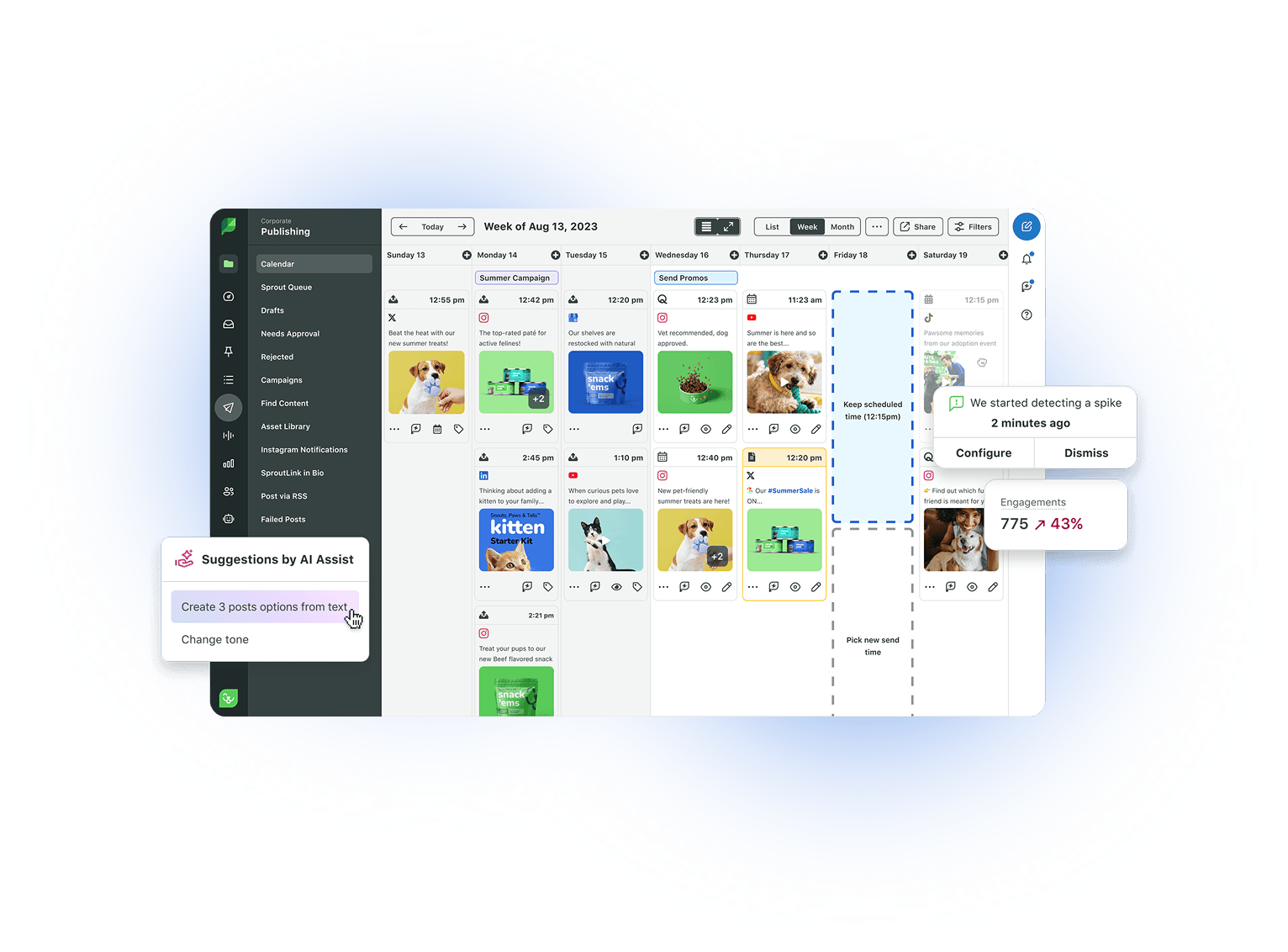
Sprout Social’s Suggestions by AI Assist support copywriting
Sprout’s Suggestions by AI Assist can support copywriting for social media by generating tailored copy that align with your brand’s voice and audience preferences. You can also choose from different tone options such as informative, humorous or persuasive to further refine your messaging. The tool analyzes past performance and trending topics to provide relevant and engaging suggestions, helping you create posts that resonate. AI Assist also optimizes your copy for different social networks so each post is suited to the unique traits and audiences of platforms like Instagram and LinkedIn. Using Suggestions by AI Assist help you save time while also enhancing the quality and effectiveness of your social media copy.

Prepare the next generation of marketers to use AI
Understanding the different AI in marketing examples is the first step to improving your strategies and achieving better results. As the digital landscape continues to evolve, staying informed and adaptable will enable you to save more time and effort. To further explore how AI can revolutionize your marketing efforts, see our AI marketing strategy guide.
Frequently asked questions about AI in marketing
How is AI used in marketing?
AI in marketing analyzes data, personalizes campaigns, automates customer interactions and sharpens reporting so teams make faster, smarter decisions at scale.
What are the main types of AI used in marketing?
- Generative AI: Creates copy, images and video content at speed.
- Predictive AI: Forecasts campaign outcomes and audience behavior.
- Conversational AI: Powers chatbots and real-time customer care.
- Analytical AI: Surfaces trends in campaign and audience data instantly.
How do marketers measure the ROI of AI?
Tie AI use to a specific business goal first, then track its impact on efficiency, engagement, response times and revenue. According to the 2025 Indexae, 58% of teams rated as experts at measuring social’s business impact rely on social media management tools to do it.


Share