Social media ROI statistics marketers need to know in 2026

Written by Jacqueline Zote
Published on May 14, 2026
Reading time 9 minutes

Table of Contents
Social media ROI reports often present a challenge: a disconnect between available metrics and actual business impact.
Reach and impressions don’t always equal immediate ROI, but they are undeniable indicators of social’s broader impact. Teams should focus on framing these metrics into a larger story that demonstrates their measurable contribution to business objectives, including revenue. But even robust data can fall flat without the right story to tie it to business goals.
The 2025 Sprout Social Index™ reveals the expectations of leaders:
- 65% want to see direct connections between social media campaigns and business goals.
- 52% want quantifiable cost savings across social channels.
- 45% want better visualizations of social data.
Armed with clear benchmarks and industry statistics, you can confidently prove what’s working. It empowers you to defend your social media marketing strategy and make smarter decisions that drive future success.
Let’s look at some of the top social media marketing ROI statistics to help you see how your performance compares to the rest of the industry.
Social media ROI benchmarks for 2026
These social media ROI benchmarks are conversation starters—not absolute ceilings. While Facebook often dominates the conversation, what works for the average marketer might not work for you.
What’s the average ROI for social media marketing? Across most industries, a 3:1 return is considered the standard baseline, while a 5:1 return is a strong benchmark for paid campaigns. These statistics reflect perceived and actual social channel performance based on audience behavior. Your own data will provide more insights into what works for your target audience.
Knowing that industry averages are just a starting point, here are platform-specific social media marketing ROI benchmarks to consider in 2026:
1. Consumers make purchases on Facebook first
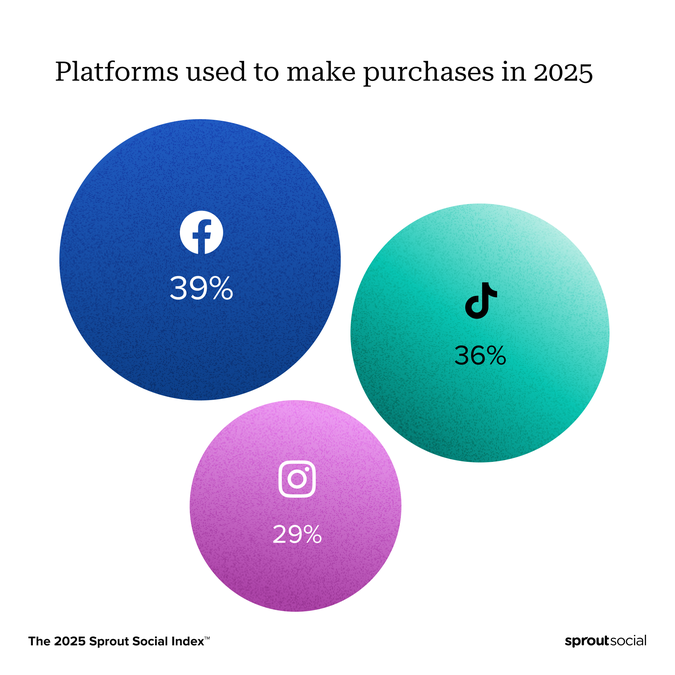
When consumers are ready to make a purchase on social media, Facebook is the first network they turn to. According to the 2025 Sprout Social Index™, 39% of consumers turn to the platform to make a purchase. TikTok follows close behind at 36% and Instagram at 29%.
The pattern flips for Gen Z: TikTok is the clear frontrunner for their social media purchases.
2. B2B marketers rate Facebook’s ROI highest
A Statista survey reports that Facebook leads in perceived B2B ROI, with 22% of respondents saying it’s the highest. Instagram, TikTok and YouTube came in second, each was mentioned by 16% of respondents.
3. Facebook is the top ROI social channel for 70% of marketers
The impact of Facebook extends beyond B2B, with the platform delivering strong ROI for marketers in general. Seventy percent of marketers in Sprout Social’s 2026 Social Media Content Strategy Report say it has the strongest impact on their business among social platforms.
Other studies back up these findings.
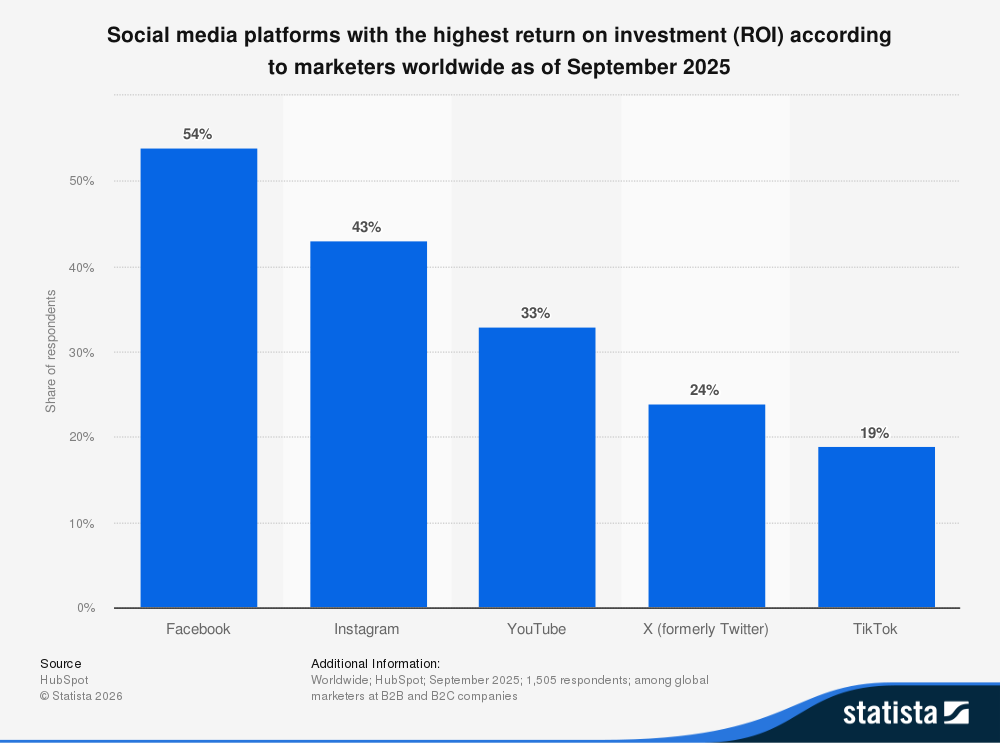
A global survey of marketers in September 2025 revealed that Facebook delivers the highest ROI (54% of respondents). Instagram came in second (43% of respondents), followed by YouTube (33%), X (24%) and TikTok (19%).
Source: Statista
These numbers make sense given Facebook’s role in driving product discovery and purchases. According to the same Sprout report, it’s the #1 network for product discovery. Nearly 40% of social media users use Facebook to find new products.
4. Many marketers trust LinkedIn to deliver a positive ROI
Trust in LinkedIn to deliver positive ROI is high among marketers. A global August 2023 social media marketing survey showed marketers’ confidence level reached 70%.
Instagram followed LinkedIn with a 68% trust rate for positive ROI. WhatsApp rounded out the top three at 66%. X (formerly Twitter) saw 70% of marketers indicating a lack of trust in its ability to provide positive ROI.

Source: EMARKETER
Key social media advertising ROI stats by platform
In social media, smart execution beats platform selection. The data shows that while networks battle to boast the highest ROI, real performance gains hinge on execution: visible logos, quality creative, brand-focused marketing campaigns and full-funnel approaches boost your returns.
The following social media advertising statistics show that a well-executed campaign can crush a poorly executed one, regardless of network.
5. Facebook has the highest social media ad ROI
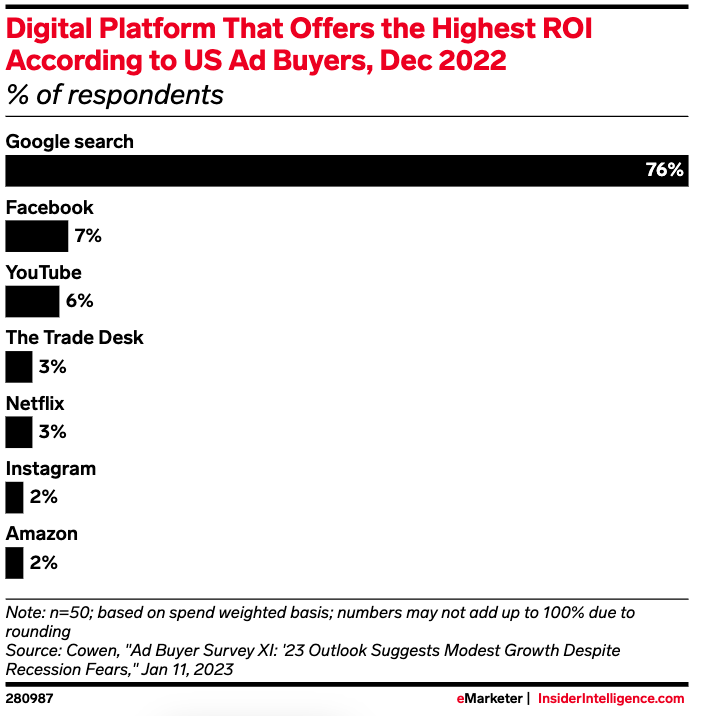
According to a December 2022 survey of US ad buyers, 7% of respondents believe Facebook offers the highest social media ad ROI, with YouTube at 6%.
While social’s combined 15% doesn’t rival organic search’s 76%, the data reminds us why savvy marketers use social as part of a broader marketing strategy rather than placing all bets on search. An integrated approach maximizes the unique advantages each platform offers.
Source: EMARKETER
HawkSEM claims advertisers can expect a good Facebook ads campaign to yield ROI between 4x and 5x of spend. Layer your campaign with expert strategies, and you can multiply your ROI.
6. TikTok ads deliver a short-term ROI of 11.8
TikTok’s own research with Dentsu highlights its strong ROI potential, with an impressive short-term ROI of 11.8 and an average long-term ROI of 4.5.
The study also shows that 75% of advertisers achieved their highest ROI on TikTok compared to other social channels.

Source: TikTok
7. A full-funnel YouTube strategy drives a 9% increase in conversions
You can do more on YouTube than build brand awareness. Google’s internal data demonstrates that combining top and bottom funnel approaches creates a stronger connection with viewers that pays off in measurable returns.
8. Awareness formats drive 28% of conversion assists for advertisers
A Think with Google study shows the danger of underestimating the impact of awareness content on your conversion rate goals. Those early upper-funnel touchpoints do a lot of heavy lifting behind the scenes, prepping your audience to be more receptive to your conversion ads later.
9. Creative fuels nearly 50% of YouTube ROI
The quality of your social media ad creative will have a bigger impact on your YouTube ad spend than almost anything else. According to the same Think with Google research, creativity will account for nearly half of your campaign’s return. If your ads follow YouTube’s ABCD guidelines (attention, branding, connection, direction), you could see a 30% higher sales lift.
10. LinkedIn ads deliver a 113% ROAS
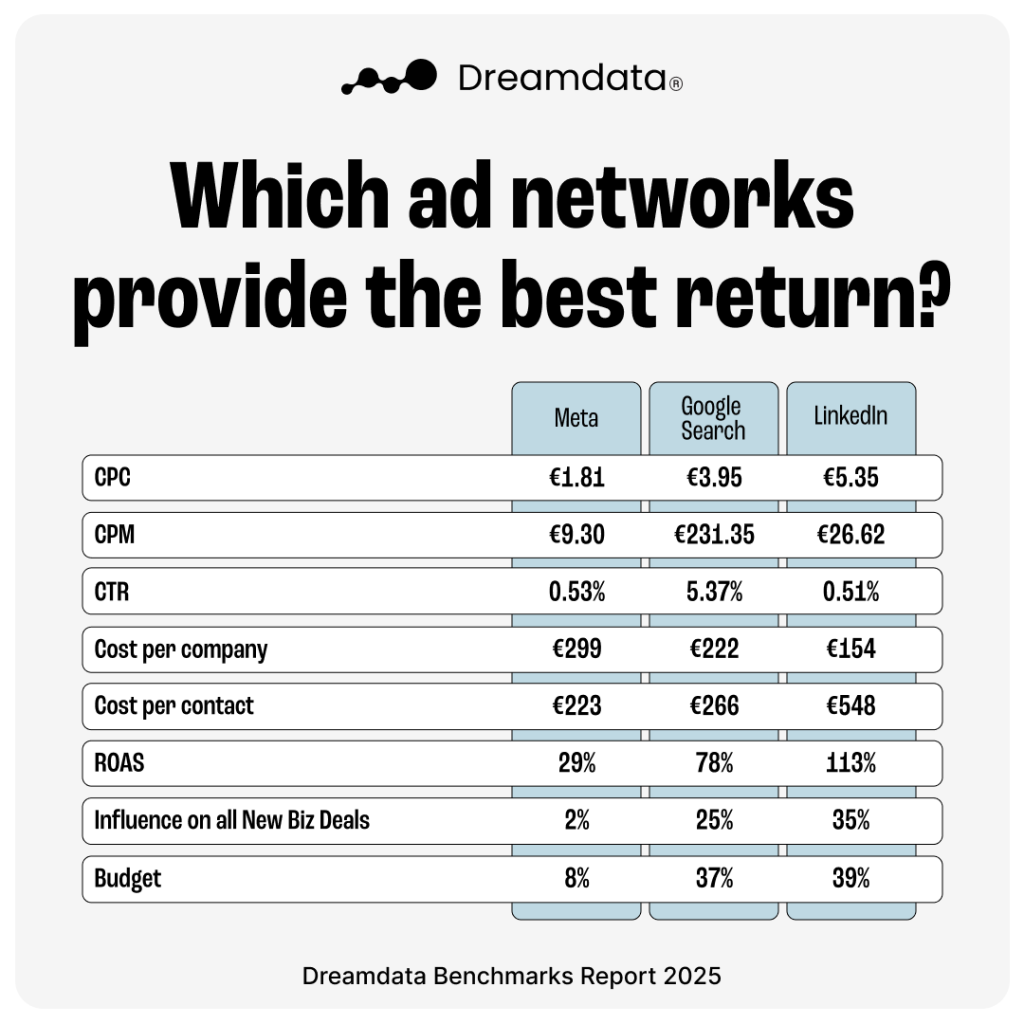
When it comes to the immediate revenue generated from advertising, a Dreamdata analysis found that LinkedIn offers a 113% return on ad spend (ROAS) compared to Meta’s a 29% ROAS.
This directly aligns with the platform’s focus on high-ticket B2B purchases.
Source: LinkedIn
11. Brand-metric focused LinkedIn campaigns impact business results
Research from Les Binet and Peter Field for LinkedIn’s B2B Institute shows that brand-focused campaigns achieve four times the bottom-line impact compared to campaigns that don’t prioritize brand metrics.

Source: LinkedIn
Brand-focused campaigns are also more likely to show a 50% improvement in short-term activation metrics, including marketing qualified leads (MQLs). The companies with the most effective lead generation strategies have 71% more brand-focused marketing roles on their teams.
12. Visible logos on ads can drive 5x ROI on Facebook
Research from Meta and Analytic Partners reveals that making your logo visible, especially within the first two seconds of an ad, can result in 5X higher ROI on Facebook. The research also indicates that format matters. Ads optimized for mobile—using square and tall formats—nearly double returns compared to assets that aren’t mobile-friendly.
13. Video ads deliver higher ROI than static images on Instagram
According to SQ Magazine, video and Reels-based ads beat static image formats when it comes to delivering returns. These formats see a 38% higher engagement and ROI, highlighting the strong influence of audio-visual formats on ad audiences. They offer a quick and visually stimulating way to get your message across, share product information and guide buying decisions.
Meanwhile, carousels and multi-asset formats also have a stronger impact on ROI than single-image ads. They see a 72% higher conversion rate, which indicates that presenting users with different options ultimately improves their chances of converting.
Seeing the role that your ad creative plays in driving ROI, it’s vital that you keep testing and pivoting to optimize it for your Instagram advertising campaigns.
14. User-generated content drives ROI for Instagram ads
User-generated content featuring real customers, reviews and testimonials provides social proof. This gives social users the confidence to go through with a purchase even if they’ve only just discovered the product.
That’s exactly why Instagram ads featuring UGC creative get a 28% higher engagement and 29% higher conversion rates than brand-generated creative, according to SQ Magazine.
Trends impacting ROI in 2026
Social media delivers marketing ROI when it functions as a product education, customer support and community channel all at once. To succeed, marketers must move past separating content, care and commerce and work to connect all three intentionally and visibly on each network.
15. Social networks accounted for 15.2% of all online sales
According to Statista research, social networks generated 15.2% of total online sales in 2026.
This will only grow as platforms ramp up their in-app shopping features and adopt native checkout to drive social commerce. The global social commerce sector is seeing steady growth, with annual revenue jumping from $683.85 billion in 2024 to $819.78 billion in 2025. According to projections, global social commerce revenue will hit the $1 trillion mark by 2027.
16. Social media drives impulse purchases for 81% of consumers
Social content’s direct influence on consumer spending proves its bottom-line impact. According to the 2025 Sprout Social Index™, 81% of consumers are swayed by social media to make spontaneous purchases multiple times a year.
Plus, with more consumers making in-app purchases (currently at 13% overall and rising to 50% with Gen Z), it’s getting easier to track where sales and revenue are coming from.
17. Influencer posts inspire monthly purchases for 49% of consumers
According to Sprout Social’s State of Influencer Marketing Report, Gen Z and millennials are most likely to buy products recommended by influencers, doing so daily or weekly. But the reach of influencers has no demographic borders: 86% of all consumers make at least one influencer-driven purchase a year, cementing the role of social media creators in buying decisions.
For those who buy frequently, the influencer’s posting frequency and follower count matter the most.

18. Short-form videos are the top ROI driver for 71% of video marketers
A December 2024 Statista survey confirms short-form video reigns supreme as the revenue powerhouse of social content marketing. The competition isn’t even close. Only 22% of marketers said long-form video had the highest ROI, and live video lagged further behind at 6%.
19. Consumers increasingly prefer a human-led social presence
Despite the growing investment in AI for content creation, consumers on social media expect brands to maintain a more human-led presence. According to the 2026 Social Media Content Strategy Report, human-generated content is the top priority consumers expect from brands.
They also want brands to prioritize personalized customer service, emphasizing a desire for human connection.
Marketers who align their strategies according to these priorities have a strong chance of differentiating themselves and maximizing their social media ROI.
20. Real-time insights and AI-powered reporting offer a competitive advantage
When asked what would increase their social media impact, marketers in the 2026 Social Media Content Strategy Report cited real-time insights. Specifically, real-time insights into what their audience wants to consume will help them show up on social media in a way that resonates.
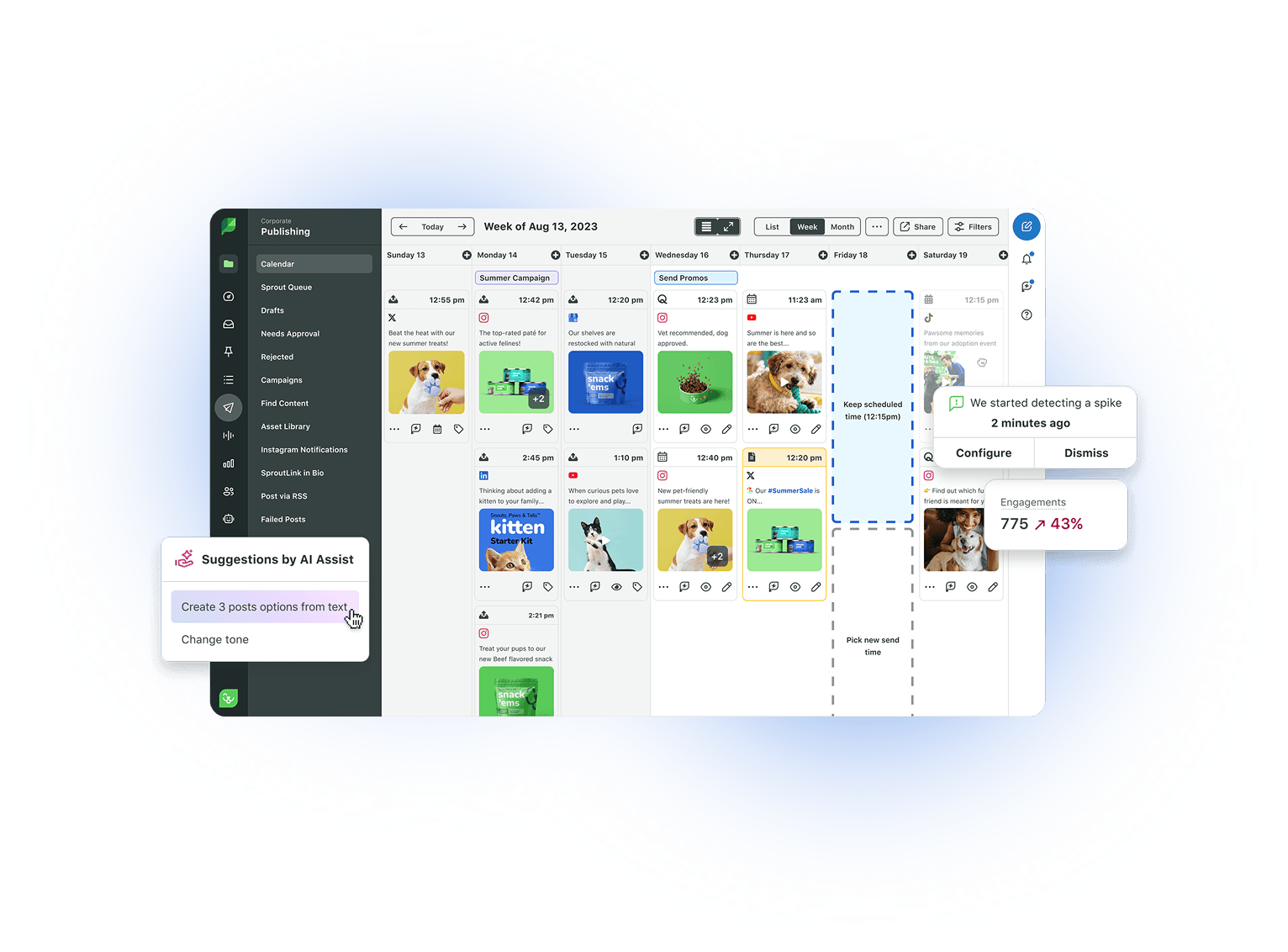
Using AI-powered analytics, like Sprout Social’s Premium Analytics and Listening tools, allows teams to get timely intelligence into audience cravings.
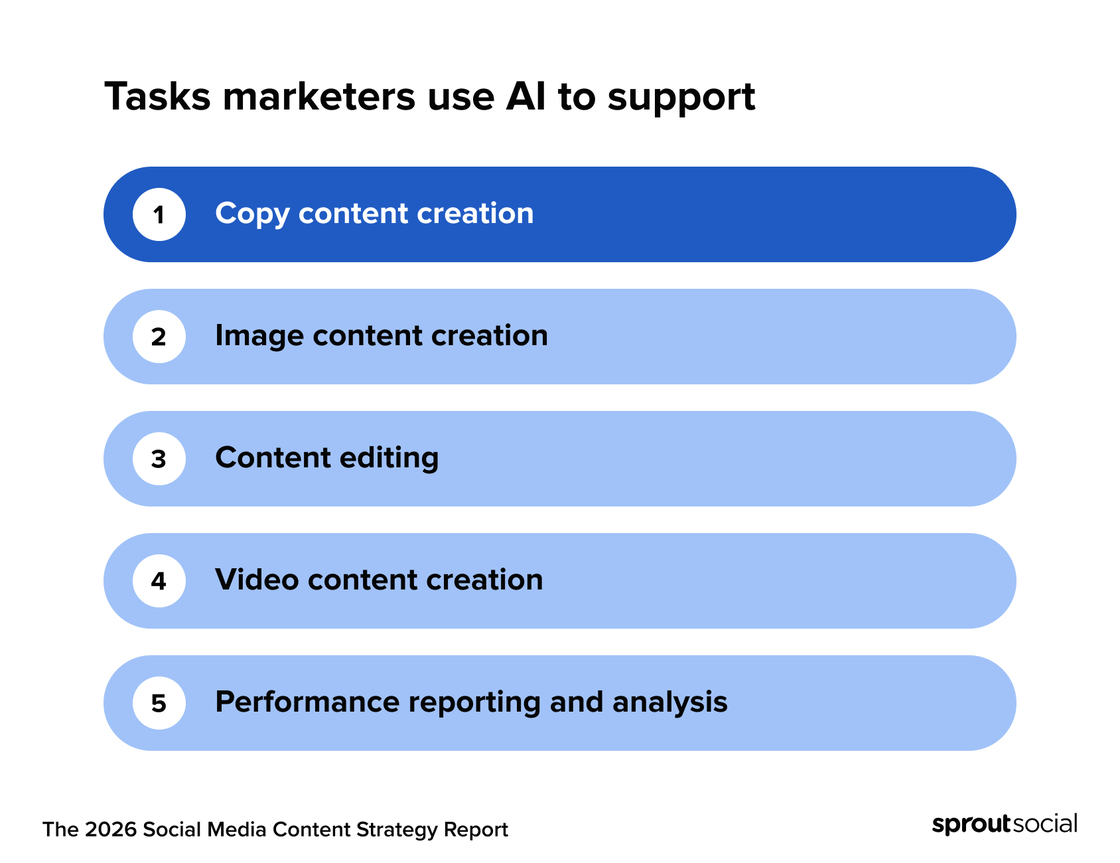
Yet only 40% of marketers are using AI for performance reporting and analysis, leaving a massive competitive advantage on the table. Given that half of marketing leaders prioritize AI use for content creation, there’s a clear disconnect between how social teams are using AI vs. how they really need to use it.
21. Expert social teams are using revenue and efficiency metrics to measure ROI
According to The CMO’s Social Media Planning Guide for 2026, social teams that are rated as “expert” in measurement are significantly more likely to use revenue and efficiency metrics to measure ROI.
But most teams limit themselves to engagement and conversion metrics.
As the 2025 Impact of Social Media Report shows, 68% of marketing leaders look at engagement to define social ROI. Conversion (65%), revenue (57%), efficiency (55%) and discoverability (51%) are also popular metrics.
Expert teams are adopting advanced ROI tracking methods that focus on real business outcomes to quantify the impact of their social media efforts. This can reveal actionable insights to refine their strategies and maximize impact.
When the Sprout Social team switched to a multi-touch attribution model, they uncovered a 5,800% increase in additional pipeline impact.
How Sprout Social helps you maximize social media marketing ROI
When you can accurately measure the value of social media marketing, you turn data into a strategic advantage. To measure the social media ROI that counts, you need to collect social performance data, lean on strong data-storytelling and link that data to business results.
Sprout delivers the social media insights teams need to demonstrate real value by simplifying how teams:
- Track performance across multiple networks: Use a unified dashboard that separates paid from organic marketing efforts, showing which investments deliver results.
- Connect social media efforts to business outcomes: Tie engagement trendlines and post-level performance data directly to your bottom line..
- Build convincing ROI narratives: Use presentation-ready, scheduled reports that reduce manual data collection and foster alignment with leadership.
- Compare campaign effectiveness: Use standardized metrics across all networks to identify high-performing content formats and confidently allocate your budget.
Sprout’s platform reduces the friction between your marketing budget spending and proving value. Teams can spend less time compiling reports and more time optimizing performance.
Try Sprout for free today to transform how you track and report social ROI—or explore our complete analytics toolkit to see all available measurement options.
Social Media Marketing ROI FAQs
What is a good ROI for social media marketing?
There’s no universal benchmark for social ROI. For paid campaigns, a 5:1 return is a standard expectation. Organic success typically manifests as increased leads, conversions or improved customer retention over time rather than immediate revenue generation.
Does social media deliver immediate returns?
Paid campaigns, product launches and social e-commerce can generate quick returns. But most social programs build value gradually by developing awareness, trust and engagement with their audience and a shrewd understanding of a network’s algorithm. This longer-term approach is widespread in B2B and brand marketing, where customer journeys extend beyond a single interaction.
Is it hard to prove social media ROI?
No, the challenge of proving social media ROI has decreased significantly with modern analytics. Tools such as Sprout Social can track conversions, connect engagement rate to business metrics and distinguish between paid and organic performance.
The real difficulty isn’t measurement—it’s confidently telling the story of how social aligns with broader business objectives.
What is the average ROI for social media marketing?
The average social media marketing ROI is roughly 3:1 across most industries. This varies depending on industry and business model. For example, B2B SaaS companies and service-based businesses often see higher returns because of their recurring revenue models.
Which social media platform has the highest ROI?
Facebook is where social media marketers has the strongest impact on business, according to the Sprout Social 2025 Impact of Social Media Report. This stems from the platform’s role in driving product discovery and social commerce.
How do you measure organic social media ROI?
To measure organic social media ROI using the following steps:
- Define your specific goals (brand awareness, conversions, engagement, etc.)
- Calculate total investment, including tools used, agency or freelancer fees and employee time.
- Measure essential metrics relevant to your goals, such as sales, conversion rate, website visits, engagements, etc.
- Use tracking links (UTMs) and analytics platforms to attribute website actions to specific posts.
37 free social media strategy templates that will elevate your workflows
Published on December 5, 2025 Reading time 15 minutes







Share