16 social media best practices for your brand to succeed in 2026

Written by Nader Nekvasil
Published on February 6, 2026
Reading time 13 minutes

Table of Contents
Social media best practices are the proven strategies that support brands in delivering consistent, high-quality content while maintaining authentic connections with their audience. These practices span platform selection, customer care, content creation and team workflow. All are essential for cutting through the noise in today’s crowded social landscape.
To help you get ahead with your social media marketing and maximize your social channels in the coming year, we’ve compiled essential social media best practices for 2026.
We group these best practices below into key areas for your brand, including platform prioritization, customer care, bringing authenticity into your strategy and beyond.
Choosing the right platforms for your business
The pressure to be everywhere is real. But spreading your team thin across every social media platform is a fast track to burnout and mediocre results.
Instead of chasing every new app, use data to determine where your audience spends their time. Most consumers are comfortable with brands showing up on all social platforms, but they don’t divide their time equally between networks.
The data reveals a dangerous misalignment. Consumers across generations plan to spend more time on Facebook, Instagram and YouTube. Yet most brands are over-investing in TikTok relative to actual audience behavior.
Use data to understand your audience’s social media habits instead of relying on assumptions. Use platform analytics and demographic data to guide your investment decisions.
Analyze your demographics and align them with network user bases. Use this framework to prioritize platforms:
| Target Audience | Primary Platform | Secondary Platform | Key Use Case |
|---|---|---|---|
| Gen Z consumers | TikTok | Product discovery, news, entertainment | |
| Millennials | Lifestyle content, shopping, community | ||
| Gen X & Boomers | YouTube | News, connection, long-form video | |
| B2B professionals | X (Twitter) | Thought leadership, networking, industry news | |
| E-commerce brands | TikTok | Product showcasing, social shopping | |
| Service businesses | Trust building, local engagement |
Prioritize the platforms that align with your business goals and resource capacity. It’s better to dominate two networks than to be invisible on five.
Remember: When we asked consumers which platforms brands should stay away from, their number one answer was somewhat surprising: none. Every network offers opportunities for finding and growing your community.
Best practices for world-class social customer care
Social media customer care best practices include responding within 24 hours (expected by 73% of consumers), personalizing every response, automating repetitive tasks with AI while maintaining human oversight and collaborating across marketing and customer service teams. These fundamentals separate brands that retain customers from those that lose them in the feed.
Here are a few social media marketing best practices for stellar customer care.
1. Focus on responsiveness and personalization to build loyalty
According to The 2025 Sprout Social Index™, 73% of social media users expect brands to respond on social within 24 hours.
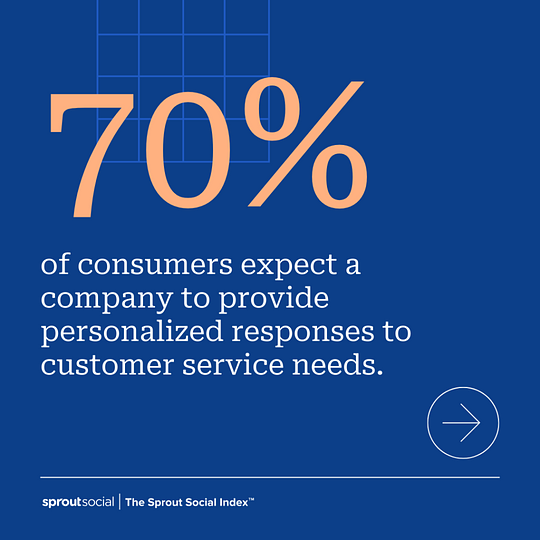
But the quality of your responses also matters—70% of consumers expect a company to give them personalized responses.
Ensure your team has the tools they need to shorten your brand’s response times and create more quality responses. A few ways to start:
- Audit your current response time average. A report like Sprout Social’s Inbox Activity Report will quickly calculate your performance by response rate and percentage.
- Use tools like customer service chatbots to have chat coverage 24/7 for low-lift questions to free up your team.
- Ensure your team is engaging with positive comments to build loyalty, too—not just questions or complaints.
2. Automate where you can—with a human touch
A greater need for personalized, frequent responses means more time for your already-strapped teams. Enter AI and automation.
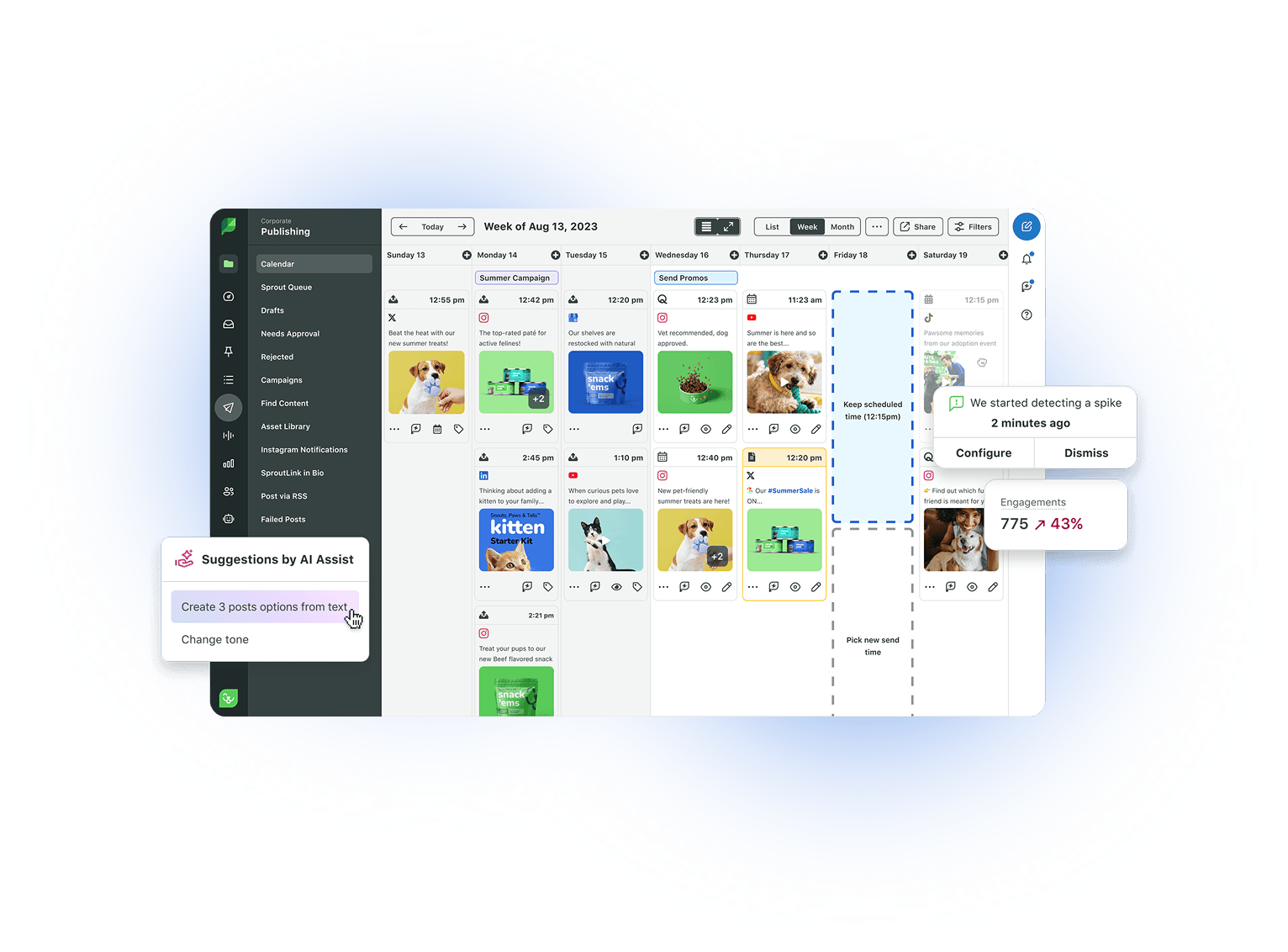
For example, 54% of marketers plan to employ customer self-service tools and resources like chatbots, FAQs and other forms to scale social customer care. They also want to use AI copy tools, like ChatGPT or Sprout Social‘s Suggestions by AI Assist, as a starting point to generate real-time responses to customer questions and FAQs inside self-service tools.
Just always edit to humanize and stay on-brand—you don’t want to lose trust with consumers who are already wary of brands speaking to them through AI.

3. Examine your social customer service strategy
Prioritizing social media customer care is crucial as more people turn to social for their customer support needs. 73% of social media users expect brands to respond on social within 24 hours. Rethink how you approach social customer care, and whether you’re prioritizing it.
The Index also found that 58% of social and marketing teams will either share social customer care in 2025, or customer service will be assisting marketing. If you’re not already collaborating across these teams, it’s time to start. Think: splitting up social monitoring, or working together to create FAQs, canned responses and bot copy.
And scale social customer care by utilizing the right social customer service tools, including AI and automation. A tool like Sprout Social will give you a 360-degree view of your brand’s interactions with your customers—integrating the worlds of social media and customer service.
4. Plan for crisis management and brand protection
Your brand’s reputation shifts in seconds on social. Early detection and swift action are the difference between a minor blip and a full-blown crisis.
Build your crisis response framework around these elements:
- Early detection: Use spike alerts to detect unusual surges in brand mentions or sentiment shifts in real-time
- Response protocols: Document who approves crisis communications, who pauses scheduled content, and mobilization timelines
- Instant controls: Implement pause scheduling capabilities to halt all outbound content when situations demand it
- Post-crisis analysis: Review sentiment data, response times and conversation patterns to strengthen future defenses
Sprout Social’s spike alerts provide the critical lead time you need to respond before damage escalates. The pause scheduling feature protects you from tone-deaf campaigns during breaking news.
Redefine how you work and social’s role in your business
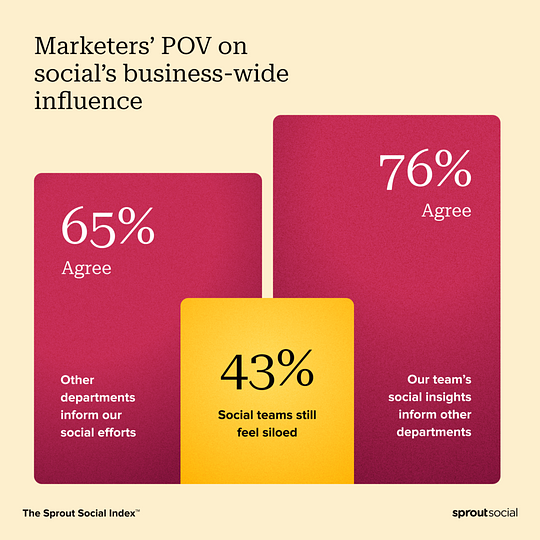
Social media insights have impact and implications beyond social—just look at the need to prove social media ROI. And according to the Index, 76% of marketers agree that their team’s insights inform other departments.
But just as social media changes, teams must also change to keep up with the demands put on them. Here are a few tips to bring into your workflow.
Sprout Social provides the infrastructure to execute these best practices across your entire social operation:
| Capability | Key Features | Business Impact |
|---|---|---|
| Social Customer Care | Smart Inbox, Inbox Activity Report, AI Assist, spike alerts, pause scheduling | 73% of users expect 24-hour response times—centralized tools make this achievable |
| Publishing & Scheduling | Sprout Queue, ViralPost (Optimal Send Times), Asset Library, Approval Workflow | 55% productivity increase by eliminating manual scheduling tasks |
| Analytics & Reporting | Cross-channel Post Performance Report, UTM tracking, custom reports, export capabilities | 75% reduction in reporting time while demonstrating clear ROI to leadership |
| Social Listening | Sentiment analysis, competitive intelligence, trend detection, brand monitoring | Transform reactive monitoring into strategic intelligence informing product development |
| Team Collaboration | Message assignment, task management, external stakeholder review, tagging system | Break down silos between marketing and customer service teams (43% report feeling siloed) |
| Employee Advocacy | Content curation, sharing workflows, performance tracking | Amplify reach through authentic employee voices—over 50% of engaged users share employee content |
5. Be more business-focused and strategic with sharing your social data
According to the Index, social media traffic to the website is a top metric that 60% of marketing strategists, managers and directors track regularly. This is your sign to start tying your social media data to larger business goals.
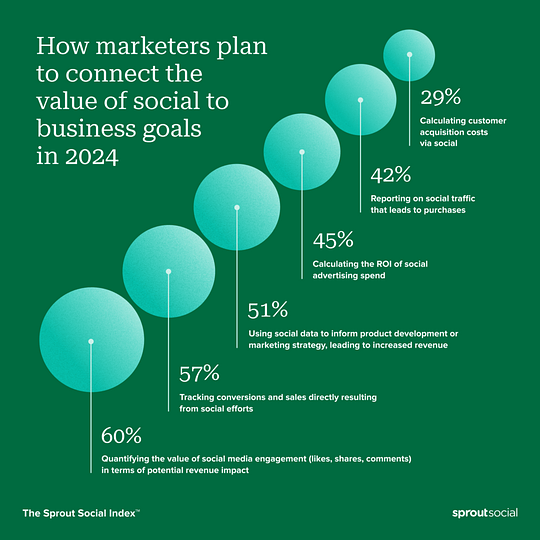
Turn to your fellow marketers for reference. The Index found that in 2025, most marketers plan on connecting the value of social to business goals by quantifying the value of social media engagement in terms of potential revenue, tracking conversions and sales from social and using social data to inform areas outside of their team.
A few key ways to do this:
- Use UTMs to connect social media posts and strategy directly to website traffic and sales.
- Deploy social listening: Sprout’s social listening transforms reactive monitoring into strategic intelligence—tracking competitor activity, identifying emerging market trends and surfacing product feedback before it becomes a pattern across consumer sentiment, competitive share of voice and beyond
- Create reports for collaborators outside of the social team to expand social’s impact cross-org. Get started with these 10 social media report examples.
6. Leverage AI…and refine how you use it
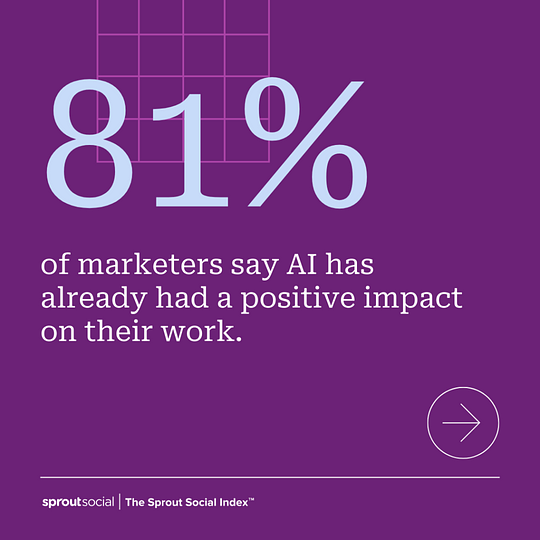
The Index found that 81% of marketers say AI has already had a positive impact on their work—especially freeing up time for creativity and increasing efficiency. And the questions around AI have shifted from “will it take my job?” to “will it impact consumer trust?”
As you move into a new phase of the AI era, refine how you use it. Experiment with it for customer care responses, and content ideation and creation. But ensure you’re always editing for brand voice, humanizing the copy and personalizing customer-facing messages.
Apply it: Start using AI for the repetitive tasks you complete regularly, from strategy planning to content creation and data analysis. Try Sprout‘s AI Assist technology to see how we can streamline your day-to-day across publishing, engagement, reporting and beyond.
7. Iron out your approval process
Trend cycles move at the speed of light. Which means your approval process must keep up.
If you’re feeling bogged down by a slow approval process, take the initiative to create an optimized workflow for your team and cross-collaborators. Build a seamless social media approval process all drafters and approvers can agree to. It is the difference between going viral and getting left behind.

8. Reimagine your team’s structure and size
The way you use social data, insights and platforms has evolved. And so too must your team.
We’ll always say that now is a good time to add fresh talent to your team. But it’s not just team size that needs to be rethought—it’s your team structure and how you work. For example, 64% of social teams are organized by network. That is, one team member is responsible for TikTok, one for Instagram, etc. But this approach may not be as effective as it once was as teams share insights beyond social.
Even though social data informs other departments, 43% of social teams remain siloed. Restructure your team by function: dedicate one member to engagement and another to awareness, or split responsibilities between analytics and content creation. This functional approach breaks down silos and aligns social data with broader business objectives.
What skills do social media managers need for the future? And what will social team structures look like? Find out in our latest webinar. #socialmediamarketing #socialmediamanager #socialmediatips
Best practices to bring authenticity into your strategy
There’s a reason why Merriam-Webster’s word-of-the-year in 2023 is “Authentic.” Between the rise of AI and shaky brand promises in recent years, audiences are wary of inauthentic messaging. In fact, authentic, non-promotional content is the number one thing consumers report not seeing enough of from brands on social, according to The Sprout Social Index™.
Creating authentic content is one of the quintessential best practices for social media. Here are a few ways to do it.
9. Feature customers and trusted faces on your feed
Featuring actual customers and user-generated content on your feed helps build social proof and trust, and bring authentic voices into your content.
Partnering with creators and influencers also adds a trusted voice to your content and extends your reach. In fact, 81% of social marketers describe influencer marketing as an essential part of their social strategy in our Q3 2023 Sprout Pulse Survey.
52% of brands are using dedicated influencer marketing platforms to help offset the challenge of finding the right influencer for their campaigns. If that’s something you’re looking for, consider adopting a platform like Tagger to manage your partnerships.
Which new arrivals are your fave, Aerie fam? @grace weldon #AerieNewArrivals #NewArrivals #AerieOutfits #AerieTryOnHaul
10. Be selective about taking a stand
Only a quarter of consumers polled in the Index said that the most memorable brands on social speak out about causes and news that align with their values.
Audiences are wary of inauthentic brand statements and promises. Know your values, and take a stand on issues that are aligned with them. Take L.L Bean, for example—they took a social media pause for mental health awareness month because it aligned with their brand values and mission.

11. Leverage your employees
Some of your most influential brand advocates are the people behind your brand: your employees. Adding employee advocacy to your social strategy is one of the most effective ways to amplify your content, humanize your brand and engage your audience.
Launch an employee advocacy program and curate a pipeline of content to ensure long-term success. In a Sprout survey of 1,110 US social media users across industries, over half of engaged social users are most likely to share employee updates. So create a “meet the team” series to showcase your employees.
@sproutsocial
At Sprout, our north star means empowering you to drive business impact using our product. Listening to customer feedback is critical for us to do this and provide the resources you need to move your brand forward. We love celebrating when we get it right and looking at ways to be iterating along the way to stay relevant to the current needs of businesses. Our north star drives us, but recognition like this from #G2 and our customers fuels us along the way. We know every decision matters when dealing with evolving market dynamics and fierce competition. Our intuitive platform speedily uncovers insights, helping you define that path forward more clearly. Thank you for letting us know we’re getting it right. 🫶💚 #SaaS #CustomerReviews #Fyp #B2B #SocialMediaMarketing #Marketing
♬ original sound – Sprout Social
Social media best practices for evolving your content
Just as people’s interests and tastes change, so too do the types of social content, preferred formats and trends they follow.
Here are a few social media best practices to evolve your content for optimal engagement.
12. Think platform-first before diving into tactics
Repurpose content across networks to save time—but customize each post to feel native to its platform. What works on LinkedIn won’t work on TikTok. What resonates on Instagram Stories falls flat on X.
Tailor your content to each platform’s unique characteristics:
- LinkedIn: Professional insights, industry analysis, thought leadership in formal tone
- TikTok: Authentic, entertaining short-form video with trending audio and effects
- Instagram: High-quality visuals, Stories for behind-the-scenes, Reels for reach
- X (Twitter): Real-time commentary, news, concise text-based updates
- Facebook: Community building, longer-form content, varied post formats
- YouTube: Educational long-form video, tutorials, product demonstrations
For detailed platform-specific guidance, explore these resources:
- Best practices for Facebook
- Best practices for Instagram
- Best practices for X (formerly known as Twitter)
- Best practices for LinkedIn
- Best practices for YouTube
- Best practices for TikTok
13. Use video…but mix it up
Video’s popularity is here to stay, and more brands are leaning in, making it a non-negotiable. According to The 2025 Content Benchmarks Report, across networks and industries, the percentage of video content is increasing overall—with a 3 percentage point increase on Facebook and Instagram, and a 2 percentage point increase on X.
Fill your content calendar with a healthy mix of video, carousels, polls and static photo or graphic-based posts. And pro tip: lighten the video lift by recruiting social video talent from your team and beyond.
14. Redefine your relationship with trends
Using trends is a great way to build awareness. But you don’t have to jump on every single one—that’s inauthentic and unsustainable. According to the Index, 38% of consumers say the most memorable brands on social prioritize original content over trending topics.
Use a healthy mix of on-brand trends and original content, and keep looking at your social analytics to find your top-engaged and most successful formats. If you use Sprout, the Post Performance Report surfaces your top posts across networks by your metric of choice.

15. Highlight your product in action
According to the 2022 Index, 51% of consumers like to see brands highlighting their product or service in their social posts.
But remember, your product or service shouldn’t be the hero of your posts. Instead, demonstrate how it empowers your target customers to overcome their challenges. With your customers’ use cases in mind, show your product or service in action.
If you want to be less stressed at work, stick around. 🤝 #ProfessionalTips #CorporateTips #AITools #ProductivityHacks #ProductivityTools #WorkTips #WorkLife #Grammarly
16. Make your content accessible to everyone
Accessibility isn’t optional—it’s essential. Creating accessible content expands your reach and demonstrates your brand values in action.
| Accessibility Element | Best Practice | Business Benefit |
|---|---|---|
| Alt text | Describe visual content concisely for screen readers (e.g., “woman presenting data on laptop to three colleagues in conference room”) | Improves SEO and reaches visually impaired users |
| Video captions | Add captions and transcripts to all video content | Serves deaf/hard-of-hearing users and 85% who watch with sound off |
| Color contrast | Ensure text is easily readable against backgrounds using high contrast ratios | More visually striking content performs better in feeds |
| Hashtag formatting | Write in #CamelCase capitalizing first letter of each word | Makes hashtags readable by screen readers |
| Plain language | Avoid jargon, explain acronyms, keep sentences straightforward | Benefits cognitive differences and non-native English speakers |
Accessible content drives better engagement overall. When you design for inclusivity, everyone benefits. Store approved alt text templates in Sprout Social’s Asset Library to maintain consistency across your team.
17. Optimize existing platform strategies
New platforms are bound to emerge—just look at the recent launch of Threads.
Experimenting with new platforms will always be important. But optimize the content and approach you take on the platforms you use—and that your audiences uses most often.
Here are a few tips:
- Find the best times to publish: Optimizing your publishing time is an easy way to achieve more engagement. Check out our best times to post guide, pinpoint the best times for your brand to post based on channel and industry, and use Sprout’s Optimal Send Times as you schedule your posts.
- Post regularly: Consistency is key—74% of consumers think the publishing sweet spot for brands is one to two posts per day. Check out our article on how often to post on social media.
18. Optimize for social commerce
By 2025, social shopping is set to become a $1.2 trillion channel. And with TikTok recently rolling out TikTok Shop in the US, platforms are continuing to invest in this approach. Social commerce is a great way to sell directly on social.
Have a point of view and use data to back up your decision on where your customers want to buy, and optimize your social commerce tools on platforms where they are ready to go all in. According to The 2025 Sprout Social Index™, 81% of consumers say social media compels them to make spontaneous purchases multiple times per year or more.
Whether you set up shop directly in your platforms or link to products in posts, optimizing your social channels for social commerce directly connects your customers and products. Start enhancing your omnichannel customer experience with all-in-one social commerce tools the help reduce friction in the buying process—for example, you can use Sprout‘s social commerce solutions to integrate your social and commerce workflows.
Develop your social media best practices this year
Social media never stops evolving—platform shifts, algorithm changes and new technologies demand constant adaptation from your team.
These best practices give you a foundation that holds steady through the chaos. Bookmark this guide and return to it as your strategy matures.
Put these best practices into action with Sprout Social, the platform that handles response time tracking, ROI data surfacing, posting schedule optimization and approval streamlining in one place. Organizations see 55% productivity increases and 75% reduction in reporting time. Start your free trial and move from best practices to proven results.
Start your free Sprout Social trial
Frequently asked questions about social media best practices
How often should I post on each social media platform?
Post one to two times per day, which is the sweet spot that 74% of consumers prefer according to The 2025 Content Benchmarks Report. Consistency beats intensity, so choose a sustainable cadence over unsustainable bursts.
Which social media platforms should I prioritize for my business?
Match platforms to your target audience: LinkedIn for B2B professionals, TikTok and Instagram for Gen Z consumers, Facebook and YouTube for Millennials and older demographics. Consumers plan to spend more time on Facebook, Instagram and YouTube in 2025. Prioritize where your audience actually spends time, not where headlines focus.
What metrics should I track to prove social media ROI?
Track business-impact metrics including conversion rates, qualified leads generated, direct revenue attribution and social media traffic to your website (monitored by 60% of marketing leaders). Use UTM parameters to connect social posts directly to purchases and sign-ups.
How do I get leadership buy-in for social media management tools?
Present efficiency and risk mitigation data: According to 2023 Forrester research, Sprout Social users see 55% productivity increases and 75% reduction in reporting time. Frame the platform as an efficiency engine that eliminates security risks from shared passwords and disjointed workflows rather than a cost center.
How do I balance promotional content with authentic, value-driven posts?
Follow the 80/20 rule: dedicate 80% of content to educating, entertaining or inspiring your audience and 20% to conversions and product promotion. Authentic, non-promotional content is the #1 thing consumers report not seeing enough of from brands on social according to The Sprout Social Index™.





Share