How to conduct a Facebook competitor analysis report [plus template]

Written by Ronnie Gomez
Published on December 5, 2025
Reading time 10 minutes

Table of Contents
A bit of competition brings out the best in people. On social, a Facebook competitor analysis brings out the best in your brand.
Successful marketers know that decisions aren’t made with owned analytics alone–routine competitive analyses are essential for getting the full picture.
Using Facebook data to bolster your competitive intelligence provides you with the insights needed to zig where others zag. It’s no wonder Facebook is the most-used platform by marketers worldwide.
If you’re ready to engage in some good old-fashioned competitive sleuthing, you’re in the right place. Here’s everything you need to know to start monitoring your competition on Facebook.
What is a Facebook competitor analysis?
A Facebook competitor analysis means systematically evaluating your competitors’ Facebook performance to benchmark your own strategy. This process reveals what content formats, posting frequencies and engagement tactics drive results in your industry.
The analysis tracks key brand growth and engagement metrics across competitor profiles. You examine posting habits, content formats and audience engagement patterns to establish performance baselines.
These insights define what superior content and service look like in your space, driving measurable business impact.
Why should you do a Facebook competitive analysis?
When conducting a social media competitive analysis, make Facebook your top priority. According to Sprout Social’s 2026 Social Media Content Strategy Report, 85% of social users across generations have a Facebook profile, and nearly 40% are using it to find new products.
All of these little interactions, compounded over tim,e make Facebook a goldmine of strategic insights. If that’s not enough, here are some other reasons to consider.

Establish more relevant KPIs
Competitive benchmarking on Facebook takes the guesswork out of goal setting.
For example, imagine you’re trying to set a new engagement goal. Looking at your historical data supports setting an achievable target, but without competitive insights, you’ll set goals that aren’t in line with industry standards.
Your Facebook competitor analysis motivates you to aim higher with your social content while keeping your strategy attainable and actionable.
Identify content gaps
Competitive analyses illuminate cracks in your content strategy while supplying the information needed to fill them.
For instance, an oral health care brand conducting a Facebook competitive analysis will discover that Quip incorporates month-long observances into its content strategy. This provides an endless stream of social media content creation ideas that tap into trending topics.
Since these posts drive strong engagement, that brand will apply their own unique spin on similar events.
Create better content for your followers
Coming up with new content ideas is a top challenge for many social media marketers.
Industry data provides valuable insights during brainstorming sessions, supporting the generation of smarter, more relevant content ideas for each social platform. That’s where your Facebook competitor analysis comes in.
The analysis identifies your rival’s content themes. As you notice them, ask yourself how your brand will approach something similar.
Eventually, you’ll come up with a unique piece of inspired content that stands independently from its source material.
Understand the strength of customer service efforts
Consumers are also more likely to turn to Facebook for customer care compared to any other platform, especially Millennials, Gen X and Baby Boomers.
A quantitative and qualitative review of your competitors’ Facebook pages supports defining what they are and aren’t getting in terms of customer service.
This shows you what it takes to gain a competitive edge on social.
Facebook competitive analysis tools support keeping a pulse on what your audience expects from brands on the network. Eventually, you’ll find ways to one-up their service offerings, cementing your spot as the brand people turn to for a better customer experience.
Learn from your competitors’ strategies
A Facebook competitive analysis gives you a well-defined snapshot of what’s working—and what’s not—for your top competitors.
By digging into their content, engagement metrics and audience interactions, you pinpoint winning strategies like the best posting frequency, content formats that get the most traction and the optimal times to post.
This data supports refining your content strategy, adopting what works and avoiding common pitfalls, so your brand stands out.
Also, it gives you a deeper understanding of how competitors are positioning themselves, supporting you in staying ahead with more strategic differentiation.
Key metrics to track in your Facebook competitor analysis
Tracking the right metrics transforms competitor research into actionable strategy. Focus on these key areas for maximum impact.
Audience metrics
- Follower growth rate: Track monthly growth percentages to identify successful campaigns or viral content
- Audience demographics: Analyze age, location and gender data to confirm you’re competing for the same market
- Audience quality: Use engagement rates alongside signals like sudden follower spikes, suspicious profiles and low-quality comments to distinguish between authentic and potentially purchased or low-quality followers
Content performance metrics
- Engagement rate: Calculate likes, comments and shares as a percentage of total followers
- Post frequency: Document daily and weekly posting patterns so you understand competitors’ content capacity
- Content mix: Measure the ratio of videos, images, links and text posts to identify format preferences
- Peak performance times: Note when competitors’ posts generate the highest engagement
Brand perception metrics
- Sentiment analysis: Monitor comment tone and brand mention sentiment across posts
- Share of voice: Measure your competitors’ presence in industry conversations
- Response rate: Track how quickly competitors respond to customer inquiries and comments
Free vs. paid Facebook competitor analysis tools
Your tool choice determines the depth and efficiency of your analysis. Here’s what each option delivers.
Free analysis methods
Facebook’s native Page Transparency feature reveals active ads and basic page information. You manually track competitor posts and engagement through direct observation.
- Time investment: 5-10 hours per competitor per month
- Data accuracy: Limited to publicly visible information
- Analysis depth: Surface-level insights only
- Best for: Small businesses with single-digit competitor counts
Comprehensive analysis platforms
Tools like Sprout Social automate data collection and provide advanced analytics across multiple competitors simultaneously.
- Time investment: 30 minutes setup, then automated reporting
- Data accuracy: API-level precision with historical trending
- Analysis depth: Post-level performance, audience insights, sentiment tracking
- Best for: Growing businesses tracking multiple competitors across platforms
How to conduct a Facebook competitor analysis
Let’s go over our top tips for an effective Facebook competitive analysis.
1. Identify your Facebook competitors
Before conducting your competitive analysis, narrow in on three to four key competitors on Facebook. Tracking every competitor big and small becomes an unwieldy task.
Aim for an even representation of direct, indirect and aspirational competitors. This is a good time to talk to your sales team and customers about which competitors supported their decisions.
2. Gather your data
Once you’ve confirmed your target competitors, it’s time to gather your data. While this process is time-consuming, especially in competitive industries, thorough insights lead to more informed strategies.
Use a social media analytics tool to streamline your approach to tracking competitor metrics. If you’re using Sprout Social, you dig into data at the post level to figure out what content formats and themes are resonating most with the audiences of individual competitors.
Remember, this isn’t a one-time task. To stay ahead, update your analysis quarterly or biannually, aligning with your overall social media reporting.
3. Analyze your competitors Facebook presence
Competitive intelligence involves both quantitative and qualitative insights. To gain the most comprehensive understanding of your competitors’ social platforms, you need to explore how they present themselves across each platform.
Start your analysis by asking these three key questions:
- How active are your competitors? Examining their posting frequency reveals insights into their content and customer care strategies, as well as gaps you will exploit.
- What types of content do they share? Review each competitor’s last 10 posts and determine the percentage that are promotional, such as calls to action for sign-ups or purchases.
- What is their brand persona? Identify the different brand voices your competitors use and evaluate how well they resonate with their audience.
4. Use a tool to conduct a Facebook competitor analysis
Sprout Social’s Social Media Productivity Report shows 63% of social marketers waste time on manual tasks instead of strategic work. Sprout Social’s automated competitor tracking eliminates hours of manual research while delivering deeper insights than manual methods.
These tools offer valuable data-driven insights, such as engagement rates and follower growth, which support your evaluation of competitor performance and ability to spot trends. Social listening platforms also track audience sentiment toward competitors, providing richer qualitative insights that reveal how well they engage their audience and where they are falling short.

While Sprout Social’s built-in competitor reports are powerful, they are just one of many robust Facebook analytics tools designed to benchmark you against the competition.
5. Identify areas of improvement
The insights from your competitor analysis, especially when gathered using a Facebook analytics tool, reveal strategic opportunities to support your brand in outpacing the competition. Focus on doubling down on what’s working well and closing any gaps that may be allowing competitors to get ahead.
Use these findings to develop a clear action plan, and share it with your team to gain their support and collaboration. Engaging your colleagues in this process fosters teamwork and ensures everyone is aligned in driving the brand forward.
6. Create a Facebook competitor analysis report
Numbers are nothing without the right context.
For example, what if one of your competitors ran an enticing social media contest during your reporting period? That would definitely have an impact on either their engagement or audience growth.
Use storytelling to give your data meaning. Include the “why” behind your most interesting numbers so that your teammates understand the full story behind the report as well.
How to analyze competitors on Facebook with Sprout Social
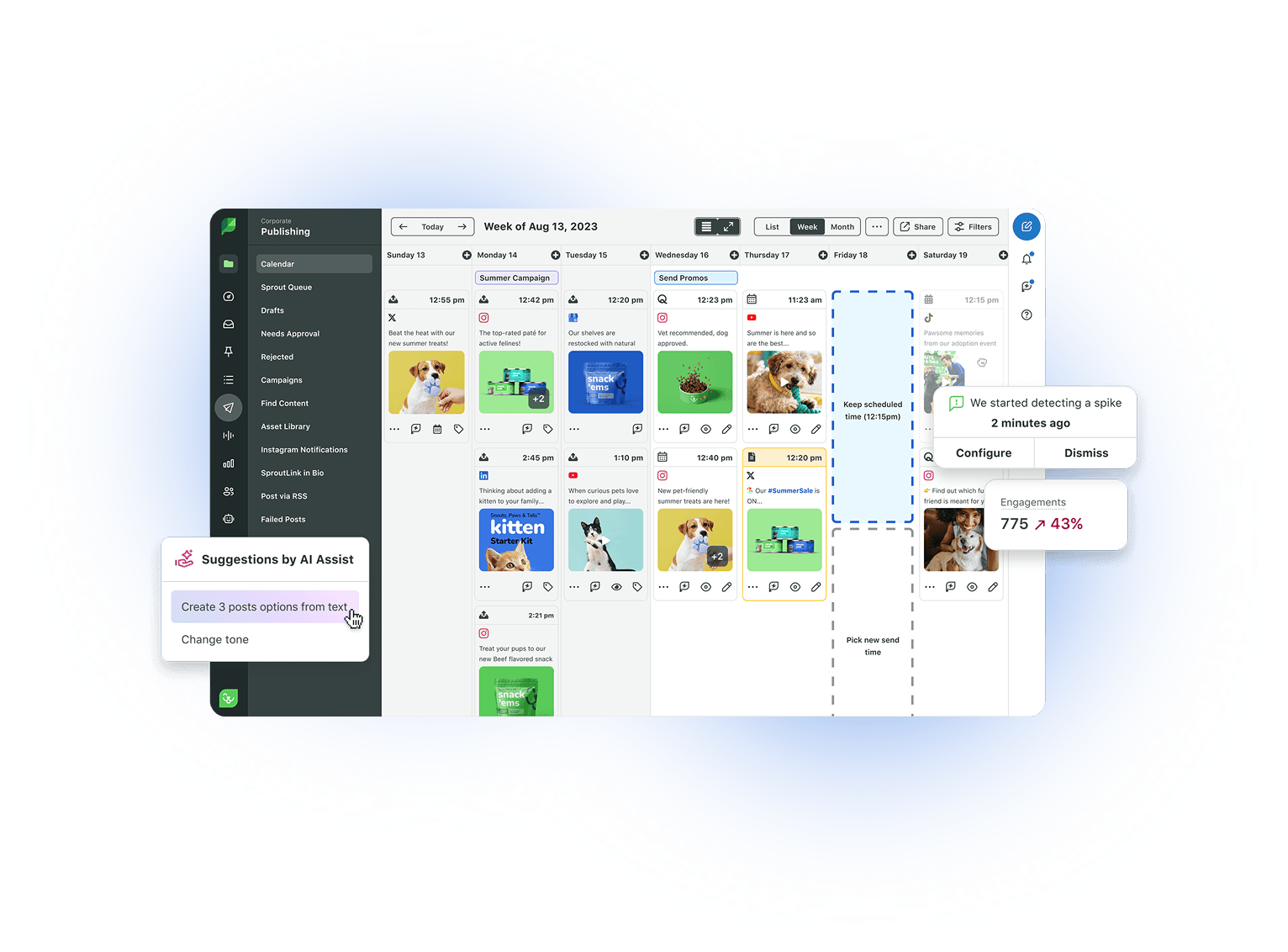
You could do some of this research manually, but Sprout Social will make the process much more efficient. Sprout Social’s Facebook Competitors Report lets you track metrics for any Facebook page to compare them against your own.
Getting started with Sprout Social
If you don’t have a Sprout Social account, no problem.
Step 1: Start a free 30 day trial by setting up an account with your business email [you don’t even need a credit card].
Step 2: Go to “Account and Settings” and select “Connect a Profile.”
Step 3: If you need to, choose a group for this Page from the “In Group” dropdown.
Step 4: Navigate to “Connect for Facebook.” > “Connect Page” to link your Facebook Page.
Step 5: Select “Go to Facebook” and follow the simple instructions to authorize the connection.
How to use the Facebook Competitor Report
Here’s how you can discover what your competitors are doing differently on Facebook:
Step 1: Set filters
Use the Filter Menu to customize the data you want to see in your report.

You’ll find three different filters within the menu: Pages, Competitor Pages and Date Range.
- Use Pages to select which owned Facebook pages you’d like to include in the report.
- Use Competitor Pages to manage and select competitor Facebook pages
- Use the Date Range date picker to select a time period for your report.
Step 2: Check the summary
The top widget in the Facebook Competitor Report is a summary table. This features averages of key metrics including Fans, Public Engagements and Public Engagements per Post.

Use the trends highlighted in the summary as starting points for your competitive investigation. For example, if you notice that your fan average is lagging behind, that is the first item to review and cover in your report.
Step 3: Dig into the numbers
You’ll find three different chart widgets in the Facebook Competitor Report:
- The Audience Growth chart shows how your audience grew compared to your competitors’ during the selected time period.
- The Publishing Behavior chart shows the different types of posts you and your competitors published during the selected time period.
- The Engagement chart evaluates how people are engaging with posts based on publish date.
Each of these charts goes deeper into the high-level metrics available in the Summary table. They also provide averages of each metric for both owned and competitor Facebook pages.
Step 4: Review post-level data
Use the Top Posts widget to review the most popular posts published during your selected time period.

The Top Posts widget supports your analysis of published content across all competitors to understand what’s resonating within your shared audience. As you review the data, stay on the lookout for qualitative trends as well.
Understanding these trends will come in handy during your next brainstorm.
Step 5: Share findings
There are a few different ways you can distribute your report from Sprout Social.

If you’d like to limit the number of disparate files floating around people’s inbox, try the link sharing option. This will allow you to share reports with multiple stakeholders regardless of whether they have a Sprout Social account.
Top Facebook competitive analysis tools
1. Sprout Social
Sprout Social provides social media marketers with a well-rounded perspective on competitors’ performance across various platforms and data points.
With Sprout Social’s range of competitive reports, you evaluate and enhance your social strategy using valuable metrics from Facebook, X (formerly Twitter), Instagram and more. Sprout Social’s suite of competitive intelligence tools supports teams in seeing what your competitors are posting and comparing your growth to the profiles you are monitoring.
Through Sprout Social’s Premium Analytics, you gain in-depth insights into your social platforms, accompanied by customizable interactive charts and graphs tailored to your objectives. If you want to discover how to use Sprout Social for analyzing your Facebook competitors, sign up for a free 30-day trial today.
2. Socialinsider
Socialinsider is another social media management tool that offers several different features—including Facebook competitor analysis reporting.
Marketers use Socialinsider to monitor metrics like views, engagement, follower growth and more, while also giving them access to information like historical content trends and top-performing content. The platform also supports users in getting competitive insights at the campaign level, so you study specific tactics in competitor strategies.
3. Brandwatch
Brandwatch offers data analytics for consumer intelligence and social media management, including competitive benchmarking for Facebook and X.
These tools allow users to monitor their competitors’ social media output, while tracking all mentions of specific competitors across the web. Reports are exported and shared via Excel, PowerPoint, PDF file or through the Brandwatch API.
Turn competitive insights into social media success
Your Facebook competitor analysis reveals where opportunities exist. Every gap you identify becomes a strategic advantage waiting to be captured.
Manual analysis consumes weeks of time across multiple competitors. Sprout Social’s Facebook Competitor Report delivers those same insights in minutes, not days.
Stop guessing what works in your industry. Start your free 30-day trial and see how your competitors drive engagement on Facebook.
Frequently asked questions about Facebook competitor analysis
How often should I update my Facebook competitor analysis?
Most brands benefit from quarterly reviews, while fast-moving industries like retail need monthly updates.
What's the difference between direct and indirect Facebook competitors?
Direct competitors offer similar products to your audience, while indirect competitors solve the same problem in a different way.
Can I legally track private Facebook competitor data?
You will only analyze public data through official platform APIs and transparency features.
Which Facebook metrics matter most for B2B vs. B2C brands?
B2C brands typically lean on broad engagement, reach and community growth tied to revenue, while B2B brands focus more on qualified engagement, account-level interactions and downstream metrics like lead quality and pipeline influence.




Share