Public relations statistics you need to know in 2026

Written by Mary Keutelian
Published on June 11, 2026
Reading time 11 minutes

Table of Contents
The public relations statistics defining 2026 tell a clear story: PR has entered a new era, and social media is driving it. A 24/7 news cycle, viral content and a trust-fractured information landscape have changed how brands protect their reputations and communicate with audiences.
To help communications teams, agencies and executives stay ahead, this roundup tracks the rapid evolution of PR market growth, social integration, media relations, AI adoption and measurement strategy.
Top PR stats at a glance
- Global market value: The global PR market is projected to reach $132.51 billion by 2029, growing at a 5.78% CAGR.
- The customer care window: Nearly three-quarters of consumers expect a response to their customer service questions on social media within 24 hours or sooner.
- AI integration: 97% of marketing leaders say it’s crucial that marketers know how to use AI in their work, and 48% are keen to invest in even more AI tools in 2025.
- The trust shift: 55% of Gen Z consumers trust influencer recommendations, compared to just 28% of Baby Boomers.Overall, close to 30% of consumers trust influencers more today than they did six months ago.
- The burnout crisis: 50% of PR professionals considered leaving their job in the last year due to burnout, and 96% report difficulty “switching off” after work.
PR industry size and growth statistics
The global public relations market is expanding rapidly as enterprise brands shift from reactive communications to proactive brand equity management. Investment in PR is accelerating across in-house departments and global agencies alike.
- The global PR market was valued at nearly $100.06 billion in 2024 and is expected to grow to $132.51 billion by 2029. According to The Business Research Company (TBRC)’s Public Relations Market Report, this expansion reflects rising demand for strategic communications across enterprise organizations and the growing recognition of PR as a business-critical function.
- The global PR market is projected to grow at a compound annual growth rate (CAGR) of 5.78% between 2024 and 2029. This consistent annual growth reflects rising investment in communications as a strategic business function rather than a reactive cost center. Organizations across industries are allocating more resources to PR because they recognize its direct impact on brand reputation, stakeholder trust and competitive positioning.
- A separate analysis by Mordor Intelligence puts the 2026 market at $114.17 billion, projecting $160.54 billion by 2031 at a 7.18% CAGR—a different methodology, but the same directional story. On the domestic side, the US PR services market presents a $15.94 billion opportunity projected to grow to $22.37 billion by 2030, signaling increasing client investment and a higher bar for agencies to demonstrate measurable communications outcomes.
- Two structural shifts are worth noting within that growth: Digital and online media captured 57.84% of 2025 spend, and agency-based outsourced PR held 61.63% of the market—with the agency-based outsourced segment expected to expand at a 7.64% CAGR through 2031.
- According to the Sprout Social Impact of Social Media Report, 56% of marketing leaders say social media drives revenue for their businesses—yet only 44% rate their teams as experts at measuring that impact. Closing that gap starts with understanding where the market stands and building the measurement infrastructure to keep pace with where it’s headed.
Growth alone doesn’t guarantee results. A larger industry means more noise, more competition for attention and higher expectations from every stakeholder. The brands and agencies that win aren’t just spending more; they’re measuring smarter and moving faster.
Social media and public relations statistics
Social media is the live ecosystem where brand reputation is continuously built, evaluated and defended. The conversations happening across social media platforms shape how audiences feel about your brand before your press release ever lands.
- Increased governance: 46% of organizations now have formal, board-level processes to update directors on reputational risks—more than double the 15% reported in 2024, according to WTW’s 2026 Reputational Risk Readiness Report.
- Visibility gap: Despite this increased focus, executives admit they’re losing visibility in the fragmented digital landscape. Only 37% of respondents said they knew where negative sentiment around their brand was most concentrated, a significant drop from 56% in 2024. That 19-point decline is a direct argument for investing in real-time listening infrastructure—the organizations that can’t locate their reputational risk can’t manage it.
- PR and marketing integration: 65% of communications professionals report being at least somewhat aligned with their marketing team on strategy and goals, with 30% specifically stating they’re “very closely aligned.” Another 26% note they’re either on the exact same team or don’t have a separate marketing team at all.
- The value of transparency: Consumers prioritize authentic brand behavior. When brands openly acknowledge their shortcomings and take accountability for the customer experience, it builds trust that translates into stronger retention and sustained growth, according to Sprout Social’s Social Intelligence Report.
- Niche trust: 52% of Gen Z consumers trust brand information found natively on social channels more than results surfaced by standard search queries or AI chatbots, according to the Sprout Social Q3 2025 Consumer Pulse Survey.
- The AI backlash: 83% of users report seeing AI-generated “slop” on social media. This is having a direct impact on brand credibility, with 20% of users who have lost trust in social media over the last year citing unregulated AI slop as a primary driver for that decrease.
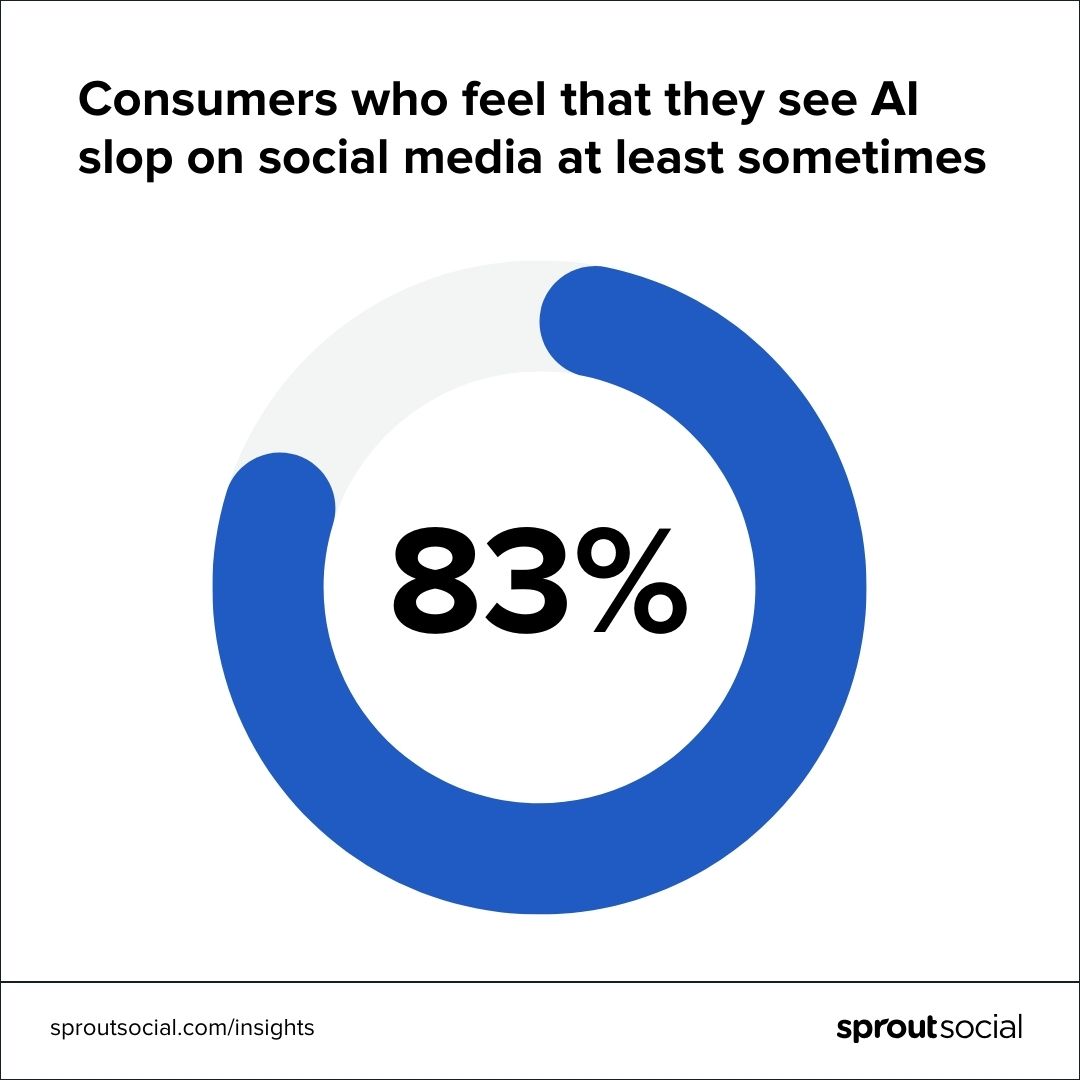
- Erosion of trust and misinformation: 30% of social media users report that their overall trust in digital platforms has decreased in the last 12 months due to the unchecked spread of misinformation, according to the Sprout Social Q1 2026 Pulse Survey. Consequently, 93% of consumers think brands need to combat misinformation more than they are today.
- Response expectations: Nearly three-quarters of consumers expect a response to their customer service questions within 24 hours or sooner.
PR measurement and ROI statistics
The gap between tracked outputs (press clips) and actual business outcomes (pipeline influence, revenue) is where communications teams win or lose internal authority. C-suite leaders increasingly demand that PR justify budgets with the analytical rigor typical of paid media, forcing a major shift in how professionals track their time and prove their worth.
- The time investment: 90% of PR professionals spend up to four hours a week on media measurement and reporting.
- The ultimate priority: 67% of PR professionals state that producing measurable results is their absolute top priority for proving value to leadership, eclipsing the desire to “deliver creative solutions” (12%).
- The core challenge: 54% of PR professionals cite “managing stakeholder expectations” and “linking PR metrics to business goals” as the greatest challenges they face when measuring and reporting their efforts.
To bridge this gap, high-maturity PR teams are abandoning isolated vanity metrics—like Advertising Value Equivalency (AVE) or raw impressions—in favor of unified reporting frameworks. The most effective teams translate media outputs into executive-friendly business narratives by tracking:
- Awareness and reach: Share of voice (SOV) against key competitors, not just isolated impressions.
- Qualitative impact: Sentiment and key message pull-through to ensure the coverage resonated.
- Downstream conversions: UTM parameters and tools like Google Analytics to connect earned media placements directly to website traffic, lead generation and revenue impact.
Media relations and journalist outreach statistics
Earned media remains the most trusted form of brand communication—but securing it has never been harder. Shrinking newsrooms, inbox overload and rising relevance standards mean the gap between a pitch sent and a story published is wider than ever.
- The pitch reality: More than half of journalists (54%) say they seldom or never respond to PR pitches. Meanwhile, inbox pressure is inching upward, with 29% of journalists receiving six to 10 PR pitches on a normal workday, and 14% receiving more than 20.
- What journalists want: When receiving a pitch, 70% of journalists prioritize clear relevance to their beat. Beyond that, 58% want interview access to relevant sources, and 40% want original data or research. Tactics like providing pre-written quotes (14%) or social media copy (3%) rank far lower.
- The relevance problem: 88% of journalists immediately disregard or delete a PR pitch because it’s irrelevant to their coverage area. Other top reasons for instant rejection include pitches that are overly promotional (71%) or look like mass emails (50%).
- Email dominates: 62% of journalists prefer to be pitched via one-to-one email. When it comes to social platforms, Facebook is actually considered the most valuable by journalists (28%), followed by LinkedIn (20%). However, LinkedIn stands apart as the most trusted platform, with 58% of journalists trusting it to treat journalistic content fairly.
- Social media’s shifting role: Reliance on social media for reporting is falling, with only 21% of journalists saying it’s very important—down 12 points since 2024. Its role in distribution remains steady, with 45% of journalists citing social media as very important for promoting their work.
Crisis communications and brand reputation statistics
A brand crisis no longer unfolds over days. It unfolds over hours, sometimes minutes. Organizations relying on manual, multi-day approval chains for statements are often late to the narrative, allowing public judgment to solidify before their perspective is heard.
- The preparedness gap: Corporate crisis readiness is slipping. Only 80% of organizations maintain formal crisis teams today (down from 87% in 2024), and just 25% report they have the highest level of crisis escalation processes in place. Overall corporate confidence in crisis communication has fallen to 78%.
- The cost of silence: When brands ignore or fail to engage with customers, audiences walk away. If a brand is unresponsive on social media, 49% of users will only sometimes try reaching out on traditional channels, and 19% never will, according to the Sprout Social Q2 2025 Consumer Pulse Survey. And 73% of social media users agree that if a brand doesn’t respond to them on social channels, they’ll actively buy from a competitor next time.
- The need for early detection: 31% of organizations admit they’ve missed opportunities due to missing early signals of changing customer preferences, and 26% cite escalated customer issues that could have been mitigated earlier, according to Sprout’s Social Intelligence Report.
- Authenticity is non-negotiable: 50% of consumers rank “honest” as the number one trait they associate with a “bold” brand, and they agree that brands should stop using “salesy” and “corporate” messaging.
AI and technology in PR statistics
AI has fundamentally changed how PR teams operate. The fastest-moving communications teams use AI and automation to eliminate manual bottlenecks, redirecting energy toward the strategic work that defines great PR: message development, relationship building and crisis response.
When your team spends less time on media monitoring, report compilation and coverage summaries, they spend more time on the judgment calls that matter most.
- Broad adoption: As of early 2026, 76% of PR professionals use generative AI in their work, and 75% now use at least one paid AI tool (up from 57% year-over-year), signaling that AI has moved from a novel experiment to core software infrastructure.
- Corporate oversight: 51% of PR teams now operate under an official organizational policy dictating the permissible use cases of AI in client and public communications.
- The opportunity: 48% of PR professionals recognize AI as a significant opportunity for its ability to drive efficiency and insights.
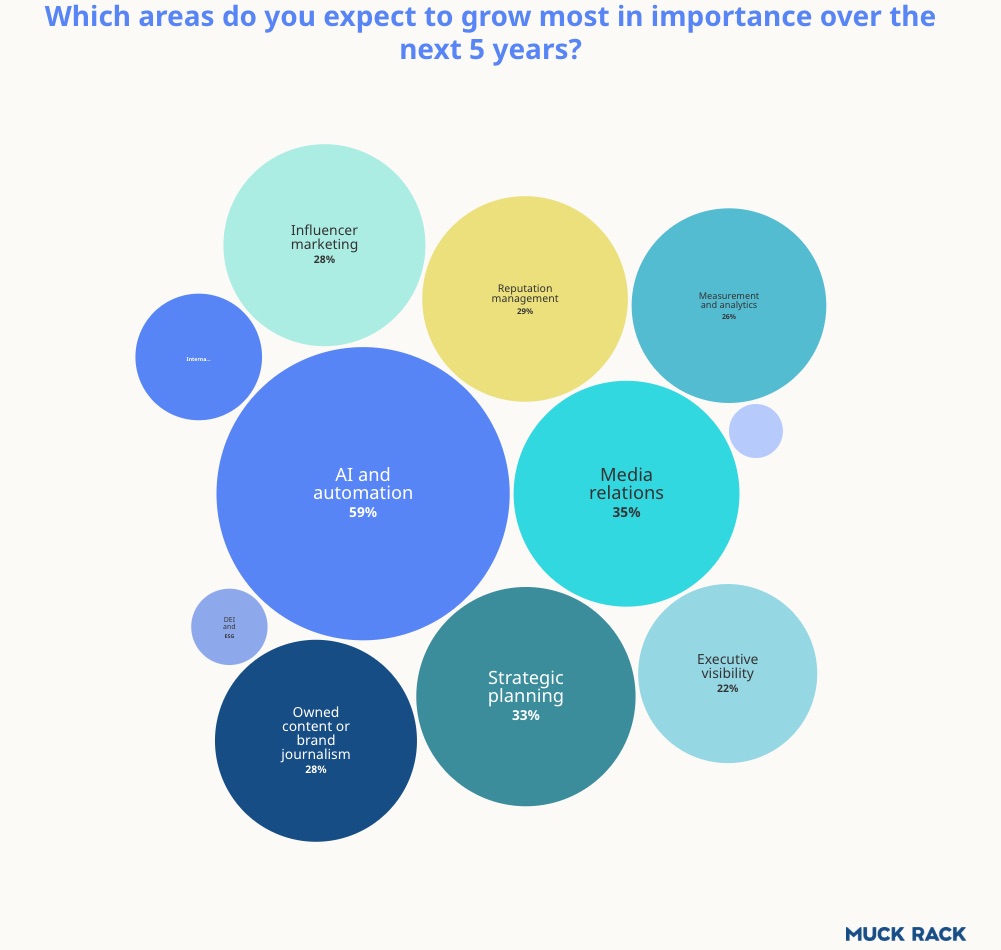
- The long-term outlook: 59% of professionals expect AI and automation to be the single most critical factor in industry growth over the next five years, outpacing media relations and traditional strategic planning.
- Skills in demand: For 59% of PR professionals, “storytelling and content creation” will be the number one in-demand skill of 2026, followed by “media relations” at 44%. AI is the opportunity—but human skills still top the demand list.
Influencer marketing and PR statistics
55% of Gen Z consumers trust influencer recommendations—nearly double the rate of Baby Boomers. That gap isn’t just a demographic footnote; it’s a strategic mandate for how PR teams allocate creator budgets. The most effective communications strategies are built on creator partnerships, where trusted voices carry brand messages to audiences that are already engaged and ready to act.
- The authenticity crisis: 53% of consumers say they have less trust in a product recommendation if they know the influencer was directly paid for the promotion. PR teams must prioritize organic relationships over purely transactional ones.
- The micro-influencer advantage: 20% of survey respondents prefer recommendations from micro-influencers (10,000 to 100,000 followers) because they’re perceived as more accessible and authentic than massive celebrities.
- Direct commercial impact: 49% of all consumers make a purchase because of an influencer post at least once a month, and 86% make an influencer-inspired purchase at least once a year, according to the Sprout Social Influencer Marketing Report. Among younger demographics: 53% of Gen Z consumers have purchased a product or service directly through an influencer’s sponsored post in the past 12 months, and 90% of Gen Z users say social media overall has influenced their purchases within the last six months.
PR workforce and skills statistics
The PR profession has expanded far beyond media relations. Today’s communications professionals are expected to be part strategist, part analyst, part content creator and part crisis manager—all at once. The expectations placed on PR teams have never been higher, and the gap between what’s required and what teams can deliver is widening.
- Headcount constraints: 64% of organizations are keeping their internal communications headcount exactly the same, and only 27% of teams expect to add staff this year, according to 2026 benchmarking data by Simpplr. Most in-house communications teams manage more social media platforms, more stakeholders and more content than ever, with the same headcount they had years ago. When every team member is stretched thin, strategic work gets crowded out by reactive tasks.
- The intelligence perception gap: 25% of directors and executives are “extremely confident” their organization is maximizing the value of its social data—but only 10% of their frontline staff agree. In reality, 80% of individual contributors spend the majority of their time bogged down in operational execution rather than strategic work, citing barriers like organizational silos, limited resources and technology limitations, according to the Sprout Social Intelligence Report.
- The toll of burnout: 50% of PR professionals considered leaving their job in the last year specifically due to burnout, and 96% of professionals report difficulty “switching off” after work.
- Compensation: Despite these challenges, the strategist value placed on communications expertise continues to grow, with an average annual pay for a Public Relations Manager currently sitting at $83,626.
- The baseline skill set: 33% of communications professionals cite AI and data literacy as an essential skill for the next 12 months, while another 20% highlight the need for data analysis and 25% select social media skills as a critical competency, according to Cision’s 2026 Inside PR Report. With resource pressures ranking as the industry’s top challenge (34%), professionals who develop AI and data fluency are best positioned to automate routine tasks, translate performance metrics into actionable insights and prove their bottom-line impact to the C-suite.
What these PR statistics mean for your strategy
The data points to one clear direction: PR is faster, more public and more measurable than ever before. The brands winning aren’t the ones with the biggest budgets; they’re the ones that connect communications, social, customer care and analytics instead of managing them in silos.
Here’s what that looks like in practice:
- Align PR and social strategy. Your communications team and your social team are talking to the same audience. When they operate separately, messages fracture and opportunities disappear. Build shared workflows, shared calendars and shared goals.
- Define your measurement framework before you need it. Establish the metrics that matter—share of voice, sentiment trends, response time and coverage reach—and track them consistently so you prove impact when it counts.
- Build crisis workflows before a crisis hits. Speed is everything when reputation is on the line. Document escalation paths, assign roles and test your response process so your team moves with confidence, not chaos.
- Invest in listening and cross-team visibility. The conversations shaping your brand happen whether you’re watching or not. Real-time listening surfaces emerging risks, competitor moves and audience sentiment shifts before they become headlines.
The through-line across all of it is visibility. You can’t protect what you can’t see, and you can’t prove what you can’t measure.
Sprout Social—including NewsWhip’s earned media intelligence—gives PR and communications teams the unified infrastructure they need to monitor digital conversations, track real-time sentiment, manage customer care at scale and report on the business impact of every effort. Trellis, Sprout Social’s proprietary AI agent, powers the analysis behind it all: surfacing signals faster, reducing manual reporting and keeping your team focused on the strategic work that moves the needle.
Request a demo to see how Sprout Social helps your communications team move faster, prove more and stay ahead of every conversation that matters.
39 free social media strategy templates that will elevate your workflows
Published on August 20, 2026 Reading time 15 minutes








Share