How influencer follower count affects audience expectations

Written by Benedict Nicholson
Published on July 29, 2026
Reading time 5 minutes
Table of Contents
The playbook for launching an influencer marketing campaign used to be straightforward: find the brand-relevant account with the most followers your budget could afford, write them a script and watch your impressions rise. That model doesn’t work anymore.
As algorithmic feeds change how social distribution works, audience attention is a completely separate metric from an account’s reach, and a creator’s follower count is no longer a reliable predictor of campaign reach or success.
According to our Q2 2026 Pulse Survey, just 17% of social users look at an influencer’s follower count before deciding to follow them. Modern consumers are much more focused on the actual substance of the content, and prioritize the specific subjects discussed (47%), the brands or companies that the creator partners with (29%) and the quality of their recent posts (29%).
To build a sustainable influencer strategy, you must understand the difference between mainstream influencers and niche creators, when to use each for brand partnerships and for what types of campaigns.
What is the difference between niche and mainstream influencers?
We often sort creators into neat little boxes based on the size of their audience. But if you look past that headline metric, the distinction runs much deeper than a few extra zeroes.
Here is how they break down:
Mainstream influencers
Mainstream influencers are creators with massive follower counts who offer widespread appeal and broad reach. Their content covers generalized lifestyle, entertainment or pop culture topics, so they can cast an incredibly wide net. They are the go-to choice for massive brand awareness campaigns where the goal is to get as many eyeballs on a product as possible.
Niche influencers
Niche influencers (aka micro-influencers or nanoinfluencers) are experts or enthusiasts within a specific field or community, providing depth and authenticity. They speak directly to a dedicated subculture, whether that’s mechanical keyboards, vintage watch restoration or vegan baking. They understand the nuances of their industry, making them highly respected voices within their specific circles.
While follower count is the easiest and most obvious way to differentiate the two, the true difference lies in the creator’s relationship with their audience. Mainstream is about aspiration and has a broad appeal, while niche is about community, with active, conversational content.
What do audiences want from niche vs. mainstream influencers?
People look to influencers for different reasons. Mainstream mega-influencers and high-profile celebrities definitely serve a purpose in the consumer ecosystem, but not necessarily for product recommendations or direct purchases.
Our Q2 2026 pulse survey reveals that entertainment (59%) is the primary reason people follow high-profile influencers. For Gen Z (64%) and millennials (61%), these massive accounts function primarily as an analog for broadcast TV, entertainment and digital escapism, but not necessarily something to aspire to be. Their audiences know they’re going to see polished lifestyle content or cultural moments of the affluent, and view these influencers more like a media brand than peer-to-peer social creators.
Because these large influencers broadcast to an incredibly broad audience, their purchase recommendations can feel disconnected from everyday reality, more like a traditional ad than a recommendation from a peer. That’s not necessarily bad, just different. For large brands reaching broad audiences and higher budgets, this makes sense.
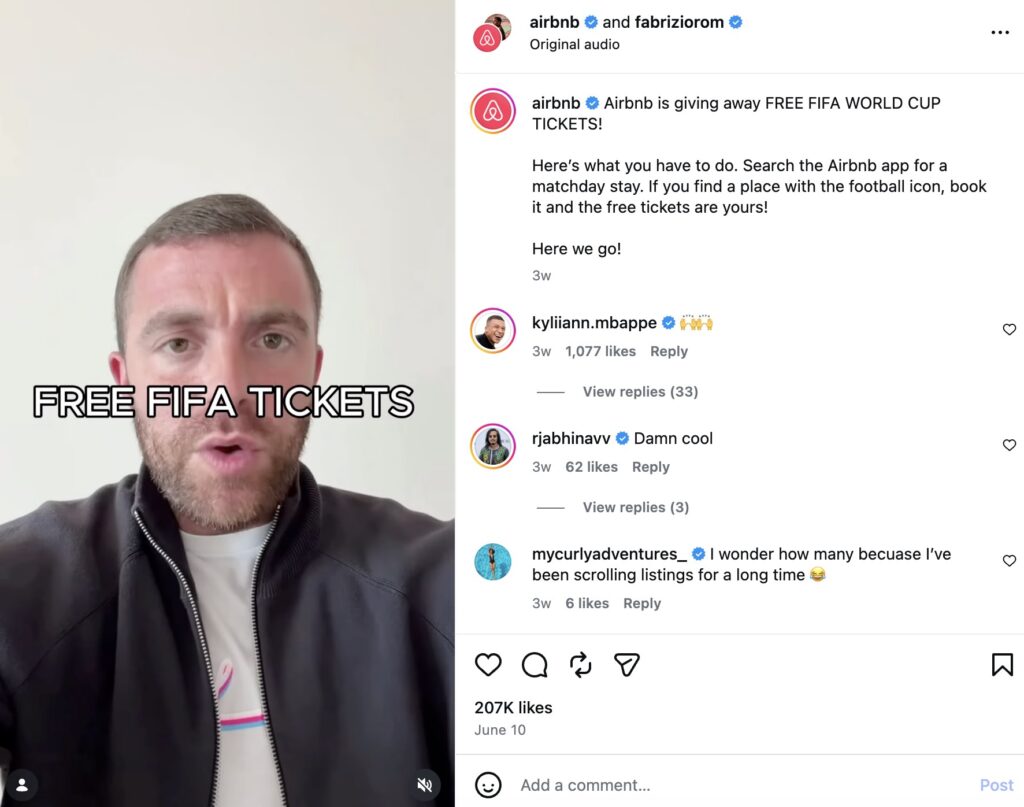
Take Airbnb’s campaign with Fabrizio Romano advertising free World Cup tickets for example. The World Cup is one of the biggest events in the world, Romano is one of the biggest non-athlete influencers in the world, and hundreds of thousands of people travel for the World Cup. It’s an awareness campaign that makes sense because of the broad audience that’s already engaged with the event. It drove more than 200,000 engagements for the brand, making it one of its top five Instagram posts of 2026.
Niche influencers are much closer to the experience of an everyday social user, which shifts the relationship from viewing and supporting to active community participation.
Their content is more focused, and as such so are their recommendations. When Kim Garcia traveled to Coachella, she included one sponsored post for Maruchan’s ramen noodle pop-up. This was a natural progression in her journey and as such had almost 400 likes on the paid promotion from an audience of 4,000—an engagement rate of 10%.
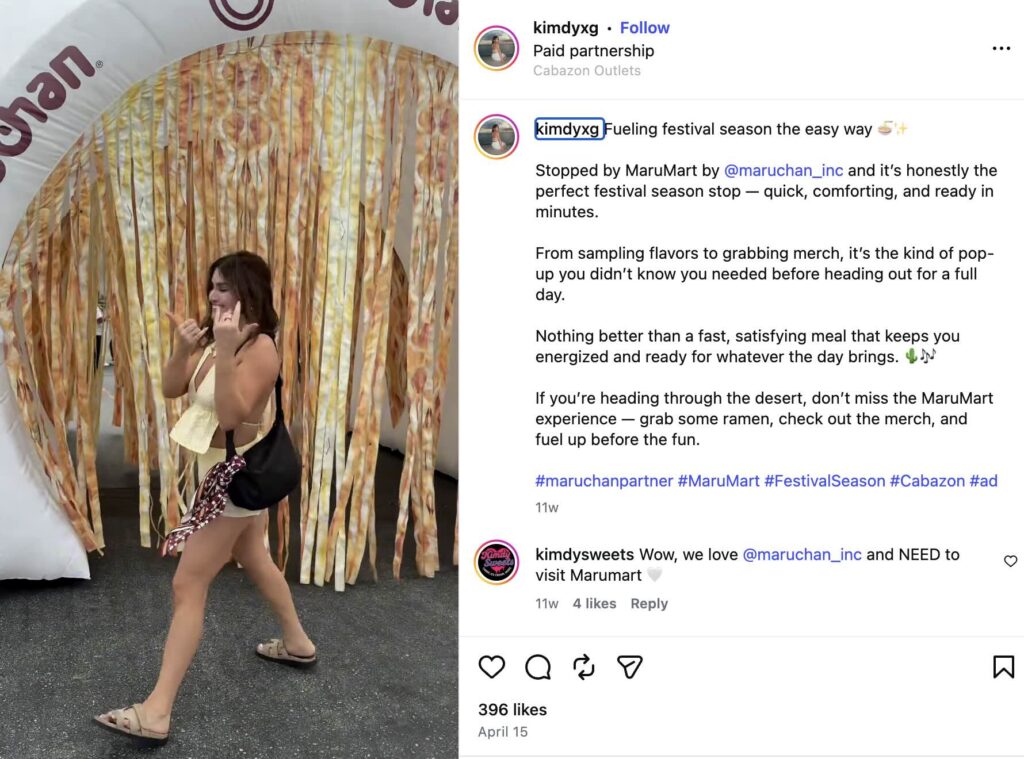
She had also already spoken about the noodles as part of her preparation for travel, putting some in her luggage to serve as a crucial festival snack. This helped her to position the brand as a logical extension of her life and content, so the sponsored post didn’t feel out of place.
Why niche influencers can drive higher success rates
According to our Q2 2026 pulse survey, audiences are more likely to look to niche creators to provide educational value or teach them a specific skill or hobby (38%), facilitate product discovery and reliable reviews (36%) and foster a genuine sense of community or belonging (31%). These creators often focus heavily on specific verticals, whether that’s tech, skincare or personal finance, and they have deep expertise and topic credibility within a specific niche audience segment.
Specific expertise in niches or consistent content themes correlate directly with their followers’ willingness to purchase the products they promote. Our survey showed that when asked to choose between a product recommended by a large vs. small creator, 21% expressed a preference for niche influencers, compared to just 15% for large influencers. This disparity is even wider for Gen Z (29% vs. 18%). This shows how niche influencers cultivate communities built on trust and shared interests, which serve as a natural endorsement before a consumer makes a purchase decision.
But what does that mean for you and your brand?
How brands should navigate the creator economy
As the industry moves away from follower metrics, brands need to approach the full influencer spectrum strategically. That means choosing partners based on campaign objectives rather than volume or followers alone.
Some moves you can make:
- Match creators to your full-funnel goals: Mainstream mega-influencers can be utilized like traditional broadcast media and leveraged for mass reach, cultural alignment and broad top-of-funnel brand awareness. Smaller niche influencers should be selected when your primary objectives are conversion, product education and driving localized return on investment (ROI).
- Track engagement metrics, not followers: When evaluating potential creator partnerships, shift your discovery workflows away from profile metrics toward the performance of the content. Dive into advanced influencer marketing metrics like historical engagement rate and sentiment analysis to understand how deeply a creator’s community trusts their voice.
- Balance your influencer portfolio: Algorithms are constantly shifting, and what’s true now doesn’t always last forever. You should be building a sustainable social presence by blending large-scale awareness campaigns with more niche advocacy.
This is all backed up by the way modern feeds work. Because algorithms prioritize relevance, not followers, topical alignment is more important than reach when choosing an influencer partner. Finding and choosing an influencer who matches your audience’s niche interests is the best way to ensure your message is distributed effectively, wherever your audience is in their journey.
Mastering the full influencer spectrum
As you scale your creator program and optimize your partnerships spend, keep these three principles in mind when building your strategy.
- Understand exactly what your target demographics are looking for on each platform. If they are seeking entertainment, match them with macro-storytellers. If they want deep-dive tutorials, partner with specialized experts.
- Avoid placing your entire budget into a single high-profile activation, unless all you want is awareness. Cultivate a mixed roster of brand ambassadors across different follower count tiers to secure broad visibility and deep community conversion.
- Evaluate potential partners based on the subjects they consistently discuss and the quality of their recent posts. Look for stable engagement rates and positive sentiment signals to ensure their community is genuinely listening.
Authenticity and trust take time to grow. By establishing long-term creator relationships grounded in shared values and topical relevance, your brand can move past short-term digital noise and unlock sustainable, compounding returns.
Ready to learn how to drive revenue with influencer marketing campaigns? Download our 2026 Influencer Marketing Report .for all the latest insights.
39 free social media strategy templates that will elevate your workflows
Published on August 20, 2026 Reading time 15 minutes




Share