
AI in Social Media
AI in social media: 10 ways to scale your impact
Social media moves relentlessly. Manual workflows trap your team in reactive cycles, stalling your brand’s growth. Embedding integrated AI into your workflow transforms chaotic global conversations into decisive business action. Discover ten practical ways to maximize efficiency, accelerate revenue and command your market today.
Reading time 18 minutes
Published on June 24, 2026
Table of Contents
Summary
- Modern social strategy requires shifting focus away from sheer publishing volume and using AI tools to analyze consumer data, allowing you to prioritize highly original, human-generated content.
- Audiences expect responsive on-platform care, making it critical to deploy AI-driven customer service tools to scale personalized responses, protect brand loyalty and drive revenue.
- Integrating AI within performance reporting workflows allows teams to move past manual data aggregation and instantly translate complex cross-channel metrics into digestible, executive-ready insights.
- Navigating a fast-moving media ecosystem demands proactive AI monitoring to detect risk signals and misinformation early, giving teams a strategic warning system to protect brand reputation.
Social media moves fast. Trends shift, competitors pivot and audience behaviors evolve, all within the same news cycle. Keeping pace with that volume demands more than manual effort; it demands AI in social media that turns the noise of global conversations into clear, decisive action.
AI works as a force multiplier for social teams by surfacing what matters, flagging opportunities before they peak and prioritizing the actions that build a real competitive edge. Here are 10 practical ways to use AI for social media to strengthen your social strategy and the mistakes to avoid for a stronger ROI.
What is AI for social media?
AI for social media is the use of artificial intelligence to plan, create, publish, analyze and optimize work across social media platforms, turning high-volume, fast-moving social activity into clearer decisions and faster action.
Implementing social media and AI tools strengthens your strategy by surfacing trends sooner, accelerating content creation, improving response consistency and uncovering insights that manual workflows miss. It doesn’t replace your team’s judgment, creativity or brand voice. It gives them more room to use all three.
AI in social media marketing delivers the most value when it supports the work that drains time and focus.
When AI and social media strategies intersect to handle repetitive, high-volume tasks, your team reclaims time for the strategic work that moves the business forward. That’s where speed becomes impact.
Ready to turn raw social conversations into a clear competitive edge?
Start a free trial of Sprout Social today to see how our embedded AI streamlines your connected workflows and delivers smarter, faster business impact.
Why using AI in social media is a competitive necessity
AI in social media has evolved far beyond drafting captions. It now operates as a full execution engine, automating social listening, analyzing sentiment in real time, managing influencer workflows and surfacing priority customer inquiries before they escalate.
Teams that rely on manual processes face a hard ceiling. Social volumes keep rising and consumer expectations for instant responses have become non-negotiable. Data from our 2025 Sprout Social Index™ shows 73% of consumers expect brands to respond on social media within 24 hours—and those who don’t hear back take their business elsewhere. Using disconnected tools to manage this data influx locks valuable insights in silos.
The competitive stakes extend well beyond response time. Integrating AI for social media posts and brand strategy now powers the full social lifecycle:
- Real-time trend detection: Surface emerging conversations before competitors act on them. Sprout’s Social Listening uses AI to continuously scan conversations across major social networks, surfacing trends, themes and sentiment shifts while the narrative is still forming.
- Sentiment analysis at scale: Understand how audiences feel about your brand without manual review.
- Influencer workflow automation: From creator discovery to campaign attribution, AI handles the operational lift so teams focus on strategy. Learn more about AI influencer marketing.
- Cross-functional intelligence: Feed social insights directly into the tools your broader business already uses.
Organizations that integrate AI-powered social platforms eliminate the operational limits that manual tracking imposes. Deploying AI across your connected workflows drives undeniable business value, expanding team productivity and demonstrating a clear return on your investment.
The true value of AI does not lie in generating content volume for the sake of it. It rests in automated analysis that extracts actionable audience intelligence from the noise of daily messages.
When you automate data processing, you drastically slash manual reporting loops, allowing you to turn social into a measurable revenue driver. In fact, data from our 2025 Impact of Social Media Report shows 56% of marketing leaders say social media drives revenue for their businesses. AI is how your practitioners scale that strategic business impact without over-burdening your headcount.
Transforming social data into actionable intelligence
Shifting from a reactive posture to a proactive strategy requires more than just a mindset change—it demands a structural shift. Once your team is freed from the operational drag of manual data collection, you face a new challenge: knowing exactly where to direct that reclaimed energy to guarantee results.
If you are struggling to prove the ROI of your efforts or feel like you are drowning in data without a clear path forward, it’s time to move beyond manual workflows.
Sprout Social transforms the chaos of social data into actionable intelligence. Sprout processes over 1 billion messages a day, and our AI-powered analytics connect that performance data directly to your business goals—so you can prove social ROI to leadership without manual analysis or spreadsheets.
Presentation-ready reports with intuitive customization let you showcase the exact metrics that matter to your organization, while embedded AI surfaces the specific content themes and organic opportunities that capture audience loyalty. Rather than getting lost in data collection, our tools help you surface rapid performance patterns and optimize your agile content strategy on the fly.
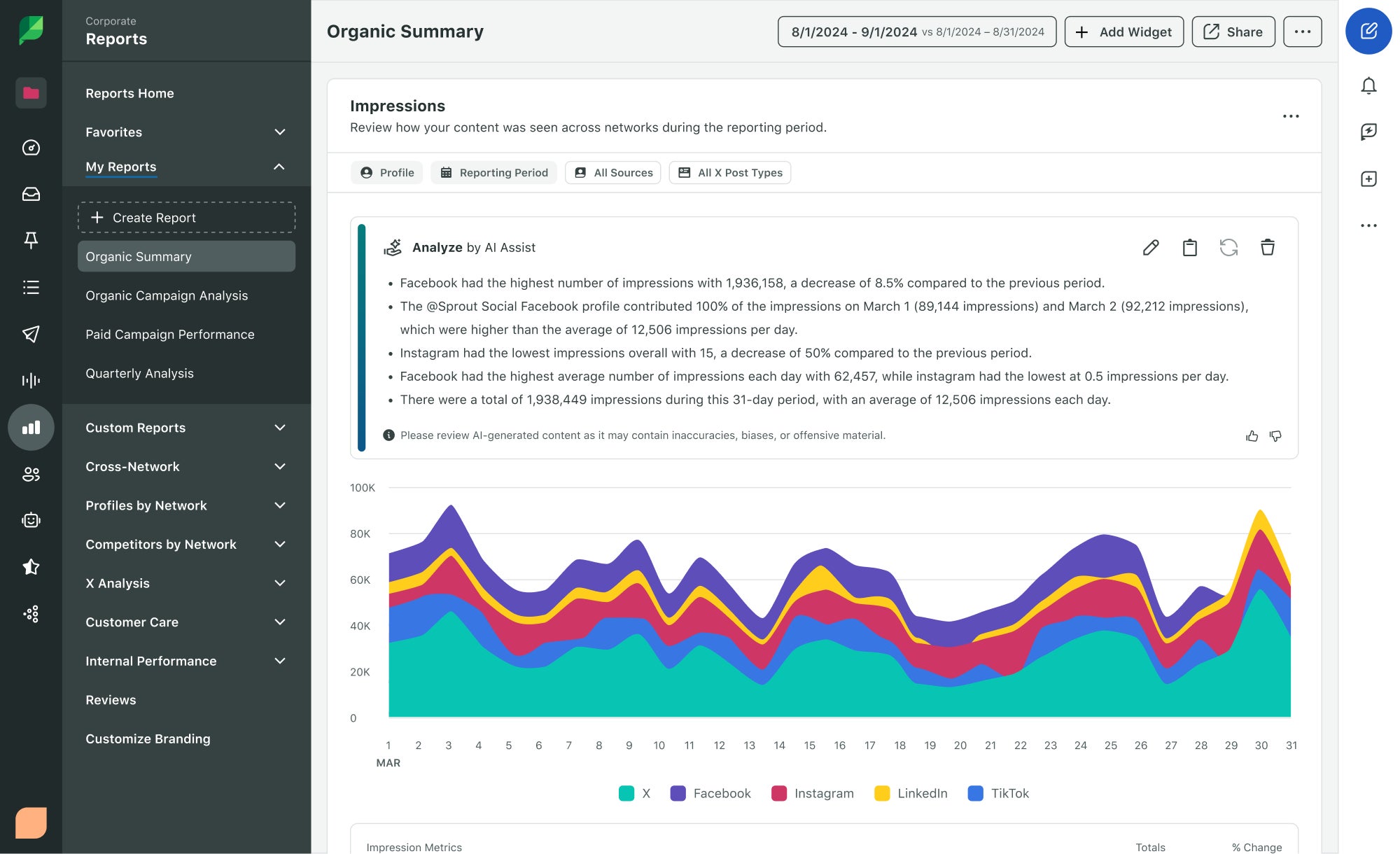
Whether you need to automate your Smart Inbox to tame message volume, use AI to surface high-impact content themes or instantly generate executive-ready performance reports, our platform gives you the tools to stop guessing and start leading.
Don’t let your team remain trapped in reactive workflows. See how Sprout Social can help you turn your social strategy into a measurable revenue driver.
How to use AI for social media
Using AI for social media means embedding intelligent automation into the workflows your team already runs, so you move faster, surface deeper insights and produce stronger content without burning out your team. The shift from reactive to proactive starts here.
Integrate AI into your daily workflows
Start by automating the tasks that drain your team’s time: drafting posts, generating alt text, summarizing conversations and prioritizing inbound messages.
Automate tagging and sentiment analysis to cut the time spent sorting and interpreting messages. Integrating AI into existing steps, rather than adding new ones, keeps adoption fast and friction low. With AI social listening you move past monitoring mentions and start identifying the subtle shifts in consumer behavior that shape your next strategic move.
To power this integration into your daily operations, Sprout Social’s agentic AI and strategic collaborator, Trellis, automates high-volume tasks like message tagging, sentiment analysis and reporting so your team redirects time toward high-impact creative and strategic work.
Choose the right AI platform for social media
Prioritize solutions that serve your core goals: stronger content, deeper insights, faster response times and better customer care.
Point solutions force your team to jump between disconnected tools, losing context and compounding manual effort at every handoff. A unified platform eliminates that friction entirely. When evaluating tools, focus on these criteria:
- Fits your existing workflow without requiring a full rebuild
- Maintains strong data governance and privacy standards
- Gives you control over tone, accuracy and brand voice
- Integrates with your broader tech stack (CRM, BI tools, etc.)
- Delivers AI across every workflow—publishing, listening, reporting, engagement and customer care—not just one isolated feature
Keep your content authentic with ethical and creative guardrails
AI accelerates ideation and production, but authenticity requires human judgment. Set clear guidelines for tone, messaging boundaries, brand safety and accessibility before your team starts generating AI in social media content at scale.
This can help you easily refine drafts to ensure they sound like your brand instead of a generic template. Think of these tools as a 24/7 AI social media assistant that handles the heavy lifting of initial drafting, allowing your creative team to spend more time on high-level storytelling. And as always, review AI-generated content for nuance, accuracy and inclusivity before publishing.
Encourage experimentation and iterative improvement
AI performs best when teams stay curious and treat it as a creative partner, not a replacement for strategic thinking. Test different prompt styles, post formats and workflows, then track what resonates with your audience. The teams that improve fastest are the ones that experiment most deliberately.
Use AI insights to inform cross-functional collaboration
AI surfaces trends, competitor movements, emerging conversations and sentiment shifts in real time. Push those insights to PR, product, sales and customer support teams to sharpen launches, refine messaging and respond faster to market changes.
Data from our 2025 Sprout Social Index™ shows 41% of social practitioners say their greatest fear is company leadership not trusting them to publish content that performs best. Sharing AI-driven intelligence across the business builds that trust and closes the gap between social teams and executives.
Build trust with transparent and responsible AI use
Your audience expects a human experience, especially in customer care. Avoid sharing sensitive data with AI tools, follow your company’s AI policy and include an AI disclaimer wherever your brand uses AI-powered interactions publicly.
Document your AI playbook as you scale
As AI use matures across your team, build a shared internal playbook that captures your best prompts, brand guidelines, approval steps and responsible use standards. Documenting high-performing AI prompts for social media maintains a consistent brand voice across departments and accelerates onboarding for new team members.
To remove the guesswork from prompting entirely, access our social media AI prompt library featuring over 70 professional-grade prompts built for marketing teams.
10 ways AI is transforming social media today
AI transforms social media from a content channel into a business intelligence engine. Data from our 2025 Impact of Social Media Report shows business leaders want teams across digital marketing, customer experience, customer care and business development to be driven by social insights.
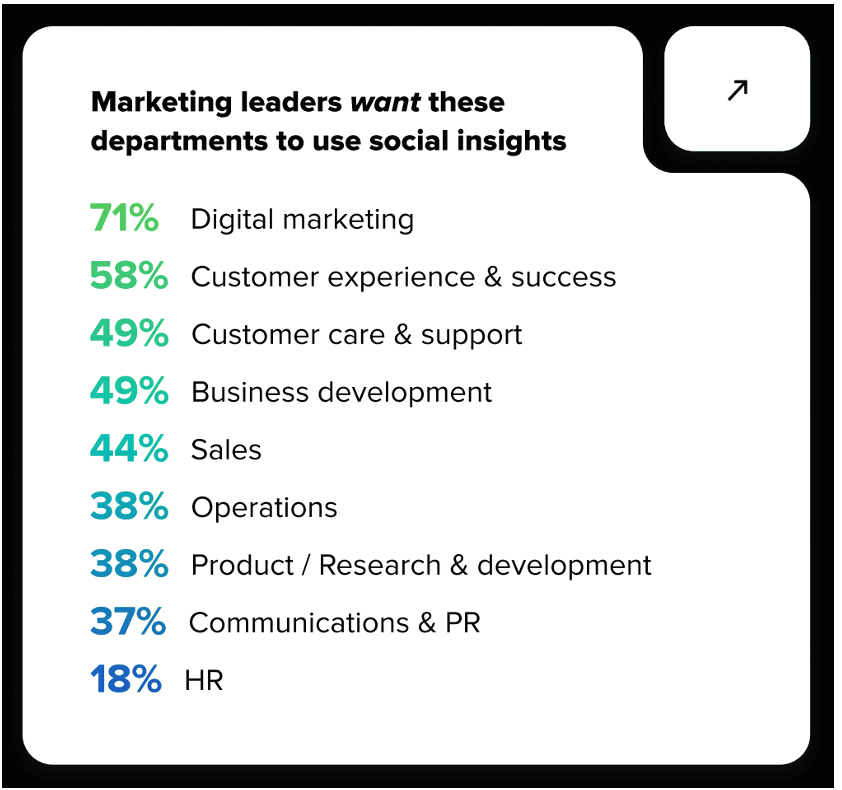
Here are 10 ways AI supports brands in gathering deeper audience insights, streamline workflows and make data-driven decisions that drive engagement, growth and measurable business impact.
1. Scale content ideation: Create a month’s worth of social posts in minutes using AI
AI acts as a creative partner for social teams, spotting what audiences care about, turning half-formed ideas into solid concepts and building drafts faster. It removes the pressure of starting from scratch so teams focus on refining the work instead. This includes customized copy for posts and image alt texts optimized for social search and accessibility.
Customized content
AI tools generate customized content for different social platforms instead of one-size-fits-all posts.
For instance, Paychex utilized AI as a creative partner for content ideation and draft copy, enabling their lean two-person organic social team to scale output and generate over $300,000 in Earned Media Value (EMV) in just one month. This structural assistance proves that AI acts as an operational amplifier rather than a human replacement.
Alt texts for optimized search and accessibility
Standing out on social requires being discoverable and accessible, not just creative.
Here’s accessibility advocate and @RNIB‘s social media manager, Holly Tuke, sharing why inclusive content matters for brands and audiences alike.
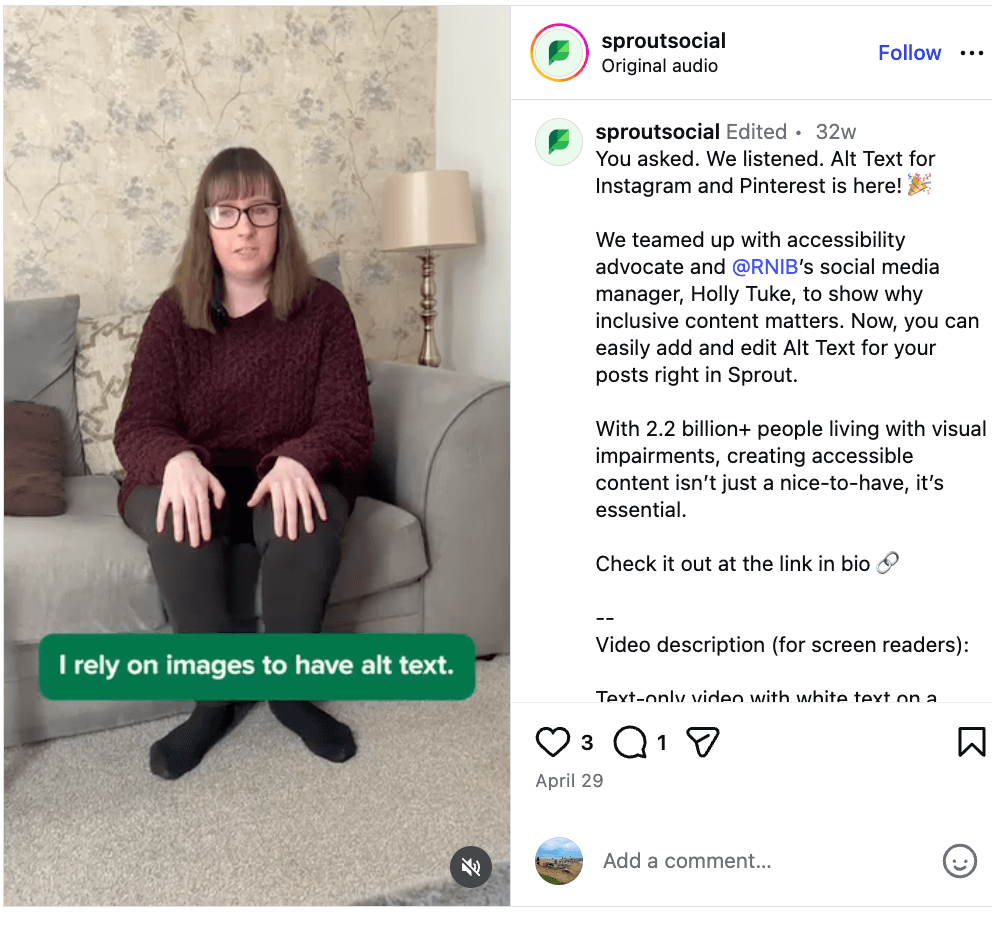
Rahul B., Digital Marketing Specialist at Vindicia, says, “I really like the AI-powered tools, especially the automatic ALT text suggestions for images, which save time and improve accessibility without extra effort.”
2. Social listening and trend analysis
Social listening is one of the most impactful applications of AI for social media marketing, operating as a key mechanism to close the widening operational agility gap.
According to the 2026 Social Intelligence Report, 74% of professionals note that social data delivers insights faster than traditional research, yet only 10% of organizations currently possess the operational agility to translate these real-time signals into tangible business actions within hours.
Sprout Social’s marketing team used social listening insights to build landing pages around trending events, directly increasing lead generation and conversions—like this page on 2025 Holiday shopping trends:
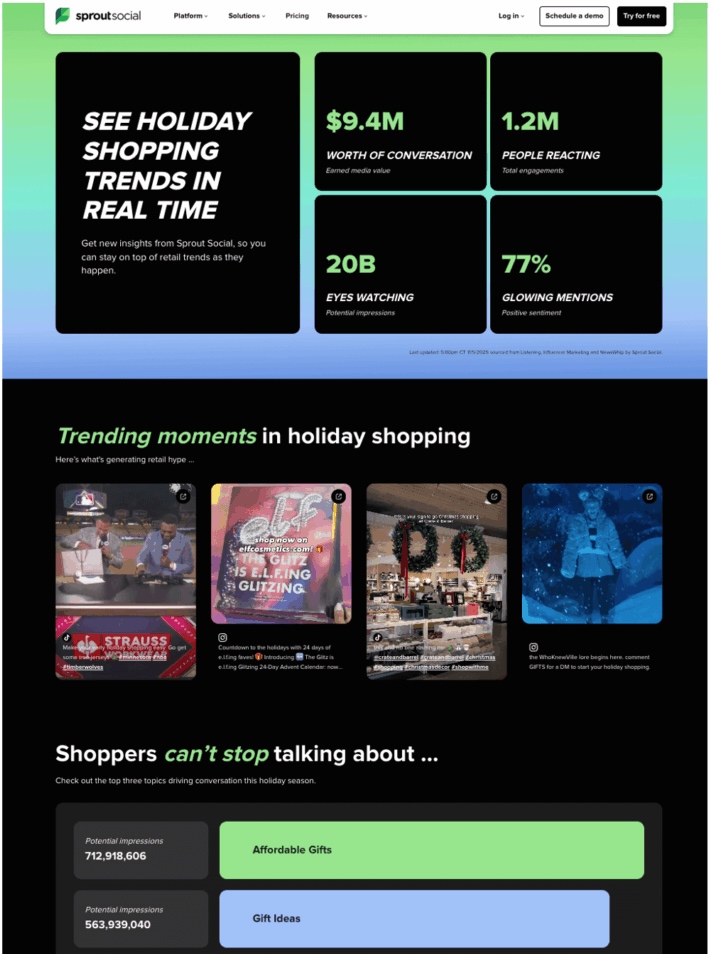
To close this agility gap, enterprise teams must shift from historical reporting to real-time directional analysis.
When AI-driven tools continuously scan global conversations, they function as an early warning system rather than a retroactive dashboard. This allows brands to map emerging consumer behaviors directly to their product or campaign roadmaps, ensuring they are actively shaping conversations rather than merely reacting to them after they have already peaked.
Turn social signals into strategy before your competitors catch on
Trends do not wait for your next reporting cycle. By the time a conversation peaks, the best window to shape it may already be gone.
Sprout Social Listening, powered by Trellis—Sprout’s AI Agent—helps you cut through the noise and surface the social signals that matter: emerging themes, sentiment shifts, competitor movement and changes in brand health across major networks and the web.
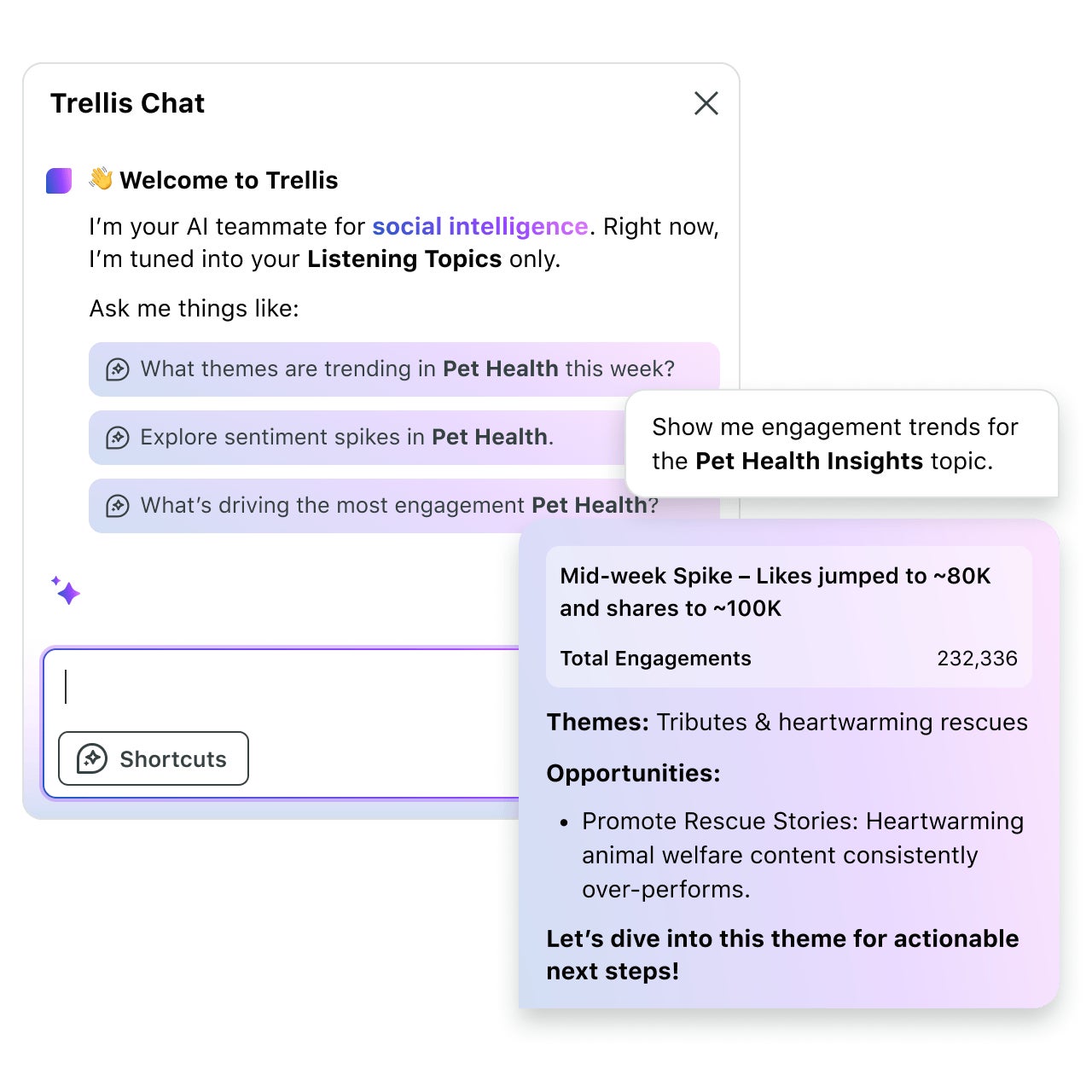
With NewsWhip by Sprout Social’s predictive media intelligence, your team can also see which narratives are gaining momentum before they break into the mainstream.
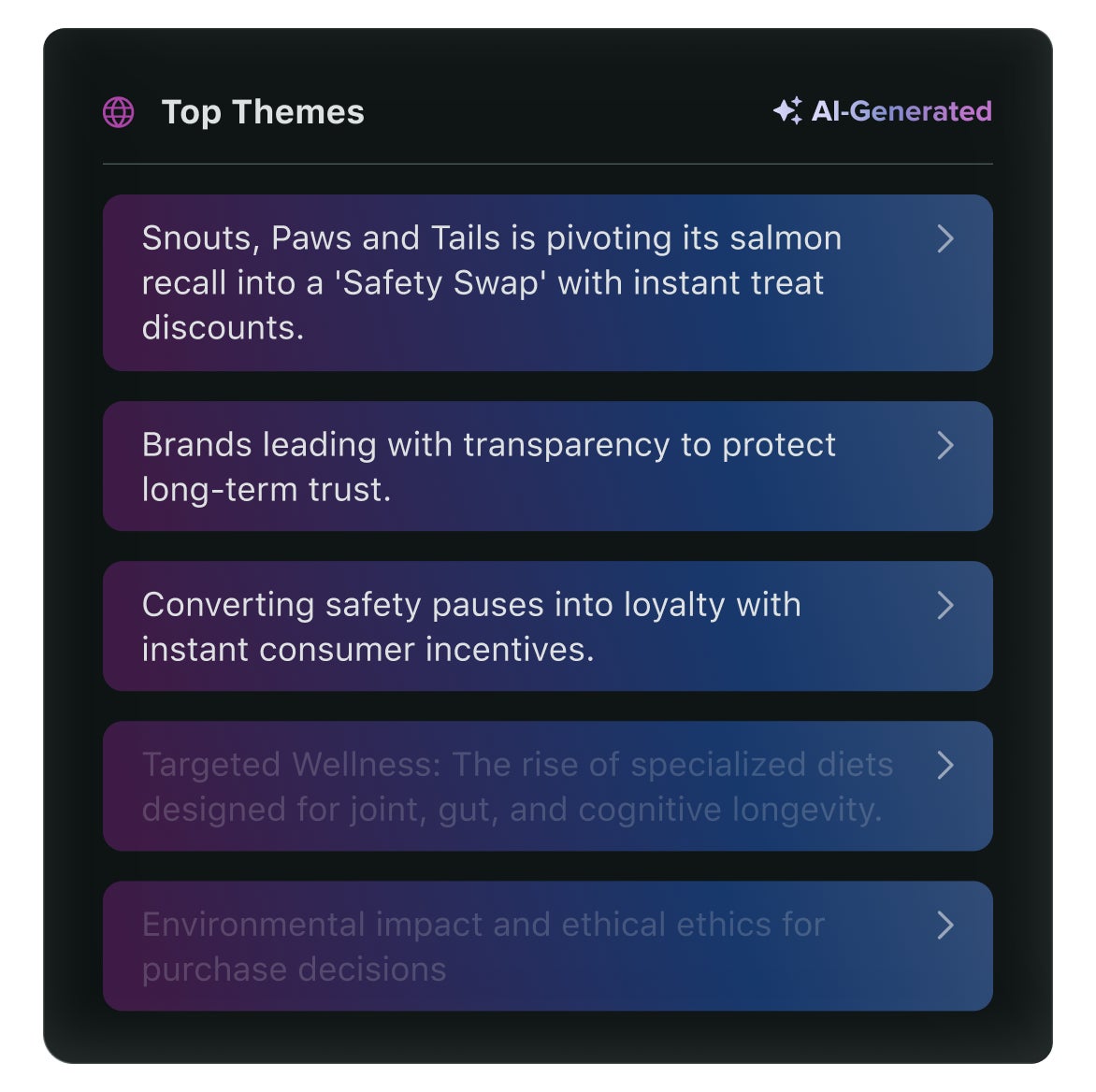
Together, they give marketing, social and comms teams the insight to move faster, align sooner and act with confidence when the moment matters most.
Request a demo to see how Sprout turns real-time social signals into smarter business action.
3. Scheduling and workflow automation
By relying on comprehensive tools to automate high-volume tasks rather than using disconnected systems, social teams achieve a 60% time savings on scheduling, publishing, and planning campaigns. Matt Dunham of Forrester noted during the webinar Data to Dollars: Leveraging Social Data for Increased Investment that without a unified suite, “it would be almost impossible to manage scheduling and publishing for all these accounts.”
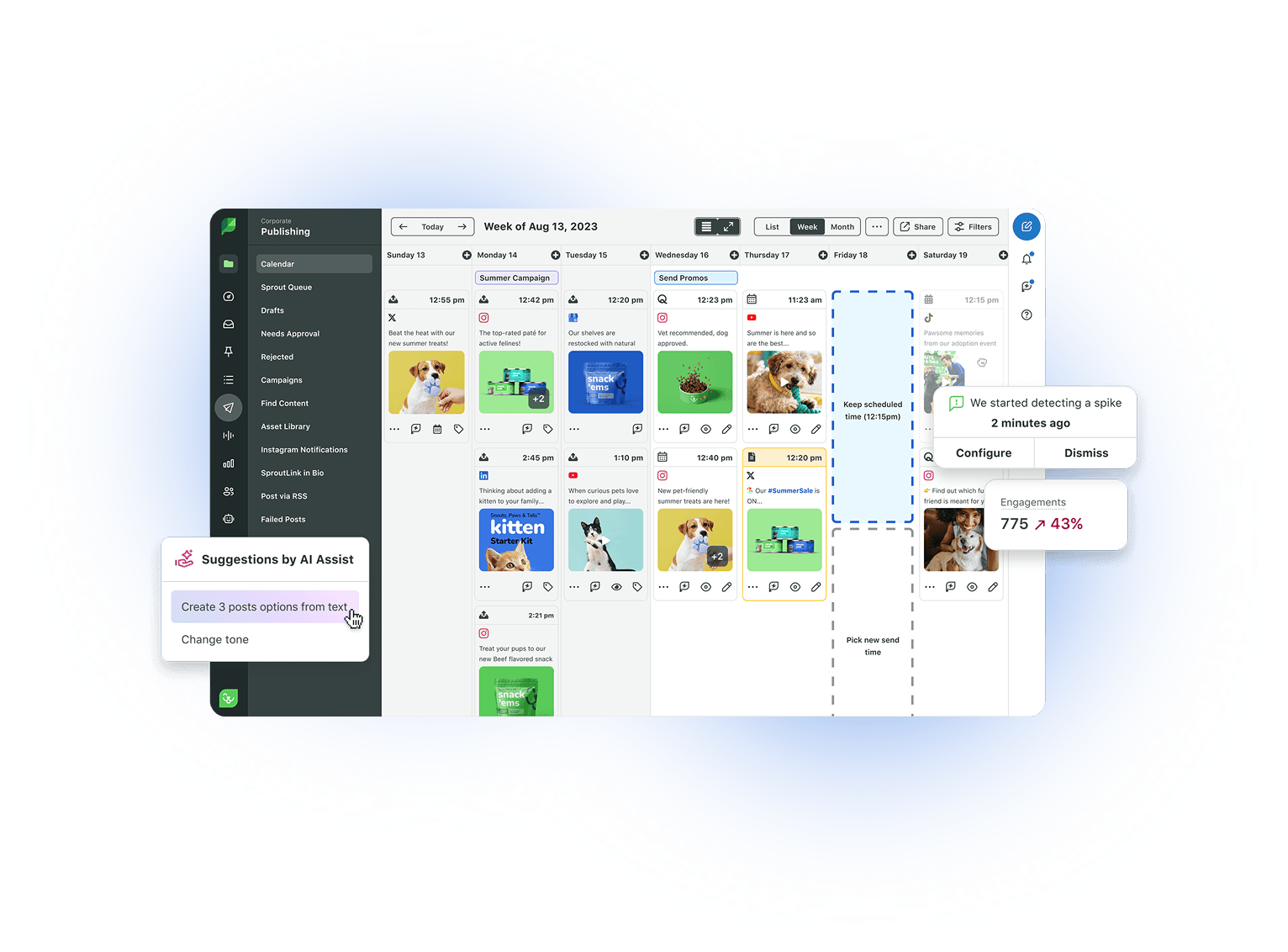
Workflow automation takes this further. AI automatically routes posts to the right stakeholders, flags missing components and surfaces potential issues before content goes live, reducing back-and-forth and keeping everyone aligned without adding extra work.
4. Audience targeting and personalization
AI supports social teams in understanding audience segments on a deeper level to deliver content that resonates. You analyze engagement patterns, interests and behaviors to tailor messages to what different audience groups care about—especially valuable for niche marketing.
Sprout Social’s AI-powered insights highlight sentiment trends, recurring themes and what’s driving engagement in audience subsets, giving you a clearer picture of consumer needs in near real time. Examples of brands using Sprout Social AI show how diverse industries use these insights to create more tailored digital experiences.
Personalization at scale is now a competitive requirement. The Q3 2025 Pulse Survey found that audiences are increasingly skeptical of undisclosed AI-generated content, making the ability to personalize at scale a critical advantage for social teams.
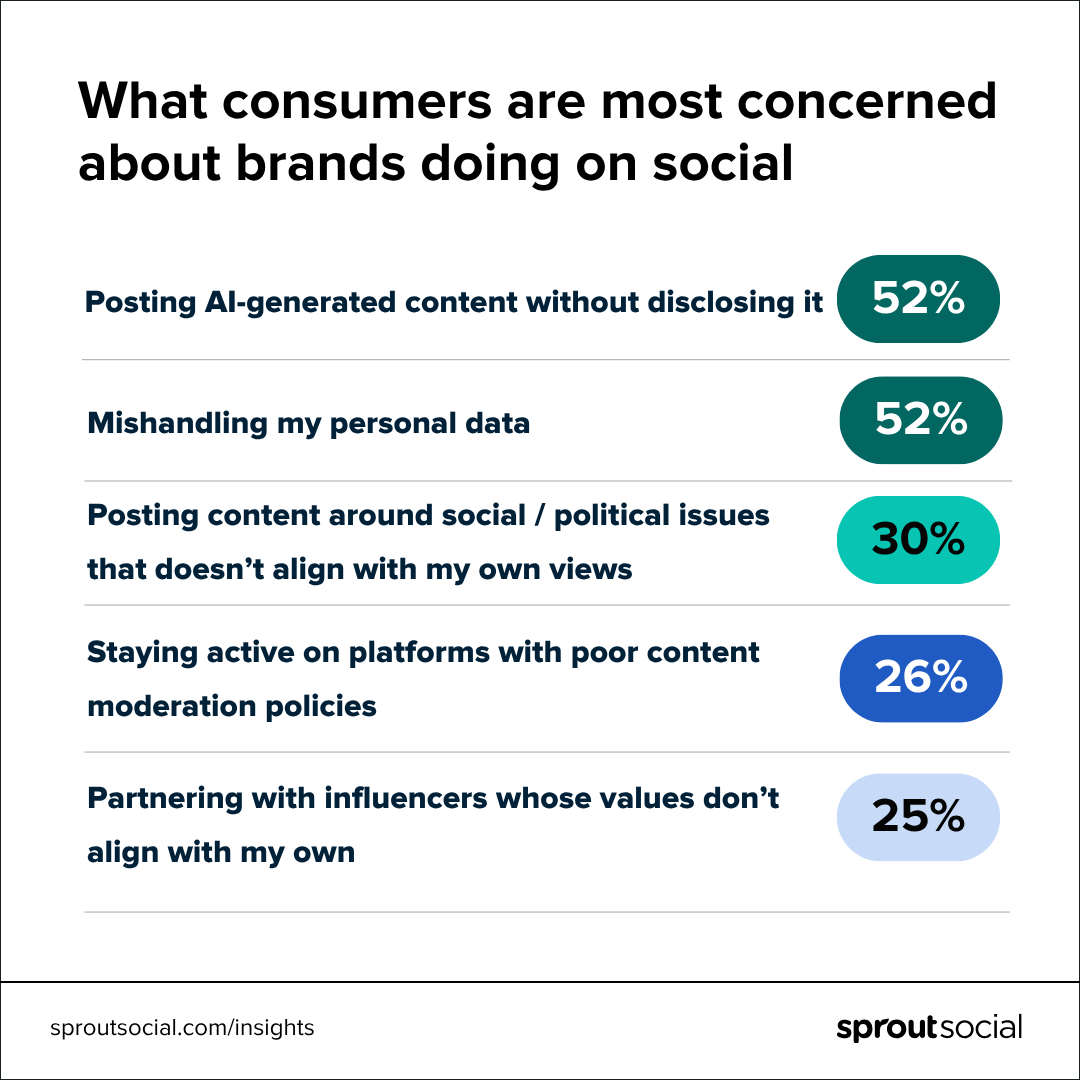
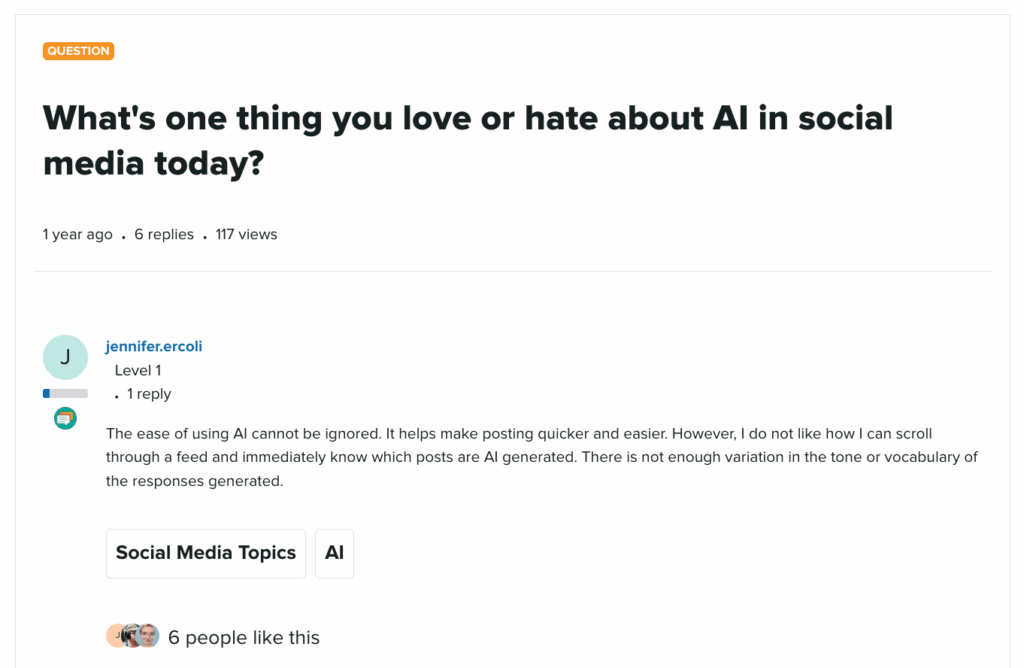
The sentiment was also reflected in a Q&A session where Sprout’s Arboretum community members shared what they loved or disliked about AI in social media.
5. Performance tracking and optimization
Highlighting the massive competitive advantage brands gain when they automate reporting, only 40% of marketers are currently using AI tools for performance reporting and analysis, representing a massive missed opportunity for teams to simplify cross-channel reporting and quickly prove business impact, per The 2026 Social Media Content Strategy Report.
The Analyze Chart by AI Assist capability processes numeric values from charts in My Reports and summarizes them in a digestible view. When it detects a sudden spike in activity, it reviews the top posts from that day to explain what caused it.
AI also strengthens the optimization workflow by turning complex analytics into practical next steps, recommending ideal posting times, highlighting top-performing formats and flagging underdelivering content. Teams iterate quickly and base decisions on evidence, not intuition.
6. Advanced customer service automation
AI has fundamentally changed customer care on social media. Consumer comfort metrics indicate that users actively want faster, AI-assisted care workflows. Data from the Q4 2025 Pulse Survey Analysis notes that 69% of social media users are actively comfortable with companies using AI—such as chatbots or response-refinement tools—to deliver faster customer service.
Data from the Data to Dollars: Leveraging Social Data for Increased Investment webinar highlights the mechanics of automated routing, demonstrating that using smart inbox features to filter, assign, and route priority inquiries results in a 10% time savings for customer service specialists.
Consolidating fragmented tools into a unified platform with Sprout Social’s automated Smart Inbox monitoring allowed pay.com.au to efficiently capture, classify and route high-priority customer inquiries, which improved their customer response rate from a mere 20% to 98% in only one week.
Similarly, mitigating agent burnout through automated triage filters has yielded remarkable operational returns. By automating high-volume, repetitive inbox management tasks and utilizing intelligent queue management filters, Honda decreased their time spent triaging messages by up to 40%—saving 40 hours a month that were redirected toward strategy and contributing to a 251% increase in community engagement.
This level of automation ensures your brand stays consistent across channels without putting added strain on human agents. By establishing custom views based on sentiment and automated routing rules, social teams can easily transform an overwhelming inbox into an optimized customer care machine.
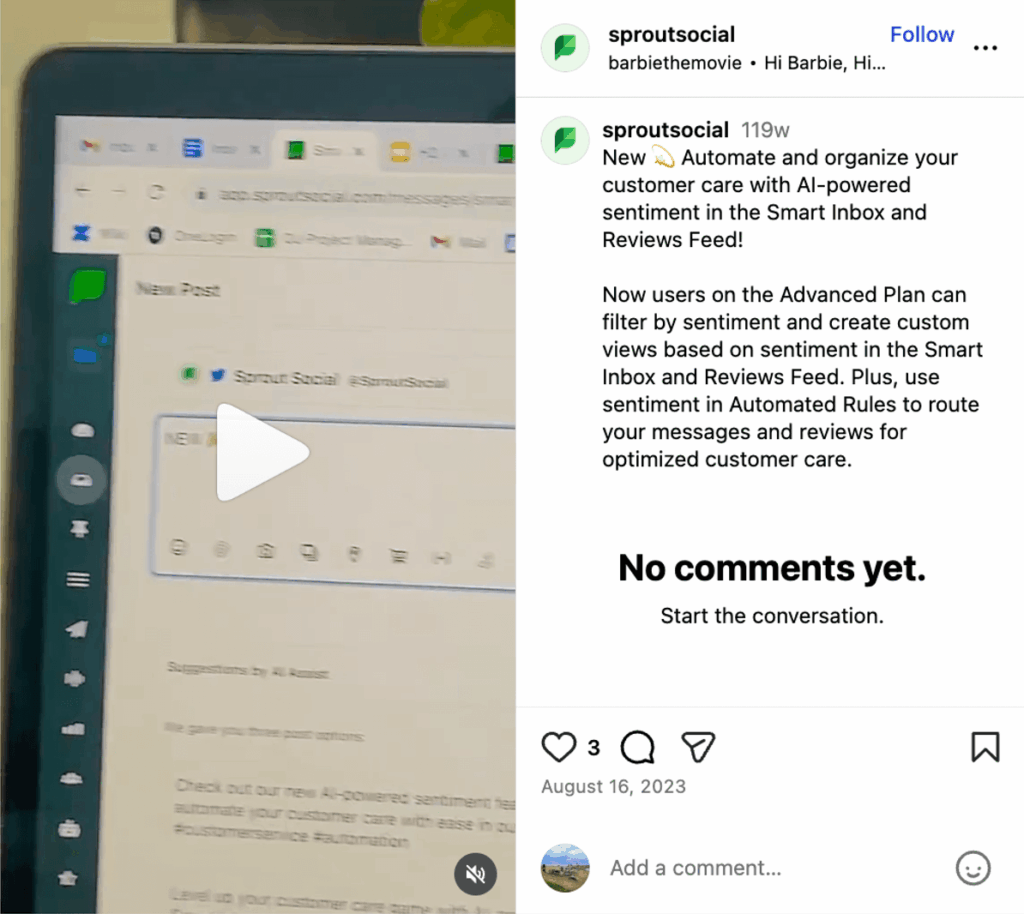
Real-time triage ensures critical messages never get buried.
Once inquiries are routed and prioritized, AI tools accelerate resolution by suggesting contextual replies, predicting intent and automating repetitive workflows, while giving agents full control when nuance is required. Customers get answers when they need them, agents solve meaningful problems and your organization maintains high-quality service at scale.
7. Competitive benchmarking and market insights
AI streamlines competitive analysis by surfacing real-time signals you act on immediately. With this level of clarity, you refine your strategy, differentiate your voice and stay competitive in crowded markets.
8. Visual and creative asset enhancement
AI supports faster creative production so teams produce high-quality assets at scale. Whether you’re repurposing existing visuals or generating new concepts, AI tools reduce time spent on manual edits so creative teams focus on the storytelling that drives real connection.
9. Risk detection and crisis monitoring
AI identifies risks before they escalate. Proactive monitoring supports cross-functional collaboration during high-stakes moments. With centralized dashboards and automated insights, PR, legal and support teams stay aligned on what’s happening and how to act, getting ahead of potential crises, protecting brand reputation and maintaining audience trust.
10. Influencer marketing discovery and management
AI has transformed influencer marketing from a time-consuming manual process into a precision-driven strategy. Contrast the precision of AI matching by citing The CMO’s Social Media Planning Guide for 2026: nearly 40% of marketing teams still rely on tedious manual research to find the right influencers for their business instead of using AI-powered discovery tools.
Proving the operational efficiency gains that come with automated creator vetting tools, data from the Data to Dollars webinar shows that utilizing tools designed to intelligently identify and vet creators reduces manual search efforts significantly, delivering a 25% time savings on discovering and working with influencers.
Utilizing an AI-powered influencer marketing solution for audience quality vetting and authenticity checks allowed Care to Beauty to reduce manual profile analysis time by 75%, supporting a targeted strategy that drove a 10x increase in influencer-attributed sales during key retail moments.
In Sprout Social Influencer Marketing, search for a topic like “sustainable fashion” and the platform instantly surfaces creators who regularly speak about that subject, ensuring topical alignment between the influencer and your campaign before you ever reach out.
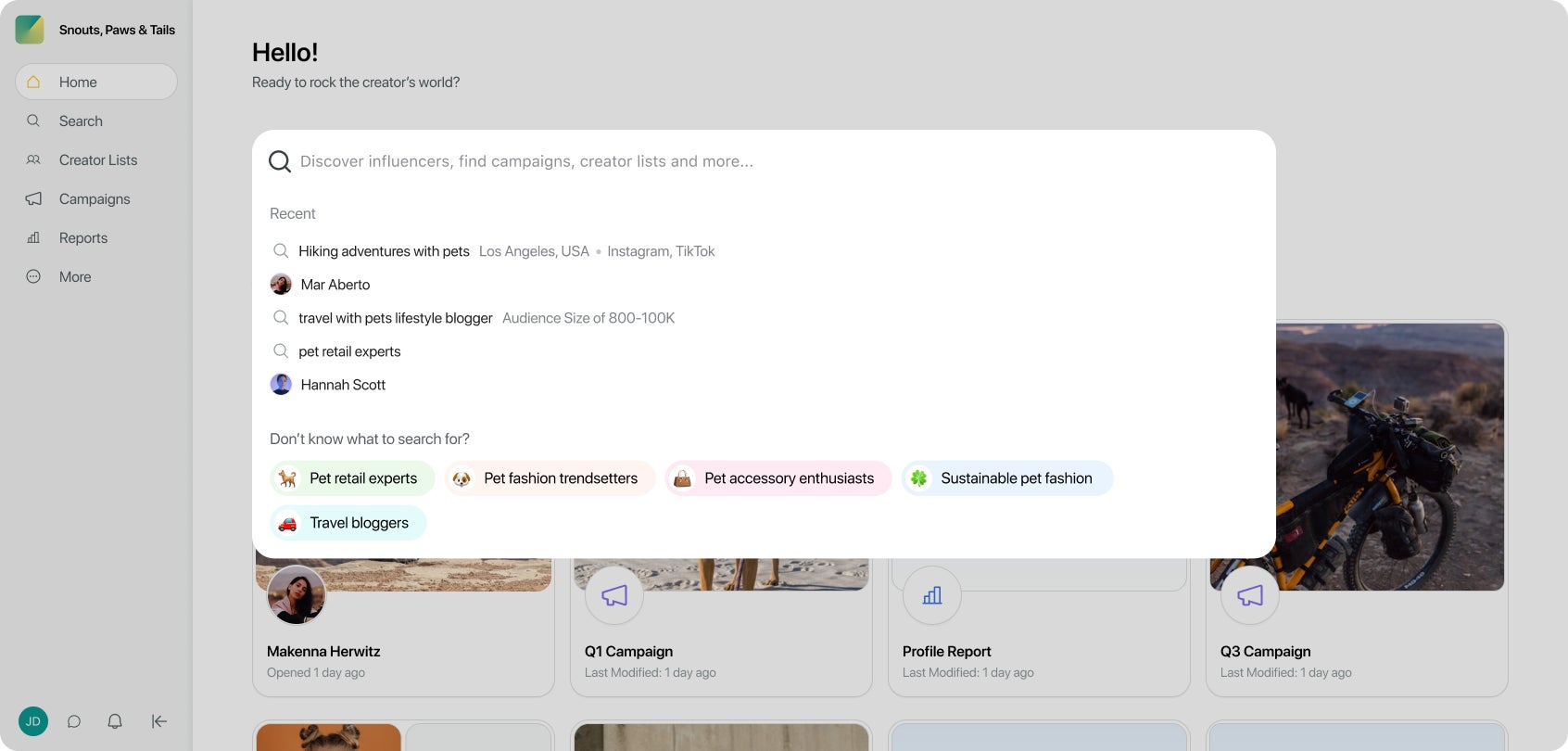
The Brand Fit Score takes this further by evaluating how closely a creator’s voice, content themes and niche match your brand’s goals, giving you a clear, data-backed signal of partnership potential at a glance.
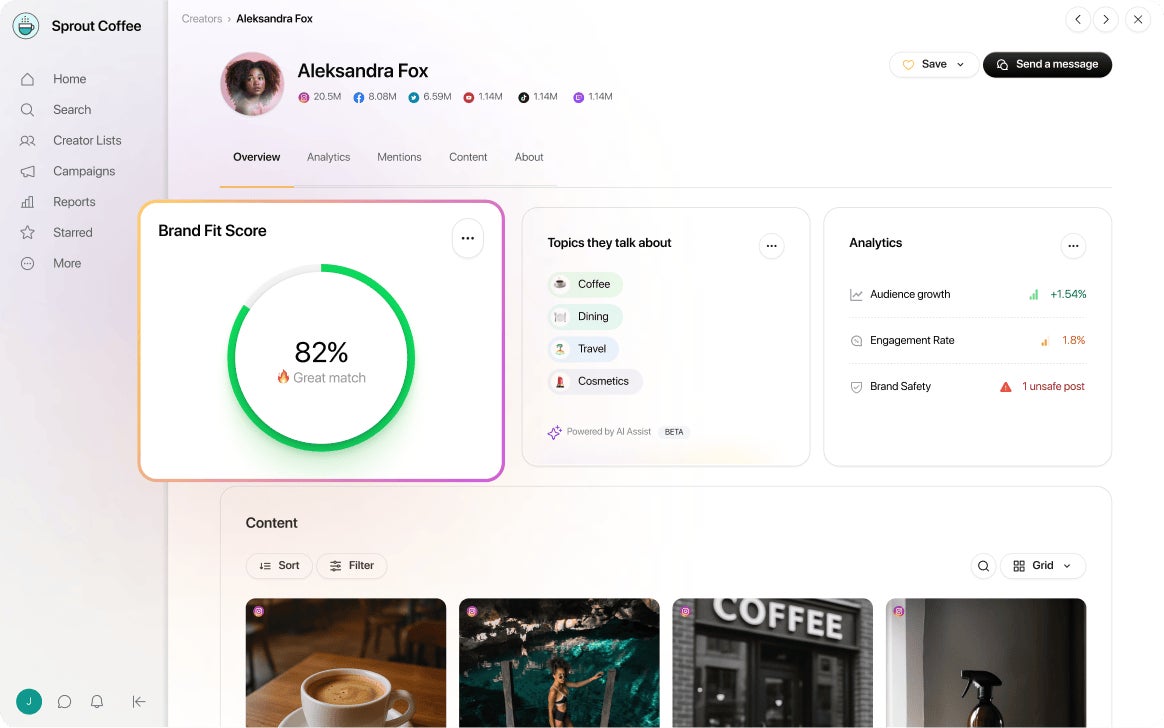
AI-powered Creator Suggestions within Creator Lists also automate ongoing discovery, continuously recommending new brand-aligned creators as your audience preferences evolve.
Data from our 2024 Influencer Marketing Report shows 49% of consumers make purchases at least once a month because of influencer posts. The brands that win aren’t just finding influencers. They’re finding the right ones, fast. AI makes that possible at scale.
AI in social media examples from brands who are ahead of the curve
The brands winning on social right now aren’t just using AI for content creation. They’re using it to detect trends before they peak, decode audience sentiment in real time and build campaigns that respond to what people actually feel. Here’s how leading brands put AI for social media to work.
Mastercard started jumping on microtrends with AI data analysis
Global brands need a head start to respond to social media microtrends—conversations that dominate social platforms for three days, max. Mastercard built a digital marketing engine that monitors social conversations, identifies microtrends before they go mainstream and cross-references them against approved brand topics. When a trend fits, AI notifies the marketing team and activates pre-made posts and targeted ads instantly.

Source: Instagram
Chipotle leaned on sentiment analysis to craft timely strategies
During the COVID-19 pandemic, Chipotle used AI to track shifts in customer sentiment and behavior on social media. According to Forbes, the brand used these analytics to inform its marketing, customer service and food safety practices—supporting Chipotle in shifting messaging toward free delivery and employee and guest safety in real time.
Using sentiment analysis also led to successful campaigns like #ChipotleTogether, where Chipotle got celebrities like Colton Underwood (The Bachelor) and Kaskade to host lunch parties and gave away free burritos.

Source: Instagram
Mercedes-Benz pulled data using AI to create a responsive campaign
Mercedes-Benz launched a localized campaign at its Poland headquarters to promote the new T-Class vehicle. Called “The moody colors of Poland,” the campaign used an AI tool to gather Polish social media posts from Facebook, Instagram, Twitter and blogs via emotion-focused keywords and hashtags (#joy, #love, #sadness). Based on how its Polish audience felt online the previous day, the lighting on their headquarters building, billboard and a special outdoor display featuring the T-Class changed to match—yellow for happiness, green for relaxation and so on.

The campaign earned widespread recognition and proves that AI-driven social insights feed directly into creative marketing executions, not just dashboards.
Louis Vuitton is using sentiment analysis to proactively moderate content
Louis Vuitton uses sentiment analysis to stay ahead of sensitive and problematic content, assessing over 250,000 messages a month on social media. When sensitive topics like cultural appropriation or animal welfare surface, the brand receives immediate alerts. When user-generated content is flagged as toxic, AI removes it automatically, protecting brand integrity and keeping online spaces safe.
Vanguard is experimenting with messaging on LinkedIn
Brands in heavily regulated industries need guardrails to stay compliant on social media. Vanguard Institutional turned to AI to test multiple versions of LinkedIn messages, analyze their components and identify the most effective phrases for their audience. The result: more personalized content that drives stronger engagement without compliance risk.

The NFL is overcoming language barriers with AI
As the NFL expands beyond the US, it’s using AI to scale and personalize content across markets—generating copy in multiple languages, swapping creative based on channel or location and personalizing in-person experiences. If a player resonates more in the US, that player’s image runs in US ads. If Germany favors a different player, the AI translates the copy and swaps the creative automatically. This is what audience-first, AI-powered content strategy looks like at scale.
Common mistakes to avoid when using AI for social media
AI delivers real value for social teams only when used with intention. The most costly errors happen when teams over-automate, skip compliance checks or deploy AI without clear human direction.
Grounding this oversight boundary check with the Sprout Social Q1 2026 Pulse Survey Analysis, findings demonstrate that posting AI-generated content without clear labels is the number one behavior consumers wish brands would stop doing in 2026, cited by 28% of users. Avoiding these pitfalls is what separates brands that scale confidently from those that create more work for themselves.
Paula Perez, Brand Communications representative at Oatly, issued a clear community stewardship warning during Sprout Social’s Oatly Webinar:
“It’s not so much about using AI as a tool because I think a lot of us will have to learn how to do that. But it’s just more so…is this serving the community? Does the entertainment outweigh their concerns?”
Brands must carefully smooth out scripted templates for personalized customer care to mitigate consumer alienation. For example, by using AI to rewrite customer service responses to be more personable rather than relying on scripted templates, Paychex avoided the pitfall of a robotic brand presence and decreased its average Service Level Agreement (SLA) response time by 67% within 60 days.
AI is a co-pilot, not a replacement. It amplifies human capability but cannot replicate the emotional intelligence and strategic intuition that social marketers bring to a brand. The question of whether AI will replace social media marketers misses the point—the real question is how well you direct it.
- Over-automation: Relying too heavily on AI for responses or content makes your brand feel robotic and disconnected. Use automation to support your team while keeping human interaction intact where it matters most.
- Lack of human oversight: AI requires human review to ensure tone, accuracy and brand alignment. Build in checkpoints for editing and approvals before anything goes live.
- Ignoring privacy and compliance: Feeding sensitive data into AI tools without understanding data privacy rules or network policies creates real compliance risk. Follow all platform policies and internal governance standards.
- Using generic prompts: Vague prompts produce irrelevant, low-quality output that creates more work for your team. Give your AI tool clear context, audience details and specific goals.
- Not reviewing for bias: AI reinforces stereotypes or biased language when left unmonitored. Review all outputs before publishing to catch what the model misses.
- Automating without strategy: Using AI without a defined purpose leads to inconsistent results and wasted effort. Map out exactly where AI fits in your workflow and what it should measurably improve.
- Neglecting accessibility: AI-generated captions and alt text require human review to stay accurate and inclusive. A quick check protects both your audience experience and your brand reputation.
Scale your social media impact with AI—starting today
Implementing AI across your social ecosystem fundamentally transforms how your marketing organization operates—turning highly fragmented consumer noise into highly structured business growth. Rather than simply using these tools to increase content volume, forward-thinking brands use smart automation to scale enterprise productivity, protect brand reputation and maximize the bottom-line value social commerce delivers.
The most effective teams use AI across every layer of their social strategy:
- Content creation: Draft, refine and personalize posts at speed while keeping your brand voice intact.
- Audience intelligence: Surface real-time insights from social conversations to inform campaigns before competitors catch on.
- Workflow automation: Eliminate manual reporting, approval bottlenecks and repetitive tasks so your team focuses on strategy.
- Performance analysis: Connect social activity to business outcomes with data executives act on immediately.
AI works best when human judgment stays in the loop. As the AI-Powered Social Intelligence platform, Sprout Social pairs with Trellis to surface what matters most across connected workflows, empowering your team to speed up decisions and transition from reacting to yesterday’s data to shaping tomorrow’s strategy. Discover how your business can lead the conversation by requesting a demo today.
AI in social media FAQs
What is AI in social media?
AI in social media is an operational engine that uses machine learning to automate content creation, real-time social listening and customer sentiment analysis.
It enables brands to deliver personalized audience experiences and instant customer service at scale by identifying emerging trends and prioritizing urgent interactions. By streamlining workflows like scheduling and reporting, AI allows teams to move from reactive tasks to data-driven strategies that drive measurable business impact.
How is AI used in social media?
Today’s AI turns complex data into actionable insights. By automating social listening and prioritizing high-value messages, AI empowers brands to provide instant, personalized care at scale.
Whether it’s generating captions or identifying emerging trends, AI acts as a creative partner that elevates every part of your social strategy.
Which AI is best for social media?
The best AI for social media fits directly into the way your team already works, supporting publishing, listening, reporting, engagement and customer care in one unified platform. The result is smarter decisions, faster execution and measurable business impact from social.
How do I use AI for social media without losing brand authenticity?
Yes. Let AI accelerate drafts, surface insights and streamline workflows, then rely on your team to shape the final message, tone and creative direction.
What is the 30% rule for AI content?
The 30% rule keeps human judgment in the lead: use AI to accelerate the first draft or handle repetitive tasks, but always apply human editing, context and creative direction before content goes live.
Will AI replace social media marketers?
No, AI changes the job by removing manual work, highlighting patterns and speeding up execution, but social marketers still drive strategy, protect brand voice and build the kind of authentic connection no tool manufactures.
Additional resources for AI in Social Media

How to use an AI social media assistant to amplify your team’s impact
AI in social media: 10 ways to scale your impact

How to integrate Agentic AI for social media into your workflows

30 ways to master AI prompts for social media: A marketer’s guide
10 ways AI social listening tools help your brand

AI influencer marketing: Enhancing your campaigns with AI tools
8 top AI social media content creation tools to streamline your strategy

AI won’t replace social teams: Here’s why

Share