Bluesky SEO: Your guide to social search and discoverability

Written by John Paul Hernandez
Published on January 30, 2026
Reading time 12 minutes

Table of Contents
Consumers are increasingly turning to social networks like Bluesky not just to connect but to find news, research products and discover solutions that meet their needs. This rapidly expanding network, on which users are seeking a decentralized, community-focused culture, is quickly becoming a significant connecting point in the customer journey.
For social media marketers, this shift represents a prime opportunity. As social search continues to accelerate, establishing a strong, measurable presence on Bluesky allows you to connect with early adopters and secure a foundational advantage. These evolving user behaviors make optimizing for Bluesky SEO a critical strategy to boost your brand’s in-network visibility, reach and authority.
What is Bluesky SEO? And why does it matter?
Bluesky SEO is the strategic optimization of your profile and content to maximize in-network discoverability and authority. This effort is crucial because establishing an early, visible presence on a rapidly growing network like Bluesky offers significant first-mover benefits.
Fundamentally, Bluesky is a microblogging network that’s similar to X and Threads, where users publish short posts, links, videos and images. Its core differentiator—and why marketers are now paying attention to it—is its decentralized structure that runs on the AT Protocol. This decentralization gives users the unique advantage of seamlessly porting their content and identity across other compatible networks.
The opportunity for early adopters
Bluesky’s rapid growth, which has surpassed a 372% year-over-year increase as of June 2025, makes it a prime opportunity for early adopters. Optimizing for search on this network now lets you tap directly into emerging social trends and fundamentally reshape how users discover your brand. This consistent upward trajectory, often referred to by analysts as a new era of Bluesky growth, signals that the platform is moving beyond its niche origins and toward a more permanent fixture in the social ecosystem.
This powerful digital marketing strategy will increase your in-network exposure precisely when users are actively searching for your brand or exploring related topics.
A critical caveat: External indexing
While the primary focus of Bluesky optimization is in-network visibility, there are also early signals that external search engines like Google are indexing Bluesky profiles (and potentially posts), which adds a layer of off-network value.
But this external indexing isn’t yet consistent or widespread. That’s why brands should file this information under “emerging trends to monitor” instead of relying on it as an active SEO tactic. Your immediate priority remains building strong in-network visibility and meaningful engagement.
The rise of social search and its impact on SEO
Sprout Social’s Q2 2025 Pulse Survey found that one in three consumers turn to social media to research products or reviews, and 76% of buyers report that social posts influenced their purchases. Furthermore, the Sprout Social Index™ 2025 revealed that 86% of users plan to maintain or increase the time they spend on social networks in 2025.
As consumers continue to prioritize social networks, social search optimization is rapidly becoming a primary driver of discoverability. Here are a few ways that social search is changing how customers look for solutions and products:
Using social networks as primary search engines
The current shift in search habits toward social media and AI engines requires SEO to evolve and reflect new user behaviors. Marketers are increasingly referring to this phenomenon as “search everywhere” optimization, which signals the necessity for social media and SEO teams to collaborate and meet audiences where they are searching.
Social media search is when users intentionally look for answers, products and information on their preferred social networks instead of traditional search engines. A few years ago, a user who searched for “best independent sci-fi podcasts” would have relied solely on Google. But today, that user is just as likely to turn to social networks like Bluesky for real-time recommendations and authentic reviews.
Traditional SEO methods remain a core pillar for ranking on SERPs and securing AI mentions. However, by strategically leveraging social networks like Bluesky, your team actively builds real-time credibility, which helps your brand stand out where audiences are searching.
Boosting traditional SEO with social
While traditional SEO relies on long-term authority, social activity allows you to rapidly accelerate your brand’s credibility through interactive engagement. This gives you real-time control over essential social signals.
Engagement signals, such as likes, reposts and virality, are powerful social signals that boost your visibility within Bluesky’s feeds. This increased exposure can then indirectly build your authority by earning essential links or mentions on external sites, which reinforces your brand’s E-E-A-T. The more actively you engage and grow your following, the more you will amplify your overall discoverability.
Synergy with traditional SEO funnels
As search habits shift across networks, a unified social search strategy is becoming more essential for discoverability. Taking this approach helps your team meet audiences on the networks they prefer, like Bluesky, and then connect that activity back to measurable business impact.
This strategy complements creating a cross-channel ecosystem where social content builds real-time authority and engagement signals reinforce search visibility. In this new landscape, social and search remain distinct disciplines but increasingly operate in tandem to strengthen a brand’s overall discoverability and credibility online.
How to optimize for Bluesky SEO
Your social media team can seamlessly integrate Bluesky SEO into your existing overall social media and SEO strategy. Below are some actionable steps you can take to embed this strategy into your current SEO initiatives and connect them to real business impact:
Optimize your Bluesky profile for discoverability
First, you should optimize your profile. This page is what immediately communicates who you are, what you offer and, most importantly, who you serve.
Here are some quick ways you can optimize your Bluesky profile:
- Use your official brand name for your handle and display name.
- Change the generic Bluesky handle URL (“[handle name].bsky.social”) to your owned domain to strengthen brand consistency and trust.
- Upload your professional brand image for your profile and banner.
In addition to optimizing for your company name, be sure to proactively optimize your bio with strategic keywords. For instance, a podcast creator could include targeted keywords like “sci-fi” and “independent podcast” so their content surfaces when users search Bluesky for recommendations like “What are the best independent sci-fi podcasts right now?”
Here’s a profile example from Limited Run Games, a game publisher in Cary, North Carolina. The brand uses its domain name for its handle, which boosts its SEO signals and authority. Its bio also includes keywords like “physical games,” “indies” and “cult classics.”

Source: Bluesky
Your profile should also include your website link and relevant hashtags in the bio. Furthermore, when you post an image, always include descriptive alt text. This is crucial for both accessibility and keyword optimization.
Finally, you’ll want to ensure that your profile is consistent with your other social accounts to simplify cross-platform discoverability. Since Bluesky allows you to pin a post, prioritize content that immediately represents your brand’s current positioning, voice and high-value offerings.
Create content that surfaces in Bluesky search
Once you’ve optimized your profile, the next step is publishing content that directly supports your Bluesky SEO strategy.
To accomplish this, begin producing descriptive content that aligns with relevant topical queries and use keywords and phrases in your posts. When appropriate, use strategic hashtags sparingly to anchor niche relevance and ensure that users who are searching for that topic discover your content.
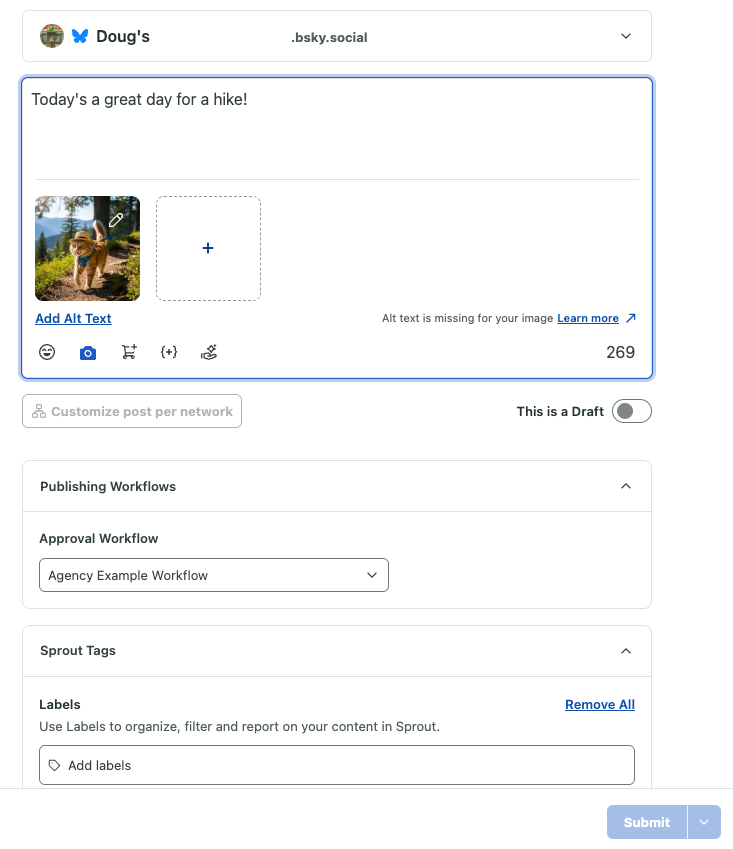
You should also remember that users are increasingly prioritizing engaging with rich media like videos and images. According to Sprout’s 2025 Content Benchmarks Report, “video content is on the rise,” with a 3% increase on networks like Facebook and Instagram. When you do include this kind of media in your posts, be sure to write descriptive alt text for accessibility. That text can help search engines understand your content if they index the image.
Publishing and reporting tools are essential for streamlining this part of your strategy. Not only do they help you connect your efforts to real business outcomes, but they also facilitate easy cross-posting across all your social channels and help you drive consistent engagement through collaborative workflows.
Structure threads for maximum discoverability
The thread format is a highly effective posting method for microblogging networks like Bluesky, X and Threads. Essentially, a thread is a series of posts that begins with a primary, attention-grabbing post (the hook), followed by replies that expand on the main points, much like in a long-form article.
To craft a successful thread, treat your initial post like an article headline and a compelling introduction. Then, use a concise, keyword-rich hook that immediately tells users what you will cover, sets clear expectations and promises significant value.
For example, the Ship 30 for 30 course shows how effective threads work in practice. Its founders went viral on X by applying the following methods for making threads engaging:
- Add a “big bold claim” to stop users from scrolling.
- Include a “moment-in-time opener” like “in the last 3 weeks” to add specificity.
- Mention an impressive number if possible, like “over 19,000 fans,” to add credibility.
- Insert a benefit for the reader, like mentioning a resource that they can use, to hook them in.
- Embed a “big, scroll-stopping thumbnail image” to capture attention.
- “Cast a wide net” by mentioning a free resource, for example, but emphasize universality with phrasing like “easy to use anywhere.”
While these tactics helped this brand in particular reach over 2 million impressions, you can directly apply them to engage users and significantly build your own brand’s visibility on Bluesky.
While these structural elements help with search, they are most effective when paired with a comprehensive Bluesky strategy that balances informational threads with the community-centric engagement the platform is known for.
Drive engagement to improve your visibility
Engagement is precisely where Bluesky SEO provides the most impact. In fact, Bluesky shared a post from Dave Earley of The Guardian, who noted that traffic from Bluesky is “significantly higher” than Threads.
As a brand, you absolutely should use these engagement signals to your advantage. To start, deliberately cultivate your following and establish consistent, predictable posting habits. Posting regularly at similar times builds user familiarity and trust, which naturally increases the likes, shares and replies you’ll see on your content.
For every post, you’ll want to prioritize meaningful engagement—especially reposts, quotes and replies—soon after publishing. While Bluesky hasn’t publicly shared how its algorithms weigh these signals, early interactions often help posts gain traction in custom feeds and communities. Responding promptly to comments and quote-posts also strengthens your in-network relationships and signals authenticity and consistency that build long-term visibility.
Partnering with creators who already show up in Bluesky search is a great way to amplify your in-network reach and authority too. Their existing momentum will provide a significant boost in your own discoverability on the network.
When a post gains traction, one way to promote further growth is by reposting or quoting it. If you quote-post the content, you can strategically add more insights based on original comments, increasing relevance and encouraging future engagement.
If you’re new to Bluesky, you should immediately take advantage of starter packs or community lists to accelerate visibility. Themed lists are an ideal way to quickly find and connect with your target audience based on their specific interests.
Optimize for Bluesky’s custom feeds
One of Bluesky’s most powerful features is its custom feeds, which allow you to join existing communities and choose a niche algorithm. Because custom feeds are laser-focused on mutual interests, they create a highly intentional environment for engagement, which is ideal for connecting with your target audience.
These curated feeds not only guarantee exposure to the right audience but also significantly increase your credibility within your niche. Active engagement with this audience signals to both Bluesky and external search engines that you are a genuine authority in that area.
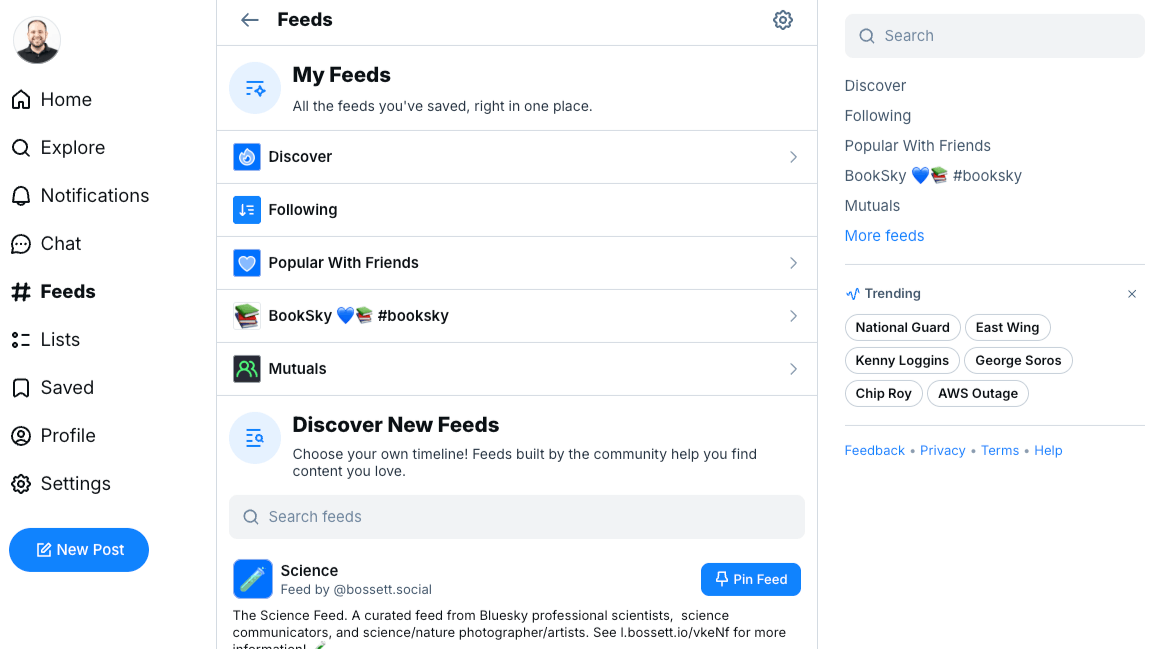
To find custom feeds, simply search for existing communities. Then, follow the feed and actively engage with posts on it to accurately assess its user base and community culture. Once you’re done there, you can begin contributing your own content.
Own topical pillars in your niche
Mirroring traditional SEO best practices by focusing on key topical pillars also helps your brand build consistent authority and relevance. While Bluesky’s discovery algorithms are still evolving, centering your content on a few core themes reinforces your brand identity, makes your expertise recognizable within communities and positions your content for stronger visibility as search and social discovery continue to converge.
To do this effectively, select one or two core themes and decisively take ownership of that space. Through consistent, high-value posting, rigorous keyword optimization and targeted engagement, you’ll build and solidify your brand’s authority there.
Leverage influencers for discoverability
Influencer content marketing is growing exponentially due to its unique ability to rapidly earn trust and reach new users. By collaborating strategically with an influencer in your niche, you’ll immediately gain access to their followers and existing momentum, which is a key component of the “Authority” element in E-E-A-T.
In fact, a successful influencer partnership provides a major jumpstart for both engagement and immediate visibility. According to Sprout’s State of Influencer Marketing Report, marketers often notice the following results when they partner with influencers:
- 92% see greater reach.
- 90% experience higher engagement with their content.
- 83% find that conversions increase.
The best way to begin an influencer partnership is by identifying and engaging with key influencers who are already generating high, authentic engagement on Bluesky. Once you find a creator who consistently posts about your target keywords, contact them about a potential partnership or collaboration to maximize your reach.
How to measure your Bluesky SEO impact
Once you’ve successfully implemented your Bluesky SEO strategy, it’s critical to proactively tie your efforts to demonstrable business outcomes. This is how you’ll refine your strategy and effectively report success to stakeholders.
Since Bluesky is still developing its analytics capabilities, you can use social media management tools like Sprout to bridge the gap. This allows you to tag posts, tracking engagement trends and compare them to performance across other networks.
When you’re measuring impact, though, be sure to focus on directional insights rather than precision. This means prioritizing patterns of growth and engagement quality over raw volume.
When measuring your Bluesky SEO results, categorizing them into the following two distinct groups will provide you with clear attribution and reporting:
In-network Bluesky metrics
These metrics, as the first stage of Bluesky SEO analysis, focus on how your content performs on the network. Optimizing them is key to maximizing your in-network engagement and reach.
To get started here, use Sprout Social’s Tagging feature to measure the impact of your Bluesky SEO efforts. Then, create campaign-specific tags (like “Bluesky SEO,” for example) and apply them to posts that you’ve optimized for in-network visibility. In Sprout’s Tag Performance Report, you can also compare engagement, impressions and other performance metrics for tagged posts versus your non-optimized content, which will give you clear insight into how your Bluesky SEO strategy drives results.

Here are some key engagement metrics you can analyze and optimize for:
- Reposts: This metric indicates that your content resonated enough with your audience that they felt compelled to spread the word, which increases your content’s reach.
- Quotes: These are valuable posts that provide more insight into what audiences think of your content. You can use this content to inform future posts.
- Replies: Responses indicate that users connect with your content enough to initiate a conversation. To maximize replies, strategically ask questions in your posts and explicitly invite engagement. Then, make sure to reply to every user who responds.
- Shares: When users share your posts in DMs or via other social networks and sources, you’ll expand your reach beyond the feed.
- Likes: These engagements signal that your audience enjoyed or related to your content. To boost likes, analyze which posts resonated most effectively and quickly iterate on those successful ideas.
Cross-network metrics
The most direct way to track Bluesky’s impact on your business is by analyzing the referral traffic it drives to your brand’s website.
In order to ensure accurate attribution, even with Bluesky’s planned “go.bsky.app” redirect, you should continue to use UTM-tagged URLs. Because traffic from Bluesky can still appear as direct or ambiguous “social” or “referral” traffic, UTMs are a safe way to track direct impact.
Here are some multi-network metrics you can use to understand the impact of your Bluesky SEO strategies:
- Conversion events: If you have goal completions, sign-ups or downloads, track how many conversions came from Bluesky traffic.
- Engaged sessions and engagement rate: Google Analytics 4’s “engaged sessions” metric provides a more meaningful engagement measure than just bounce.
- Average engagement time: This metric reveals users’ time on site from Bluesky traffic vs. from other networks.
- Pages per session: This reveals whether visitors from Bluesky browse further or bounce quickly.
- Return visits: Looking at this metric shows whether Bluesky-sourced visitors are coming back.
- New users: Seeing how many users were new to your site indicates if you’re reaching a new audience.
- Sessions per user: You’ll want to track this metric to learn how many sessions or unique users came from Bluesky.
- Landing pages: This metric reveals which pages on your site Bluesky links are redirecting to. This helps you understand what content resonates with your audience.
Get ahead in the new era of social search
As social search fundamentally reshapes customer shopping behavior and Bluesky establishes itself as a significant network, there’s no better time to build a robust, data-driven presence. Brands that strategically invest in Bluesky SEO now will capitalize on the search disruption and, as a result, secure authority and results.
Ready to launch a successful social media SEO strategy for Bluesky and all your social channels? Try Sprout’s free demo today.
FAQs about Bluesky SEO
What is Bluesky SEO?
Bluesky SEO is the practice of optimizing your profile and content to maximize discoverability and authority within the social network’s search, custom feeds and community. This focus on in-network visibility ultimately supports broader brand growth and measurable traffic goals.
How does Bluesky impact Google search rankings?
Bluesky’s primary SEO value is indirect. While Google can index optimized profiles and official links, its individual post indexing is inconsistent. The true impact comes from growing your brand awareness and authority on this network. High engagement and a strong presence on Bluesky build your brand’s E-E-A-T, which naturally leads to more external brand mentions and backlinks, which are what truly improve your Google rankings.
What are the best Bluesky optimization tactics?
The best tactics for Bluesky SEO focus on profile optimization (like keywords and owned domains), content optimization (like keyword-rich posts, alt text and threads) and proactive user engagement. By maximizing your in-network visibility and authority in this way, you’ll build a sustainable foundation for social search success.
Is Bluesky relevant for brands?
If your audience uses Bluesky, then yes, you’ll have the opportunity to connect with them there. Because of Bluesky’s Custom Feeds, you also have the unique advantage of joining curated communities to increase your reach and awareness. Additionally, since Bluesky is a newer social media network, you can tap into a first-mover advantage now to gain momentum with early adopters.
37 free social media strategy templates that will elevate your workflows
Published on December 5, 2025 Reading time 15 minutes










Share