What is predictive media intelligence?

Written by Paul Quigley
Published on June 18, 2026
Reading time 13 minutes

Table of Contents
Summary
- Predictive media intelligence uses AI, real-time media data and historical patterns to forecast which stories, trends and conversations are likely to gain popularity.
- Predictive alerts, monitoring and models help teams spot risks and opportunities earlier, before they show up in traditional reports or dashboards.
- As part of social intelligence, predictive media intelligence can empower faster decisions across comms, marketing, product, sales, customer experience and leadership.
A customer posts a clip mentioning your brand. At first, it looks like any other post. There are a few hundred views, a handful of comments and no clear reason to escalate. Then it keeps climbing. By evening, it has reached people who have never heard of you.
That’s how quickly brand narratives can shift now. People are discovering news, weighing in and forming opinions in the same feed, which means a single social post can affect brand perception before the brand even has time to respond.
According to the Q1 2026 Sprout Social Pulse Survey, social media is now the most common channel for discovering breaking news. Forty-nine percent of consumers named social media as a source, ahead of TV at 45% and digital news apps at 32%.
For organizations, the gap between what’s happening externally and what internal data can confirm is becoming more costly. Historical reports and dashboards can explain what changed, but often only after the best window to act has closed.
Predictive media intelligence helps close that gap, and works best as one layer of a broader social and media intelligence strategy that connects press coverage with social conversation. It uses AI to analyze live social and media data, identify emerging patterns to forecast how public stories are likely to develop before they peak.
In this article, we’ll explore how it works, the models behind it and how teams use it to stay ahead of fast-moving developments.
What is predictive media intelligence?
Predictive media intelligence describes a set of technologies that enable PR professionals and reporters to predict the impact of news stories, consumer trends, and create optimized content, earned media and content distribution plans.
It works by analyzing patterns across social, digital and news media, including how quickly a story is spreading, who is engaging with it, how sentiment is changing and whether similar issues have gained traction before. These indicators help the system estimate which conversations are likely to grow, fade or require a closer look.
The growing volume of public data, stronger processing power and more advanced AI models make this possible. It forms part of a wider trend of predictive analytics informing everything from cybersecurity threat detection to food safety.
For communications and marketing teams, this brings more confidence to a chaotic media environment. Reputation threats, crises and major news moments can surface across countless channels at once. With the right predictive analysis, communicators can see the patterns underneath the noise and make more grounded decisions about what to watch, when to respond and when to escalate.
What is predictive media monitoring?
Predictive media monitoring is the process of detecting newly published news stories, then forecasting their likely impact in the hours or days ahead. It’s used by reporters and communications professionals wherever advance knowledge of a story’s impact can assist in a decision, such as a crisis or time-sensitive opportunity.
In high-stakes moments, organizations like the World Health Organization (WHO) have used it to identify emerging vaccine-related commentary to brief their communications teams accordingly. In more routine situations, brands can use it to evaluate whether a critical story is gaining visibility or a cultural trend is worth joining.
How predictive media monitoring works
Traditional media monitoring covers what’s already happened: who mentioned the brand, where coverage appeared, how much engagement it earned and how sentiment changed over time.
Predictive media monitoring adds a forward-looking layer by estimating where a story may go next.
| Traditional media monitoring | Predictive media monitoring |
|---|---|
| Tracks mentions, coverage and engagement after they happen | Detects emerging stories and forecasts future reach |
| Helps you understand what happened | Helps you anticipate what may happen next |
| Relies heavily on historical data and reporting | Combines historical patterns with real-time engagement activity |
| Supports retrospective analysis and reporting | Supports faster decision-making during active moments |
| Shows where attention has been | Shows where attention may be headed |
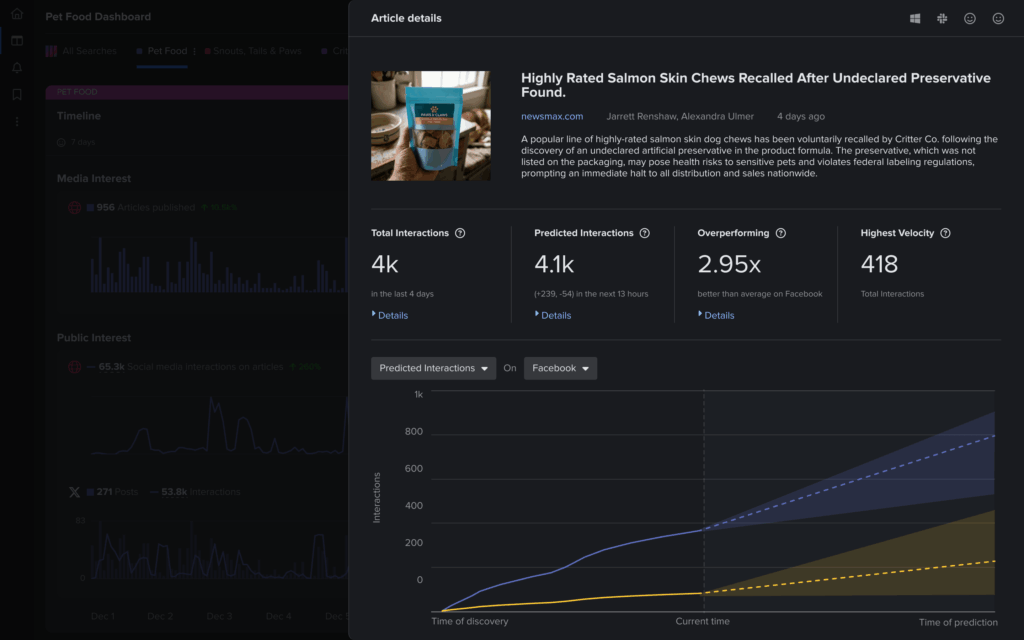
In NewsWhip by Sprout Social, the process begins as soon as a news story or social post is published. The platform captures details like the source, category, author, topic and other characteristics, then gathers engagement data and calculates how quickly that engagement is changing. From there, it can estimate what level of engagement to expect in the coming hours.
If a story is predicted to grow, users can see which reports are likely to drive engagement, how quickly the story may spread and which audiences are engaging. These insights help communicators understand which audiences are paying attention and whether the story is likely to fade or keep moving.
Jaclyn Ruelle, formerly of the Martin Agency, explains, “We rely on NewsWhip predicted interactions to see if this story is going to die out by this time tomorrow morning… Or if our brand joined the story is it on the brink of being something that could have some staying power and push beyond the 24-hour window?”
Those predictions can change as new activity reshapes the story. A brand statement, creator response or celebrity re-share can give a story new life. NewsWhip accounts for these changes by updating predictions as fresh engagement comes in.
Why platform coverage matters in predictive monitoring
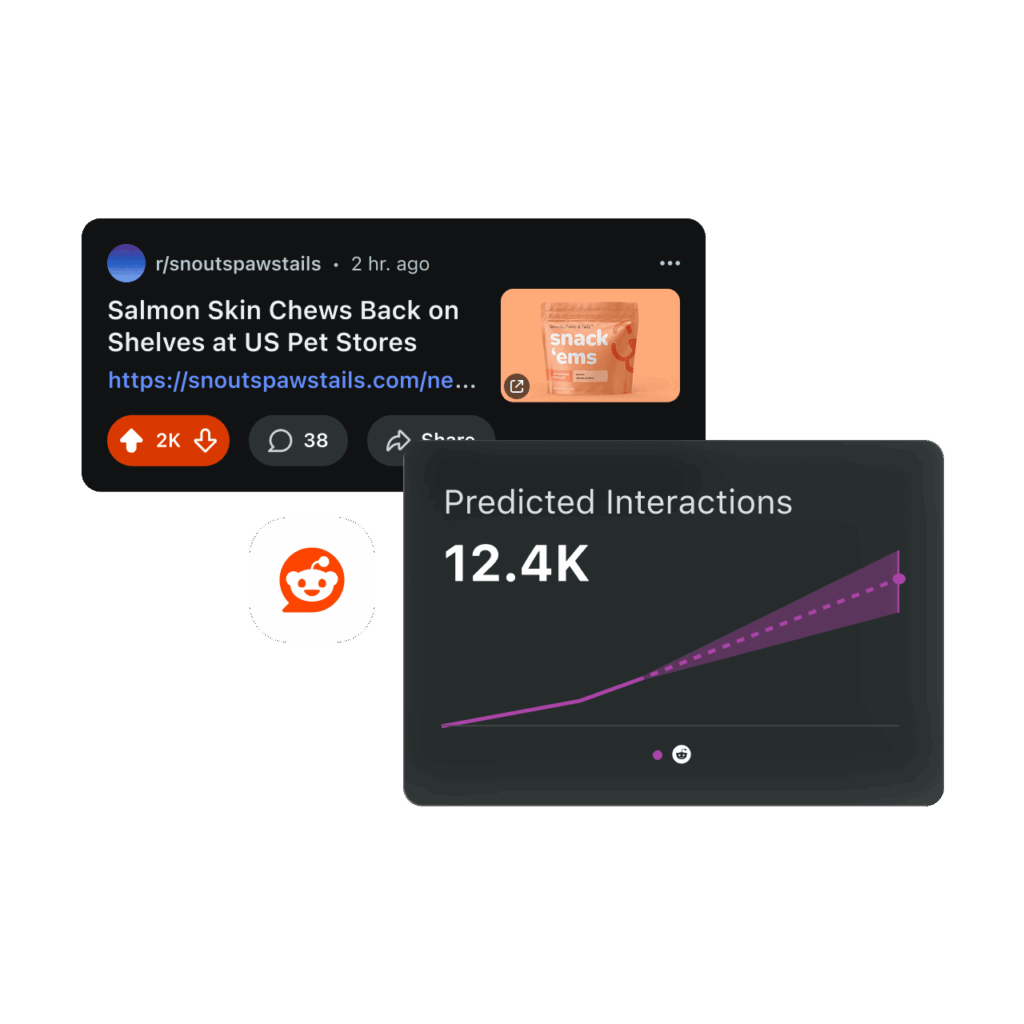
Predictive media monitoring is only as strong as the data it can access. As news discovery spreads across social, community-driven and decentralized platforms, prediction engines need a broader view of where attention is building.
Major networks are still important. According to the Q1 2026 pulse survey, a majority of consumers turn to Facebook for news, followed by Instagram and YouTube. Sprout’s Q4 2025 Pulse Survey also found that consumers plan to use Facebook (39%), Instagram (32%) and YouTube (30%) more in 2026.
But early signals are also emerging beyond the largest networks. According to the Q2 2025 Sprout Social Pulse Survey, 51% of global social media users plan to spend more time on community-driven platforms like Reddit, while 48% plan to spend more time on newer platforms like Bluesky, Mastodon and Threads.
That’s why NewsWhip combines and provides relevant discussions across social media, so any story’s arc can be seen alongside the latest Reddit discussions about it, the hottest Bluesky takes and the most engaged X commentary.
NewsWhip’s predictive signals for Facebook, Reddit, X and Bluesky brings those insights into article rankings, helping teams see when a story is starting to spread across these communities. These predictive metrics are integrated across NewsWhip workflows, including predictive alerts and the Trellis Monitoring Agent, so comms teams can identify early movement without adding more manual steps to their monitoring process.
A breakdown of predictive media intelligence models
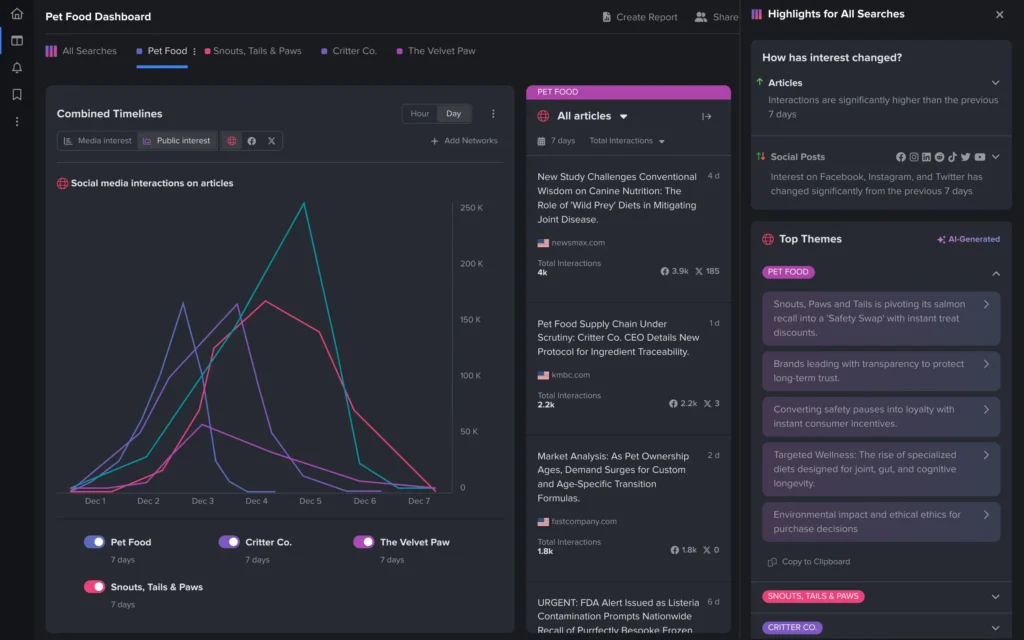
Predictive media intelligence relies on multiple AI and machine learning models to detect patterns, interpret context and forecast how conversations may evolve. Each model adds a different level of insight, from what people are saying to how quickly a conversation is changing and what it may lead to next.
Sentiment analysis
A post going viral is one thing. A post going viral because people are angry, confused or losing trust is another.
Sentiment analysis identifies the emotional tone behind social posts, review sites and online conversations. It can classify language as positive, negative or neutral, while more advanced models can detect emotions like anger, frustration, excitement or trust.
For example, a brand monitoring a product launch with Sprout Listening may see mentions rising. Sentiment analysis shows whether that attention is driven by excitement, confusion or customer complaints, which provides a clearer read on whether to amplify the moment, clarify messaging or respond to concerns.
Time series forecasting
Time series forecasting uses historical and real-time data to predict how a metric may change over time, from engagement growth and story volume to shifts in sentiment or audience attention. In media intelligence, that means estimating whether a conversation is likely to fade, hold steady or keep spreading over the next few hours or days.
For example, a communications team might use time series forecasting to determine whether a critical news story is likely to fade by the next morning or continue to draw attention. They can then use those insights to decide whether to issue a statement, escalate internally or keep monitoring.
Topic modeling
Topic modeling turns large volumes of posts, comments and articles into clear themes, making it easier to see which narratives are attracting engagement. During an industry event, for example, it can reveal whether discussion is clustering around pricing, sustainability, product features or executive remarks.
Since each theme may require a different response, this context helps your team adjust planned content, refine messaging or prepare leadership talking points based on which topics are driving the conversation.
Anomaly detection
Anomaly detection identifies unusual spikes, drops or patterns in data. In media intelligence, that might mean a sudden increase in brand mentions, an unexpected change in sentiment or a story spreading faster than typical coverage for that topic.
For example, a brand might see a sudden spike in mentions overnight. Anomaly detection can flag the change early, giving the team a chance to investigate whether the increase is tied to a creator post, breaking news, customer complaint or coordinated activity before the conversation escalates.
How do predictive alerts work?
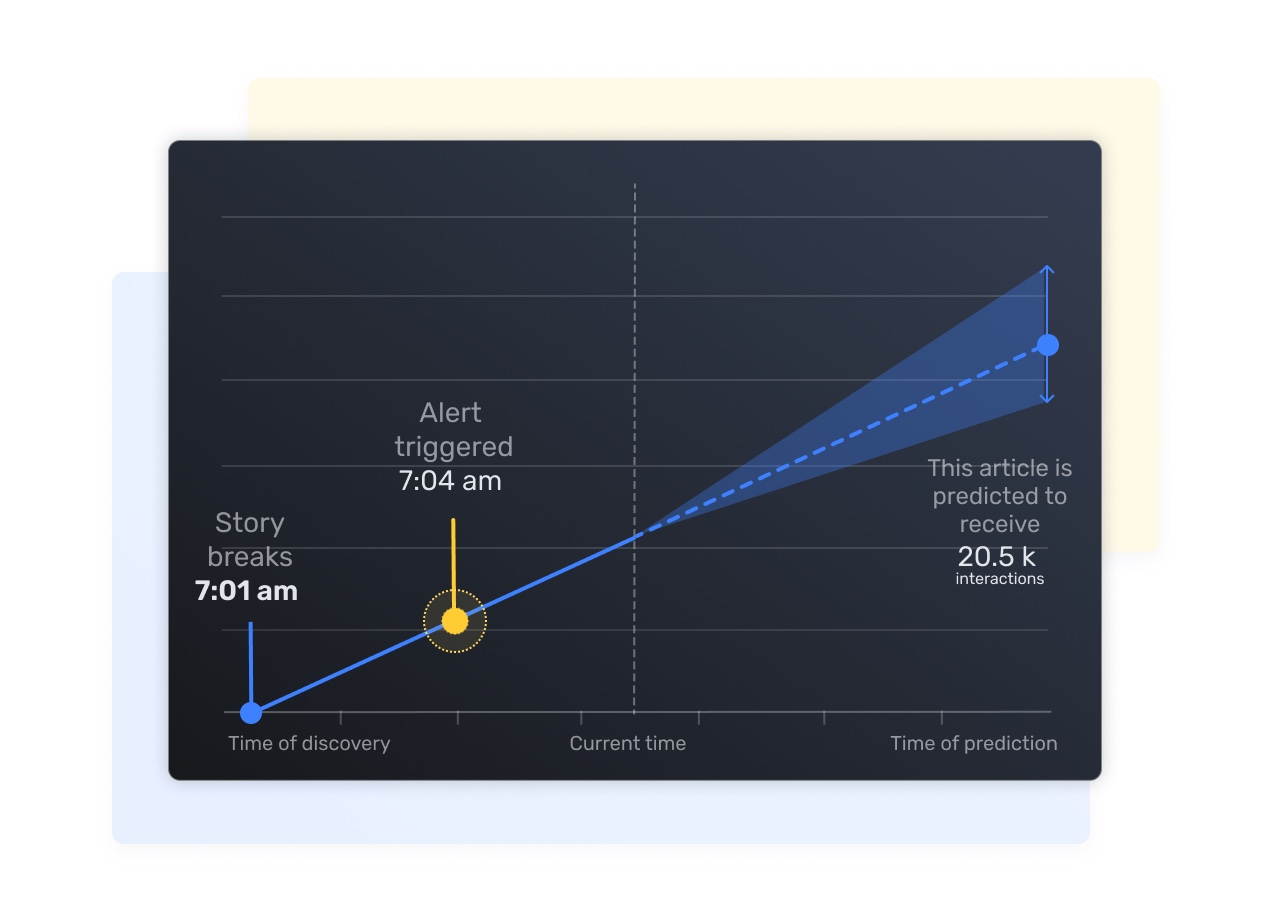
Traditional media alerts usually rely on fixed thresholds, like a story reaching a certain number of mentions, interactions or articles before you get a notification. But by then, the conversation may be moving too fast.
Predictive alerts move that window earlier. They use early patterns to flag stories likely to reach a user-defined threshold before they actually do, so teams monitoring their brand, executives, competitors or sensitive issues can notice a story while it’s still developing.
In NewsWhip, predictive alerts are used across industries, including:
- Alert NGOs monitoring for misinformation of a breakout new story or narrative
- Alert consumer brands to emergent reputation threats
- Alert communicators to spiking cultural moments for comment or newsjacking
- Alert journalists to a major story emerging on their beat
But speed isn’t enough. If every small change triggers a notification, you end up with a different problem: too many alerts and no clear sense of what matters.
How Trellis Monitoring Agents reduce alert fatigue
As an autonomous engine, Trellis Monitoring Agent is an always-on analyst that spots emerging stories and meaningful shifts early, delivering concise briefs with scale and context.
Using AI judgment, Trellis evaluates coverage based on the following factors:
- Is this shift in attention meaningful enough to investigate?
- Is it relevant based on the team’s brand, topic or issue context?
- What does the team need to know next, and where can they go to explore it?
From there, it delivers full-context briefs with workspace links for deeper investigation.
NewsWhip’s predictive signals strengthen that process by giving Trellis earlier visibility into discussions forming in community-driven and decentralized spaces. When a story starts drawing engagement within a discussion on Facebook, Reddit, X or Bluesky, those cues can inform article rankings and alert you before the narrative reaches mainstream coverage.
Together, predictive alerts and Trellis Monitoring Agents change alerting from “something happened” into “something important is changing.” Teams can prioritize critical developments with more confidence, reduce unnecessary notifications and build stronger defensive strategies around the stories most likely to affect their brand.
6 ways to use predictive media intelligence
Predictive media intelligence doesn’t replace the tools organizations already use to track business performance. It adds valuable external context, such as how public conversations are changing before those shifts turn up in sales, customer feedback or quarterly reports.
| Existing system | What it typically shows | What predictive media intelligence adds |
|---|---|---|
| Business intelligence | Validates past operational history, such as sales performance, campaign results or customer behavior | Forward-looking foresight into where the market is moving and which public narratives may influence future outcomes |
| Customer intelligence | Tracks past transactions, profiles and direct customer interactions | Real-time human sentiment and emotional context from conversations happening outside owned or direct channels |
| Market intelligence | What competitors did, often through slower reports and periodic research | A live view of competitor developments, category shifts and emerging risks |
With that broader context, communications and analyst teams can connect media intelligence to decisions around brand strategy, product positioning, customer experience, competitive response and risk management.
Here are six ways organizations can put predictive media intelligence to work.
1. Predictive crisis management
Not every negative mention is a crisis. But the hard part is knowing which one might become significant.
Predictive crisis management is one of the primary applications of predictive monitoring. It uses real-time data to assess an issue as it develops, estimate its scale, predict its trajectory and inform the response plan.
A product complaint, legal issue or environmental concern may be a passing story, or it may be the beginning of a larger reputation risk. Predictive media intelligence helps communicators compare the current conversation against similar past crises, so they can make a more grounded call on whether to monitor, respond or escalate.
2. Proactive campaign optimizations
A campaign can look solid in the deck and still fall apart in the wild. Maybe the message works in one market but lands wrong in another. Or maybe the topic means something different in Atlanta than it does in Miami. Predictive media intelligence helps marketers catch those gaps before launch.
Analyzing how people, publishers and communities are talking about a topic can inform where a campaign is likely to connect, where it may miss and where the strategy needs to shift.
Todd Ringler, Head of US Media at Edelman, saw this firsthand when his team was tasked with implementing an experimental campaign in 12 cities across the US. After using NewsWhip to audit how the topic was being discussed in each city’s media, the team realized the campaign needed a different approach.
“We used NewsWhip to go in and audit how this topic was being discussed in various cities’ media. Once we were able to go into each city and come back with insights for how this particular community spoke, how the media spoke about it, which topics rose to the fore around this topic, we were able to go back to the client and say: ‘Now that we’ve looked at the various cities, we can tell you that this is not going to land well in about 80% of the cities that you want to go into. And we need to dial the program in different directions, depending on if we’re going into Miami or Atlanta or Philadelphia or Dallas.’ The client was at first a bit dumbfounded that we were able to come up with and prove this with data, not just with our gut and our experience.”
For a multi-market campaign, that kind of insight can enable compelling predictions of campaigns’ impact and shape the local angle, proof points, media targets, spokesperson or call to action. The goal isn’t to predict performance with perfect certainty, but to spot the places where one broad message may need a sharper local read. This kind of data-rich planning is a clear area where technology can assist with direct recommendations as models improve and are tailored to campaign planning needs.
3. Predictive media relations
A media list can look impressive and still be wrong for the story.
With predictive media intelligence, PR and comms professionals can look at who covers a specific topic, how often they write about it and how much engagement those stories generate, then prioritize the writers, outlets and channels most likely to extend the reach of a pitch.
Zach Silber, former Chief Innovation Officer at PR agency Kivvit, explains, “If you are building your media lists using Cision and calling it a day, then you are doing it wrong. NewsWhip data tells us how many social engagements different reporters receive on a particular topic to determine which outreach is most likely to generate the widest engagement.”
That social layer is increasingly part of how stories travel. According to the Q1 2026 pulse survey, 39% of consumers said they want news organizations and individual reporters to be more active on social media to share breaking updates and engage with audiences. For media relations departments, social data can reveal which reporters are not only covering a topic, but also keeping the conversation going on social.
4. Predictive trendspotting
Predictive media intelligence helps teams spot emergent cultural trends. That might be a recurring question in a subreddit, a creator’s comment section lighting up or a few niche articles starting to circulate.
This mix of culture trend identification and prediction is a huge area of potential. By comparing current activity against past patterns around key conversations or issues you’re monitoring, you can see when interest in a topic rises above the norm and reaches a tipping point.
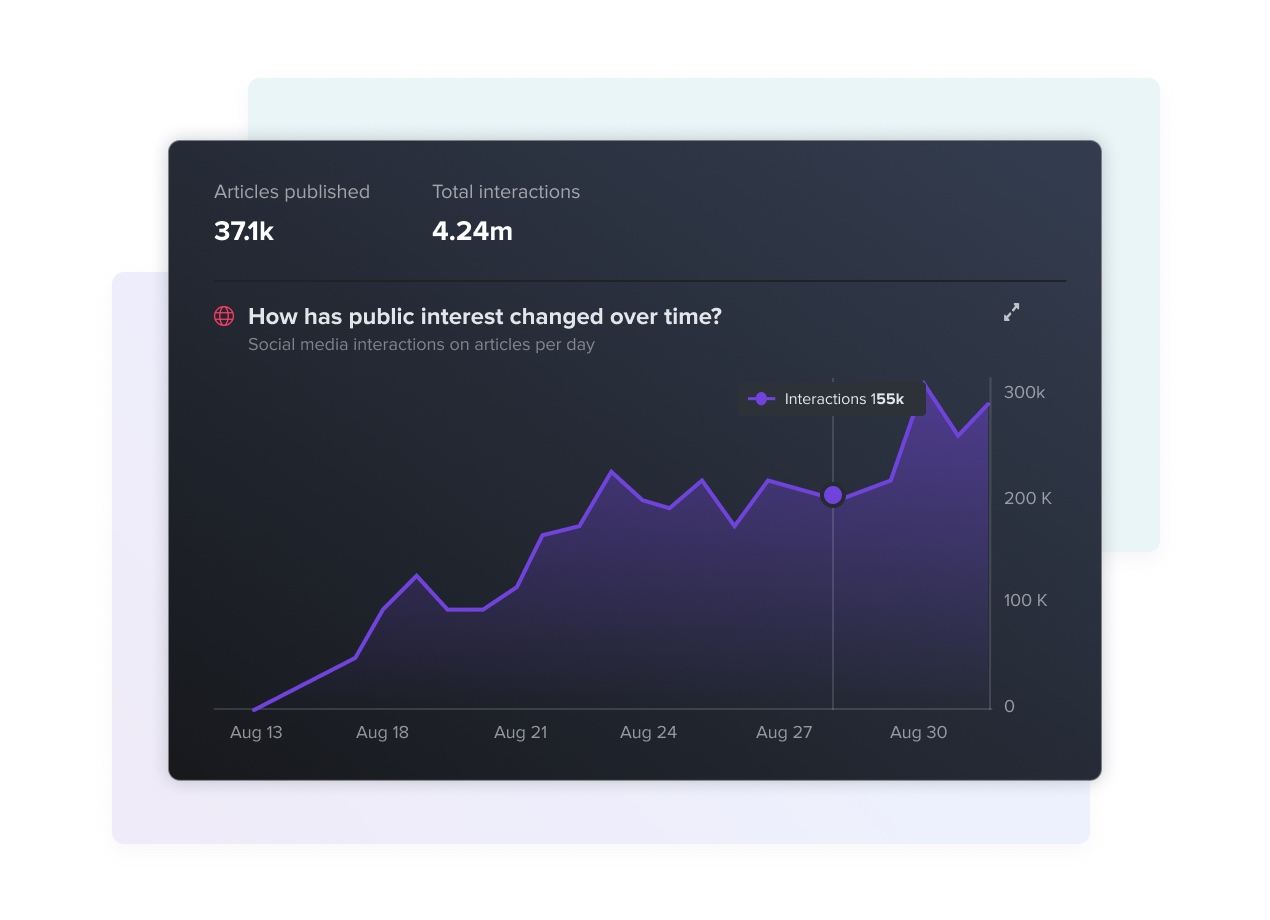
For example, a brand or agency tracking consumer trust in AI-generated content could see when the conversation starts to rise above its usual baseline. That gives teams a clearer read on whether to join in, adjust messaging or brief leadership while the conversation is still forming.
5. Real-time business strategizing
Quarterly reports can tell you what customers did. They can’t always tell you what customers want next.
Predictive media intelligence offers these insights on what people are asking for, complaining about and expecting from a category before those patterns show up in sales data or support tickets.
For example, if buyers start talking more about affordability, transparency or ease of use, you can use that context to pressure-test the roadmap, sharpen positioning or adjust launch messaging.
These real-time insights give your teams another layer of context to make decisions that reflect what the market is saying right now.
Transitioning to a proactive mindset requires operational shifts, which you can learn about by exploring how Sprout Social approaches social intelligence to remove strategic blind spots.
6. Improve brand awareness
Brand awareness grows when people see your brand in the right conversations before they’re actively looking for you.
Predictive media intelligence can highlight where those openings are. Across news, social media, Reddit, forums and other online communities, you can see which questions, interests, frustrations and comparisons keep coming up in your category. Those patterns can reveal where audiences are interested, but underserved.
If people are debating a problem your product solves, asking questions your team can answer or comparing options in ways your messaging doesn’t address, those are awareness opportunities. For example, Ford’s Global Insights Team leveraged real-time data from NewsWhip during a blizzard in Texas to identify an opportunity to actively support the community. By monitoring the situation as it unfolded, they were able to pinpoint where their resources were needed most, simultaneously reinforcing their brand and building goodwill through timely, community-focused action. Use those insights to shape content, media outreach and campaigns around the conversations your audience cares about.
What’s the future for predictive media intelligence?
Predictive media intelligence is becoming part of a bigger shift toward social media intelligence. Public conversation online affects more than just comms and marketing. It can influence product expectations, customer trust, sales conversations, competitive positioning and leadership decisions. The next step is to ensure those insights reach the right teams so they can act on them sooner.
NewsWhip is building toward that future with agentic AI capabilities like Trellis. The idea is to make predictive media intelligence more hands-free, so it can learn what a business cares about, monitor the topics and narratives that matter, and surface changes with less manual searching.
For teams, the goal is simple: fewer blind spots, less time sorting through noise and a better read on what is changing outside the business.
Schedule a NewsWhip demo to see how predictive media intelligence can support faster, more informed decisions.
Frequently asked questions
What’s the difference between social listening and predictive intelligence?
Social listening tracks what people are saying across social channels. It’s useful for understanding current and historical mentions, sentiment, audience feedback and brand perception. Predictive intelligence goes a step further by using AI, historical patterns and real-time media data to forecast what stories the media and public will continue to engage with in the hours ahead. That could mean identifying which stories are likely to keep spreading, which topics may become larger issues or where public sentiment may be headed.
How does predictive media intelligence improve crisis management?
Predictive media intelligence gives communicators more context earlier in the crisis cycle. It can show how fast an issue is spreading, where it is gaining attention and whether it resembles past situations that escalated. That helps teams avoid treating every negative mention like a crisis while still catching the issues that may require a faster response. The result is more grounded decisions about when to monitor, respond, escalate or take no action at all.
Can AI actually predict media trends?
AI can’t predict media trends with perfect certainty. But it can identify patterns that are hard to spot manually, especially across large volumes of social, news and community data. Predictive models can compare current activity against historical benchmarks, detect unusual changes and estimate whether a topic is likely to keep growing. While it’s not a guaranteed prediction, it makes it easier to see which topics, stories and conversations deserve a closer look based on thresholds you set.
39 free social media strategy templates that will elevate your workflows
Published on August 20, 2026 Reading time 15 minutes




Share