How to use AI brand monitoring for always-on brand health

Written by Benedict Nicholson
Published on April 16, 2026
Reading time 10 minutes
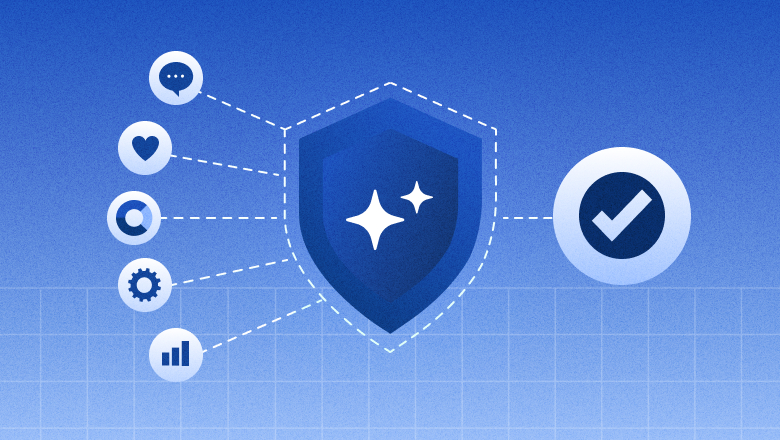
There have never been more places to monitor your brand health, and the volume of online content increases every day. While manual tracking worked a few years ago, today’s landscape is too vast for even the largest teams to navigate alone. To keep up with the speed of online culture and reputation, you need to evolve the way you work.
Brand mentions in media and on socials are only the beginning. AI chatbots like ChatGPT, Claude and Gemini are also drivers of traffic and brand awareness. They pull information from every corner of the internet, presenting your brand to audiences in ways that are impossible to track through traditional means.
And this is all happening alongside the standard work of monitoring news and traditional media, creating new layers of brand risk. As AI lowers the barrier for content creation, the volume of video and text will only continue to rise. AI chatbots are already answering questions about your brand that you don’t even know are being asked.
Pairing AI brand monitoring with a dedicated media intelligence strategy gives you a fuller picture of both social sentiment and press coverage. You need a strategy that evolves as fast as consumer tech. AI brand monitoring is the new standard for brand health. What was once a competitive advantage for early adopters is now a must-have for any brand that wants to stay ahead in the age of AI.
What is AI brand monitoring?
AI brand monitoring synthesizes the entire internet into a single, cohesive view of your brand health. By processing massive datasets across social, news outlets, forums and review sites, AI does the heavy lifting, surfacing the insights that manual teams miss due to the overwhelming quantity of data.
The processing power involved means you can move your strategy beyond individual mentions and basic volume metrics. Instead of just seeing a spike in activity, you’ll understand the reason behind it. AI groups conversations into themes instantly, allowing you to identify trends and patterns in the data and intervene in critical situations before they escalate.
Relying on traditional keyword monitoring means you’re blind to the deeper context of how people actually talk to each other and create content. With the language processing power of LLMs, you can understand the nuance and sentiment of a conversation without needing a perfectly refined keyword list. AI monitoring, especially with AI agents, saves hours of researching the broader conversation, and gives the context you need to understand brand health.
There are a number of ways to approach AI brand monitoring, and much of it depends on the maturity of your team. At the most basic level, you’re using brand safety tools to summarize conversations happening about your brand. This gives you a complete picture of whatever has happened in the time period you’re looking at, whether that’s news coverage, a spike in social posts or a bad review. You can then layer on analysis of what LLMs are saying about your brand for a more complete picture of how your brand is seen across the internet.
For more sophisticated teams, AI agents will join your workflows and be a crucial tool for understanding how conversations are changing. Agents are autonomous, meaning you don’t have to spend time constantly checking a dashboard. You set them a task and they complete it based on the instructions given. For brand health monitoring, this means they are constantly scanning for new information that might be relevant to your brand.
Using AI to distill the themes about your brand
It’s impossible to keep track of every conversation that involves your brand. The digital landscape is too vast and the volume is too high. To protect your brand, you must understand what’s driving the most relevant conversations and how those drivers shift over time.
AI processes thousands of individual conversations, from social posts to review sites, and groups them into broader, logical themes. Instead of a disorganized clump of text, you get a clear map of the specific topics affecting your brand health.
This thematic approach serves as your early warning system. By distilling conversations into themes, AI helps you spot emerging trends or subtle shifts in public opinion before they become mainstream or even out of control. When a new sentiment begins to ripple through a specific theme, you see it first through AI summaries. This foresight transforms your strategy from reactive to proactive, allowing you to address concerns or capitalize on opportunities while they’re still gaining momentum.
The real value lies in the context, not the volume of mentions. A bird’s-eye view allows you to understand the actual narrative surrounding your brand. When you understand the narrative, you gain the strategic perspective needed to shape your brand’s future instead of reporting on the past.
Agentic AI brand monitoring
While summarization is a useful first step, it still requires a lot of manual work to set up the query and keep revisiting it as new data emerges. AI agents are designed to do the heavy lifting of brand monitoring, so you can spend time on the response. It’s impossible to monitor a dashboard all day, and AI agents are designed to alleviate that burden.
This can take a number of forms but one of the strongest use cases involves scanning for changes in coverage or audience engagement. Any new article, social post or narrative that mentions your brand and gains significant traction will trigger the agent to investigate the cause of that traction. Then alerts you with the context of the posts, so that you’re always ahead of the coverage and can make decisions with confidence.
The advantage of this is being able to react quickly to what actually matters, rather than being caught up in social media noise. Agents can be set up to focus on whatever metric matters most to your team, whether that’s mentions, a shift in sentiment or rising engagement, so that you can spend time on strategy.
Tools such as NewsWhip by Sprout Social that utilize our Trellis Monitoring Agent can do this for you. If there’s a crisis emerging, you need to know even if you’re away from your dashboard. The monitoring agent constantly monitors any dashboard you have set up, and alerts you when something changes via email or your preferred workplace messaging solution. Depending on the specificity of the search powering your dashboard, you can set sensitivity to alert you to any changes in coverage or only when something big happens.
“The Trellis Monitoring Agent takes over the most stressful and difficult part of the job for many of our users. Previously, when a negative story broke on social media, comms professionals had to scramble to quickly detect, understand and quantify it. Now when something kicks off, they get an immediate notification and a comprehensive report. It puts them squarely in the driving seat for understanding what’s happening, and deciding the best response.” said Paul Quigley, General Manager of Sprout Listening and NewsWhip.
While these alerts can be distributed widely, it’s important that stakeholders have the context of what’s happening to avoid potential panic or misunderstanding. That’s where a human in the loop of these agentic systems comes in. The smartest teams will have internal benchmarks set up for whatever goal they have in mind.
Humans can define the thresholds required to trigger alerts based on their past experiences, and also have the context to understand when something needs to be escalated or when it can be left alone. If that’s responding to a crisis, they might want to be alerted if more than 20 articles are published about their brand and a given topic, or if a single article about their brand receives more than 1,000 shares.
Used correctly, the pairing of human context with AI agents can be a mechanism for reason and strategic action in a potential crisis. Together they give teams access to relevant information for decision making earlier, providing a 24/7 early warning system for potential brand crises.
AI-powered sentiment analysis
The core problem with traditional sentiment analysis is its tone deafness. It often stumbles over the grey areas like sarcasm, cultural nuance or other linguistic subtleties. AI-powered sentiment analysis bridges this gap by looking past the text to identify the underlying intent. It recognizes that a “great job” on a delayed delivery post isn’t a compliment, allowing your team to capture the true emotional intent behind it.
AI is able to distill these emotional nuances into high-level, clear reports that demonstrate how your PR, marketing or customer care efforts are moving the needle.
Ultimately, understanding the “why” behind the data transforms your engagement strategy. When you can see the intent behind the sentiment, your team has a fuller picture of brand health. This clarity helps you decide exactly when to step in with a high-touch human response to de-escalate frustration, and when it’s more effective to let an organic conversation play itself out. It ensures your energy is focused where it actually drives connection and impact.
Tracking your brand visibility in AI search
Despite the loud declarations that search is dead, that’s not true. But the way we search is changing. Gone are the days of blue links and 10 results per page. With the rise of chatbots and LLMs, people are approaching search in a more conversational way. And there’s a high likelihood that they’ll never make it to your website, even if it’s your content being cited. As of early 2026, studies show that AI overviews significantly reduce the number of click-throughs to the content.
This means that you need to be aware of what those AI overviews are saying, because they’re often functioning as zero-click content. The best way to monitor this currently is to track mentions, citation frequency and sentiment across platforms that are providing these AI summary answers. Currently, the big players in this space are ChatGPT, Perplexity, Google and Anthropic, but it’s also crucial to monitor for new players that could take market share in this emerging industry.
Of course, much of the content that feeds into these AI answers are sourced from the same social feeds, news outlets and forums that you are already monitoring, so having a double layer of context here will help you understand the source of any narrative so that you can successfully shape it.
Generative engine optimization (GEO) is an evolution of search engine optimization (SEO) for this new world of content creation. Search tools can help you find the gaps in your content based on what LLMs know about your brand and how frequently they cite you for a related answer. For example, you can see how frequently your brand is mentioned alongside a key feature or market segment (e.g. best CRM tool for small businesses) vs. how often a competitor is mentioned. If a competitor is mentioned more frequently, or your brand is not mentioned at all, this is a key content gap that needs to be addressed to position your brand as the leader in the market.
GEO is also an opportunity to provide clarity about your brand. LLMs offer a blended synthesis of all the information around your brand. If that doesn’t align with your messaging, it creates confusion for the consumer and could potentially damage your brand. Monitoring the AI overviews allows you to see where there is inconsistency around how your brand is represented, and engineer the narrative back towards your messaging and business goals.
What are the best AI brand monitoring tools?
There are a wide variety of tools that can help you to maximize the success of your AI brand monitoring, focusing on everything from AI-empowered news and social alerts to answer engine optimization (AEO).
Below are some of the best tools you can use for AI brand monitoring.
Sprout Social
Sprout Social offers a variety of AI brand monitoring solutions through its agentic AI, Trellis. The monitoring agent tracks news coverage and social posts for any change in frequency or engagement, and alerts users with the context of when, why and how that has changed. With NewsWhip by Sprout Social, alerts are available across all major social networks, including X, TikTok, Bluesky, Facebook, Instagram and Reddit.
Sprout Listening also includes Trellis, which provides conversational, custom insights on data across social media and the web. Teams can ask plain-language questions to query billions of data points for instant market research, competitive analysis and brand health monitoring.
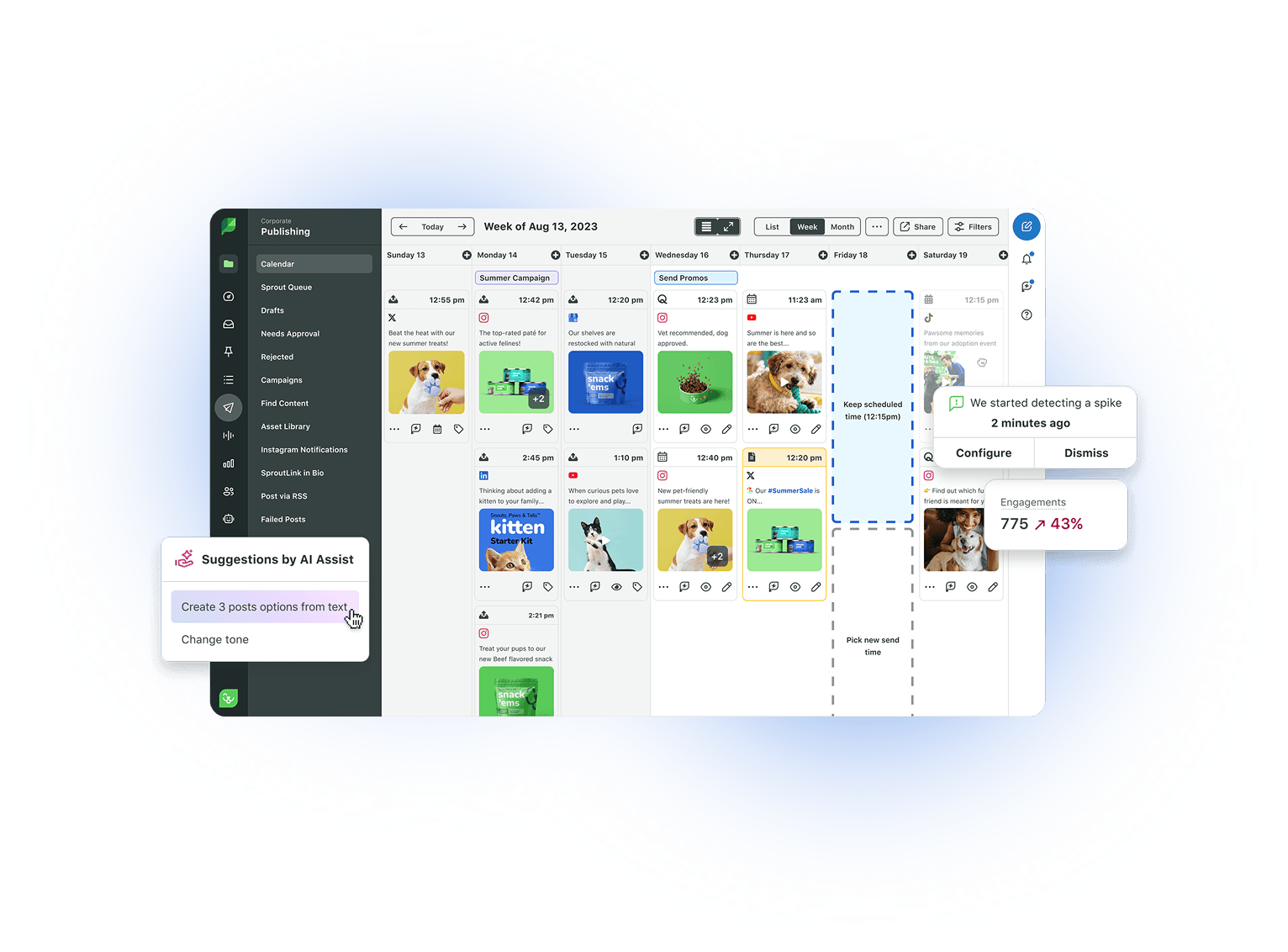
NewsWhip and Listening used together help you identify signals early and then go deeper to see how they are evolving, running the full gamut of brand health monitoring. These can also be combined with Sprout Social’s Smart Inbox, which uses AI to alert you when there is a spike in messages compared to the hourly average. This acts as another early warning system for changes in context or conversation that your team needs to be aware of and address quickly with customers.
Semrush Enterprise AIO
Semrush Enterprise AIO focuses on maximizing brand visibility within AI-driven search environments like Google AI Overviews and ChatGPT. It provides AI Visibility Tracking to monitor mentions, citations and sentiment globally. It maintains a database of over 213 million LLM prompts, allowing brands to align content with actual user queries.
Additionally, it offers competitor benchmarking via its AI Visibility Index and technical audits to ensure content is easily readable by AI crawlers for consistent monitoring.
Profound
Profound is a specialized platform designed to monitor and optimize brand performance across the likes of Perplexity, Gemini and ChatGPT. Its Answer Engine Insights track how AI represents a brand’s narrative in conversations, while Agent Analytics provides data on how AI bots crawl and interpret website content.
The platform monitors prompt volumes to identify shifting consumer demands and specifically tracks product placement in AI-generated shopping recommendations. By using autonomous agents, Profound helps teams automate AI-optimized content, ensuring brands remain recommended and cited in AI-driven discovery.
AI brand monitoring makes brand health proactive, not reactive
By identifying the earliest signals of a narrative shift or a spike in engagement, AI moves teams away from the reactive mode of responding to crises after they’ve already broken. Instead, these tools act as an early warning system, allowing you to address concerns and shape conversations before they become unmanageable.
In an ecosystem where a single post or an AI-generated answer can redefine your reputation in seconds, always-on monitoring is the only path forward. Maintaining a resilient and trusted brand requires a constant pulse on your brand health ensuring that you are staying one step ahead of the news.
Start layering more AI onto your crisis and reputation management strategy by heading to our AI prompt library. These prompts help you use AI to execute early warning and crisis detection triggers, executive and legal alignment and responses to crises. Plus, there are 70+ professional-grade prompts across nine critical pillars to help you leverage AI across your social media strategy.
39 free social media strategy templates that will elevate your workflows
Published on August 20, 2026 Reading time 15 minutes



Share