YouTube shorts vs long-form content: How to find the right content mix

Written by Annette Chacko
Published on June 23, 2026
Reading time 11 minutes
Table of Contents
YouTube is the world’s largest video archive, where content remains indexed and discoverable for years. Even as audience behavior evolves across social media, with searching, shopping, streaming and scrolling, YouTube remains one of the most popular networks across generations, especially with Shorts.
For brands, the network’s searchable architecture makes it a crucial destination to meet audiences where they are to build brand connections and conversions. But to ace this, businesses need a savvy YouTube content strategy that covers long-form content as well as Shorts for effective YouTube marketing.
In this guide, we share how to create a successful YouTube content strategy using both formats, with tips from Sprout and industry experts, so you’re equipped with the necessary tools to sharpen your brand presence on this network.
YouTube Shorts vs. long-form content: What’s the difference?
YouTube content is split into two distinct ecosystems: Shorts and long-form videos. Understanding how these formats differ in purpose, audience behavior and mechanics is essential to build a successful brand strategy on the network.
- Shorts are meant for quick discovery and reach: Shorts act as a channel’s discovery engine and have already taken over the internet with their immense popularity. They appear in a fast-paced, swipeable feed, bypassing the need for a viewer to know your brand or click a thumbnail. This format is effective for reaching new audiences and adding new subscribers quicker than it takes long-form content.
- Long-form is for deeper engagement and watch time: The traditional long-form videos are where you build true community, authority and deep subscriber loyalty. Viewers approach long-form with intent. They spend time watching to learn, be entertained and/or solve a specific problem. While it takes more production effort and a longer time to build momentum, long-form generates significantly higher watch time, stronger emotional connection, and vastly superior monetization through ad revenue and memberships.
How the algorithm treats each format differently
YouTube has two separate recommendation systems for these formats based on how audiences consume the content.
The Shorts algorithm ignores thumbnail performance entirely and instead measures success based on “viewed vs. swiped away” ratios. And since it’s designed for frictionless, viral distribution, it prioritizes the content hook along with replay rates and completion loops.
The long-form algorithm depends on click-through rates (CTR) and the average view duration (AVD). It optimizes for overall session time, rewarding videos that keep a viewer on the platform for long, intentional periods.
Benefits of YouTube Shorts and when to use them
YouTube Shorts offer brands a faster way to connect with audiences on the network that has traditionally hosted only long-form content. Here’s a breakdown of why the format is so powerful and when’s the right time to add it to your YouTube content strategy.
Engage mobile-first audiences
Most people scroll through their phones during quick breaks, commutes or downtime. Shorts are tailor-made for this on-the-go lifestyle, giving mobile viewers exactly what they want in a format that fits comfortably in one hand. Use Shorts when you want to meet your audience right where they are—on their mobile screen.
Expand reach and visibility quickly
If you want your brand or channel to get noticed fast, Shorts are your best bet. The platform pushes this format out to massive audiences, with Shorts now racking up over 70 billion views every single day. It’s the perfect tool when you need to break out of your current follower bubble and find new eyes.
Capture attention in seconds
With so much competition for audiences’ attention, you only have a short window to make an impression. Shorts force you to cut the fluff, deliver an attention-grabbing hook right away and get straight to the point. Tap into this format when you have a singular, punchy idea that can deliver instant value or entertainment.
Increase discoverability through the Shorts feed
Unlike traditional videos that rely on people clicking a thumbnail, Shorts are served to users through a frictionless, swipeable feed. The algorithm handles the heavy lifting by popping your content directly onto the screens of people likely to enjoy it. Lean into this when you want to get discovered without forcing viewers to search for you.
Upcycle and repurpose existing video content efficiently
You don’t always need to start from scratch to make a great Short. You can easily chop up your existing long videos, podcasts or livestreams into bite-sized, high-energy clips. This is a brilliant strategy when you want to keep your posting schedule consistent without burning out on production.
Participate in trends and cultural moments faster
Internet culture moves fast, and long-form videos can take too long to script, shoot and edit before a trend dies. Shorts let you grab your phone, jump on a trending audio or challenge and publish it in minutes. Use this format to show your brand’s personality and stay relevant in real-time conversations.
Drive traffic to long-form videos and channels
Think of Shorts as an exciting movie trailer for your main channel content. You can use YouTube’s related video feature to link a short clip directly to a deeper, longer video on the same topic. This is your go-to move when you want to hook casual scrollers and convert them into deeply engaged, long-form viewers.
Test content ideas with lower production effort
If you’re unsure if a new topic or video style will resonate with your audience, you can script and shoot a quick Short to gauge the community’s reaction. It’s a low-risk, high-reward way to experiment with fresh concepts and see what sticks. Plus, you don’t need to spend weeks on a massive video project.
Benefits of long-form YouTube content and when to use them
Long-form content on YouTube builds brand trust and drives watch time, but can deliver even more benefits. Here’s a deeper dive into how you can use this format to your advantage.
Build trust via deeper storytelling
Long-form videos give you the breathing room to share real stories, show your personality and connect on a human level through brand storytelling. When viewers sit down to watch a 10 or 20-minute video, they get to know the face behind the screen, making them way more likely to trust your message. Use this format when you want to build an authentic relationship that goes deeper than a quick teaser.
Drive engagement and watch time
Because long videos keep people on the network longer, they are the gold standard for racking up watch time. This deeper investment leads to more meaningful comments, shares and interactions from audiences who are genuinely interested in your brand. Lean into long-form if your goal is to create content that people actually pause their day to absorb and engage with.
Repurpose content for Shorts
Long-form videos act as the ultimate creative anchor, giving you a library of raw material to power the rest of your marketing strategy through content atomization. For example, you could create several Shorts from a long-form 15-minute video. This approach helps you maximize your efforts and get weeks of content out of a single recording session.
Build community by building viewer loyalty
When someone routinely watches your longer videos, they cease being a casual scroller and become a loyal fan. Long-form content creates a shared space where inside jokes, recurring segments and deep community discussions can actually grow over time. That’s why long-form content is great for building a loyal community of subscribers who will show up for everything you launch.
Support product education and brand awareness
Some products and concepts can’t be explained in 60 seconds, and trying to rush can be counterproductive. Long-form videos let you run step-by-step tutorials, unboxings and feature deep dives that show exactly how things work. Turn to this format to build awareness by answering questions viewers might have about your brand and offerings.
Nurture buyer intent and purchase decisions
People rarely buy expensive or complex products on a whim after seeing a short clip; they want to do their research first. Long-form videos enable you to provide the thorough reviews, comparisons and real-world testing that hesitant shoppers look for before making a purchase. This makes long-form videos a good bet to guide interested leads through the final steps of YouTube shopping and making a purchase decision.
Establish brand authority in competitive markets
Long-form videos enable you to showcase yourself as the expert in your niche or industry. Product deep-dives, industry breakdowns and masterclasses highlight your expertise in a way that quick tips can’t. Analyze your competitors on YouTube and use long-form to outshine them by offering the most valuable, thorough information available in your stream.

YouTube Shorts vs. long-form content: 7 expert tips on how to grow using both formats
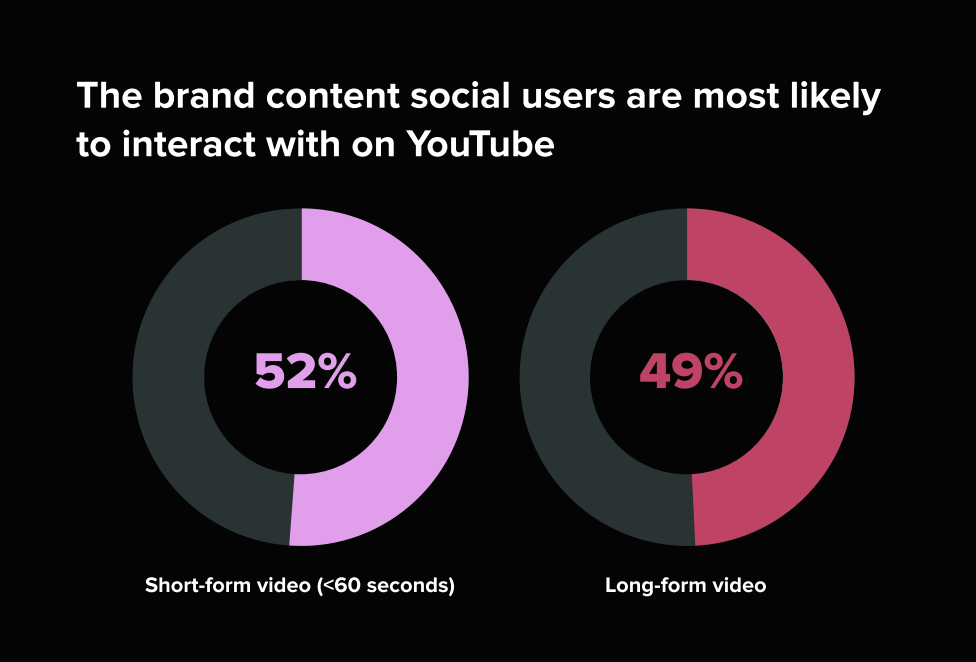
The 2026 Content Strategy Report shows audiences interact with both Shorts and long-form content in almost equal measure, with a 52-49 split in favor of Shorts. That’s why having the right mix and knowing how to master both content formats is critical to balance quick attention grabs with deep viewer loyalty.
According to experts in a recent Sprout + YouTube webinar, here are seven proven ways that brands can strategically use Shorts to hook new subscribers and long-form videos to build a highly profitable channel.
1. Prioritize social search discoverability
Audiences use the YouTube search bar like a regular search engine, typing out full questions rather than short keywords. To capture this search traffic, make sure your Shorts captions and long-form titles answer real, conversational phrases your audience is looking for. YouTube SEO ensures your content gets discovered by high-intent viewers who are actively looking for solutions.
Global Influencer Marketing & Social Agency Strategy Lead at Google, Jen Mbunga advises brands to take advantage of YouTube’s tools for ideation. She says, “The Inspiration Tab in YouTube Studio uses AI to suggest video concepts and titles based on what your specific audience is already watching, which can be a really helpful starting point when planning new Shorts.”
2. Create a strong Shorts hook and build open loops that long-form closes
Use YouTube Shorts to pique curiosity in audiences. Social Media Strategist at Sprout, Jamia Kenan says, “Shorts have become a major discovery entry point on the platform by giving audiences a quick way to ‘sample’ information before deciding whether they want to go deeper with longer content.”
To grab audience attention, brands need to create strong content with just enough value to hook viewers.
“Make sure you hook viewers immediately. Shorts live in a fast-scrolling feed, so the first few seconds really matter. Starting with a striking visual, a bold statement, or a moment of curiosity can help stop the scroll and pull someone into the video,” Mbunga advises.
Once viewers are in, let them know that the details are in your latest long video. This trigger naturally drives high-intent traffic over to your main content library.
3. Use real-time data to pivot your content strategy
Use YouTube analytics to understand what your audience wants to watch. Pay close attention to which Shorts get rewatched the most and where people drop off in your long-form videos to spot what is and isn’t working. Letting actual viewer behavior data dictate your next moves takes the guesswork out of creation and guarantees you are making content people love.
Additionally, matching your YouTube ads to how people actually watch videos can give your ROI a massive boost. In fact, using vertical videos on YouTube Shorts drives 10% to 20% more conversions per dollar compared to traditional landscape assets.
4. Lean on your internal expert authority to build trust
Per the 2026 Content Strategy Report, 48% of users want to hear from company leadership. Interweave your long and short form videos with deep expertise by featuring internal experts like product designers, developers or customer success teams.
Use Shorts to let internal experts share quick, behind-the-scenes product hacks or snappy thought leadership tips, then point viewers to long-form videos where the team can dive deep into your brand’s core values and technical mastery. Showing the real human faces and brains behind your brand instantly builds a level of trust and authority that polished corporate marketing can’t.
Digital marketing expert Lia Haberman agrees, “For a long time, brands relied heavily on external creators or polished thought leadership campaigns to build credibility. But today, they want to hear from people actually doing the work: leaders, practitioners and subject matter experts who can speak from experience. And that shift makes sense. In B2B, credibility comes from professional judgement and lived experience. When someone shares insights from their own career or their own decision-making process, it truly carries a different level of trust.”
5. Build a seamless viewer journey with smart cross-linking
Prioritize a seamless viewer journey with cross-linking so your viewers know exactly what to do after they finish watching a video. Use YouTube’s native related video tool to attach your long-form deep dives directly to your Shorts, and use long-form end screens to recommend your top-performing Shorts. Creating this continuous loop keeps people on your channel longer, which signals to the algorithm that your content is worth promoting.
6. Partner up through trusted creator collaborations
Collaborating with trusted creators can be helpful to increase reach more quickly. For example, a high-energy, fun Short can instantly tap into an influencer’s audience, which can then lead to deeper influencer storytelling in a long-form video. This dual-format approach enables you to reach more subscribers while keeping viewers hooked across different viewing habits.
Tools like Sprout help execute this approach. Specifically, Sprout’s YouTube Creator Partnerships API integrates directly into Sprout Social Influencer Marketing, bringing YouTube’s powerful creator engine into your existing workflows. With this integration, brands can bridge the gap between creator discovery and high-level performance reporting—find YouTube creators, manage collaborations and see your ROI data, all in one place.
7. Stagger your release schedule to avoid audience fatigue
Don’t push your long-form video and five related Shorts onto your channel close together. Instead, stagger them by posting your deep-dive first, and then slowly trickle out the Shorts over the next two to three weeks to keep the momentum alive. Spacing out your uploads gives your channel a steady heartbeat and constantly feeds the algorithm fresh entry points to your content.
Common YouTube content strategy mistakes and how to fix them
Even the most savvy teams can fall into predictable strategy traps. Here are the most common missteps that can negatively affect channel growth and how to avoid them.
- Treating Shorts and long-form as separate strategies: Thinking of these two formats as completely different strategies is a common mistake. Both formats need to be produced in tandem, with Shorts casting a wider net to attract new audiences and long-form videos turning casual viewers into dedicated fans.
- Prioritizing views over audience quality: Chasing a massive view count by jumping on random viral trends will usually ruin your long-term growth. If people watch a Short that has nothing to do with your business or niche, they will probably never click on your actual videos or buy your products. Focus on attracting the right audience, even if the crowd is smaller, because a loyal, targeted audience is worth way more than empty vanity metrics.
- Ignoring retention metrics and watch time: If you only look at your total views count, you’re missing the real story of how your channel is performing. The algorithm cares deeply about retention, considering exactly when people click away or swipe past your content. By ignoring these drop-off points, brands often miss the chance to fix boring intros, tighten up editing and optimize video pacing. Analyzing these metrics can teach you how to keep viewers hooked for the long haul.
Strike the right balance between YouTube Shorts and long-form content
Finding the perfect mix between Shorts and long-form content is the secret to sustainable growth on YouTube. Shorts open the door for rapid brand discovery, while long-form content builds the deep trust and loyalty that turns casual scrollers into actual customers.
To get this balance right, you have to stop guessing and start listening to your community. Keep a close eye on your audience’s consumption habits and monitor your retention metrics, like where people swipe away or how long they stay tuned, so you can let real-time viewer behavior dictate exactly how much of each format your channel needs.
Learn more about how to find insights in a video-first world through YouTube social listening.
Frequently Asked Questions
What are the advantages of a YouTube Shorts content strategy?
A YouTube Shorts strategy acts as a powerful discovery engine that drives rapid channel growth and viral reach through a seamless, mobile-first feed. It also offers production efficiency, enabling you to easily test new ideas and upcycle existing content to hook casual scrollers.
What are the benefits of long-form content marketing on YouTube?
Long-form YouTube content acts as an engine for deep engagement, brand authority and sustainable business growth. It provides you with:
- Durable, long-term search discoverability
- High watch-time accumulation
- Deep audience trust and community building
- Effective nurturing of high buyer intent
- Establishment of industry authority and thought leadership
- Repurposing foundation for micro-content
When should I create YouTube Shorts vs long videos?
Create YouTube Shorts when you want to maximize rapid reach, jump on trends and capture casual mobile scrollers with quick, bite-sized value. Switch to long videos when you need to build deep trust, teach complex topics and nurture high-intent buyers who are ready to invest their time.
How do I best optimize engagement for Shorts and long-form YouTube content?
Optimize Shorts by packing an undeniable visual hook into the first second and designing seamless loops that keep mobile scrollers watching. For long-form, master your title-and-thumbnail promise while using brand storytelling to hold viewer attention and build long session times.
39 free social media strategy templates that will elevate your workflows
Published on August 20, 2026 Reading time 15 minutes








Share