Social media customer service statistics to know in 2026

Written by Jamia Kenan
Published on September 8, 2026
Reading time 9 minutes

Table of Contents
Social media customer service statistics tell a clear story heading into 2026: customers expect fast help where they already spend their time. Here’s what the data reveals.
- Personalized customer service is consumers’ number two priority for brands in 2026 (28%), yet it doesn’t crack marketers’ own top five, per the 2026 Sprout Social Content Strategy Report.
- About two-thirds of consumers (65%) plan to use social as much if not more to get customer service questions answered during the holiday season compared to the previous year, per the Q4 2025 Sprout Pulse Survey.
- Most consumers (69%) are comfortable with brands using AI to deliver faster care (Q4 2025 Sprout Pulse Survey).
Social is the front-line for customer care. It’s public, it’s instant and it’s where people bring their best compliments and their sharpest complaints. Today’s consumers want a real human fast, and they turn to customer care on social to get one.
Here’s the catch. Consumers keep raising the bar on fast, personal support, while many brands still treat social care as an afterthought. Close that gap and you earn loyalty your competitors can’t buy back.
These stats show where expectations are heading, and what your strategy needs to do to keep up.
Explore other latest social media stats that reflect the changing consumer behavior on social media platforms.
How do customers use social media for support?
Brands offer countless support channels, but social is the undeniable crowd favorite. How are people using it to get help?
Comments, @-mentions and direct messages are consumers’ preferred methods for customer service, according to the 2025 Sprout Social Index™. Because these are consumers’ go-to channels, brands that ignore them risk losing business. Prospects research products on social for months before buying, and are influenced by how a brand treats other users in the comment section.
“About 70% of my customers reached out to me through social media channels, the other 30% by email,” said Zoila Streich, Co-Founder of Independent Fashion Bloggers and former fashion business owner. “Most questions are about product availability and payment methods, but a few are feedback about the products or the buying process.”
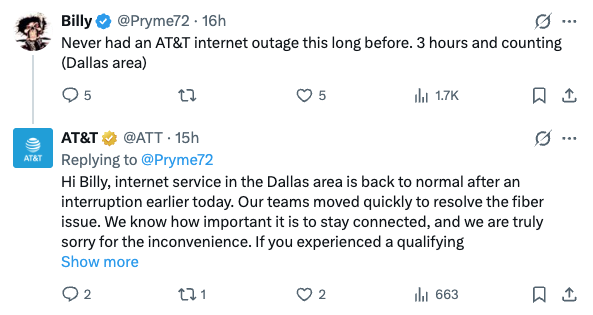
You’ll also find customers using social to report service outages:
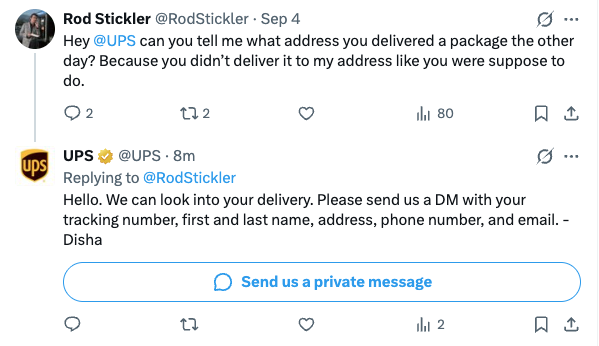
Or to flag issues with shipments and deliveries:
Negative feedback stings, but staying respectful and helpful pays off. The most memorable brands on social are the ones that respond, and customers notice who shows up.
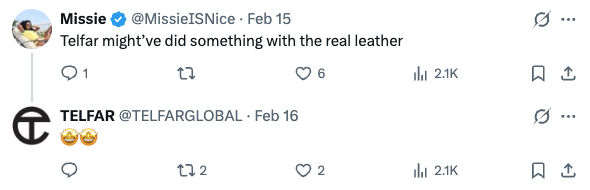
Pair a great product with quality service and the praise follows. A Telfar customer raved about the brand’s materials.
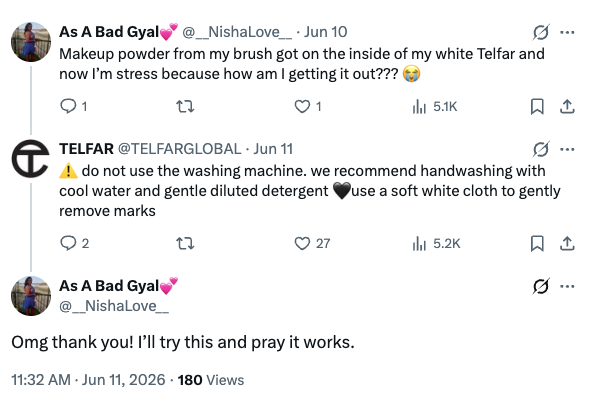
Another customer thanked the brand for offering advice on cleaning their products:
The takeaway: Meet customers in the comments and DMs they already use, and treat every public reply as a shopfront your next customer is watching.
How do customer care professionals use social media for support?
Care teams are feeling the squeeze. Managing a high volume of requests is the top challenge for support organizations, which makes scaling your customer service strategy non-negotiable.
The volume is climbing fast. Instagram incoming messages jumped from 13 to 18 a day between 2023 and 2024, per the Sprout Social 2025 Content Benchmarks Report. Over the same period, the across-the-board daily response rate to social messages and comments slipped from 8% to 7%. This proves that even as teams handle more messages, they are struggling to keep pace with rising inbound volumes.
A customer service-filled feed can also drown out the campaigns your brand wants to spotlight. That’s why some brands run dedicated social accounts just for customer care.
“Businesses use social media for a variety of purposes, including marketing, engaging with customers, interacting with influencers and more,” said Keenan Beavis, founder of Longhouse Media. “That’s why having a distinct social media account dedicated to customer support inquiries is so important. You don’t want your advertising, likes and shares to bury client demands and questions.”
Prepare for the ebbs and flows, too. New product launches and promotions drive a spike in sales, which means more inbound questions.
“The volume of customers using our social media customer support fluctuates between 40% to 60%, depending on promotions,” said Yuvi Alpert, Founder, Creative Director and CEO of jewelry brand Noémie. “Because we drive people to our social media profiles through other channels, such as our newsletter, many of the questions we receive come through those platforms.”
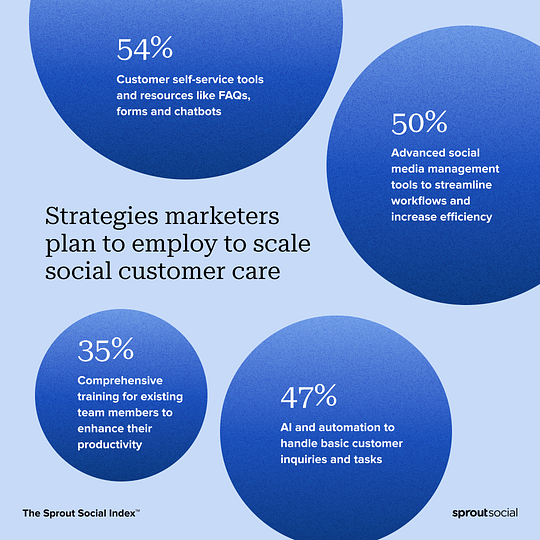
To keep up, marketers lean on self-service tools like chatbots and forums, social media management tools and AI-based automation. Sprout Social Index data shows how teams plan to scale social care:
This is where a tool like Social Customer Care by Sprout Social earns its keep. The Smart Inbox pulls every message into one stream. AI classifies and routes each case to the right agent, so rising volume doesn’t force slower replies.
The takeaway: Build for peak volume before it hits. Let automation triage the routine so your team can focus on the conversations that need a human.
How fast should brands respond on social?
Being present on social is table stakes. A fast social media response time is what separates the best-in-class brands from the ones customers unfollow.
How fast is fast enough? Often, it depends on the industry and the situation.
Yuvi Alpert told us one day is fast enough during promotions.
“It is critical that we answer those questions within 24 hours. We found that allowing more time to elapse lowers customer interest. By offering prompt responses, we see dramatic increases in sales of featured items.”
So what’s the response-time sweet spot? About three-quarters of consumers expect a response within 24 hours or sooner, according to the 2025 Sprout Social Index™. The bar keeps rising as more people bring their questions to social.
Speed isn’t the whole story. Half of consumers (51%) who reach out publicly expect a public acknowledgement first before moving to a private DM, per the Q4 2025 Pulse Survey. How you respond matters as much as how fast.
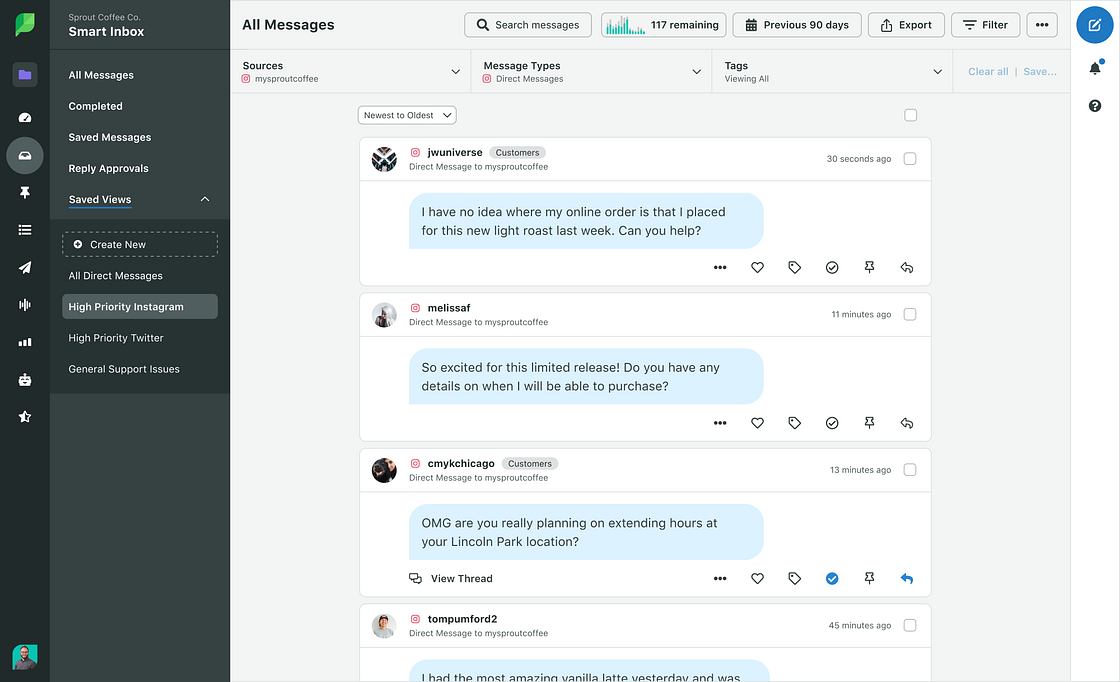
Some brands set aggressive targets to meet that demand. Papa Johns needed to handle high message volume across platforms during peak hours without letting replies slip, so they turned to a unified inbox instead of juggling native apps.
With Sprout’s Smart Inbox, they consolidated all social media direct messages, mentions and comments into one stream, cutting response time and keeping their team focused during the dinner rush.
A fast reply isn’t the finish line—resolution is. Some brands are quick to respond but slow to solve—and unhappy customers won’t hesitate to tell their followers. People don’t just want speed; they want a solution.
The takeaway: Aim for minutes, not hours, and design your workflow so a fast acknowledgement always leads to a real resolution.
How important is social media customer service to consumers?
Social media customer service isn’t a perk—it’s a revenue protection strategy. Almost three in four social users (73%) say they’ll buy from a competitor if a brand doesn’t respond on social, according to the 2025 Sprout Social Index™. Silence has a price.
There’s an upside, too. Responsive brands turn strong support into loyalty and repeat business, so good service isn’t a cost center, it’s a revenue driver.
Consistent support builds trust and loyalty. Nail the personalization people want and they’ll go out of their way to praise you in public. Hello, social proof.
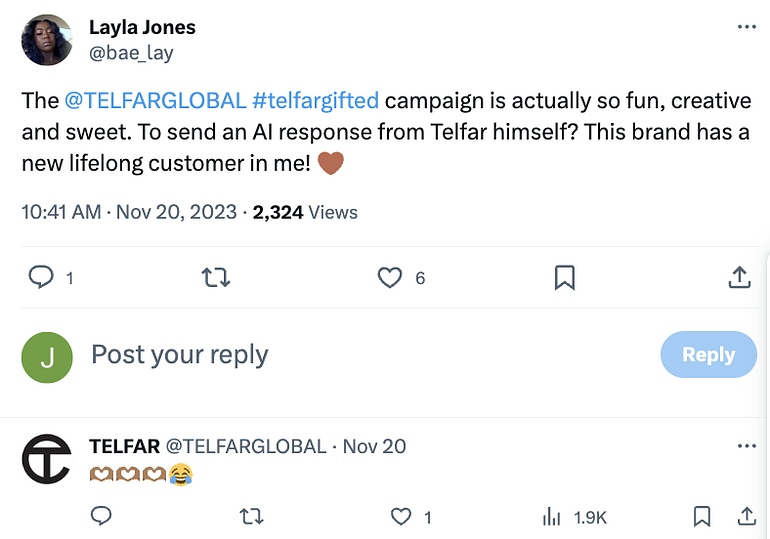
As part of their Telfar Gifted promotion, Telfar sent participants personalized AI-generated videos featuring designer Telfar Clemens, and customers raved:

Social has flipped the balance of power between brands and consumers. Only on social can people compare your support to a competitor’s in a few clicks. That visibility pushes brands to rethink both the quality of their care and the social media platforms they offer it on.
Responding to every message manually across multiple accounts and thousands of customers doesn’t scale.
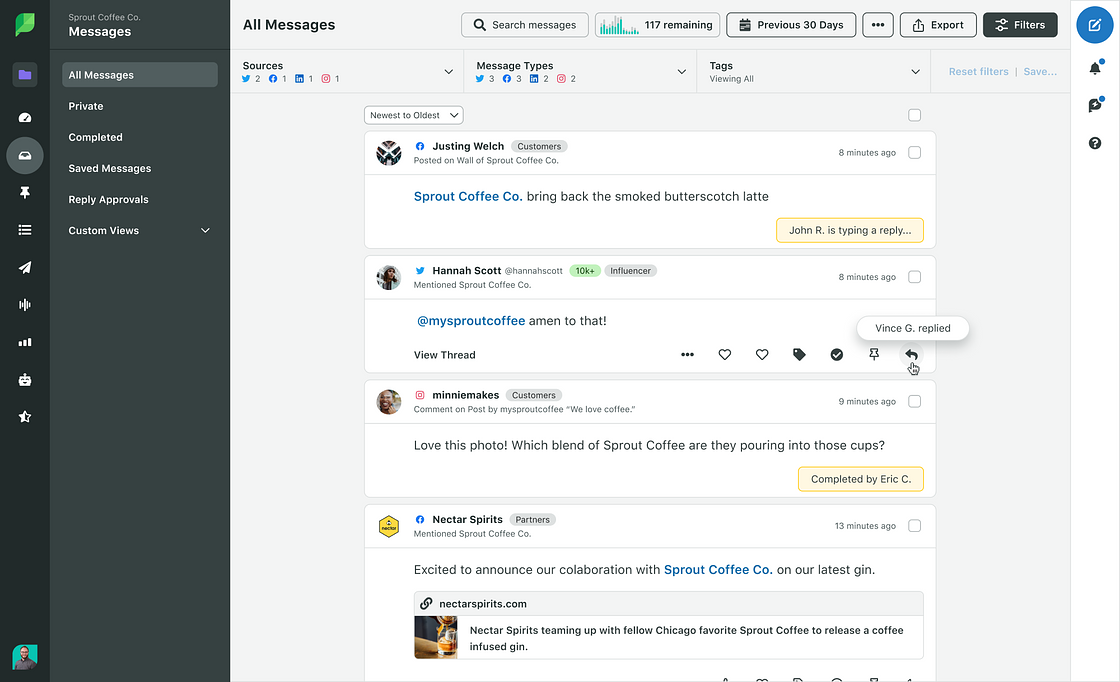
With Social Customer Care by Sprout Social, teams filter incoming messages across platforms, triage responses into Cases and see key customer information in one place. Our Salesforce Service Cloud integration gives customers a complete view enriched with social data, so every reply carries more context.
The takeaway: Treat social care as a growth lever, not a chore, and give your team the tools to respond at the speed and scale customers expect.
Social media customer service statistics by network
Now that we’ve covered what consumers expect, let’s look at how social media customer care plays out platform by platform.
Instagram customer service statistics
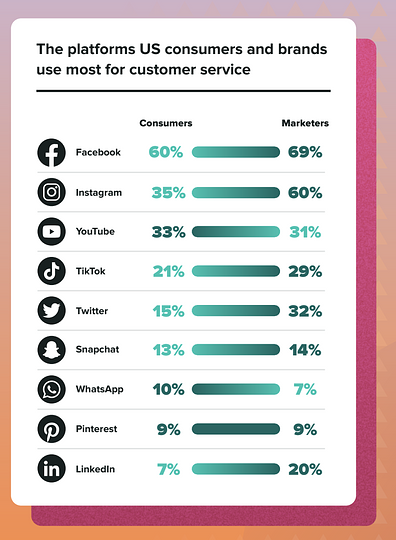
Instagram is one of the most popular social media platforms for customer service, second only to Facebook.
It’s also where the conversation is loudest. Instagram averages 27 engagements a day, the most of any major platform, per the 2025 Content Benchmarks Report. For the full picture, explore our Instagram statistics.
Facebook customer service statistics
Facebook’s role in care is growing, not fading. It’s the number one social media platform consumers plan to use more in 2026 (39%), per the Sprout Social 2026 Content Strategy Report.
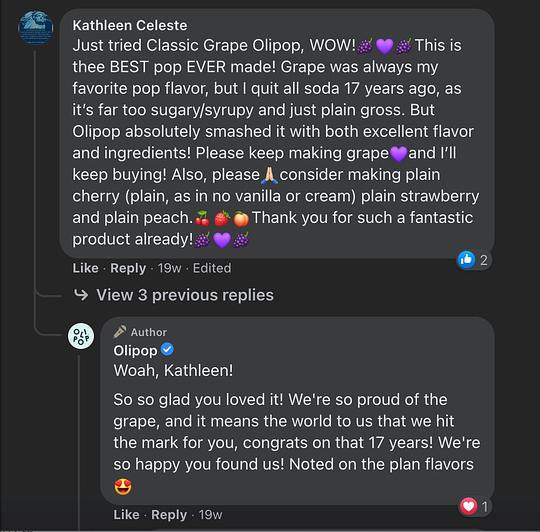
OLIPOP, a tonic brand, uses Facebook for direct support. “I’d estimate at least 50% of our customers will message us questions or comment directly on our posts across Facebook and Instagram,” Melanie Bedwell, eCommerce Manager for OLIPOP, previously told us. “Ideally, we try to reply instantly, but if that’s not possible, then at least during the same day.”
Here’s how they engage happy customers:
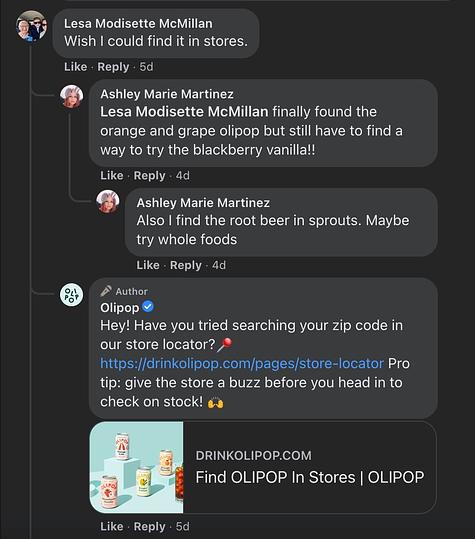
They also use these moments to promote in-store options and their store locator tool.
WhatsApp customer service statistics
WhatsApp is the social media platform to watch for customer care in 2026. Here’s why it belongs in your strategy, per the 2026 Content Strategy Report:
- Over half (52%) of social users have a WhatsApp account.
- Two in five users (40%) want companies on WhatsApp to provide customer service and support, especially Baby Boomers and Gen X.
- Almost half (46%) of marketers are investing in WhatsApp in 2026.
If you serve older customers or global audiences, WhatsApp is the platform to test first.
Threads customer service statistics
Threads is still finding its footing for customer care. It’s a low priority heading into 2026, with just 7% of consumers planning to use it more, per the 2026 Content Strategy Report. Keep an eye on it, but don’t build your care strategy around it yet.
- Low demand for direct customer support: Just 14% of Threads users want brands to show up on the platform to provide customer service and support, as noted in the 2026 Social Media Content Strategy Report. Instead, their primary expectations of brands are to post entertaining content (28%) or share educational product information (15%).
- Consumers’ last resort during peak shopping: When active customer care matters most—such as during high-volume shopping seasons—Threads is consumers’ last choice. According to the Sprout Social Q4 2025 Pulse Survey, only 3% of social users plan to contact a brand on Threads for customer support.
- Marketers are present, but mostly copy-pasting: Brands are establishing a presence early, but they aren’t dedicating unique resources to it. The Sprout Social Q1 2025 Marketer Pulse Survey reveals that while 57% of marketers are already posting on Threads, over half (52%) of those active on the platform focus strictly on repurposing content from other networks rather than offering dedicated, real-time customer care.
TikTok customer service statistics
TikTok is where discovery and support blur together. It’s among the top platforms consumers expect to use for holiday customer service, per the Q4 2025 Pulse Survey. Younger shoppers treat it as a search engine and a service channel at once.
Meet them there by handling care in the TikTok comments section. Use video replies to answer questions, or set an escalation protocol to move sensitive issues to a private conversation.
X (formerly known as Twitter) customer service statistics
X remains a go-to channel for public compliments and complaints. People use it to flag order issues, product problems and poor experiences in the open, where everyone can see how you respond. A fast, gracious public reply here does double duty as service and social proof.
One more to watch: Bluesky has surged as an emerging care channel, even topping some platforms for holiday support in our Q4 2025 Pulse Survey. It’s early, but the brands experimenting now will own the playbook later.
The takeaway: Don’t spread yourself thin across every platform. Anchor your care where your customers already are, lead with Facebook, Instagram and WhatsApp, and test emerging platforms like Bluesky before your competitors do.
How consumers feel about AI in social customer service
AI has moved from experiment to expectation in social customer care. There are proven ways of using AI for customer service without losing the human touch, and consumers now welcome automation that gets them answers faster.
58% of customer service managers see AI as a game-changer that automates tasks and offers personalized experiences, according to Freshworks’ customer service research. Consumers agree: comfort with brands using AI for faster care stayed high in the Sprout Q3 2025 Pulse Survey, even as appetite for truly human, personalized service grew alongside it.
The takeaway isn’t “automate everything.” It’s to let AI clear the repetitive work so your team can spend its time where empathy matters. Social Customer Care by Sprout Social uses AI to classify and route incoming cases, while Enhance by AI Assist helps agents craft sharper replies faster.
Deploy AI to triage, summarize and prioritize, then hand the nuanced conversations to people. That balance is what consumers are asking for.
Improve customer experiences with social media customer service
Your social profiles aren’t just billboards for products. They’re where today’s consumers expect fast, personal, public support, and where they decide whether to stick with you or switch.
The data above points the same direction: demand for social care is rising, response-time expectations keep tightening and AI is resetting what “fast” means. The brands that win close the gap between what customers expect and how quickly they deliver.
Sprout Social gives your team one place to catch every message, route it to the right person and resolve it before frustration sets in. Want to see where you stand? Explore our interactive customer service data story.
Start your 30-day free trial and turn your social channels into your fastest support team.
FAQs about social media customer service
What percentage of customers use social media for customer service?
For brands today, customer service on social media is no longer optional. Comment sections, @-mentions and DMs have solidified as consumers’ preferred channels of customer care. Neglecting these touchpoints carries an immediate year-round penalty: nearly three-quarters of consumers (73%) agree that if a brand fails to respond to their questions on social, they will buy from a competitor next time.
How quickly should brands respond to customers on social media?
Within 24 hours at the latest. About three-quarters of consumers expect a reply within a day or sooner, according to the 2025 Sprout Social Index™. Leading brands aim for minutes, not hours.
Which social media platform is best for customer service?
It depends on where your audience is, but Facebook, Instagram and WhatsApp remain vital channels for support. Facebook remains the global powerhouse at 45%, Instagram serves as a core daily channel where users expect care alongside entertainment, and WhatsApp is a network to watch heading into 2026, with 40% of consumers wanting companies to provide order and customer support there.
How is AI changing social media customer service?
AI now handles triage, routing and draft replies so teams resolve issues faster. Most consumers (69%) are comfortable with brands using AI to deliver faster care, per the Q4 2025 Sprout Pulse Survey. The strategic play isn’t to replace humans—it’s to let AI clear the repetitive work so your team can focus on the nuanced conversations that build loyalty. Deploy AI to classify, prioritize and draft, then hand the complex cases to people who can deliver the empathy and personalization consumers still expect.
Do customers switch brands over poor social media customer service?
Yes. Many social users say they’ll buy from a competitor if a brand doesn’t respond on social, so unanswered messages cost you sales.





Share