Why brands need human-generated content ecosystems

Written by Aubree Schaefer
Published on May 26, 2026
Reading time 7 minutes
Summary
- Human-generated content cuts through AI fatigue by delivering originality, nuance and real-world perspective that audiences trust.
- Brands win awareness, engagement and share of voice by building a content ecosystem powered by executives, employees and creators, not just posting on the brand account.
- Human-led content ecosystems make brands more recognizable, help them perform better in the AEO era and unite marketing functions around shared goals.
If an AI-generated post receives a thread of AI-generated comments, does any human care?
Even in B2B marketing, where professional tone and buttoned-up writing are the norm, audiences are fatigued with overly polished AI content.
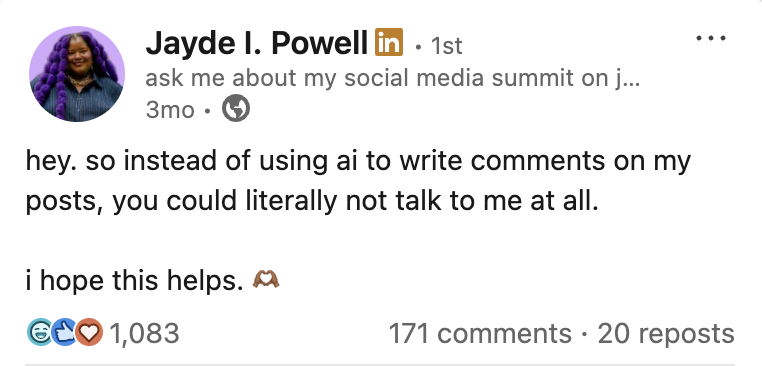
Half of Gen Z will block or unfollow an account for posting AI slop, per Sprout’s Q1 2026 Pulse Survey. Another 6 in 10 consumers report being less likely to engage with brand content in this AI atmosphere.
We’re back with the latest edition of our series, @Me Next Time, where we invite some of our favorite social experts to share how they really feel about the latest trends and industry discourse. This time, we’re addressing how AI backlash is bringing humanity back to B2B marketing, and why having a bench of employees in your content helps brands break through.
We sat down with Patsy Wagner, Associate Director of Global Content & Owned Channel Marketing at Spotify, to find out how she brings human-driven storytelling to the B2B side of the brand. We also talked about how human-generated content ecosystems drive authority, discoverability and connection in the age of answer-optimized search.
What is human-generated content vs. AI-generated content?
First, how do human-generated and AI-generated content differ?
- Human-generated content: Images, articles, videos, ads and other digital material drafted by humans. Distinctly human content pulls from lived experience and original ideas that robots can’t replicate.
- AI-generated content: Materials drafted entirely by AI (even with human refinement).
As consumers have gotten savvier, key “tells” of AI-generated content have emerged, including the overuse of em dashes, sentences that are all the same length, three-point lists and “it’s not X, it’s Y” statements. There are also the images and videos that defy the laws of psychics and the natural world. But AI is getting better, to the point where many people aren’t sure if they’ve encountered it. Some 43% of consumers say they only see AI slop sometimes or never, according to our Q1 2026 Pulse Survey.
Even as AI content evolves, consumers remain steadfast in their stated preference for human-generated social content. According to The Social Media Content Strategy Report, consumers want brands to make human-generated content their #1 priority in 2026. In a direct contradiction, marketers say they use AI for content creation more than any other task. When social teams lean on AI for the creative part of their jobs instead of tedious work like data collection and analysis, it creates a dynamic that is good for neither the creators nor the audience.
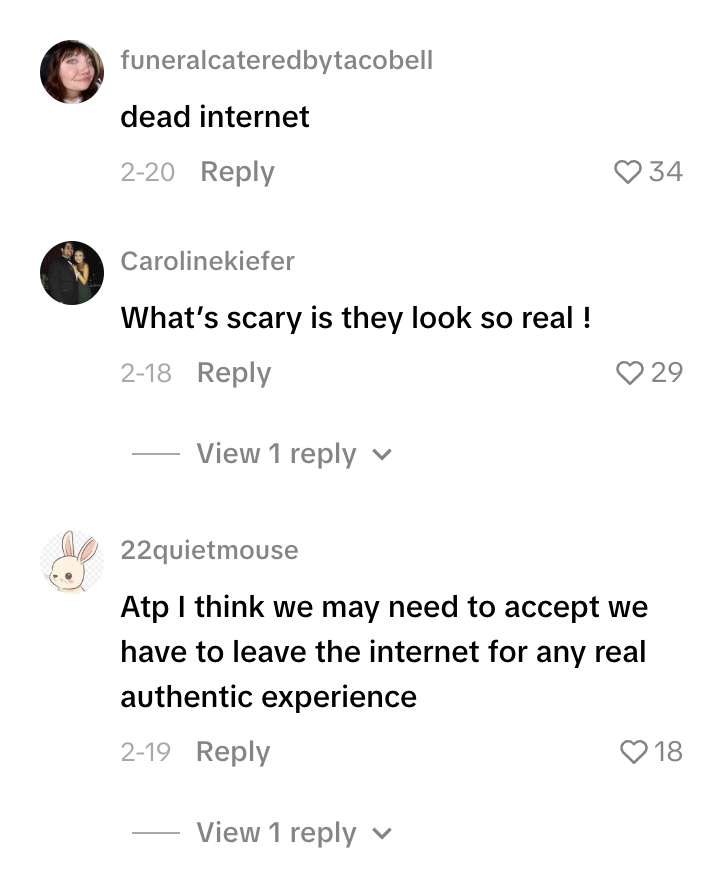
While AI tools make quick work of tasks like content editing and ideation, they can’t replace human nuance. The rise of AI-generated content and AI influencers has some users declaring we’re in the era of “dead internet.”
Wagner explained why using AI for social content can lead to an engagement drop-off. “AI content often sounds similar in cadence and punctuation. The more a brand defines its distinct tone, the more it will differentiate and connect with customers. Humans are drawn to ‘the zags’ or minor errors. AI produces textbook content, but that doesn’t get noticed. I recently told our agency, ‘Give me something I can hate,’ because it’s easier to pull back from a big swing than to work with something too palatable.”
The human voices you need in your social media content ecosystem
For brands navigating a sea of slop, just posting from the brand account reduces opportunities for success. People carry more credibility, and brands need an ecosystem of influencers, employee creators and executives to effectively reach their audience.
Wagner added, “On LinkedIn, people use their feed rather than visiting brand pages. Messages feel more authentic coming from a person. I personally pay more attention to people at my own level who are also in the weeds. Their advice is actionable, not just a framework. In the age of AI, it’s nice to see a relatable face you could DM.”
Executive voices
The Sprout Social Content Benchmarks Report found that almost half of social users say the content they wish they saw more of on LinkedIn is company updates directly from leadership.
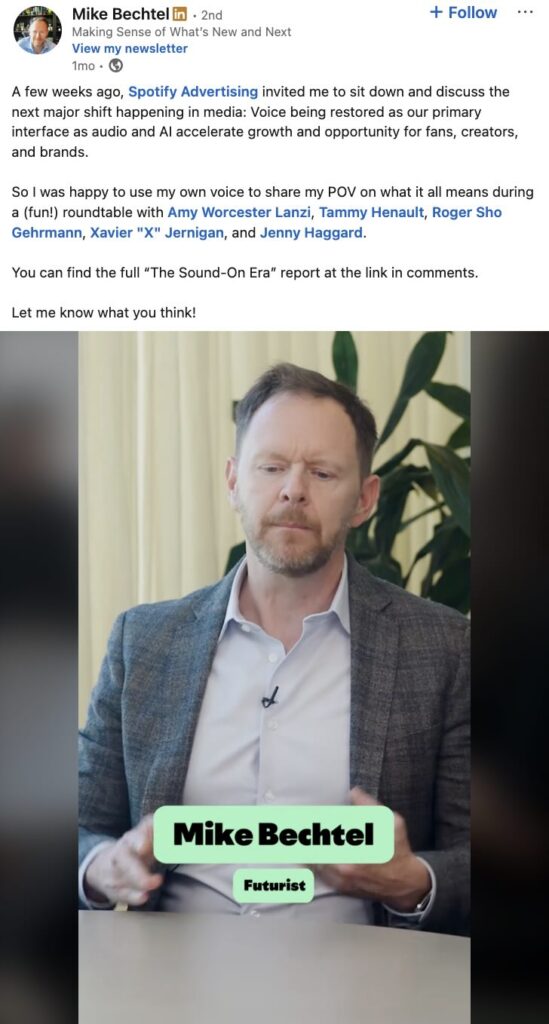
Your executives are uniquely positioned to share a POV on the future of your organization and industry, and overview of your latest features and product releases. Execs like Spotify’s co-CEO, Gustav Söderström, who has been with the company since 2008, can also help connect your brand’s history with the present.
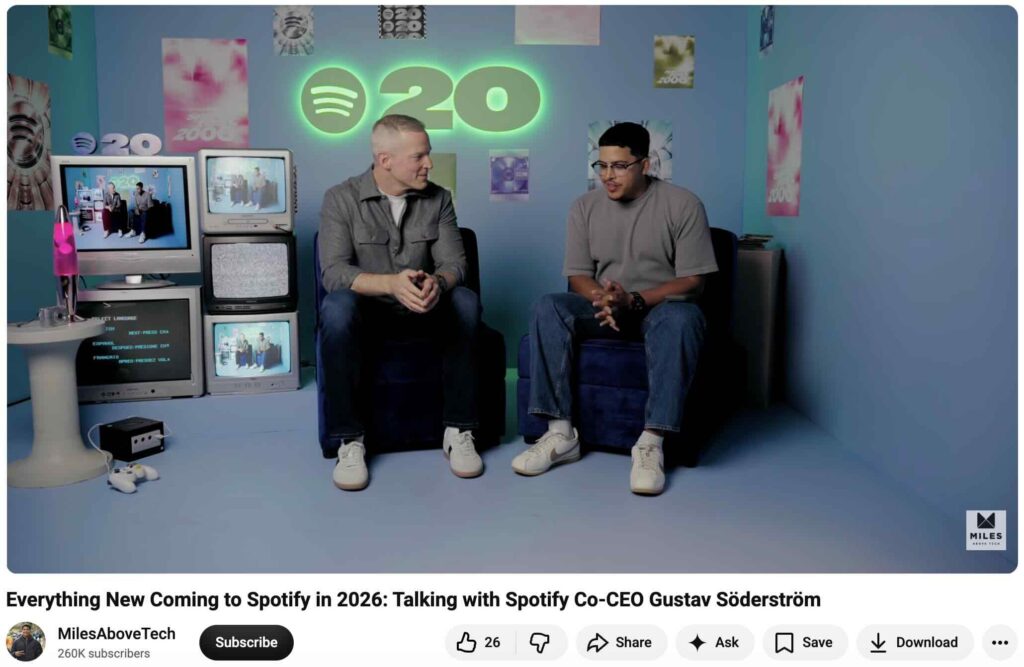
Putting executives in front of the camera makes your brand seem trustworthy and transparent, helping you earn lifelong customers. It also supports talent retention, while attracting and reassuring investors and partners.
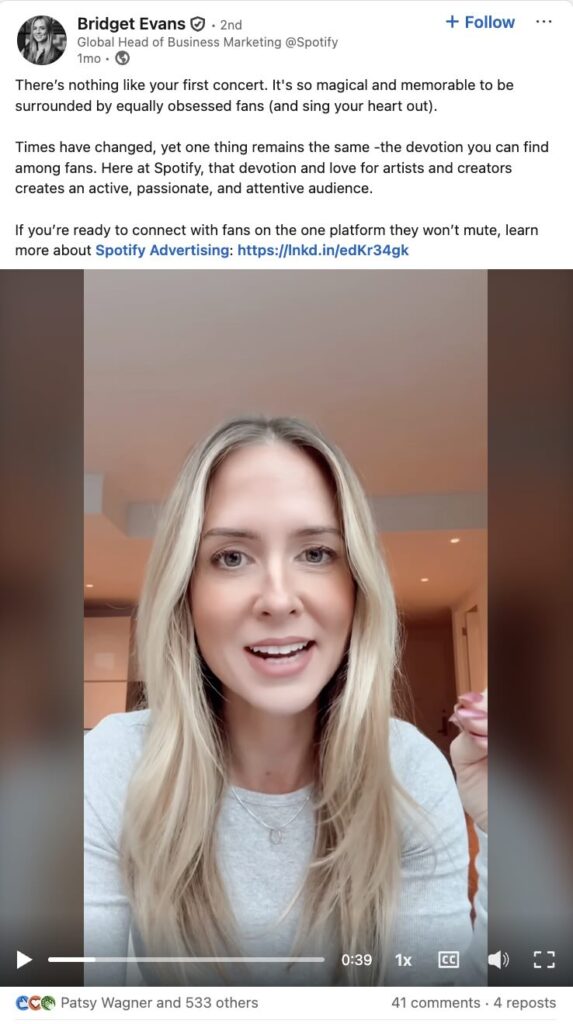
Employee creators
We’ve already written about why employee creators are so critical for helping brands maintain engagement amid AI content ubiquity. Their distinctly human quirks, talents and personalities multiply content resonance and visibility.
The best employee-generated content comes from employees who are genuinely passionate about content creation and are willing to develop their personal brand alongside the corporate brand. Within reason, they should have free rein to showcase their competency and individuality. In 2025, Sprout’s own Internal Creator Network’s share of video impressions grew 680% year-over-year. Now it accounts for almost 30% of all video impressions, despite being less than 8% of our total content mix.
Your employees help your audience emotionally connect with your brand, reminding people that there are real humans behind your logo.
Influencers and creators
Influencers and creators serve as an extension of your brand’s identity. Their content becomes part of your brand universe and shapes the way people see your products.
That’s why long-term relationships are so beneficial for brands and influencers alike. Influencer partners also become partners in collecting customer feedback, leading product innovation and, of course, crafting content that will effectively reach your shared audiences.
The impact of influencer marketing is undeniable, with 64% of consumers saying when a brand partners with their favorite influencer, they’re more likely to make a purchase per Sprout’s Q3 2025 Pulse Survey.
How human-generated content fortifies your brand
Of course, human content is more resource-intensive than AI content generation. Even with AI tools and software, it still requires talent management and sourcing, plus the time to create training materials and provide real-time coaching. But that extra effort is worth it, as human-generated content distinguishes your brand, adds new distribution channels, and brings cohesion to your audience’s experience and internal team’s strategy.
Distinct brand identity
Every marketer dreams of building brand identity so recognizable consumers don’t even need to see your logo. They know your brand from a color palette, a font or even a few lines of copy. Even when AI is trained on your brand guidelines, it doesn’t replicate the subtlety that makes your tone and voice distinct. As employee voices become more important, recognizable personalities become the characters in your extended brand universe.
Wagner explained: “As marketers, we spend a lot of time thinking about how brands show up from a creative perspective, which tends to mean their visual identity. But I would argue that as AI becomes a resource many teams use to write copy, tone, voice and humanity become even more important than visual expression of a brand.”
Whether you’re building or retaining hard-won awareness, human storytelling makes it easier to create truly original content. The personalities of the people you feature can still shine through, even while staying on-brand. The key is integrating your brand guidelines at the concepting and briefing stage. You might answer questions like:
- What cues can I provide talent so they hit the right tone (i.e., funny, educational, serious, playful)?
- How does this person’s point of view complement our brand values and narrative?
- What proprietary data points can we feature in this content?
- Should this post become a content series?
- What brand visual elements should this content incorporate (i.e., backgrounds, lighting, on-screen graphics)?
Amplified distribution
Ironically, human-generated content tends to perform just as well—if not better—with AI-driven search than AI-generated content. One study found that 82% of articles cited by ChatGPT and Perplexity are written by humans, and only 18% are generated using AI.
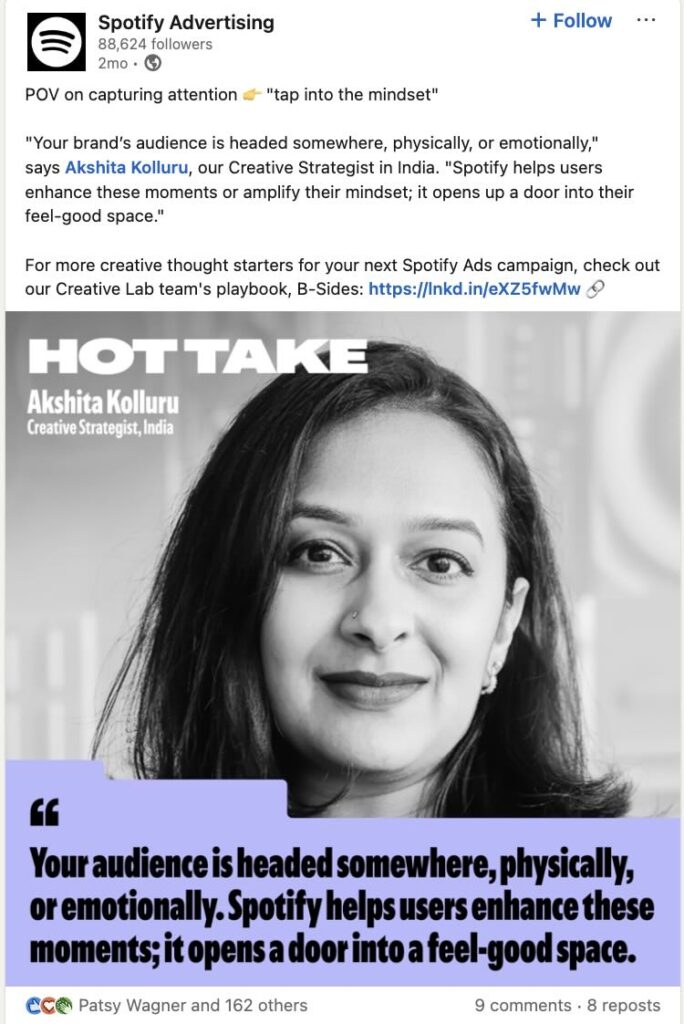
“From a technical standpoint, human-generated content helps because LLMs are looking for signals across so many different channels. My team leads our SEO function too, and those levers are evolving. Answer engine optimization (AEO) is a totally different beast. You need to be across so many channels, and the authority signals are different. Putting content on your brand’s own channels probably isn’t what gets you discovered,” said Wagner.
When you publish human-generated content like short-form videos on YouTube and TikTok, AMA Reddit threads, and expert-driven Substack and blog articles, you’re feeding the ravenous LLMs that require a constant diet of human ideas and data to remain useful.
Plus, showing up across channels meets audiences’ changing media diets.
As Wagner put it, “People are consuming media in such a fragmented way. To get in front of your audience and have an impact on their perception, you need to be everywhere they are: thought leadership blogs, influencer accounts, traditional media and your internal employees’ pages.”
Integration across functions
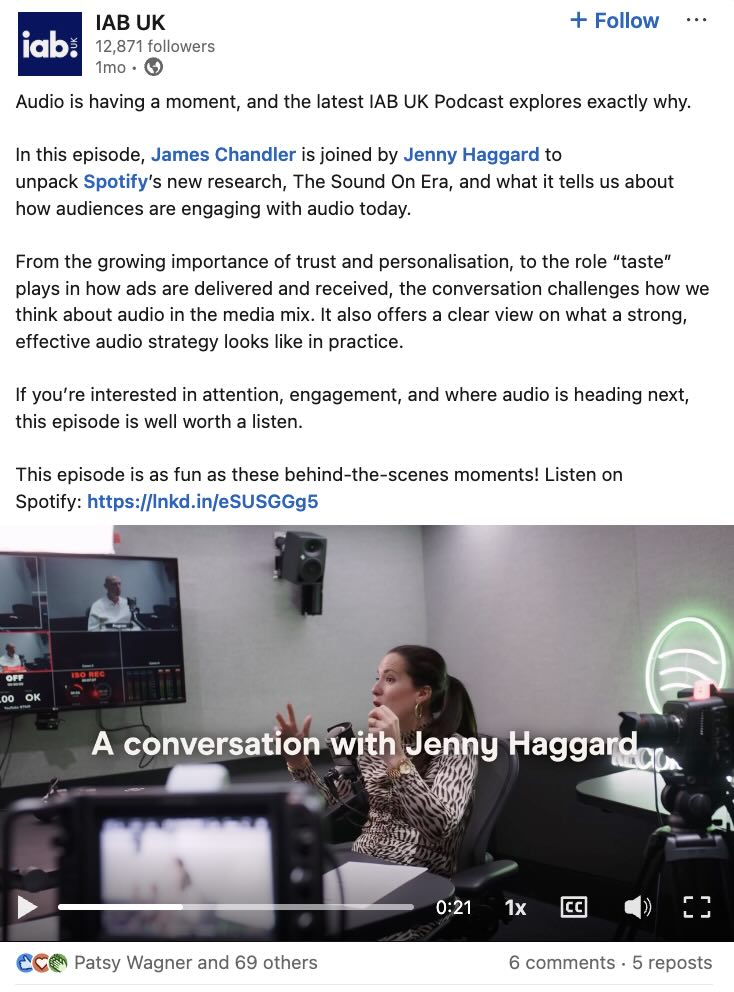
Human-led content ecosystems require social, content, SEO and other digital marketing teams to work in lockstep. These orgs must align around goals and objectives, while allowing each function the chance to lean into their expertise. For example, the content team knows how to build cohesive thought leadership narratives. The social team has mastered video production and influencer marketing. The SEO team is well-versed in the evolution of search.
At Spotify, Wagner’s team is composed of all of these different disciplines. “I’m a firm believer that content and channel marketing work better when they’re integrated. We’ve been asking big questions like: What can we do to create a more integrated approach to content marketing?”
Humans keep the internet (and your brand) alive
AI-generated content is everywhere, and it’s bogging down our algorithms and attention spans. The brands that break through will be the ones that double down on human perspective rather than dilute it.
Human-generated content builds trust, relatability, community and long-term audience connection in ways AI can’t replicate. By activating executives, employee creators and influencers, brands can create an ecosystem that expands reach while reinforcing authenticity. This approach also strengthens discoverability across increasingly fragmented channels and evolving search behaviors.
AI may accelerate content production, but it’s human creativity, opinion and imperfection that keep audiences paying attention.
Looking for more on employee-generated content? Check out our employee advocacy program launch checklist to create your own program.
39 free social media strategy templates that will elevate your workflows
Published on August 20, 2026 Reading time 15 minutes




Share