Holiday shopping is happening earlier than ever, here’s what brands need to know

Written by Jasmine Williams
Published on October 5, 2026
Reading time 6 minutes
Table of Contents
Halloween candy is still on the shelves, but holiday shoppers are making wish lists and hunting for deals months before the holidays arrive.
But as the shopping season gets longer, budgets are getting tighter. For brands, that means more chances to get in front of consumers, but also more competition for every dollar shoppers spend.
Data from Sprout Social’s Q3 2026 Pulse Survey points to three factors that will define the holiday season: campaign timing, price sensitivity and meeting shoppers where they’re increasingly discovering gifts—on social.
Consumers don’t want earlier holiday campaigns, except when they do
Consumers have mixed feelings about how early holiday marketing should start.
According to Sprout’s Q3 2026 pulse survey, nearly half (49%) say campaigns launched as early as August make them more likely to buy, including 19% who say they’re much more likely. Just 11% say an early start makes them less likely to purchase.
But ask consumers when brands should launch their holiday campaigns and the story changes. Half point to October or November as the ideal window, compared to 21% who prefer August or September. Another 12% say brands should wait until December.
Those findings may seem contradictory, but they point to a distinction between when consumers want holiday marketing to dominate their feeds and when they’re open to discovering seasonal products. Shoppers can be receptive to gift ideas, new products and seasonal inspiration well before they want brands to go all-in on holiday messaging. In other words, an earlier presence can influence what they eventually buy without making it feel like the holiday season starts in late summer.
The sweet spot: Show up early without going all-in. Use August and September to build awareness and consideration, then ramp up your holiday campaign in October and November.
For example:
- Tease what’s coming: Preview holiday collections, seasonal launches or upcoming offers.
- Get gift-worthy products on shoppers’ radar: Introduce products consumers might want to add to their lists before they’re ready to buy.
- Start publishing seasonal content: Share gift inspiration and other useful holiday content that gives shoppers a reason to engage early.
Starting earlier gives you more room to test what resonates before peak shopping begins. Then you can put more support behind the products, messages and offers gaining traction.
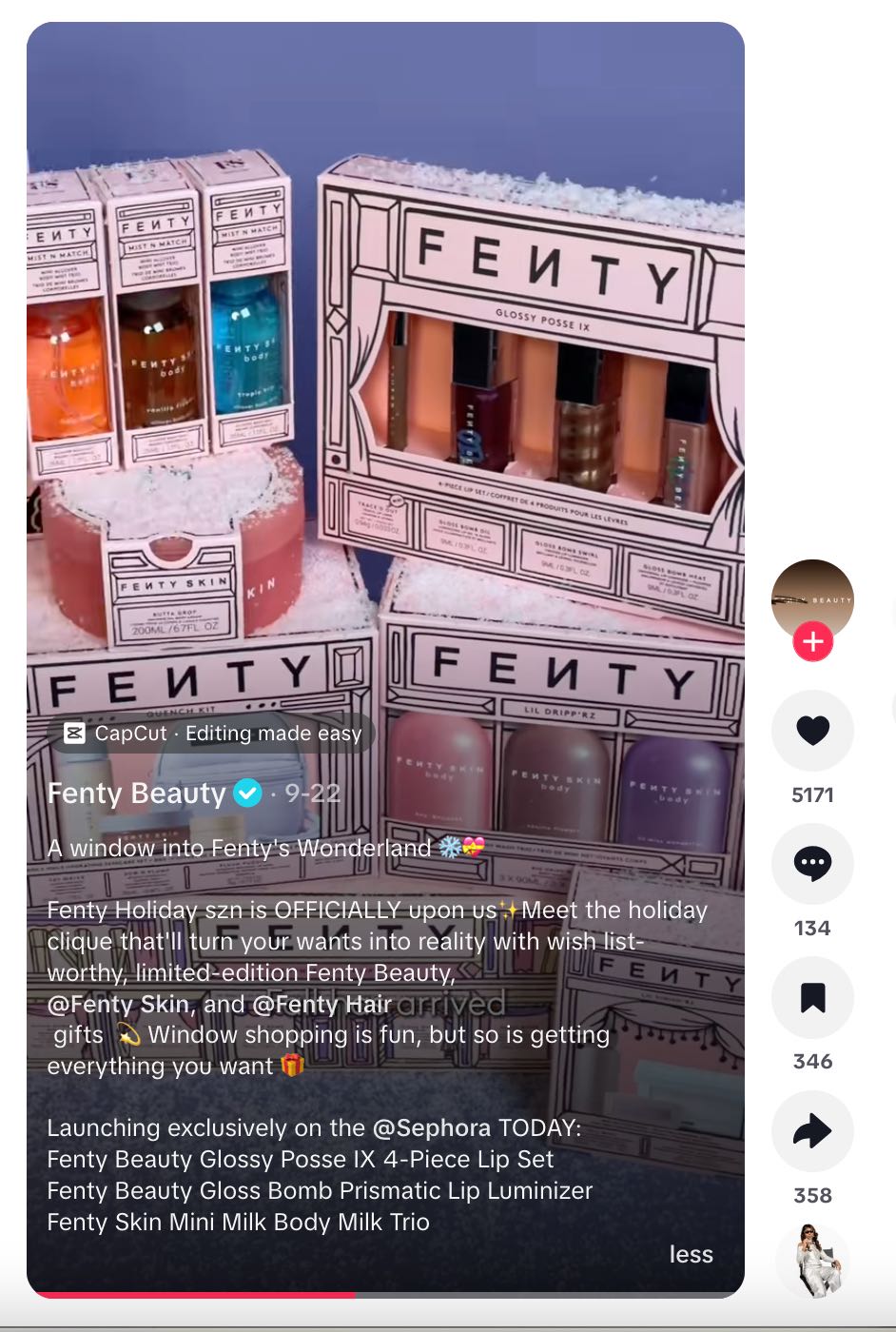
Brands are already putting this approach into practice. Fenty Beauty, for example, launched its limited-edition holiday collection in September, giving shoppers an early look at its seasonal products. As of writing, the TikTok has received over 100K views and over 5K likes.
Timing also depends on who you’re trying to reach. Younger consumers are especially receptive to an early start: 66% of Gen Z consumers say campaigns launching as early as August make them more likely to buy, compared to 49% of consumers overall.
Tariffs and price pressure are reshaping purchase patterns
Many consumers see shopping earlier as a way to get ahead of rising prices. More than a third (36%) say they’re starting their holiday shopping earlier specifically to avoid tariff-related price increases. Another 27% aren’t shopping earlier yet but are concerned about prices.
In total, 63% of holiday shoppers are thinking about the impact of higher prices.
Those concerns are also affecting how much consumers plan to spend. More than half (56%) expect to reduce their holiday spending this year because of economic conditions like tariffs and the cost of living. Only 30% say they don’t plan to cut back.
Price sensitivity doesn’t mean every brand needs to compete on having the lowest price. Shoppers may be looking more closely at what they get for their money, so holiday content should make value clear. Highlight product quality, versatility or other details that make a purchase feel worthwhile.
Discounts can also tip the scales: Promo codes shared by brands or influencers are the top purchase driver, cited by 30% of consumers. Lastly, brands with products at multiple price points can also organize gift recommendations by budget, making it easier for shoppers to find options that work for them.
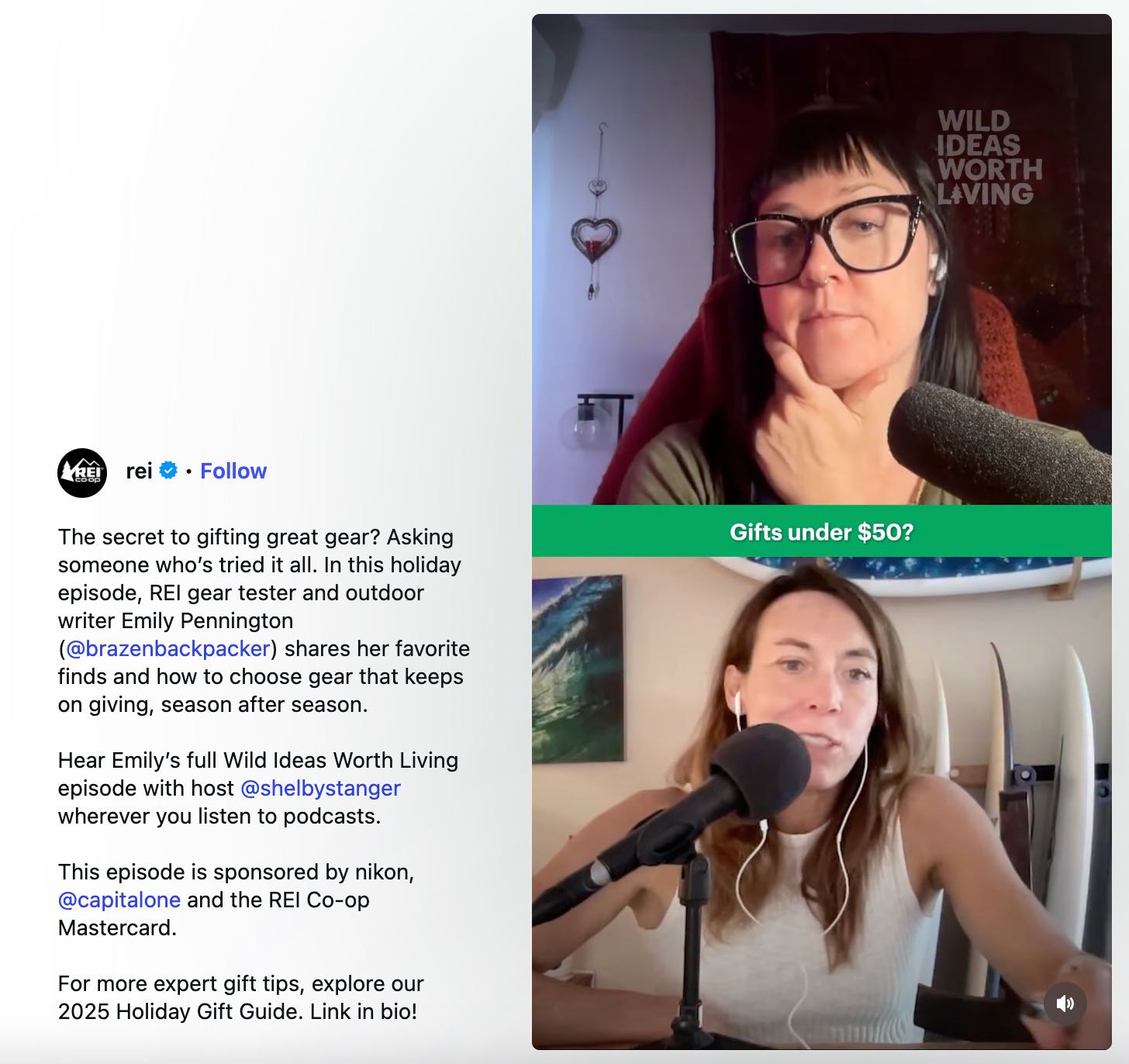
For example, last holiday season, REI shared a roundup of expert picks under $50 on Instagram, with a CTA to check out their larger holiday gift guide.
Consumers are discovering gifts on social this year
Social media now rivals in-store shopping for holiday gift discovery. This year, 46% of consumers say they’ll turn to social for gift ideas and product discovery—the same percentage who plan to browse physical stores.
Where consumers turn for holiday gift ideas:
- Social media: 46%
- Physical stores: 46%
- Recommendations from friends and family: 34%
- TV: 31%
- Review sites: 23%
- AI chatbots: 15%
And social’s influence is still growing. Compared to the 2025 holiday season, 28% of consumers plan to use social more to find gifts this year, while another 50% expect their usage to stay about the same.
That creates an opportunity to reach shoppers before they know exactly what they want to buy.
Think about how easily someone encountering your brand for the first time can understand what you sell, who your products are for and why they’re worth considering. Content organized around recipients, interests, occasions or price points can make that discovery process easier and give shoppers a reason to explore your products further.
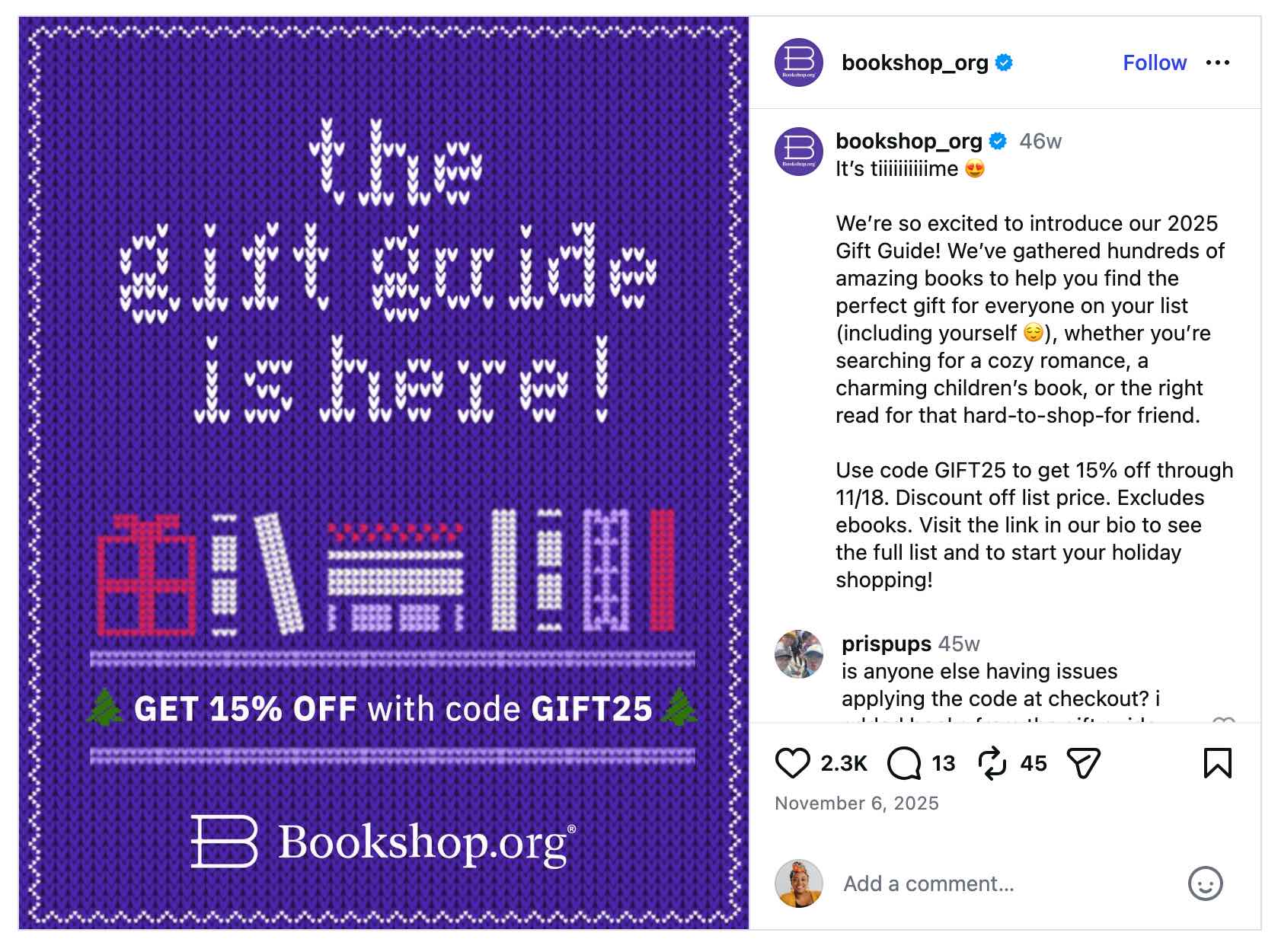
Bookshop.org, for example, used Instagram to promote its 2025 holiday gift guide, which curated hundreds of recommendations for different types of readers and paired them with a limited-time discount.
What drives a purchase on social?
Discovery is only the first step. Once shoppers find a product on social, the content surrounding it can influence whether they buy.
According to the Q3 2026 pulse survey, promo codes shared by brands or influencers are the top social-specific purchase trigger at 30%, followed closely by brand posts showing products in action at 28%. Original holiday content from brands influences 26% of consumers, while 22% point to content from non-influencer users.
Taken together, these findings show that shoppers respond to a mix of incentives, brand content and recommendations from other people. Holiday content plans should reflect that variety. A steady stream of promotional posts may capture shoppers looking for deals, but product education, original seasonal content and posts from customers or creators can give others the context they need before buying.
Creator partnerships in particular can give shoppers more context as they weigh their options. In this paid TikTok partnership, creator KC walks viewers through luxury holiday gift sets, giving them a closer look at several products in one video.
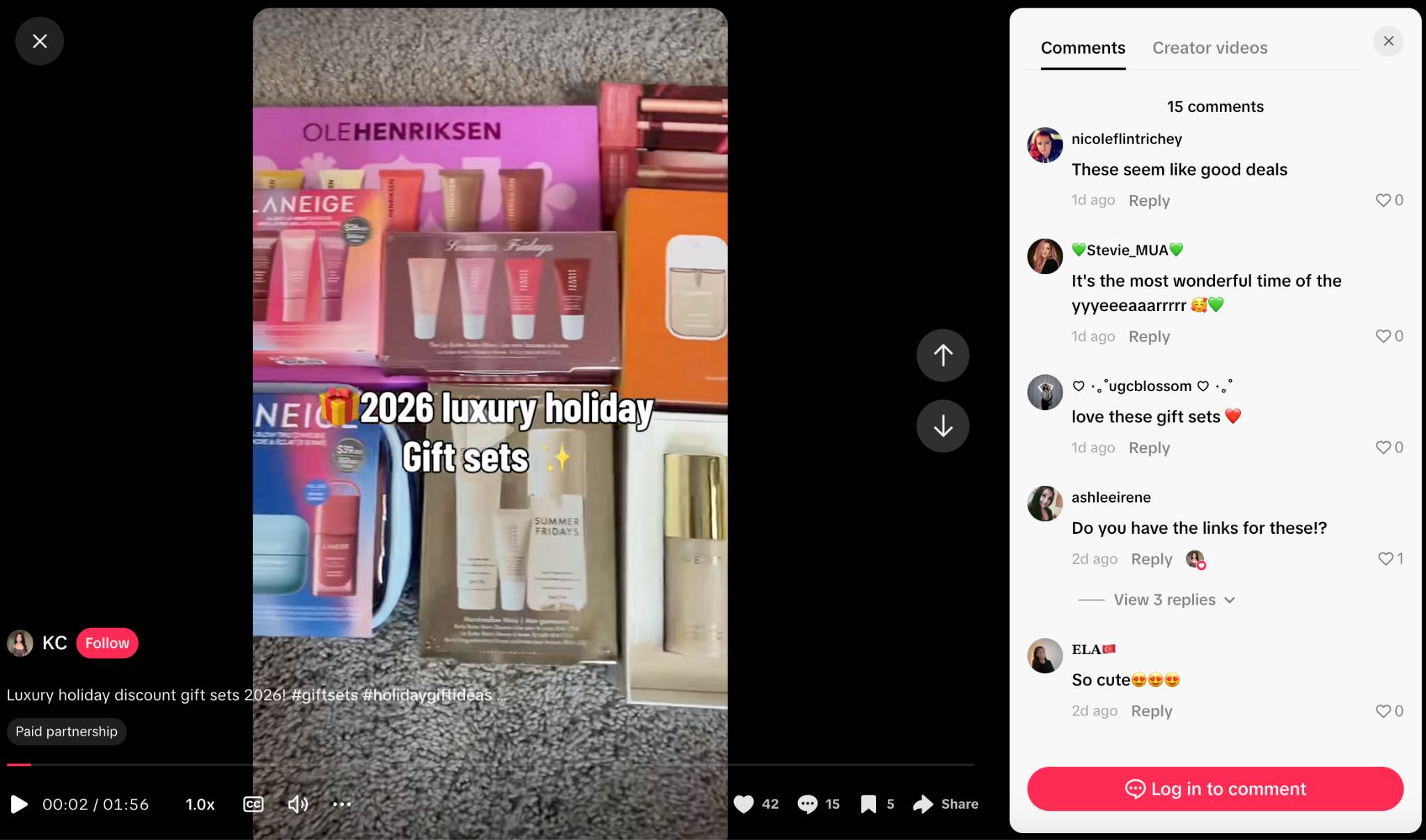
Build that variety into your holiday content strategy:
- Make products tangible. Show how they look, work or fit into someone’s life so shoppers have more context before purchasing. This also extends the campaign’s shelf life beyond the holiday season.
- Give shoppers an incentive to act. Make promo codes easy to find, use and share across brand and influencer content.
- Create for the season. Give holiday creative its own identity rather than relying on generic “shop now” messaging. Also consider using a holiday hashtag calendar to plan around relevant moments throughout the season.
Social commerce and social customer care will play a bigger role this holiday season
Finding the perfect gift can lead to an immediate purchase—or a question about shipping, sizing or availability. This holiday season, consumers increasingly expect brands to handle both directly on social.
Make the path from discovery to purchase seamless
More than half (57%) of consumers are open to completing a purchase directly within a social app this holiday season. That includes 38% who have purchased this way before and plan to do so again, plus 19% who are ready to try it for the first time.
As more purchases happen directly on social, brands need to remove as much friction as possible. Review your social commerce strategy before holiday traffic picks up, keep product information current and make key details like availability, shipping timelines and return policies easy to find.
Prepare your social inbox for more customer questions
More than a quarter (27%) of consumers expect to use social more for holiday customer service than they did in 2025, while another 59% expect their usage to stay about the same.
Commerce and customer care increasingly overlap on social. A question about sizing, inventory or delivery might be the last thing standing between a shopper and a purchase. Plan for holiday-level service volume throughout Q4, not just during Black Friday and Cyber Monday.
Clear workflows, adequate coverage and quick access to order and product information can help social teams keep up as purchase and service activity increases.
What this means for your 2026 holiday strategy
Holiday shopping habits are changing, but the data gives marketers a clearer picture of how to adapt. As you finalize your 2026 holiday strategy, focus on three priorities:
- Give yourself a longer runway. If your holiday campaign is already underway, use October and November to ramp up promotional activity. Then take what you learn this season into 2027, when you can start building awareness as early as Q3.
- Compete on value, not just urgency. Price-conscious shoppers will be paying close attention to what they’re getting for their money, so make pricing, promotions and value clear.
- Plan beyond social awareness. Consumers are finding gifts, making purchases and seeking customer service on social. Your holiday strategy should account for the entire journey.
Use these findings to benchmark your current holiday content plan and identify where you may need to adjust your timing, messaging or channel strategy. Then explore our holiday marketing strategies for more ideas to turn those priorities into campaigns that connect with shoppers this season.
Frequently asked questions
When should brands start their holiday marketing campaigns?
Most consumers (50%) prefer brands to launch holiday campaigns in October or November. However, nearly half (49%) say campaigns that start as early as August make them more likely to buy. Brands can use August and September to build awareness before ramping up promotional activity in the fall.
Are consumers spending more or less on holiday shopping this year?
Consumers are planning to spend less this holiday season. More than half (56%) say they expect to reduce their holiday spending because of economic pressures like tariffs and the cost of living.
Is social media a bigger part of holiday shopping in 2026?
Yes. Social media is tied with physical stores as the top source for holiday gift ideas and product discovery, with 46% of consumers turning to each. Plus, 57% of consumers plan to complete a purchase directly within a social app this holiday season.
39 free social media strategy templates that will elevate your workflows
Published on August 20, 2026 Reading time 15 minutes



Share