Influencer marketing trends 2026: Where smart brands are headed

Written by Mary Keutelian
Published on June 5, 2026
Reading time 11 minutes
Table of Contents
Summary
- Micro-influencer dominance: Creators with 10k–100k followers are driving the highest engagement rates and lowest acquisition costs.
- Social commerce integration: Platforms like TikTok Shop and YouTube Shopping have turned creator videos into frictionless, direct storefronts.
- AI-powered workflows: Brands are leveraging AI to scale creator discovery, ensure brand fit and measure bottom-line performance.
- Performance-based accountability: Vanity metrics are out; compensation is now tied to multi-touch attribution, conversions and direct ROI.
Influencer marketing trends don’t wait for you to catch up. In an industry projected to exceed $26 billion by the end of 2026, falling behind costs real revenue. Algorithm updates, new commerce features and shifting consumer trust constantly reshape what works.
This article breaks down the top influencer marketing trends shaping 2026, from micro-creator dominance and social commerce to AI-powered discovery and performance-based measurement.
What are influencer marketing trends?
Influencer marketing trends are the strategic, technological and cultural shifts that dictate how brands and creators collaborate to drive revenue. They reflect real-time changes in how content is made, how partnerships are structured, how performance is measured and how trust is built between creators and their communities.
Tracking these trends is how you stay ahead of what your audience expects and what your competitors are already doing. Building effective influencer marketing strategies means adapting to these shifts before they become industry standard.
Why influencer marketing trends keep evolving
Influencer marketing is a strategy where brands partner with content creators to promote products directly to engaged audiences. This strategy is reshaping how consumers discover and buy.
According to The CMO’s Social Media Planning Guide for 2026, 83% of marketing leaders plan to increase their influencer budgets in the next six to 12 months, and just over 80% are increasing their spend by reallocating funds from other channels, showing that the pace of investment is accelerating
Three forces drive constant evolution in this space:
- Platform shifts: TikTok Shop turned creator videos into direct storefronts. Instagram’s push toward Reels changed how brands brief creators.
- Consumer behavior: Trust in traditional ads has dropped while trust in creator recommendations has climbed. Today, 64% of social users say they are willing to buy more from a brand when it partners with an influencer they like—a figure that jumps to 76% for Gen Z—according to the Q2 2025 Sprout Consumer Pulse Survey.
- Commerce integration: Influencer content now outperforms brand-owned content across reach, engagement and conversion, according to the Sprout Social Influencer Marketing Report.
Sprout Social’s Listening tool tracks these sentiment shifts in real time, so you spot what’s resonating—and what’s falling flat—before your next campaign launches.
Top influencer marketing trends in 2026
1. Micro and nano creators dominate engagement
The assumption that bigger audiences yield better results is dead. Micro-influencers (10,000–100,000 followers) and nano-influencers (under 10,000) outperform mega-celebrities. Why? Because their audiences treat them as trusted peers, not distant personalities.
| Creator tier | Follower range | Engagement rate | Best for |
|---|---|---|---|
| Nano | Under 10,000 | Highest | Hyper-niche audiences, product seeding, authentic UGC |
| Micro | 10,000–100,000 | High | Community trust, conversion-focused campaigns |
| Macro | 100,000–1M | Moderate | Brand awareness, reach at scale |
| Mega / Celebrity | 1M+ | Lower | Mass reach, cultural moments, brand launches |
Brands are shifting budgets toward smaller creators because they deliver 2x-3x higher engagement rates, foster niche audience trust and keep customer acquisition costs (CAC) low.
2. Long-term creator partnerships outperform one-offs
A one-off sponsored post is easy for consumers to scroll past. A creator who advocates for your product across six months of content builds the kind of trust that drives real purchase decisions.
To structure your partnerships for sustained impact:
- Run trial periods: Test the creator with product gifting before committing to a long contract.
- Use tiered compensation: Pay a base rate plus bonuses based on content volume and conversion performance.
- Exclusive category rights: Lock in top performers so competitors can’t poach them.
- Co-created content calendars: Align the creator’s posting schedule with your product launches.
According to a Q1 2025 Sprout Pulse Survey, 59% of marketers plan to partner with more influencers in 2025—and long-term relationships are as valuable to influencers as they are to brands, with 71% of influencers offering discounts for multi-post partnerships, according to the Sprout Influencer Marketing Report.
The Sprout Social’s Influencer Marketing platform functions as your creator CRM. Build and manage Creator Lists, track performance history and compare campaign types over time—so you compare the ROI of sustained ambassador programs versus one-off campaigns.
3. Authenticity and transparency win trust and ROI
Consumers expect creators to disclose paid partnerships—and the FTC requires it. Beyond compliance, transparency drives results. According to the Sprout data, 47% of consumers say authenticity in sponsored content is a top quality they look for in influencers.
However, the definition of authenticity is also shifting. Younger consumers understand the transactional nature of creator partnerships. Gen Z is less focused on whether content feels unscripted, and more focused on whether the creator uses the product. They want proof that the product fits the creator’s actual life.
The brands winning on social right now prioritize trust by doing these four things:
- Granting creative freedom: Let creators use their own voice and style rather than forcing a rigid corporate script.
- Showing the unpolished reality: Share behind-the-scenes content that feels natural rather than highly produced.
- Encouraging honest reviews: Allow creators to talk about product limitations; unbiased content stops consumers mid-scroll, while purely aspirational content gets ignored.
- Amplifying user-generated content (UGC): Repurpose authentic videos and photos from real, everyday customers.
4. AI-powered tools elevate matching, forecasting and measurement
Manual creator discovery is a thing of the past. AI now handles the heavy lifting of influencer discovery: analyzing topical alignment, engagement patterns and brand fit in seconds.
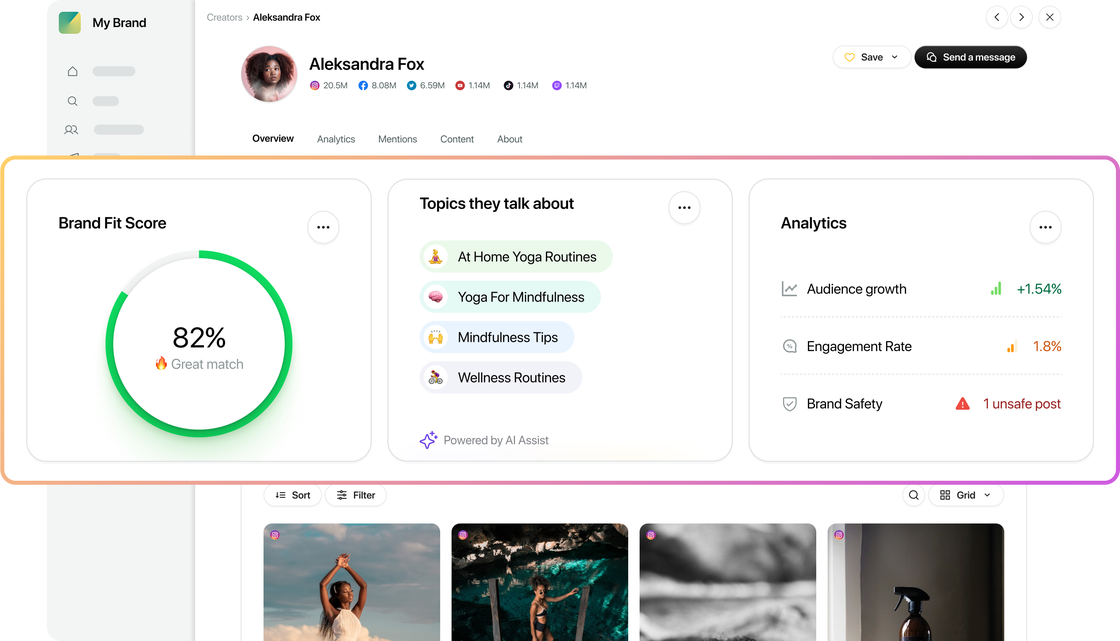
Sprout Social Influencer Marketing delivers this through AI-powered capabilities built for precision:
- Natural language creator search: Find creators based on the content you want to make, not outdated demographic filters.
- Brand Fit Score: Instantly evaluate whether a creator’s voice and content align with your brand values.
- Brand Safety reporting: Customizable audits flag controversial or risky content before you sign a contract.
According to the Sprout Influencer Marketing Report, almost half of marketers struggle to measure the effectiveness of their influencer campaigns. By using AI-powered analytics, brands close the measurement gap and connect creator activity to bottom-line business outcomes.
5. AI influencers are entering the conversation
AI-generated creators—virtual influencers entirely from artificial intelligence—are no longer a novelty. They’re becoming a real strategic consideration for brands that want consistent, brand-safe content at scale.
While AI influencers generate reliable content without the risk of real-world scandals, they lack lived experience. For categories where personal credibility drives purchases (like fitness, skincare or food), human creators still win.
If you experiment with virtual influencers, remember that FTC disclosure rules still apply: you must clearly label AI-generated paid partnerships.
6. Social commerce turns content into checkout
The junction of social media and e-commerce is one of the most critical influencer marketing industry trends of the year. Social commerce influencer marketing means using creator content to drive purchases inside a social media platform—no separate website visit required. Platforms like TikTok Shop, Instagram Shopping and YouTube Shopping have transformed standard creator videos into highly convertible storefronts.
Key features driving this trend:
- Product tags: Viewers tap a link directly inside a video or image and land on an in-app checkout page, drastically reducing friction.
- Affiliate dashboards: Creators can track their sales commissions in real time, motivating them to push for conversions.
- Live shopping events: Real-time product demos hosted by creators create urgency, driving immediate purchases.
- Creator storefronts: Curated product collections live on the creator’s profile, acting as native landing pages.
Every stage of the customer journey now exists on social media. Your content is your storefront.
7. Influencer-led creative fuels paid amplification
Creator content shouldn’t stop working when the organic post is done. The smartest brands run their best-performing influencer content as paid media—and it consistently outperforms brand-produced creative. This process is called creator licensing, formerly known as whitelisting.
According to Sprout data, 90% of marketers say sponsored influencer content outperforms organic brand content in reach and 83% say it outperforms in engagement.
To build a paid amplification workflow with creator content:
- Secure usage rights upfront: Negotiate paid amplification rights in your creator contracts before content goes live, not after.
- Test before you scale: Run a small paid boost on top-performing organic creator posts to identify which content converts before committing a significant budget.
- Track attribution separately: Use UTM parameters and platform pixel tracking to separate organic creator performance from paid ad performance so you know where ROI comes from.

8. B2B influencer marketing is gaining ground
B2B brands are actively adopting influencer marketing, but they are trading lifestyle creators for industry analysts, consultants and niche LinkedIn thought leaders.
B2B influencer marketing works differently from B2C. The purchase cycle is longer, the audience is smaller and the content needs to educate rather than entertain. The right creator for a B2B campaign isn’t the one with the most followers; it’s the one who commands the most trust in your specific professional community.
B2B influencer marketing requires a different playbook:
- Prioritize topical authority over reach: A LinkedIn creator with 15,000 highly engaged followers in your industry is more valuable than a general business account with 50,000 followers.
- Measure pipeline, not likes: Track how creator content influences deal velocity, lead quality and brand recall—not engagement rate alone.
- Build long-term relationships: B2B buyers research extensively before purchasing. A creator who advocates for your brand across six months of content builds far more credibility than a single sponsored post.
9. Performance accountability replaces vanity metrics
Vanity metrics are out. Likes and views tell you people saw your content, but they don’t tell you whether anyone bought anything. Brands are tying creator budgets directly to revenue metrics.
To prove influencer marketing ROI, track these four bottom-line KPIs:
- Cost per acquisition (CPA): How much you spend to win one customer through a creator.
- Conversion rates: The percentage of viewers who click an affiliate link or use a promo code to purchase.
- Customer lifetime value: The long-term revenue from influencer-acquired customers.
- Brand lift studies: Measurable changes in awareness and purchase consideration.
10. Build creator infrastructure and workflows for scale
Running one creator partnership out of a spreadsheet is manageable. Scaling to 20 campaigns demands an influencer CRM and automated workflows. Without infrastructure, content approvals get missed, payments are late and posts go live without proper brand review.
To scale effectively, your influencer marketing platform must include this essential infrastructure:
- Creator databases: A centralized hub for storing contracts, contact information and historical campaign performance.
- Content approval workflows: A streamlined review process that protects brand safety before content goes live.
- Rights management: Automated tracking of which creators granted you permission to repurpose their content for paid ads.
- Payment automation: Timely, friction-free compensation systems that keep your best creators loyal.
11. Tailored platform strategies replace copy-and-paste cross-posting
Every social network rewards different content. Posting the same video across TikTok, Instagram and YouTube without adapting it leaves performance on the table. The specific format matters just as much as the platform itself.
According to Sprout’s Influencer Marketing Report, 53% of influencers prefer creating short-form video (15–30 seconds), making it the most in-demand format for both brands and creators.
Here is how to adapt your strategy by platform:
| Platform | Best content formats | Primary use case | Video format guidance |
|---|---|---|---|
| TikTok | Short-form vertical video, trending audio, TikTok Shop product links | Discovery and social commerce | Under 60 seconds for awareness; use trending audio to extend reach |
| Reels, Stories, photo carousels | Audience growth, time-sensitive promotions, product breakdowns | Reels under 30 seconds drive discovery; carousels drive saves and shares | |
| YouTube | Long-form reviews, tutorials, Shorts, horizontal video over one minute | High-intent buyers and top-of-funnel reach | Long-form (3+ minutes) for detailed reviews; Shorts for discovery; live for product launches |
Influencer marketing trends across industries
IInfluencer marketing isn’t a copy-and-paste playbook. What wins in one industry will fall flat in another. Stop chasing generic best practices and start building for the way your audience buys, scrolls and trusts.
Use this section to ground your strategy in category reality: Choose the right creators, the right content style and the right activation model for your market.
Here is how the top categories are activating creators:
- Beauty and fashion: Audiences expect creators to show products in action. Tutorials, “Get Ready With Me” (GRWM) routines, styling content and honest reviews lead the way. Give creators room to demonstrate fit, feel, and real-life use.
- Food and drink: This is a top category for engagement because the content feels immediate and sensory. Recipes, taste tests, hosting moments and everyday rituals outperform polished brand talking points every time.
- Sports and fitness: Credibility is everything. Fitness audiences want creators who live the lifestyle, use the product consistently and show results through real experience, not content manufactured in a studio.
- Travel: Successful travel partnerships happen when creators turn a destination into a story. Prioritize creators who capture the entire journey—from planning and arrival to the real-world experience.
B2C vs. B2B: How strategy shifts by sector
The path from content to purchase looks different depending on who you’re selling to. Here’s how the two models diverge:
| Factor | B2C influencer marketing | B2B influencer marketing |
|---|---|---|
| Primary goal | Lifestyle fit, entertainment and fast product discovery | Expertise, trust and category authority |
| Content style | Entertaining, aspirational and visually driven | Educational, analytical and insight-led |
| Purchase path | Short—the right creator makes buying feel effortless | Long—buyers need actionable insight, not surface-level promotion |
| Creator criteria | Audience alignment, engagement rate and content quality | Industry credibility, thought leadership and topical relevance |
| Success metric | Reach, engagement and conversion | Pipeline influence, share of voice and audience trust |
How to measure influencer marketing ROI
According to a Sprout Pulse Survey, 65% of marketers are confident their leadership team sees the business value of investing in influencer partnerships. But confidence without a strict measurement framework leaves influencer marketing ROI open to interpretation. Build your attribution model before your next campaign launches.
Map KPIs across the full funnel
Multi-touch attribution tracks every touchpoint a customer hits before they buy, not just the last creator post they saw. This gives you a comprehensive picture of how influencer content drives revenue across the entire customer journey.
Track these KPIs at each funnel stage:
- Awareness metrics: Reach, impressions and brand mentions
- Consideration signals: Website traffic, email signups and content saves
- Conversion tracking: Promo codes use, affiliate link clicks and pixel tracking
- Retention indicators: Repeat purchases and customer reviews
Build a hybrid compensation model
Flat fees give creators no incentive to push for results. Hybrid compensation—a guaranteed base rate plus performance bonuses—aligns the creator’s earnings with your brand’s revenue outcomes.
Top compensation models include:
| Compensation model | Best for | How it works |
|---|---|---|
| Base fee plus commission | Mid-tier and macro creators | Flat rate plus a percentage of every sale they drive |
| Tiered bonuses | Performance-focused campaigns | Escalating rewards when creators hit specific sales benchmarks |
| Product seeding | Nano-creators and early-stage programs | Free products in exchange for content |
| Equity partnerships | Top-performing brand ambassadors | Long-term business alignment tied to brand growth |
Sprout Social Influencer Marketing’s campaign reporting tracks performance down to the post. You’ll see which creators, content formats and compensation structures move the needle and report that ROI with confidence.
The path forward for influencer marketing
Influencer marketing is no longer an experimental tactic; it is a core revenue driver. The brands winning in 2026 treat creators as long-term partners and integrate influencer content across multichannel campaigns—moving beyond the social feed into paid ads, in-person events and brand-owned storefronts.
The future of influencer marketing isn’t about AI replacing human creators; it’s about using AI tools to empower creators and scale your program’s operational efficiency. Build that infrastructure now. Start with micro-influencers, tie compensation to performance and integrate creator content across your entire marketing funnel so no activation exists in a silo.
Sprout Social Influencer Marketing gives you AI-powered creator discovery, Brand Fit Score, Brand Safety reporting and campaign analytics in one centralized platform. Find the right creators, protect your brand and prove ROI without stitching together several different tools. Request a demo to see it in action.
FAQs about influencer marketing trends
What are the biggest influencer marketing trends in 2026?
The top influencer marketing trends in 2026 include the dominance of micro-influencer partnerships, the rise of social commerce and in-app checkout, AI-powered creator discovery tools and performance-based compensation models. Brands are actively shifting budgets toward smaller, highly trusted creators and utilizing AI tools to measure direct ROI rather than vanity metrics like reach.
How does influencer marketing differ by industry?
Influencer marketing strategies differ by industry based on how specific audiences discover and purchase products. For example, beauty and fashion audiences require creator-led product tutorials, while B2B buyers require thought leadership and actionable insights from established industry experts. Success requires matching the content format to the industry’s unique buyer journey.
How do you measure influencer marketing ROI without relying on vanity metrics?
To measure influencer marketing ROI, brands must track full-funnel metrics like cost per acquisition (CPA), conversion rates and customer lifetime value (CLV). Moving past vanity metrics requires using multi-touch attribution models, promo codes and affiliate links to connect creator content directly to revenue generation.
Are micro-influencers more effective than macro-influencers for driving conversions?
Yes, micro-influencers (creators with 10,000 to 100,000 followers) generally deliver higher engagement and conversion rates than macro-influencers. Because their audiences view them as trusted peers, their recommendations carry more weight, resulting in lower customer acquisition costs for brands.
What tools support brands in scaling influencer marketing programs?
Brands scale influencer marketing programs using AI-powered influencer management platforms like Sprout Social. These tools automate manual tasks by providing natural language creator search, automated content approval workflows, centralized campaign reporting and secure payment processing in one centralized hub.
How does AI speed up creator discovery?
AI speeds up creator discovery by replacing outdated demographic filters with natural language search. AI analyzes thousands of profiles in seconds to find creators whose topical authority, content style and audience alignment match your brand’s specific campaign goals.
39 free social media strategy templates that will elevate your workflows
Published on August 20, 2026 Reading time 15 minutes



Share