32 influencer marketing statistics to guide your brand’s strategy in 2026

Written by Martha Kendall
Published on April 29, 2026
Reading time 11 minutes

Table of Contents
Influencer marketing has moved from experimental budget line to boardroom priority. The data backs it up, the results are undeniable and the brands winning on social right now have one thing in common: they’ve built influencer programs that are strategic, measurable and deeply connected to their broader social media strategy.
Knowing influencer marketing works is one thing. Making it work for your brand is another. The right statistics don’t just validate your investment; they sharpen your strategy, support performance benchmarking and give you the evidence you need to secure executive buy-in.
This article compiles the most important influencer marketing statistics across growth, AI adoption, effectiveness, influencer marketing ROI, platform performance and where the industry is heading next. Whether you’re building your first influencer program or scaling an existing one, these numbers will help you make faster, smarter decisions.
Influencer marketing growth statistics
Influencer marketing’s explosive growth is rewriting the rules of social media. These influencer marketing growth statistics reveal where the industry is heading—and how to future-proof your strategy.
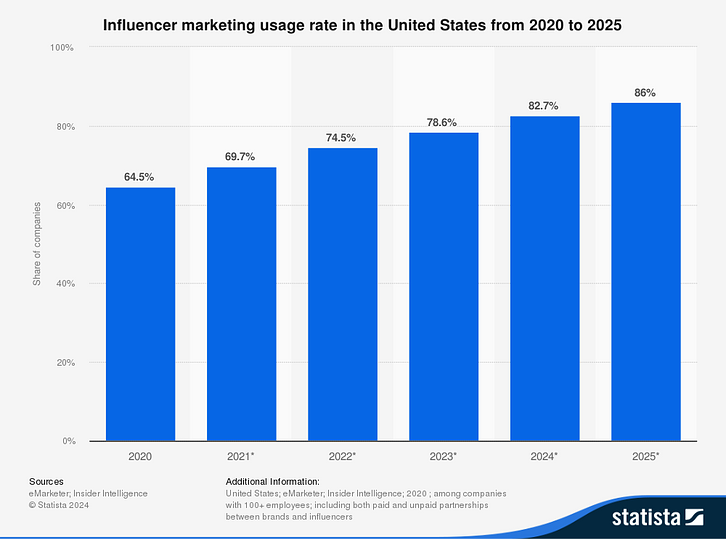
1. 86% of US marketers partnered with influencers in 2025
Influencer marketing has crossed the threshold from emerging tactic to standard practice. When the vast majority of US marketers are working with creators, the question is no longer whether to invest but how to invest smarter than your competitors.
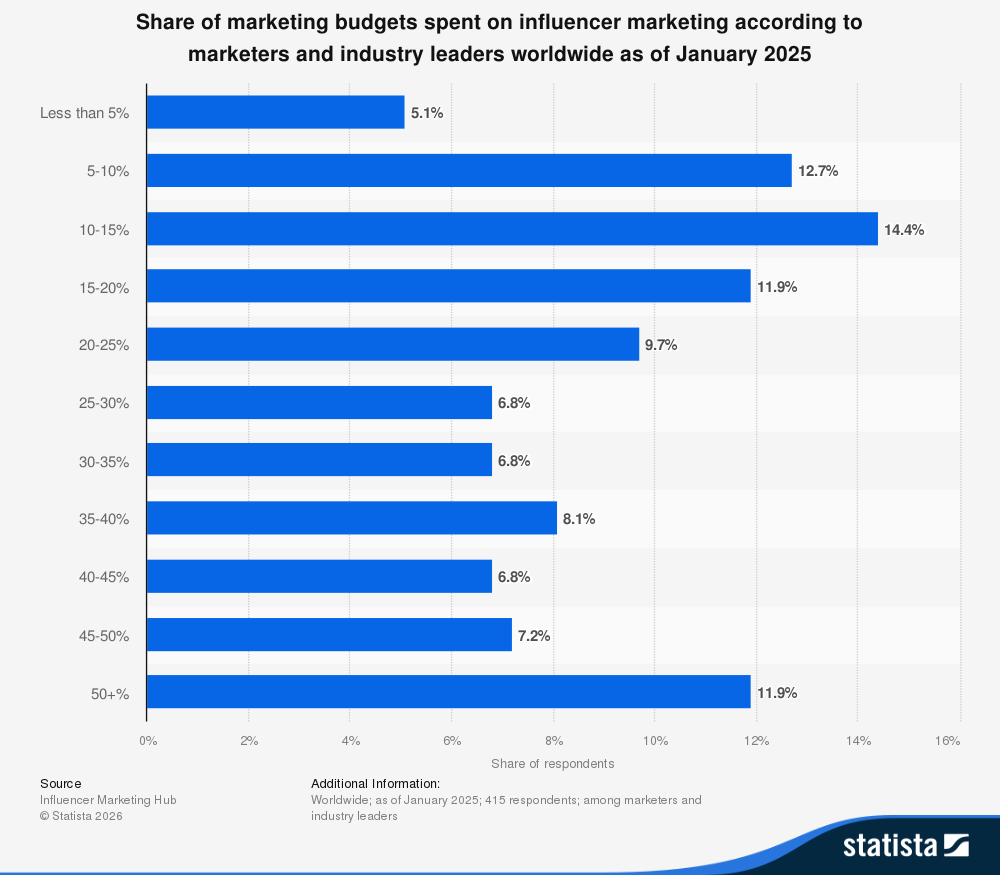
2. 26% of marketing agencies and brands allocate more than 40% of their marketing budgets to influencer marketing worldwide
Twenty-six percent of marketing agencies and brands worldwide allocate more than 40% of their marketing budgets to influencer partnerships—while 17.8% allocate less than 10%. Fewer brands plan to spend under 10% of their budgets on creators compared to last year, signaling a major shift toward influencer-first social strategies.
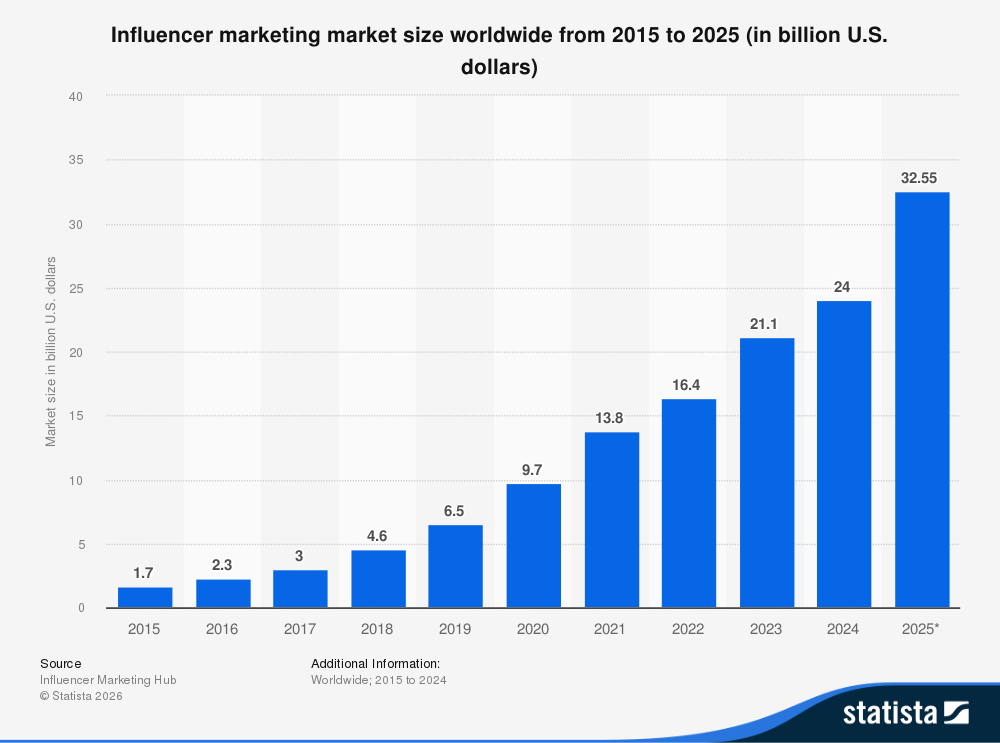
3. The influencer marketing industry was projected to reach $32.6 billion in 2025
The influencer marketing industry was worth $1.7 billion back in 2016 and hit $16.4 billion in 2022. Influencer marketing was predicted to grow to $32.55 billion in 2025. This exponential growth demonstrates the health of the creator economy.
4. 59% of marketers planned to build out their roster and partner with more influencers in 2025
According to the Q1 2025 Sprout Social Pulse Survey, most brands were expanding their influencer programs, but scaling a roster manually is one of the most resource-intensive challenges in influencer marketing. Finding potential partners isn’t as simple as doing a quick search based on age, location or demographics. This traditional approach no longer mirrors how consumers seek out content or how social media platforms suggest it.
5. AI-powered discovery is replacing demographic filtering as the standard for finding influencers
Social platforms now serve content based on topical interest, not profile attributes. A creator who consistently talks about sustainable travel will reach an audience with a predisposed interest in that topic, regardless of their age bracket or location. Brands relying on demographic filtering miss the creators who drive real results.
This is where Sprout Social Influencer Marketing comes in. Our AI-powered natural language search lets you describe the content you want to create, like “outdoor adventures” or “clean beauty routines,” and surfaces relevant creators. Combined with our Brand Fit Score and automated Creator Suggestions, you can scale your sourcing process without scaling your workload.
Influencer marketing effectiveness statistics
Effective influencer marketing campaigns share a common foundation: creator autonomy, format alignment and content that prioritizes honesty over polish. These influencer marketing effectiveness statistics reveal what separates campaigns that convert from those that miss the mark.
6. 65% of influencers want to be involved in the creative process
According to data from the Sprout Social 2025 Influencer Marketing Report, 65% of influencers prefer joining strategy development conversations with brands early on than follow a rigid brief. Influencers live and breathe internet culture and understand what angles will resonate with their own audiences.
7. Marketers measure performance through engagement and link traffic, while influencers measure audience growth
The same Sprout Social Influencer Marketing Report shows influencers measure performance by social media engagement metrics, audience growth and link traffic. Marketers vary slightly, benchmarking influencer marketing performance with social media engagement metrics (68%), link traffic from posts (50%) and increased website traffic during campaigns (45%).
8. Influencers prefer working with brands on short-form videos, giveaways and product collaborations
According to data from the Sprout Social 2025 Influencer Marketing Report, 65% of influencers would rather be involved in creative or product development conversations with brands early on than follow a rigid brief. Influencers are deeply in tune with the nuance of internet culture and understand what angles will resonate with their own audiences.
Content format matters. When asked about their preferred content format for brand collaborations in the 2025 Sprout Social Influencer Marketing Report, the formats creators most want to produce with brands are:
- Short-form video (15–30 seconds): 53%
- Short-form video (31–60 seconds): 50%
- Static image posts: 48%
- Short-form video (under 15 seconds): 43%
- Live video: 42%
- Long-form video (over 60 seconds): 27%
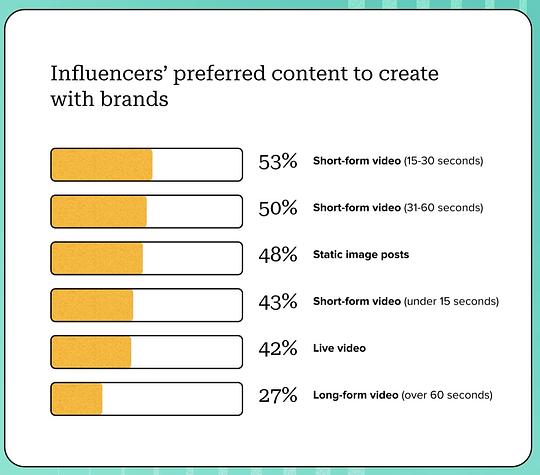
Creators are less enthusiastic about interviews, content takeovers and evergreen activations because those formats are more time-consuming to produce and carry higher resource risk. Brief for the formats your creators are energized by, and you’ll get better content.
9. 67% of consumers think the key to the best brand and influencer collaborations is being honest and unbiased
Data from the Consumer Expectations section of the Sprout Social Influencer Marketing Report shows that across all ages and genders, honest and unbiased influencer content stops consumers mid-scroll, whereas highly aspirational, overly polished content is the least likely to catch their attention.

10. 69% of marketers say influencer-generated content outperforms brand-directed content
When marketers compare sponsored influencer content to organic content posted on brand accounts, the results are consistent: influencer content wins. According to the Influencer Marketing Investments & Impact report within the Sprout Social Influencer Marketing Report, 92% of marketers report better reach, 90% see better engagement and 83% report higher conversions on average.
11. 77% of marketers actively repurpose creator content in paid ads
Nearly 8 in 10 marketers extend the life and reach of creator content by amplifying it through paid media. This approach combines the authenticity of creator content with the targeting precision of paid advertising, a combination that consistently outperforms traditional ad creative. If your influencer program isn’t feeding your paid strategy, you’re leaving performance on the table.
Influencer marketing ROI statistics
Influencer content drives real purchasing behavior: 86% of consumers make at least one influencer-inspired purchase per year, per the 2025 Sprout Social Influencer Marketing Report. These influencer marketing ROI statistics from Sprout Social’s research show what returns brands are seeing and which strategies maximize them.
12. Forming long-term relationships with influencers helps brands save money
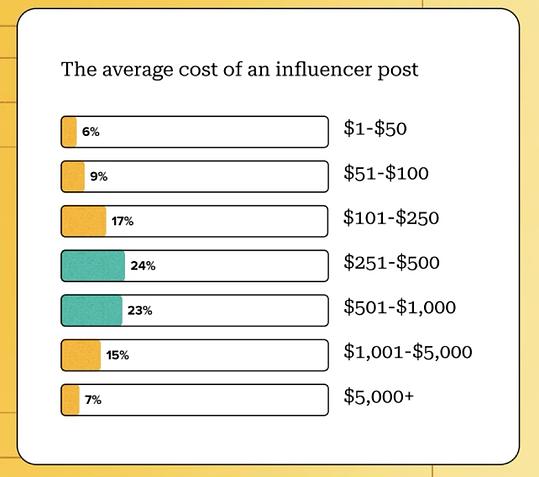
The 2025 Influencer Marketing Report indicates that half of influencers charge between $250–$1,000 per post, but 71% offer discounts for longer-term partnerships and another 25% would consider doing so in the future. This emphasizes the value of long-term influencer-brand partnerships.
13. 71% of influencers offer discounts to secure long-term brand partnerships
Influencers aren’t just willing to commit to ongoing partnerships; they actively prefer them. According to the What Influencers Want from Brands section of the Sprout Influencer Marketing Report, long-term relationships give creators the time to integrate a brand into their content, which produces more credible, higher-performing posts. Because influencers are explicitly calling on brands to prioritize these extended collaborations over one-off projects, the compounding effect of consistent creator advocacy far outweighs the short-term visibility of a single sponsored post.
14. 86% of consumers make a purchase inspired by an influencer at least once per year
According to survey responses in the Buying Behaviors section of the 2025 Influencer Marketing Report, 16% of consumers rank influencer marketing as having the most impact on their buying decisions, but the reality is that influencer content drives almost half (49%) of consumers’ daily, weekly or monthly purchases. Almost all (86%) of consumers make a purchase inspired by an influencer at least once per year.
15. 64% of consumers believe genuine reviews are the most effective influencer content type
Consumers prioritize honesty and value, with 64% reporting that genuine reviews compel them to make a purchase and 55% saying the same for discount codes. Because honest and unbiased content stops consumers mid-scroll across all demographics, brands should prioritize authentic product experiences over highly polished promotional pitches.
Ultimately, a successful influencer campaign strategy empowers influencers to share their true opinions alongside exclusive promotions, allowing brands to benefit from the higher conversion and engagement rates that sponsored creator content provides.
16. 62% of frequent buyers are likely to share product feedback with influencers
Buyer behavior insights from the 2025 Influencer Marketing Report reveal that 29% of all consumers are likely to share product feedback with influencers, a figure that jumps to 41% for Gen Z consumers and 62% for frequent buyers. Consumers are bringing influencers into the product feedback loop, creating a direct channel for real customer insights that brands can’t afford to ignore.
17. B2C brands work with multiple influencers at a time
Sprout Social’s Q1 2025 Pulse Survey data shows that B2C brands tend to partner with more influencers at a time, with 52% partnering with 6–10 at once and 23% partnering with 11–19. As brands scale their rosters, purpose-built tools for discovery, vetting and campaign management become essential infrastructure.
Sprout Social Influencer Marketing’s Campaign workflows support teams in sending outreach in bulk, managing content approvals and tracking campaign progress in one place. Campaign Summary reporting automates performance tracking so you can measure ROI across your entire creator roster without building reports from scratch.
B2B influencer marketing statistics
B2B influencer marketing has moved from emerging tactic to established practice. These statistics show how B2B brands are using creator partnerships to build credibility, expand reach and drive pipeline.
18. 49% of B2B marketers predict influencer content will trend in 2025
Nearly half of B2B marketers pointed to integrating influencer content across their marketing strategies as a top trend to watch out for in 2025. The shift reflects a broader recognition that B2B buyers respond to authentic, expert-led content just as much as B2C consumers do.
19. 58% of B2B marketing teams use an always-on influencer marketing approach
An always-on approach helps brands cultivate long-term relationships with their influencers and their audiences. According to Top Rank Marketing’s B2B Influencer Marketing Research, nearly three out of five B2B marketing teams use an always-on influencer marketing approach. Marketers who don’t use an always-on approach are 17 times more likely to report that their program is somewhat or very ineffective, while 99% of teams using an always-on approach rate their programs as effective.
20. 67% of B2B brands use influencer marketing to increase brand awareness, while 54% use it to increase credibility and trust
According to data from Sprout Social’s Q1 2025 Pulse Survey, increasing brand awareness is the top influencer marketing goal for most B2B brands (67%). Other primary goals include:
- Raising credibility and trust (54%)
- Increasing audience engagement and customer loyalty (37%)
- Informing product development and co-creation (29%)
- Revenue growth (24%)
TikTok influencer marketing statistics
TikTok is one of the highest-performing platforms in the influencer marketing mix. TikTok influencers deliver engagement rates that consistently outpace other major platforms, especially at the nano-creator tier, making it the go-to channel for brands targeting younger, highly engaged audiences. Here’s what the data shows about TikTok’s influencer ecosystem and what it means for your strategy.
21. 27% of Gen Z users engage with influencers on TikTok
Data from the 2025 Influencer Marketing Report shows that while 15% of all consumers overall engage with influencers on TikTok, over a quarter (27%) of Gen Z engage with influencers on the platform.
22. There are over 100,000 TikTok influencers in the US
There are over 100,000 TikTok influencers in the United States alone, with follower counts ranging from 5,000 to 1,000,000+. With TikTok’s global user base surpassing 2 billion, the creator pool continues to expand, giving brands access to more niche, topically aligned partners than ever before.
23. Beauty is the most-discussed industry on TikTok, but Travel has the highest engagement rate
According to The Influencer Marketing Benchmarks Report, beauty is the most-discussed industry on TikTok, with 3.63M posts and a 2.46% engagement rate. Travel is another industry to keep your eye on. While there were fewer posts in this category (300K), its average engagement rate tops the list at 3.21%.
24. 57% of brands already sell through TikTok Shop, or plan to
Social commerce and influencer marketing are converging on TikTok. According to the Aspire 2026 Influencer Marketing Report, more than half of brands are already using or planning to use TikTok Shop, and influencer content is the primary driver of product discovery on the platform. Creators who showcase products within their content and link directly to purchase represent one of the highest-ROI influencer formats available today.
Instagram influencer marketing statistics
Instagram influencer marketing is a must-use strategy for many brands. With a mature creator ecosystem, robust commerce features and audience demographics spanning Gen X through Gen Z, Instagram remains the benchmark against which every other influencer platform is measured.
25. 76% of Instagram influencers worldwide have less than 10,000 followers
The vast majority of Instagram influencers are nano-influencers, with less than 10,000 followers. Like TikTok, Instagram’s creator ecosystem is dominated by smaller accounts, which reinforces the case for building influencer programs around topical alignment and engagement quality rather than raw audience size.
26. Gen X and Millennials are almost twice as likely as Boomers to engage on Instagram
According to the Sprout Social 2025 Influencer Marketing Report, Gen X and Millennials are nearly twice as likely to engage on Instagram than Boomers. Consumer platform preferences vary significantly by age. 50% of Baby Boomers are most likely to engage on Facebook, making Instagram the strongest platform for brands targeting 25–54 year olds.
27. Fashion is the most popular niche on Instagram
Instagram is the most popular platform for fashion-related influencer content. According to our Influencer Marketing Benchmark data, the niche earned 35.8M posts and an average engagement rate of 1.59%.
For brands in this category, the competition for creator partnerships is intense, which makes having a systematic approach to influencer discovery and vetting a genuine competitive advantage.
28. Gaming, travel and sports content earns the highest engagement rate on Instagram
Sports and fitness influencer content deliver high engagement rate on Instagram, according to Sprout Social’s Influencer Marketing Benchmark Report, with 17.8M posts and a 2.31% average engagement rate. While this represents excellent performance for brands in the health and wellness space, the Gaming and Travel categories earn the highest engagement rates on the platform, at 3.15% and 2.82% respectively.
29. 79% of Reels users have purchased a product or service after watching a Reel
Instagram Reels are a great content format for driving conversions. When surveyed, 79% weekly Reels users have purchased a product or service after seeing it in a Reel. For any influencer program with commerce goals, short-form video on Instagram is a non-negotiable format.
YouTube influencer marketing statistics
YouTube occupies a distinct position in the influencer marketing landscape. Its long-form format supports deeper product storytelling and its audience seeks out review and tutorial content—making YouTube influencer marketing particularly effective for brands where education and consideration drive purchase decisions.
30. The top three YouTube categories globally are gaming, sports and fitness, and fashion
According to The Influencer Marketing Benchmarks Report, the industries with the most content on YouTube are gaming (1.24M posts), sports and fitness (650K posts) and fashion (549K posts). While the travel category only had 146K posts, it had the highest engagement rate for the platform (1.83%).
31. 52% of YouTube users prefer to engage with a brand’s short-form videos
Data from The 2026 Social Media Content Strategy Report shows that more than half of YouTube users (52%) are most likely to engage with brands’ short-form videos (under 60 seconds). This shift signals that YouTube Shorts has redefined how consumers engage with brand content on the platform, with long-form video now a close second at 49%.
Where influencer marketing is heading
The influencer marketing landscape looks completely different than it did three years ago, and the pace of change isn’t slowing. The brands building durable influencer programs today are thinking beyond individual campaigns and toward integrated, always-on systems that connect creator content to broader business outcomes.
32. Influencer marketing is expanding beyond social media into in-person events and multichannel campaigns
According to Sprout Social’s Influencer Marketing Report, most consumers agree they’re more likely to buy from brands who partner with influencers on projects beyond social media content, including in-person events, brand trips and multichannel ad campaigns. As the definition of a spokesperson changes, influencers are sliding into roles formerly held by actors, athletes and other pop culture icons. The most forward-thinking brands are already building influencer strategies that extend well beyond the feed.
Put these statistics to work for your brand
The data tells a consistent story: influencer marketing works, and the brands investing in it strategically are seeing returns that justify continued expansion. Knowing the statistics is the foundation. Building the infrastructure to act on them with faster discovery, smarter vetting and measurable ROI is what separates high-performing programs from average ones.
Find the right tools to power your strategy with our influencer marketing platform buyer‘s guide. Or explore how Sprout Social Influencer Marketing helps you build, manage and measure creator partnerships from end to end. Request a demo today.





Share