9 ways to leverage short-form video (and how to get buy-in)

Written by Carly Hill
Published on February 11, 2026
Reading time 13 minutes

Summary
- Short-form video typically refers to vertical video content between 3 seconds and 3 minutes long.
- TikTok, Instagram Reels, YouTube Shorts and LinkedIn are the primary channels for short-form videos.
- Short-form video offers the highest ROI of any content format for the third consecutive year, according to HubSpot.
At the risk of stating the obvious: Short-form video is a big deal. Who hasn’t been scrolling through TikTok or Instagram Reels only to realize they’ve lost an hour?
The fast growth of TikTok has influenced nearly every other social media network to become short-form video platforms themselves. And this shift is putting pressure on social media practitioners to put on their movie director hats. According to the The 2025 Content Benchmarks report, the percentage of video content is increasing overall across networks and industries.
The good news? The short-form video format is here to stay, and worth investing in for the long term in your video marketing strategy.
In this article, we’ll give you several tips for a successful short-form video strategy, featuring expertise from beauty giant Glossier. But first, let’s get into a few highlights about short-form video, and ways you can get buy-in.
Bonus resource: We created a guide and worksheet to help you extend the life and value of a branded video by turning it into a suite of teasers, clips, GIFs and more. Download it today to ensure you’re getting the most out of your video assets.
What is short-form video?
Short-form video is vertical video content designed for quick consumption, typically lasting between 60 seconds and three minutes.
Key characteristics of short-form video:
- Length: Ranges from a few seconds to 10 minutes depending on platform (TikTok allows up to 10 minutes, YouTube Shorts caps at 60 seconds, Instagram Reels max out at 90 seconds)
- Format: Vertical 9:16 aspect ratio optimized for mobile viewing
- Consumption: Designed for scrollable feeds and instant engagement
- Platform dominance: Primary format on TikTok, Instagram Reels, YouTube Shorts, Facebook Stories
Unlike traditional long-form video requiring significant time investment, short-form video dominates social media feeds because it aligns with how people consume content today: quickly, on mobile devices and often with sound off.
Why is short-form video worth the investment?
Short-form video is a vertical video format that balances high engagement with production efficiency. It remains the #1 most effective format for lead generation and brand awareness.
Whether you need to secure leadership buy-in or refine your current strategy, the data is clear: short-form is no longer a “trend”. It’s the foundational layer of modern social media marketing.
Here are a few stand-out use cases for short-form video to convince you, or your leadership team, that this format is worth the investment.
Short-form video statistics for buy-in
Here are a few stats that prove the value of short-form video:
- Highest ROI: According to the HubSpot 2026 State of Marketing Report, short-form video generates the highest return on investment of any media format.
- User attention: Instagram Reels now account for 50% of time spent on the app.
- Massive reach: YouTube Shorts generates over 200 billion daily views globally.
- Adoption growth: 62% more marketing teams use TikTok in 2026 compared to 2025.
Short-form video is the most popular content format
Put simply: People like short-form video. According to The Sprout Social Index™, 66% of consumers say short-form video is the most engaging type of social content in 2022.
Think about it: It’s easy to binge, easy to share with friends and it’s entertaining.
Capture your audience’s attention with the content format they already love.
@sproutsocial Talk to us about social listening. 📲#fruitrollup #fruitrollupicecream #fruitrollupchallenge #socialmediamarketing #socialmediatips #socialmediamanager
It’s easy to make and repurpose
Coming up with a short-form video strategy requires work, but producing video content is not as hard as it used to be.
And that’s made a difference. According to Wyzowl, 41% of marketers who used video as a marketing tool for the first time in 2022 did so because creating video in-house has gotten easier.
Whether you’re managing a global media matrix or a local storefront, creating vertical content doesn’t require a Hollywood budget. In fact, relying on smartphone footage and native in-app editing tools is the foundation of any sustainable TikTok marketing strategy for small business, acting as an incredible equalizer for teams with limited resources.
Thanks to social platforms like Instagram and YouTube offering their own short-form video feeds, this content has become easier to repurpose across platforms—which saves you time and energy.
Short-form video supports reaching more people organically
Today, the digital space is pay-to-play, while the economy is forcing teams to tighten budgets.
Not exactly a dream combination.
This is where short-form video is a secret superpower for increasing reach without increasing spend. It makes sense: this format’s popularity already makes it more clickable and shareable. And those stacked engagements mean that social algorithms will notice, and push, your content.
What are the best short-form video platforms?
The landscape has evolved. While TikTok remains dominant, other platforms have expanded their capabilities to compete with their own vertical, short-form video tools and feeds.
Below is the breakdown of platform priorities and optimal video length for each:
- TikTok
- Best for: Viral reach, trend participation and SEO discovery.
- User base: Estimated 1.9 billion global users
- Quick Specs: Uploads up to 60 minutes, though the viral sweet spot is 15–60 seconds.
- Strategy: Focus on TikTok SEO. Use captions filled with keywords, as TikTok is now a primary search engine for younger demographics.
- Instagram Reels
- Best for: Viral reach, trend participation and SEO discovery.
- User base: 1.9 billion monthly active users.
- Quick Specs: Uploads up to 60 minutes, though the viral sweet spot is 15–60 seconds.
- Strategy: Focus on TikTok SEO. Use captions filled with keywords, as TikTok is now a primary search engine for younger demographics.
- YouTube Shorts
- Best for: Brand awareness and driving traffic to long-form content.
- User base: 200 billion daily views.
- Quick Specs: Uploads up to 60 minutes, though the viral sweet spot is 15–60 seconds.
- Strategy: Treat Shorts as a funnel. Use the “Related Video” link feature to drive viewers to your longer videos or product pages.
- LinkedIn Video
- Best for: B2B thought leadership and professional branding.
- User base: LinkedIn video views are up 36% year-over-year.
- Quick Specs: Vertical video (native mobile upload) up to 3 minutes is performing best.
- Strategy: Focus on “edutainment”—professional advice delivered in a casual, vertical format.
How to measure short-form video performance
Measure short-form video performance through six core metrics: video views, average watch time, completion rate (full video views vs. partial), engagement rate, click-through rate and conversions. These metrics prove ROI to leadership and support refining your strategy based on what’s working.
According to Wyzowl, 63% of video marketers use video views as one of their metrics to measure ROI. But your video metrics will depend on your overarching social goals and platforms you use.
Here are a few to get you started:
- Video views: Total reach and initial interest
- Average watch time: How long viewers stay engaged
- Completion rate: Percentage who watch the full video vs. partial views
- Engagement rate: Likes, comments and shares per view
- Click-through rate: How many viewers take action (profile visits, link clicks and card clicks)
- Saves and shares: Signal of high-value content worth revisiting
Measuring short-form video performance in Sprout Social
To speed up approval processes, Sprout’s Senior Social Media Manager Olivia Jepson, advises: “Build trust. Ask what teams and leaders need to provide you so you can be more self-sufficient. Use data to back up why internal reviews need to be faster and why it’s better to be nimble vs. being bogged down by approval processes and too many inputs.”
Using a tool streamlines this process so you can prove ROI across platforms, with one hub. For example, Sprout’s Analytics and Reporting suite compiles high-impact video stats for all of your channels.

This eliminates manually aggregating data from native apps and supports identifying which content types resonate most with your audience.
Vanity metrics like views are great for awareness, but executives want to see business impact. Connect your short-form video efforts to revenue by tracking click-through rates on link-in-bio tools or using UTM parameters on Stories links.
When you show that a specific video series drove traffic that resulted in conversions, securing budget for future video production becomes easier.
9 ways to get more from your short-form video strategy
Whether you’re tackling short-form video for the first time or upping your output, it pays to have a strategy. To help, we brought in some guidance from the team at Glossier.
Here are 8 ways to get more from your short-form video strategy, plus tips on how Sprout can help.
1. Start by doing your research
Look at how your competitors are using short-form video. How often do they use video (if at all)? What’s their tone?
Crucially, pay attention to their captions and on-screen text. Gen Z and Alpha increasingly use TikTok and Instagram as their primary search engines. Ensure your video topics and keywords are optimized for search (SEO) so your content surfaces when users search for answers, not just on the For You Page.
How do your competitors tackle trends, and what gaps have they left? Use this information to stand out in your industry.
A tool like Sprout turns weeks of manual analysis into a few minutes’ work. Sprout’s Competitive Analysis Reports narrow down how often competitors post videos, their top-performing posts and engagements across Instagram, Twitter and Facebook—no scrolling or spreadsheets required.

But it’s not just about the competition: Look at the data behind videos you’ve posted, too. Knowing which videos have performed well for you in the past can help guide your future strategy.
2. Don’t be afraid to experiment
To find the themes, trends and tone that work for you, you have to experiment a lot—for instance, by trying different Instagram Reel ideas and TikTok trends.
Even social media giants had a learning curve when they shifted to short-form video. Jamie Dinar, Senior Manager of Social Media and Digital for Glossier, remembered that “It was a lot of testing and learning, and a lot of time scrolling through my own For You Feed.”
It was a lot of testing and learning, and a lot of time scrolling through my own For You Feed.Jamie Dinar
Senior Manager of Social Media and Digital at Glossier
Nearly half a million followers and over eight million video likes later, Jamie found Glossier’s TikTok identity. But it took experimentation. This is one of their first videos on the platform vs. a more recent one.

To replicate Glossier’s success, get creative and test various video content ideas. Think: behind the scenes content, FAQ answers, how-tos, product hacks, user-generated content, trend-based videos and educational videos.
Once you’ve published a variety of short-form videos, look at your data. Which drove the highest engagement? The most views?
Level up by using a tool like Sprout’s post and channel performance reports to compare your videos’ performance side-by-side, across channels—and to see if short-form video is having a positive impact on your channel growth.

3. Capture attention in the first 3 seconds
You have three seconds to hook viewers before they swipe to the next video. The scroll is infinite; your window to grab attention isn’t.
Proven hook techniques that stop the scroll:
- Start mid-action: Drop viewers into the middle of the story, not the beginning
- Ask a provocative question: Make them want to stay for the answer
- Show the result first: Lead with the payoff, then explain how you got there
- State a surprising fact: Challenge what your audience thinks they know
- Use pattern interrupts: Break expectations with unexpected visuals or statements
Test different hooks and use Sprout Social’s Post Performance Report to analyze retention rates. If viewers drop off at the three-second mark, your hook needs work.
4. Schedule your videos
Making short-form videos may be easier nowadays, but social teams are still stretched thin—in fact, bandwidth is one of their top challenges according to The Sprout Social Index™.
Many social platforms have rolled out their own scheduling tools. But that still requires you to go from platform to platform to schedule posts.
That’s all wasted time you can get back by using the right tool. With Sprout, you can schedule a video to publish on different platforms, like TikTok and Instagram Reels, at the same time.

5. Reuse videos across platforms
With nearly every social platform rolling out their own short-form video tools and capabilities, repurposing essential. In 2026, AI tools have made this seamless. You can now use AI-driven editors to automatically crop horizontal video into vertical formats, generate captions, and even identify the most “viral” moments from long-form content to clip into Shorts or Reels.
You can even start doing this now: Repurpose longer videos you currently have to get the ball rolling, without starting from scratch. For example, here is a YouTube clip our team turned into an Instagram Reel.

And pro tip: pre-made video templates are a handy way to streamline your process. Simply plug your videos into a template, and the rest is done for you.
On TikTok, find template options by tapping the plus sign at the bottom of the screen. When the editor opens, tap “templates” at the bottom of the screen.

And on Instagram Reels, you can turn any Reel with three clips or more into a template—including your own, once you start publishing videos. Simply find a Reel you like, tap the three dots at the bottom right of the screen and tap “Use as template.”

Or, tap the plus sign to create a post, tap Reel and tap Templates at the bottom of the screen to choose one you like.
6. Find the right content mix
Experimenting with content types identifies what works. Deciding how often to post each type turns experimentation into strategy.
Effective content mix frameworks:
- The 80/20 rule (TikTok-recommended): 80% original brand content, 20% trend participation
- The rule of thirds: 33% promotional content, 33% community content (UGC and testimonials) and 33% educational content
- Product lifecycle approach: New launches (40%), product education (30%), community stories (20%), trends (10%)
Jamie from Glossier shared a tip she heard directly from the TikTok platform reps—the 80/20 rule. For Glossier’s TikTok channel, that means making 20% of their videos trend-based, and 80% original programming.

Leaning on trend-based content was great for building a following, but as their channel grew Jamie needed a way to stand apart.
“We recognized that we needed to build an identity on the platform and give people a reason to come to our channel over all the others posting the same trends. That’s when we started building a strategy based on product hacks, Glossier associates and behind-the-scenes content.”
Using trends is still an important piece of Glossier’s TikTok strategy. But emphasizing original and community-first content has given their short-form video content an identity—on TikTok and beyond.
@glossier Literally gorgeous @user8037124051403
7. Lean into your community
Good social content is created with your brand’s community in mind.
Look to your community for user-generated content to re-post on your own channels, and to inspire more videos. After all, 39% of consumers like to see real customer testimonials or demos (The Sprout Social Index). Tap your community for this content, and create a relationship with them as you do.
What makes this series so special is that it was spurred organically from our community—it was something they were already posting about.Jamie Dinar
Senior Manager of Social Media and Digital at Glossier
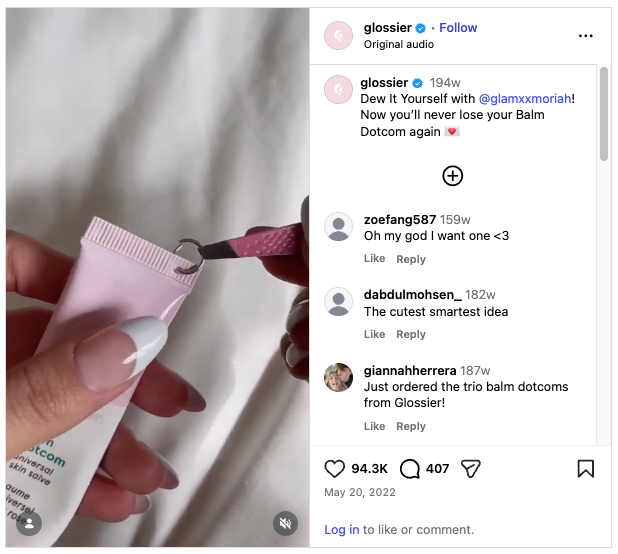
This is how Glossier’s “Dew it Yourself” series came to be. “What makes this series so special is that it was spurred organically from our community—it was something they were already posting about,” Jamie tells us. “So it was a good opportunity to build on it and make it our own.”
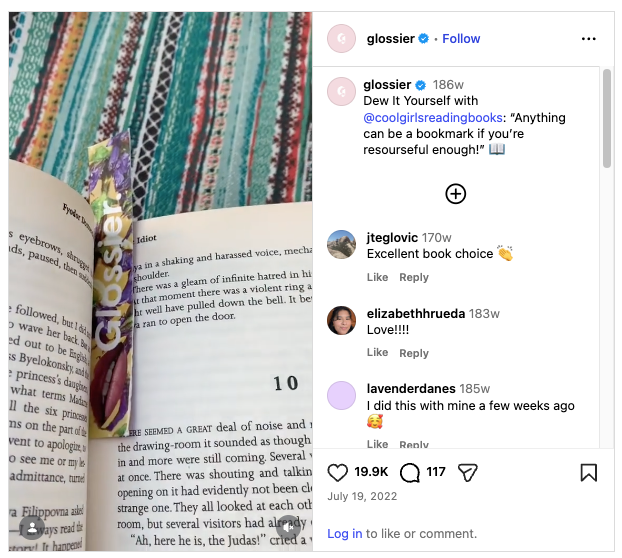
She continued, “We tried to reframe the conversation around beauty, offering our platform to the people using our products to tell their stories, rather than having it come from the brand. Ultimately, we didn’t want to tell them how to use their products—it was their story to tell.”
8. Leverage content that humanizes your brand
From embracing lo-fi authenticity to featuring real employees, short-form video is a powerful tool for humanizing your brand.
One way Glossier does this in their TikTok and Reels content is by featuring employees and their HQ. As Jamie told us, “We have a meet the team series where we ask our store associates, who we call editors, to say their name and share their favorite Glossier product, which has been really useful in reinforcing product discovery.”
@glossier No one does it better than the Glossier Editors!!!! If you’re in Philly, check our new store on 1716 Walnut Street by Rittenhouse Square. You won’t regret it 🔔 #glossier #pinkjumpsuit #youlookgood
Another way they do this is by leaning into humor. “Sometimes we’ll do silly dances if it makes sense. We’ll quiz people in line during our store openings.”
Glossier has even humanized promotional content: “If we’re running a larger campaign, we might show bloopers from set, or behind-the-scenes footage like products being made in the factory.”

9. Engage, engage, engage
It’s called “social” media for a reason—double down on engagement in the comments section of your short-form videos.
Glossier is known for going above and beyond to create relationships with their audience. As Jamie put it, “We really stood out by using social as a tool for two-way communication and to cultivate a community by responding to comments and DMs, and engaging with our audience in a really authentic, human way.”
One way the brand stands out is by using a surprise and delight strategy with everyday users who post about Glossier—not solely mega-influencers. “We send them products, we post friends-only content, we communicate with them directly in DMs,” Jamie told us. “In return, we see them post even more without us asking for it. It’s a great opportunity to build brand loyalty.”
And brand loyalty matters. According to Sprout’s #BrandsGetReal Report, 68% of consumers say who feel more connected to a brand are more likely to buy from them vs. a competitor.
Technical tips for creating short-form video
You don’t need a Hollywood budget to create high-performing short-form video. In fact, overly polished content often performs worse than authentic, lo-fi videos. But getting the technical basics right ensures your content looks professional and the algorithm favors it.
Video specs and requirements by platform
Always shoot vertically (9:16 aspect ratio) at 1080p resolution. While platforms accept other formats, vertical video takes up the full mobile screen and commands more attention. See our social media video specs guide for more details.
| Platform | Aspect Ratio | Recommended Resolution | Max Length | File Size Limit |
|---|---|---|---|---|
| TikTok | 9:16 (vertical) | 1080x1920px | 10 minutes | 287.6 MB |
| Instagram Reels | 9:16 (vertical) | 1080x1920px | 90 seconds | 4 GB |
| YouTube Shorts | 9:16 (vertical) | 1080x1920px | 60 seconds | 256 GB |
| Instagram Stories | 9:16 (vertical) | 1080x1920px | 60 seconds per segment | 4 GB |
Equipment essentials
The best camera is the one you have in your pocket. Modern smartphones shoot incredible 4K video that is more than sufficient for social. If you want to upgrade your setup, prioritize audio and lighting before buying a new camera.
A simple ring light and a plug-in lavalier microphone will elevate your production value.
Natural lighting delivers professional results. Position yourself facing a window during daytime for polished footage without equipment costs.
Captions, audio and accessibility
Sound is crucial for short-form video, but so is silence. Many users watch with sound off, so always include closed captions. Most platforms generate these, but you should review them for accuracy.
When using trending audio, ensure you select the sound from the platform’s library rather than recording it externally to ensure your video is indexed correctly with that trend. This simple step increases your content’s discoverability.
Turn short-form video strategy into long-term results
Short-form video isn’t just another fleeting trend; it’s a fundamental shift in how audiences consume content. With the strategy, platforms and measurement frameworks outlined above, you have everything needed to build a compelling business case and launch your first video campaign.
Your short-form video strategy is only as strong as the tools that power it. Sprout Social delivers cross-platform video publishing, TikTok Profile Reports with engagement analytics, competitive video benchmarking and unified performance tracking in one platform.
Start a free trial to see how Sprout Social transforms your team’s efficiency and proves video ROI to leadership.
Short-Form Video FAQs
What is the ideal length for short-form video?
The ideal length is generally 15 to 60 seconds for viral reach. However, for storytelling and tutorials, 90 seconds to 3 minutes is now supported and effective on TikTok, Reels and YouTube Shorts.
TikToks can run up to 10 minutes, Reels up to 90 seconds and YouTube Shorts up to 60 seconds. Use Sprout Social’s analytics to test different lengths and identify what works for your audience.
Does short-form video help with SEO?
Yes. Platforms like TikTok and Instagram are now indexed by Google. Also, properly optimized videos often appear in Google AI Overviews and Featured Snippets for “how-to” queries.
Can I use the same video on TikTok, Reels and Shorts?
Yes, but remove the watermark. Algorithms on Instagram and YouTube often downrank videos that have a visible TikTok logo. Use a tool to download the raw video or edit outside the app before uploading.
Do I need professional equipment to create short-form videos?
No, a smartphone with good lighting is all you need, as authenticity performs better than high production value on platforms like TikTok and Reels. If upgrading, prioritize a ring light and external microphone over expensive cameras.






Share