What is media monitoring? A complete guide to tracking the stories that shape your brand

Written by Nader Nekvasil
Published on November 12, 2026
Reading time 8 minutes

Table of Contents
Right now, someone is telling your brand’s story in a post, a podcast or a news article and odds are you had no idea.
By the end of this guide, you’ll know what media monitoring is and how it differs from social listening and media analysis. You’ll also learn how it works and how to build a program that turns mentions into action.
The Sprout Social Q1 2026 Pulse Survey found social media is now the top source for breaking news discovery. Across the US, UK, and Australia, 49% of respondents rely on social platforms first, ahead of television, podcasts, and news apps.
That shift puts media monitoring on every brand’s priority list. If your monitoring stops at press coverage, you miss where much of your audience now meets the news.
Media monitoring is also one step toward social intelligence. The real payoff comes from what you do with what you find, and this guide shows you both.
What is media monitoring?
Media monitoring is the continuous process of tracking mentions of your brand, competitors and topics across social media, online news, print, broadcast and podcasts. It captures tagged and untagged mentions, so you see the full conversation about your brand.
Media monitoring started as manual press clipping, with teams cutting articles out of newspapers by hand. Today, AI-powered tools track media mentions in real time across the web, social media platforms and broadcast.
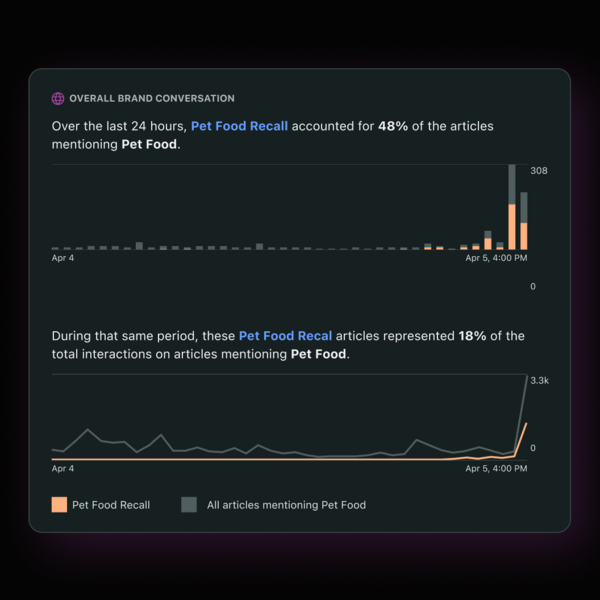
Monitoring tells you what people say and where they say it. It’s the foundation, and the value comes from what you do next.
Social and PR teams use it to find conversations worth joining and to track coverage. Marketing and customer care teams use it to measure campaigns and reach people who need support.
What are the types of media monitoring?
Your monitoring mix should mirror where people get their news. The 2026 Pew Research news platform data shows 88% of US adults at least sometimes get news from digital devices.
That means online media monitoring alone leaves gaps. Social media now sits at the center of how people find news, so social monitoring belongs in every program. Here are the four main types.
Social media monitoring
Social media monitoring tracks posts, comments, videos and threads across Facebook, Instagram, TikTok, X (formerly known as Twitter), LinkedIn, YouTube, Threads, Bluesky and Reddit. It includes untagged mentions, like a creator reviewing your product without an @.
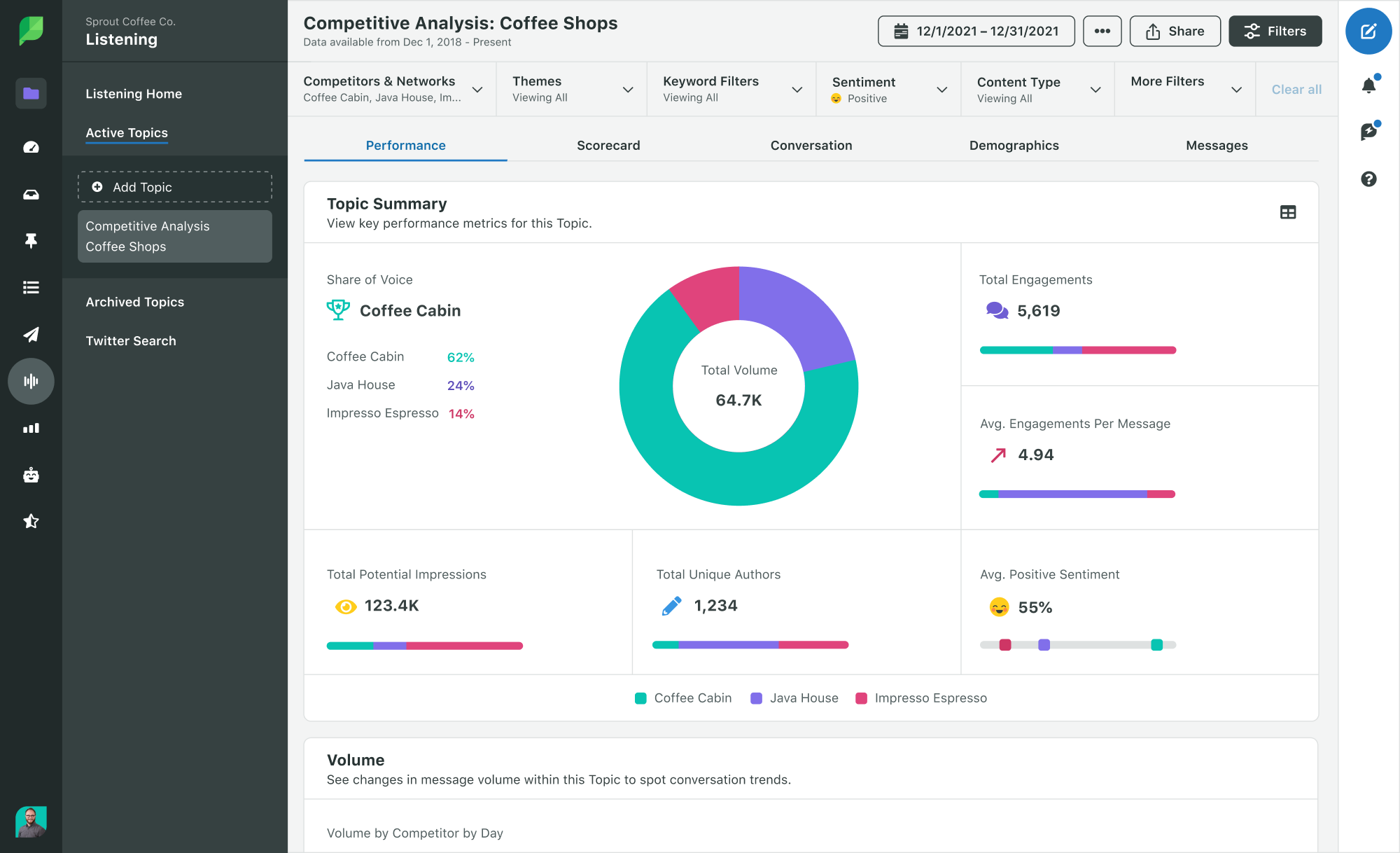
The volume is enormous. Sprout Social handles over two billion messages a day, and that scale shows why manual tracking can’t keep up.
Online news and blog monitoring
Online media monitoring covers digital publications, trade press and industry blogs. It also reaches forums and review sites, where customers share unfiltered opinions about your products.
These sources shape what people find when they search for your brand. A single trade press article or forum thread sets the tone for everyone who reads it next.
Print and broadcast monitoring
Print media monitoring tracks newspapers and magazines, while broadcast monitoring covers TV and radio. TV still matters: In the same 2026 Pew Research Center data, 63% of US adults at least sometimes get news from TV.
Broadcast mentions don’t come with links or tags. Tracking them takes transcription and dedicated broadcast coverage.
Podcast monitoring
Podcasts reach a huge audience. The 2026 Edison Research Infinite Dial found 58% of Americans age 12+ (167 million) consumed a podcast of any kind in the last month.
Spoken mentions don’t show up in text-only searches. Podcast monitoring relies on transcription to catch every time a host names your brand.
How does media monitoring work?
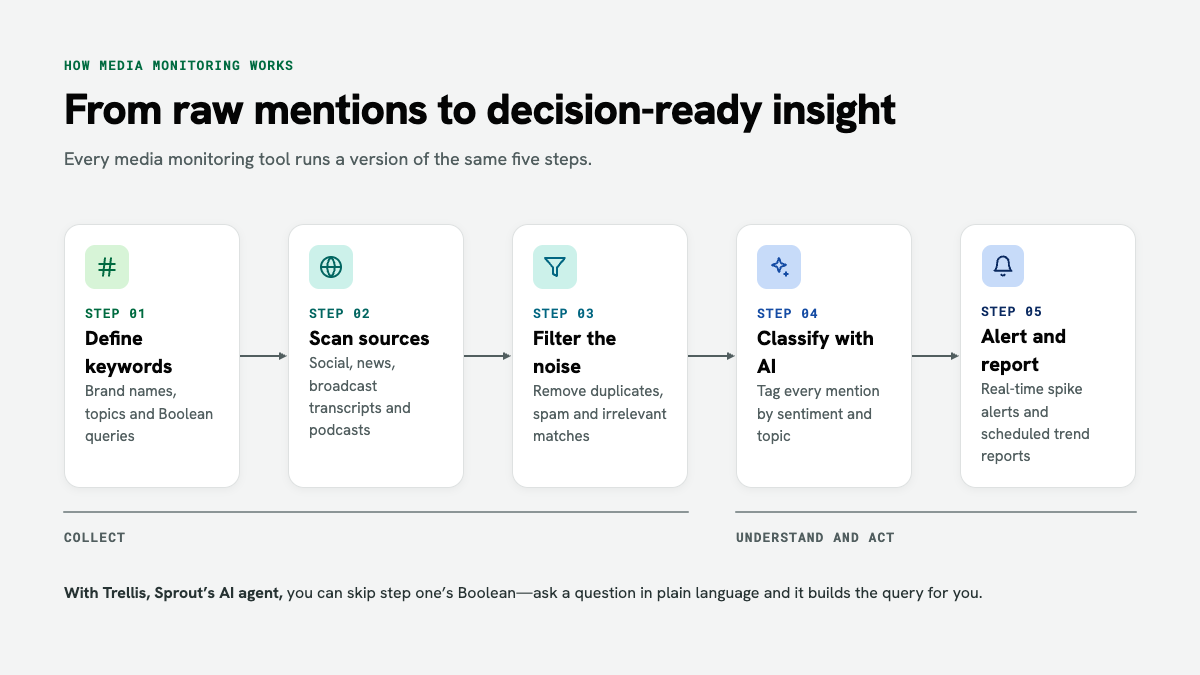
Every media monitoring tool runs a version of the same five-step process. Here’s how a media scan turns raw mentions into insight:
- Define your keywords: You set the brand names, topics and Boolean queries (AND, OR, NOT) that tell the tool what to find.
- Scan your sources: Crawlers and APIs scan social media platforms, news sites, broadcast transcripts and podcasts for matches.
- Filter the noise: The tool removes duplicates, spam and irrelevant matches.
- Classify with AI: Natural language processing tags each mention by sentiment and topic.
- Deliver alerts and reports: Real-time alerts flag spikes, and scheduled reports show trends over time.
Step four is where social media sentiment analysis comes in. It tells you whether a spike signals praise or a problem.
AI agents also change who can run monitoring. With Trellis, Sprout’s AI agent, you ask questions in plain language instead of writing Boolean queries. AI moves monitoring from data collection to decision-ready insight.
Media monitoring vs. social listening vs. media analysis: What’s the difference?
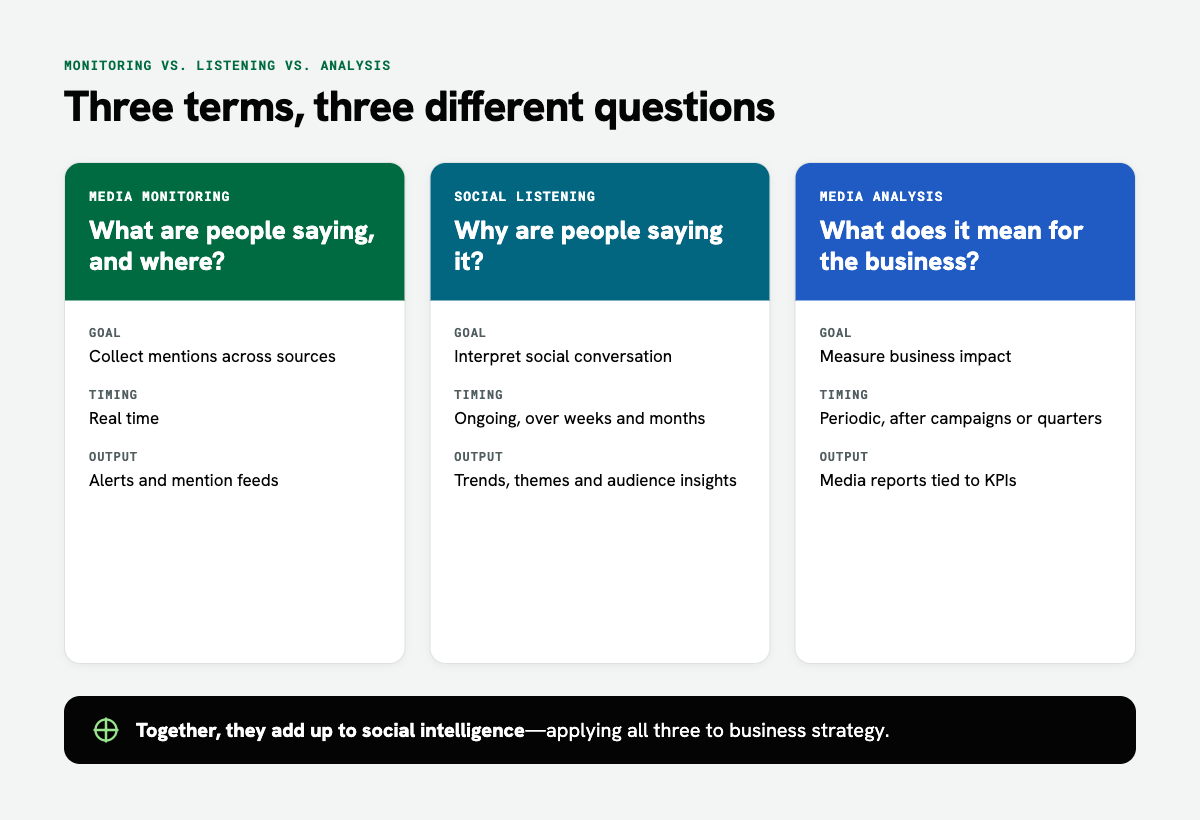
People use these three terms interchangeably, but each answers a different question. Media monitoring shows what people say and where, in real time. Social listening explains why, interpreting social conversation to guide strategy.
Media analysis reveals what it all means for your business by measuring coverage against KPIs. A media report packages that analysis for stakeholders. Social intelligence applies all three to business strategy.
| Media monitoring | Social listening | Media analysis | |
|---|---|---|---|
| Goal | Collect mentions across sources | Interpret social conversation | Measure business impact |
| Question answered | What are people saying and where? | Why are people saying it? | What does it mean for the business? |
| Timing | Real time | Ongoing, over weeks and months | Periodic, after campaigns or quarters |
| Output | Alerts and mention feeds | Trends, themes and audience insights | Media reports tied to KPIs |
At Sprout, we see monitoring, listening and intelligence as one framework. Predictive media intelligence guides what to do right now, and listening shows what to refine over time. Together, they deliver unified social and media intelligence.
Why is media monitoring important?
Most brands measure what they post and miss what the market says. Data from The 2026 Social Intelligence Report shows 57% of organizations analyze owned engagement. Only 40% analyze public posts that mention their brand, 34% analyze industry conversations and 25% analyze competitor conversations.
In plain terms, most teams watch their own posts and skip the wider conversation. Measuring only what you posted never tells you where the market is going.
Speed is the other gap. The same 2026 report found only 10% of businesses can act on real-time social insights within hours. Media monitoring insights close both gaps when they reach the right people fast.
Protect your brand reputation
Trust is fragile right now. In the global Edelman Trust Barometer 2026, 50% of respondents named the increasing prevalence of misinformation among the events most affecting trust.
Consumers expect brands to step up. The 2025 Sprout Social Index™ found 93% of consumers say brands need to combat misinformation more than they do today.
Monitoring shows you when false claims about your brand or industry gain traction. You weigh in early and protect your reputation before the story hardens.
Detect crises early
Bad news travels fast, and false news travels faster. Social is also where crises surface first. The Sprout Social Q2 2026 Pulse Survey found social media is the number one place consumers first hear about a brand crisis.
The same survey found 64% of consumers want brands to respond publicly on social rather than through a press release. Only 16% say response speed doesn’t affect their view of a brand.
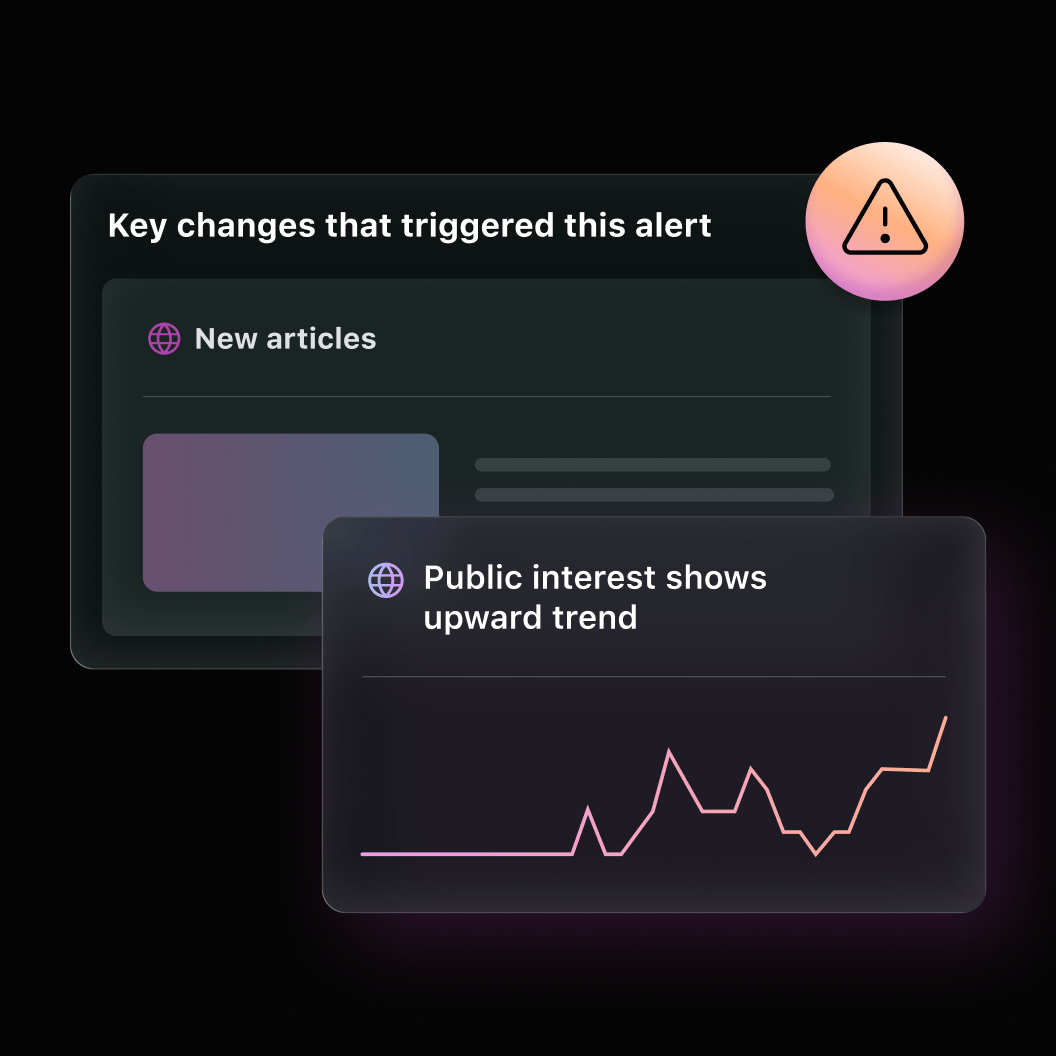
Spike alerts and predictive velocity scores give you lead time. A social media crisis management strategy tells you what to do with it.
Sharpen competitive intelligence
Monitoring competitors shows you their launches, their sentiment and their share of voice. Pair it with a regular social media competitive analysis to see where you lead and where you trail.
Real data makes the difference. Grammarly started using Sprout’s Listening tools in 2021 and found it owned 71% of its competitive share of voice.
Spot trends and customer feedback
Culture moves fast online, and consumers expect you to keep up. Per the 2025 Index, 93% of consumers say it’s important for brands to keep up with online culture.
Untagged feedback reveals product gaps your surveys never asked about. Oatly used social listening to spot demand for a matcha latte, and those signals fed R&D and a new flavor launch.
Respond while it still matters
Silence costs you customers. The 2025 Index found 73% of social users will buy from a competitor if a brand doesn’t respond on social.
Monitoring catches the brand mentions that skip your handle. That means every question gets an answer, even when no one tags you.
What should you monitor?
Start with the terms that matter most, then expand. A strong brand monitoring strategy covers six categories:
- Brand and product names, including misspellings and nicknames
- Executives and spokespeople
- Campaign names and branded hashtags
- Competitors and their products
- Industry terms and regulatory topics
- Crisis and risk terms, such as “recall” or “breach”
Untagged mentions matter as much as tagged ones, so track names without the @ or #. If your brand name is a common word, use Boolean logic or an AI query builder to exclude noise.
Say you run a coffee brand called Bean. Your query pairs “Bean” with terms like “coffee” or “latte” and excludes phrases like “bean bag,” so your media tracker only surfaces mentions you care about.
Which media monitoring metrics should you track?
The right media monitoring metrics tie coverage to business outcomes. These seven tell you the most:
| Metric | What it tells you |
|---|---|
| Mention volume | How much people talk about your brand over time |
| Reach and impressions | The size of the audience exposed to your mentions |
| Sentiment | Whether the conversation is positive, negative or neutral |
| Share of voice | Your slice of the conversation vs. competitors |
| Engagement | How people respond to mentions through likes, comments and shares |
| Top sources and authors | Which outlets and creators drive the conversation |
| Spike or velocity | How fast a story gains momentum |
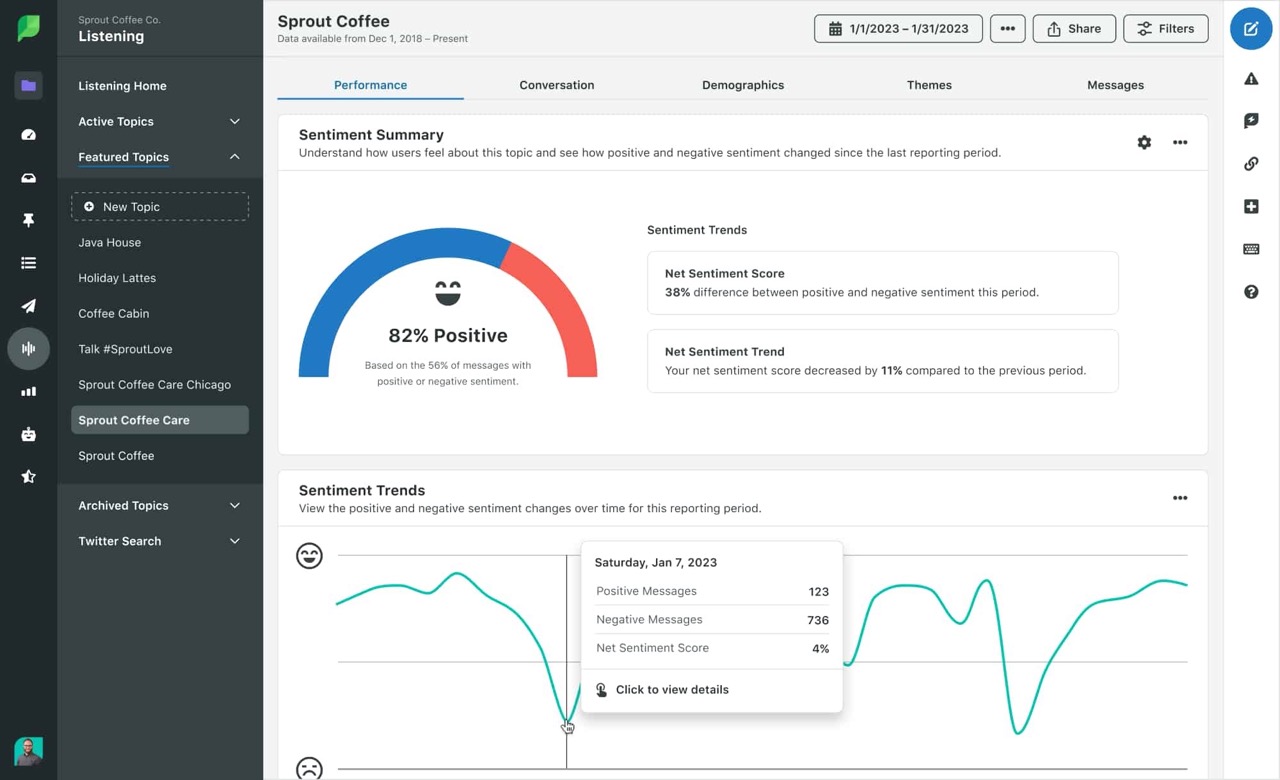
Many of these overlap with core social listening metrics, so one dashboard serves your social and comms teams. Report them together to show the full picture.
How do you build a media monitoring strategy?
A media monitoring strategy turns scattered alerts into decisions. Follow these five steps:
- Set your goals and objectives: Pick one primary goal, like reputation protection, and one secondary goal, like competitive tracking.
- Build your keyword queries: Start with the six categories above. Refine them with Boolean logic or an AI query builder.
- Choose tools that cover your media mix: The best media monitoring service matches your audience’s formats. Look for multi-source coverage, real-time alerts, AI sentiment, reporting and integrations.
- Set alert thresholds and owners: Decide what volume or sentiment shift triggers an alert. Name who responds to each one.
- Share insights and act: Send findings to product, sales, care and leadership teams, then act on them.
That last step matters most. The 2026 Social Intelligence Report found 86% of respondents believe they missed opportunities because of delayed or siloed insights.
Break down those silos. Insights only matter when they leave the social team.
How to do media monitoring with Sprout Social
Sprout brings monitoring, listening and action into one platform. Here’s how each piece fits:
- Social Listening: This paid add-on tracks brand mentions, keywords, sentiment, share of voice and competitors. Brand Health and Competitive Analysis templates speed up setup.
- Trellis: Sprout’s AI agent builds queries from plain-language questions, so you don’t need Boolean expertise.
- Spike Alerts: Alerts flag sudden shifts in mention volume as they happen.
- NewsWhip by Sprout Social: Patented velocity scores predict news and social engagement up to 24 hours ahead. Data refreshes up to 24 times an hour.
- Smart Inbox: You respond to the mentions you surface from one unified inbox.
Picture a product complaint that starts gaining traction on a Friday night. Spike Alerts flag the jump and Listening shows the sentiment and themes behind it. Your care team then replies from Smart Inbox before Monday’s headlines.
NewsWhip covers right now, Listening covers the long view and the Sprout platform lets you act. That’s one vendor from first signal to activation.
Turn media monitoring into your early advantage
Monitoring tells you what’s happening, and intelligence tells you what to do about it. The brands that win read the signals first and act while the story is still forming.
Stop counting yesterday’s posts and start reading tomorrow’s story. Request a demo to explore the platform’s features.
39 free social media strategy templates that will elevate your workflows
Published on August 20, 2026 Reading time 15 minutes




Share