Brand Trust: What is it and why it matters

Written by Sam Kendall
Published on December 2, 2025
Reading time 13 minutes

Table of Contents
Consumers, especially Gen Z, are pickier than ever. Prices are higher and the economy is in flux, meaning they need to make sure every box is checked before making a purchase. Is the product high quality? What do other people say about their experience with the brand? Is there something better out there?
Brand loyalty, once commonplace, is now rare at best. The race to win over consumers is intensified by challenger brands disrupting every industry. With so many alternatives to choose from, to emerge on top requires gaining deep brand trust—from creating the best quality products and being transparent about business practices, to aligning with the values of your audience.
The traditional channels that organizations relied on years ago to build brand trust also aren’t guaranteed to work today. According to the Sprout Q3 2025 Pulse Survey, 52% of Gen Z are now more likely to trust information about a brand or product on social media when compared with both traditional forms of search (like Google) and new AI chatbot searches.
People use social as an avenue to discover new products, shop their favorite influencer’s picks and purchase directly from the apps themselves. Which means building hard-earned brand trust on social is make or break, and requires thoughtful reputation management.
Read on to find out how to build and measure brand trust (especially on social media) and learn from other brands leading the way.
What is brand trust?
Brand trust is how much consumers perceive they can rely on your brand to fulfill its promises. Those promises include:
- Your brand values and mission
- The quality of your products or services
- Supply chain transparency (e.g., certifications, eco-friendly, etc.)
- The honesty of your advertising claims (e.g., health claims, product longevity, research efficacy)
- Your treatment of employees and manufacturers
- Customer service and care practices
This trust is established through consistently carrying out your promises across channels and touchpoints. But it’s also about curating a reliable, “bold” brand across all of your marketing operations. This includes upholding values, supporting your customers and putting the work in to make sure your brand is making a positive impact. According to our Q2 2025 Pulse Survey, social users associate the following traits with being a “bold” brand:

The main takeaway is: being honest and building trust is what makes brands stand out on social. Honesty across your social media and your business practices helps you cut through the noise and become a respected brand over time.
Remember that brand trust also refers to more than your current customers’ sentiment toward your brand. It’s also relevant within your industry and among consumers in general. While building brand trust should correlate with increases in sales and retention, it can also positively impact share value and extend your brand awareness.
Why is building brand trust important?
Brand trust is more than a “feel-good” goal. It’s a concrete way to drive profitability and expansion. While no brand can win positive public favor all the time, those that maintain long-term trust with consumers are more likely to beat out the competition and rise to the top of their industry.
Enhanced loyalty and retention
When you establish brand trust, consumers are more likely to remain loyal over the long haul, continuing to purchase your products and becoming retained customers. By cultivating a brand experience built on trust, you boost your customer retention rates, reduce churn and drive sustainable business growth.
Statistics also show that trust and connection in a brand can lead directly to more loyal customers. When they feel connected to brands, more than half of consumers (57%) will increase their spending with that brand and 76% will buy from them over a competitor.
Customer advocacy and evangelism
Trustworthy brands boast higher levels of customer advocacy, which leads to powerful word-of-mouth recommendations and a formidable brand reputation. Brand trust can differentiate your brand from competitors, attract new customers, and create valuable opportunities for future partnerships, collaborations and case studies.
This advocacy is not limited to customers; it can be even more impactful when it comes from key opinion leaders, whose expert endorsements can significantly enhance a brand’s reputation.
Increased customer lifetime value
When consumers trust brands, they are more likely to continue to engage with the brand over time, make repeat purchases, and upgrade to higher-value products or services. The most trusted brands can roll out premium pricing while continuing to attract new, long-term customers. Trust ensures business health and revenue generation for years to come.
Building trust in your brand should be a key part of your wider customer retention strategies. If you continue to boost your relationship with your customers and their lifetime value, you’ll build a healthier, more sustainable business model for the future.
How to build brand trust
While understanding what brand trust is might be relatively straightforward, building it is much more complex. This is especially true on social media, where consumers openly demand more from brands. Building brand trust must be a well-choreographed effort that encompasses everything from your operations to your social content strategy.
Prioritize consistent messages
Consistency in social messaging relates to what you’re saying across all touchpoints. Spend time refining the overall message you communicate to your customers on social, through strategies like TOV documents, style guides or content calendars. Think about the tone and cadence of your captions, and the visual language you’re focusing on. By standardizing these elements, you create a stronger brand identity, which can lead to increased trust in your brand over time.
Here’s an example from the chocolate brand Thorntons, who combine professional images with a playful caption to announce the return of a fan-favorite flavor. The message they’re communicating is also timely, as it’s focused on alerting customers that one of their flavors is returning to a gift box.

While your tone doesn’t need to be exactly the same on each channel, the underlying message and values should. A coherent brand identity reinforces trustworthiness and brand recall.
Remember that in today’s social climate, customers often search for brands or products long before they make a purchase. The 2025 Sprout Social Index™ found that customers turn to social media 1-6 months before buying. They’ll use your social content to form an early opinion, and whilst they consider their options, you should use this time to create content they can believe in, and that resonates.
Use AI thoughtfully and ethically
The wider opinion of AI on social media has fluctuated as the technology has evolved and more brands have experimented. At the moment, the wrong use of AI could have a negative impact on your brand’s trust; Sprout’s Q3 2025 Pulse Survey found 55% of all social users are more likely to trust brands that commit to publishing content made by humans. This same survey also found that 52% of users are concerned about brands using AI without disclosing it.
If you plan to experiment with AI-generated content, make sure you’re being transparent with your followers. Think about how you can use AI as a tool or an enhancement, rather than as a way of replacing real, human creators. Also, think about how AI might benefit your team in the background of social content creation, through automations, research or other improvements to your processes, rather than using it for pure content generation itself.
However, this isn’t the whole story. Sprout’s Q4 2025 Pulse Survey found that 65% of global social users are comfortable with companies using AI (e.g., chatbots or tools to help human employees refine their responses) to deliver faster customer service on social. Consider adopting AI strategies within your customer care plan to improve the speed of your replies. This data also shows how important it is to put a lot of thought into where you’re using AI, as its use will be received differently in certain contexts.
Put social media at the center of your care strategy
It might seem simple, but leaving a positive impression on your customers and community members is one of the easiest ways to build brand trust, especially on social media. A dedicated customer care strategy across socials is crucial because direct messages are one of the main ways for your customers to interact with your brand.
Your customer care strategy should prioritize quick response times; according to the 2025 Sprout Social Index, 73% of customers agree that if they haven’t received a response from a brand on social, they’ll buy from a competitor. Sprout’s Q2 2025 Pulse Survey also found that 58% of social users believe audience interactions are the most important thing for brands to prioritize on social.
To meet this expectation, improve your social media response times and stay on top of both direct messages and comments. Actively engaging with your audience through these methods, acknowledging positive and negative feedback, and addressing concerns in a timely manner will foster a sense of transparency and connection.
Work with the right influencers
Influencer marketing is a fundamental way of boosting trust in your brand, as long as you work with the right people. According to Sprout’s Q2 2025 Pulse Survey, 64% of all social users say when a brand partners with an influencer they like, they’re more willing to buy more from that brand.
Finding the right influencer is about more than just audience alignment. Vet influencers so they also align with your brand topically, meaning they talk about the same values, interests or other talking points as your audience. This topical alignment means you aren’t just reaching the right people, you’re also communicating with them in the right way.
Support causes that align with your brand values
We’ve seen a huge resurgence in the importance of brand activism recently. Followers now expect brands to be vocal about the current social and political climate; for example, 63% of Gen Z consumers are more likely to buy from companies that speak out about specific causes or topics in the news.
Brand activism is about showing up, and continuing to show up. It’s about understanding the values your brand should promote, and sticking to them. This isn’t always easy, but it’s extremely important if you want your followers to believe in and trust your brand in the long-term.
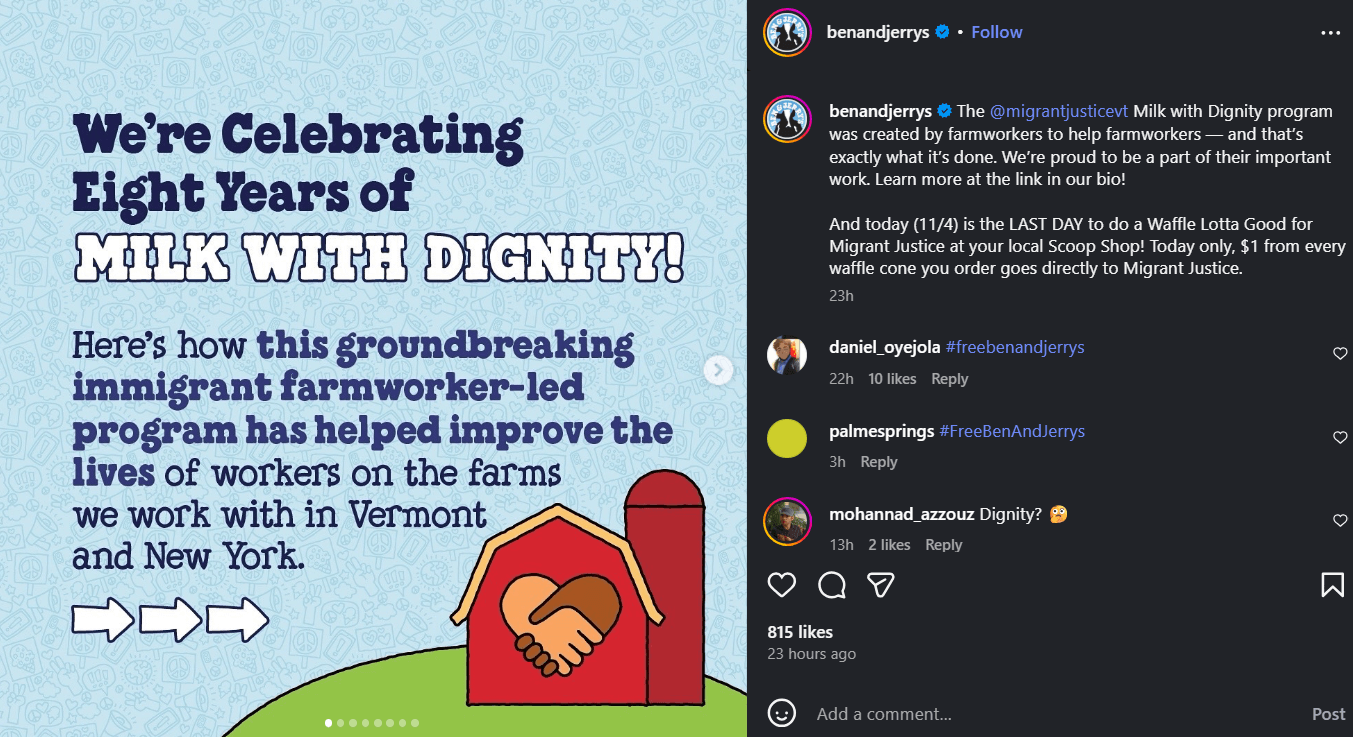
Make sure you work to stay aware of current issues that impact your followers, and take careful steps through your content to show where your brand stands. One brand to look to as an example is Ben & Jerry’s, who consistently champions social justice and climate crisis prevention on their social profiles, including often donating to charities like in this example.
How to measure brand trust
The impact of brand trust (or mistrust) is palpable. But the exact metrics needed to measure and prove out the effectiveness of your efforts can seem elusive. Here are a few key KPIs to consider when benchmarking your current rate of brand trust and charting future goals.
Sentiment
Sentiment analysis describes the process of retrieving information about a consumer’s perception of a product, service or brand. While social listening and sentiment analysis can be done natively in each network, using tools to monitor online conversations and sentiment enables brands to easily keep a pulse on brand trust trends and shifts.

Engagement metrics
Tracking likes, shares and comments provides insight into how well a brand resonates with its community on social media. Higher levels of positive engagement typically indicate a stronger level of trust and brand affinity.
Lower engagement metrics don’t necessarily indicate brand mistrust, but they do reveal room to improve. Brands with an engaged community that prioritize audience interaction are seen as reliable sources of information and part of the cultural zeitgeist.
Ratings and reviews
Customer reviews and ratings on social platforms and review sites (e.g., G2, Google My Business, Yelp, TripAdvisor) help marketers track brand trust over time. These reviews arm brands with voice of the customer feedback they need to refine product development and user experience.
Customer loyalty
Measuring retention, referrals and customer lifetime value are essential pulse checks to understand the health of your business. If your customers aren’t staying loyal to you, it means they don’t trust you with providing them with enough value to justify staying put.
Net promoter score
Collecting data directly from customers through surveys, polls and feedback forms can offer valuable insights into customer perception of your brand. Marketers should ask specific questions related to trust, credibility and accountability to gauge customer sentiment accurately. Gain specific insight into your net promoter score—or how likely a customer is likely to recommend your product or service—by asking how likely customers are to refer others to your business on a scale of zero to 10.
Media mentions
Media monitoring is a strategy that involves keeping a close eye on national and global news surrounding your brand. This becomes much easier if you use a dedicated media monitoring tool like NewsWhip by Sprout Social.
Media monitoring can uncover audience sentiment that you might not have been aware of. It’s also an effective way to understand external social, political or environmental news that’s having an impact on your brand. Once you’ve gathered these sociopolitical insights, you can figure out how to react to preserve trust in your brand.; For example, if there are new concerns about material sourcing in the fashion industry, you can build a campaign around transparency in your supply chain.
As with a lot of brand trust strategies, being proactive with media monitoring means you can also stay ahead of any possible bad news outbreaks.
4 companies building trust through social media
Building brand trust is a long game. One that helps companies survive the start-up phase, transcend point-in-time crises and shake up their industry standing. Here are three examples of brands that have established trust with their audience (and beyond), and takeaways from their strategies you can use to follow in their footsteps.
Timpsons UK
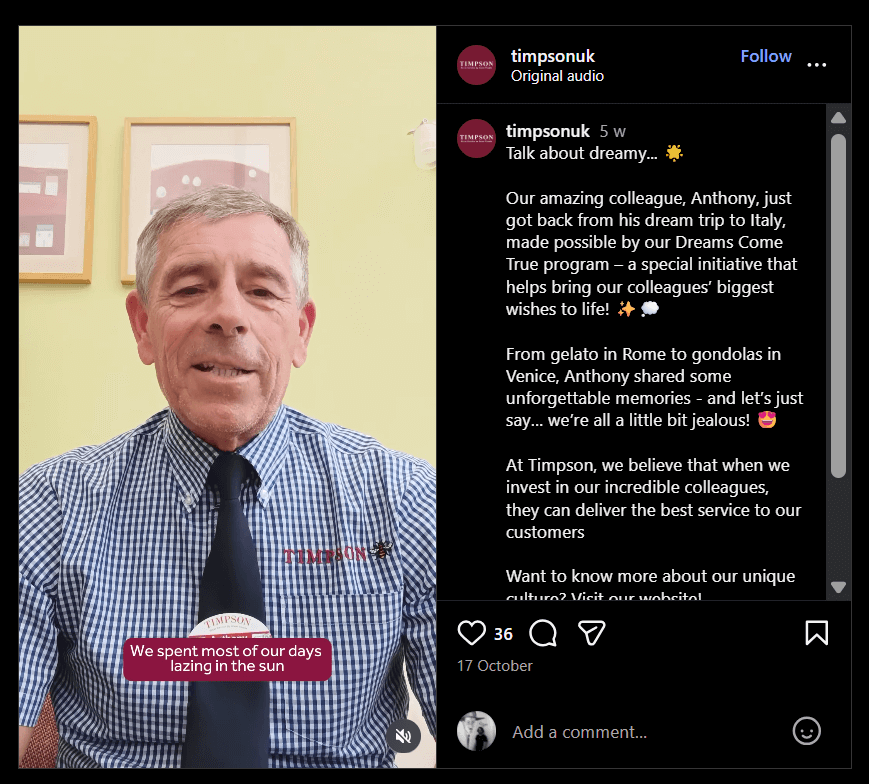
Timpsons is a major retailer in the UK and Ireland with over 2,000 operational stores and over 5,000 employees. Timpsons builds trust in its brand thanks to its employment practices. Timpsons is renowned for employing many ex-convicts in their stores, who make up over 10% of their entire workforce.
They’ve also established several employee support programs. In the example below, they’ve shared more information on social media about their “Dreams Come True” program, where they pay for employee eye surgeries. The post also features an employee testimonial.
Takeaway
In terms of social content, Timpsons shows how important it is to include your employees in your content output. By sharing this genuine testimony from one of their employees, they’ve built awareness about the program as well as spotlight what it’s like to actually work for the brand.
Another takeaway from Timpsons is the need to support your content with companywide strategies. Building employee programs and promoting them on your social platforms can have a whole range of significant benefits, including increased employee retention and recruitment, and a boost in the trust customers have in your brand.
National Trust
The National Trust is a heritage charity based in the UK. They’re very active on social media, with over 1 million followers on both Facebook and Instagram, alongside a strong presence on other platforms. In the example below, they’ve partnered with YouTube influencers Dan and Phil on a Halloween post designed to promote one of their heritage sites, Wicken Fen.

This Instagram carousel post is used to promote a longer YouTube video, allowing National Trust to market Wicken Fen across multiple platforms. They’ve also made use of several hashtags in the post caption so it’s easy for users to find.
Takeaway
National Trust’s content builds brand trust through an effective influencer collaboration. Dan and Phil have been working as YouTubers and influencers since 2009, and the trust they’ve earned from their fanbase can be passed on to The National Trust through their collaboration.
Another key takeaway from the brand is their significant understanding of their product, which in this case is the Wicken Fen heritage site. All of the content they’ve created is focused on Wicken Fen (and conveniently tied into Halloween for October), which shows their followers that they understand what their brand is and why it’s important. By focusing on folk tales, they’re also able to promote the importance of keeping history alive, which is a core message of the charity. To do the same for your brand, think about your own core message and how you can translate it effectively to your customers.
Penguin Books UK
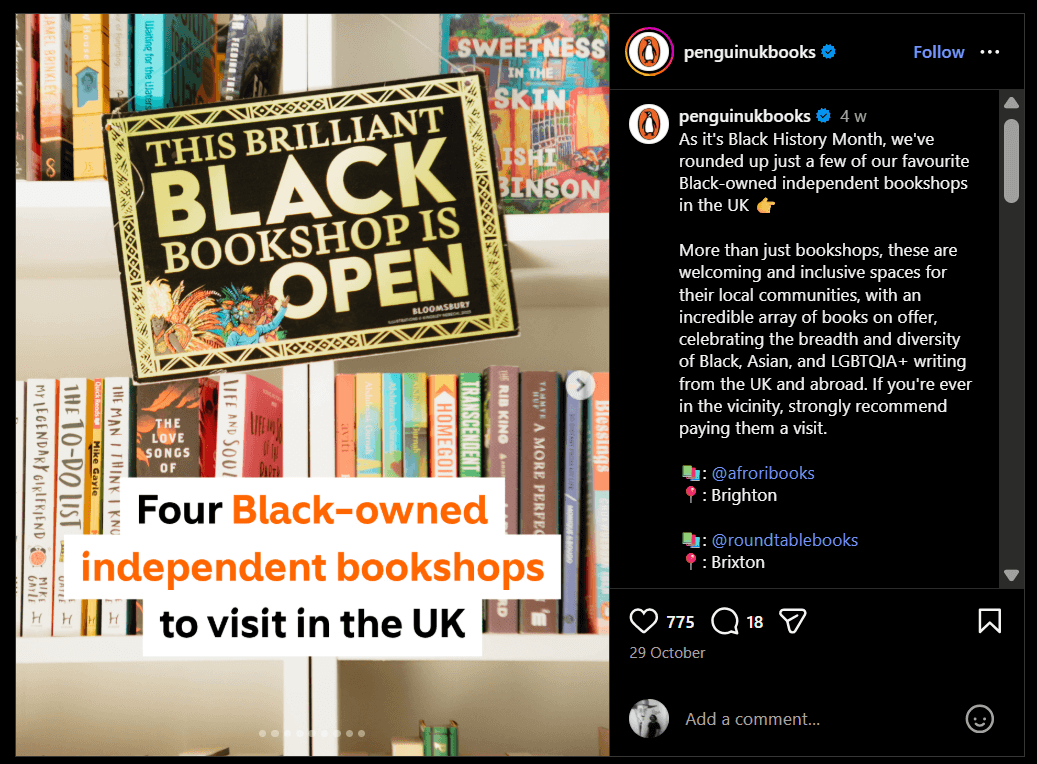
For Black History Month, Penguin Books in the UK created this social post promoting several black-owned bookshop businesses across the country. They included links to these bookshops in their caption, and through their carousel images.
Takeaway
Sometimes it’s just as important to give a shout-out to other organizations and charities in your community as it is to promote yourself. Penguin’s content is a great example, as by promoting multiple smaller businesses, they’re able to support local communities and bookshops in the UK whilst sharing their own brand message of inclusivity in the publishing industry.
It’s also an example of brand activism, as it pairs with an important national celebration (Black History Month) and shows Penguin giving something back to its followers and community. Think about how you can show up for the smaller charities and businesses around you, as supporting them will also boost trust in your own brand.
Patagonia
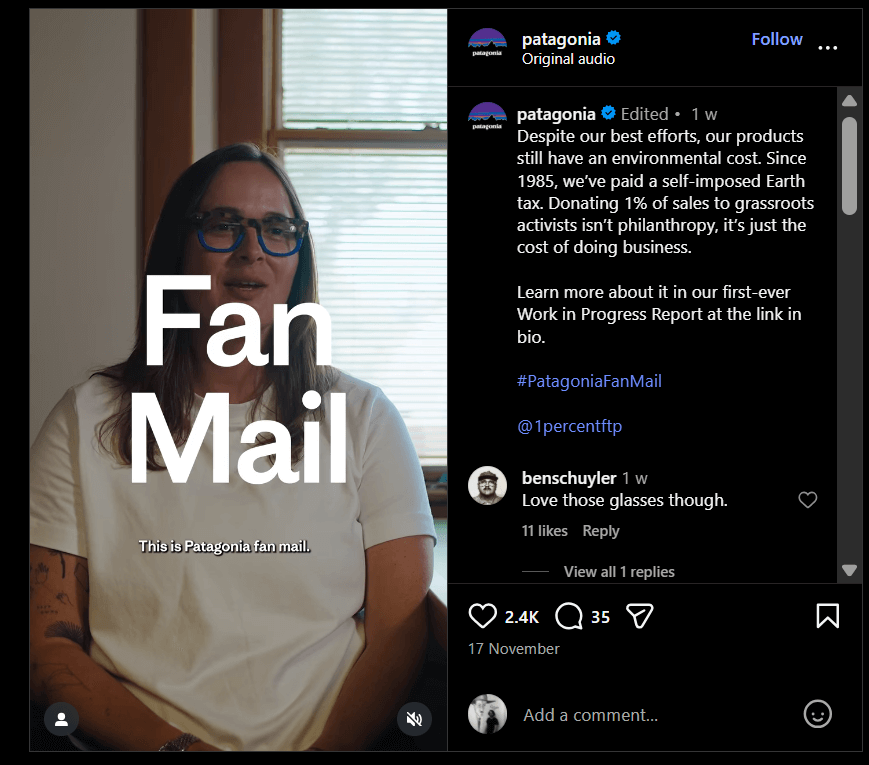
Since 1985, Patagonia has paid a self-imposed “Earth tax,” donating 1% of its sales to grassroots activists. In this reel, they interview key stakeholder members of Patagonia about their first-ever “Work-in-Progress” report.
Takeaway
Patagonia isn’t just giving lip service to its consumers. With their “Patgonia Fan Mail” initiative, they’re listening to their customers and critiquing their own policies and initiatives–it not only adds legitimacy and transparency to the process but also builds brand trust and aligns with shared environmental values.
Patagonia employees also speak animatedly in the Reel about getting involved with grassroots activists and highlight the need for dispersing their donation money to causes that truly need it–and taking the time to do the necessary research.
They also clarify in the social post that what they’re doing isn’t “philanthropy”, it’s their moral obligation to offset some of their emissions in their manufacturing and delivery supply chains. Patagonia’s assertion that what they’re doing should be the bare minimum, creates brand trust as it sets a precedent and encourages other companies to follow suit.
Consumers want to know it’s your brand they can trust
As competition grows and social media feeds become more insulated, brand trust, loyalty and awareness are more essential than ever. Yet, brand trust is simultaneously harder to come by than ever.
Building brand trust requires orchestration across your internal teams and external customer experience—from product development to operations to marketing and sales. You can achieve this by being consistent, elevating the role of customer care, tapping into social listening and humanizing your brand (whether with AI, influencers or the people on your team).
To check on how well your brand is staying protected online, download Sprout’s brand safety checklist for social media managers today.
37 free social media strategy templates that will elevate your workflows
Published on December 5, 2025 Reading time 15 minutes









Share