9 Facebook trends to watch in 2026: AI, authenticity and the new search

Written by Mahnoor Sheikh
Published on March 4, 2026
Reading time 9 minutes
Table of Contents
Facebook may be one of the oldest social platforms, but it looks nothing like it did five years ago. Artificial Intelligence (AI) now curates feeds, powers discovery and even enables agentic experiences, such as assisting with purchases directly inside Messenger.
On top of that, user habits are changing. Sprout Social’s latest data shows 39% of consumers plan to spend more time on Facebook this year. Meanwhile, 62% of marketers plan to invest more time and resources into Facebook in 2026.
Chasing viral dances won’t get you anywhere. Success today means aligning your Facebook strategy with the radically smarter algorithm, tighter privacy standards and other major shifts.
Here are nine Facebook marketing trends that will define your strategy in 2026.
1. AI-curated discovery feeds
Remember when your Facebook feed was mostly posts from friends and Pages you followed? Those days are firmly behind us. Facebook’s algorithm has fully pivoted from the social graph (who you follow) to the interest graph (what AI predicts you’ll enjoy).
The interest graph surfaces content based on behavior, preferences and engagement patterns, regardless of your connections. It’s powered by Meta’s advanced recommendation models, such as GEM (Generative Ads Recommendation Model).
For marketers, this is both exciting and humbling. Your content no longer depends on your existing follower count to get reach.
But it does need to be genuinely engaging to audiences who’ve never heard of you. This gives new and smaller brands a chance to compete with more established accounts by tapping into Facebook trending topics.
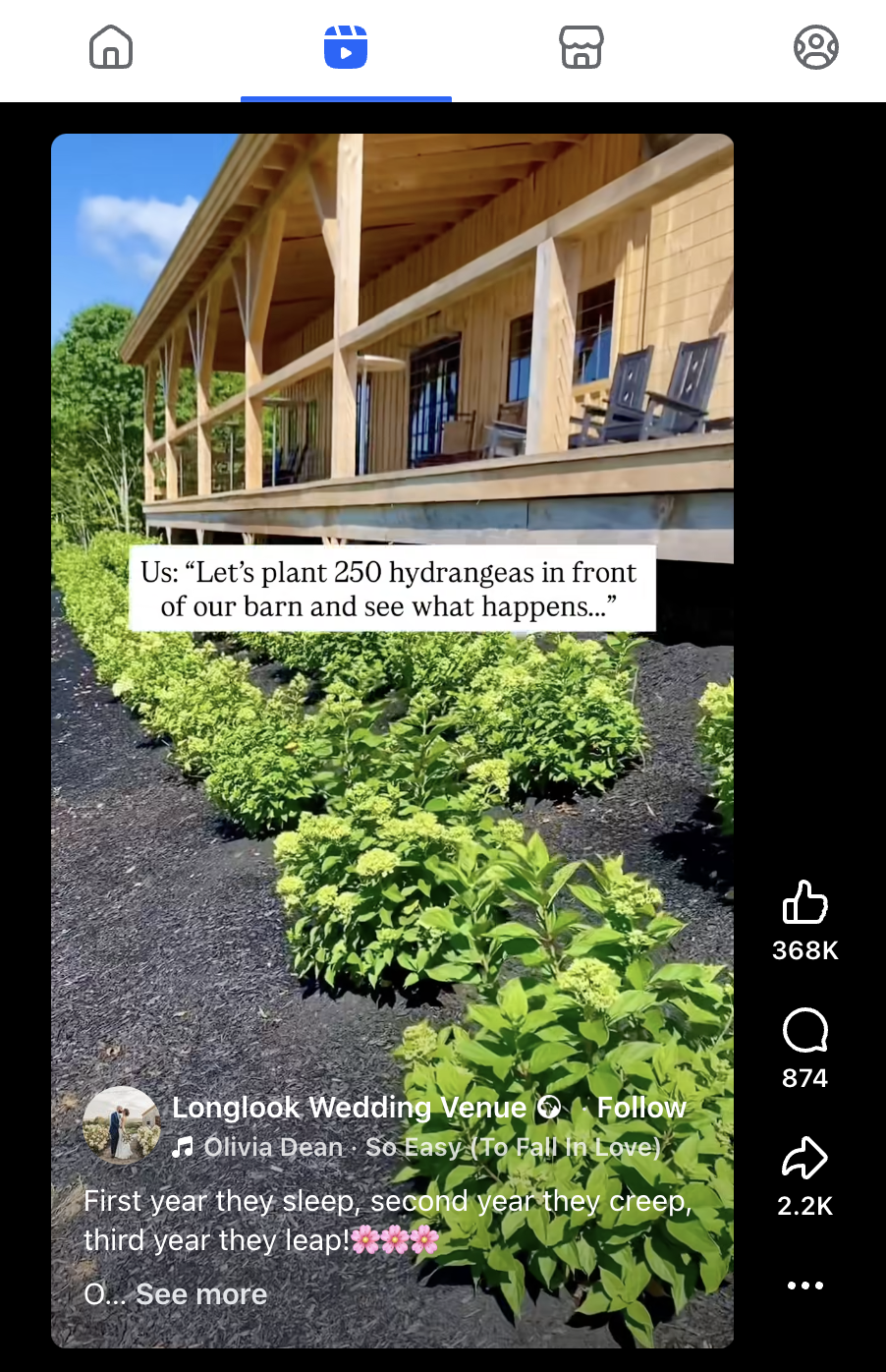
Example: A wedding venue in New Hampshire got over 9 million views on the Reel below, even though the page only has 32,000 followers.
What marketers can do
- Create content that appeals to broad interest categories (e.g. people who care about productivity), not just your current followers.
- Invest in strong hooks within the first three seconds of video or the first line of text posts, since the algorithm weighs early engagement signals heavily.
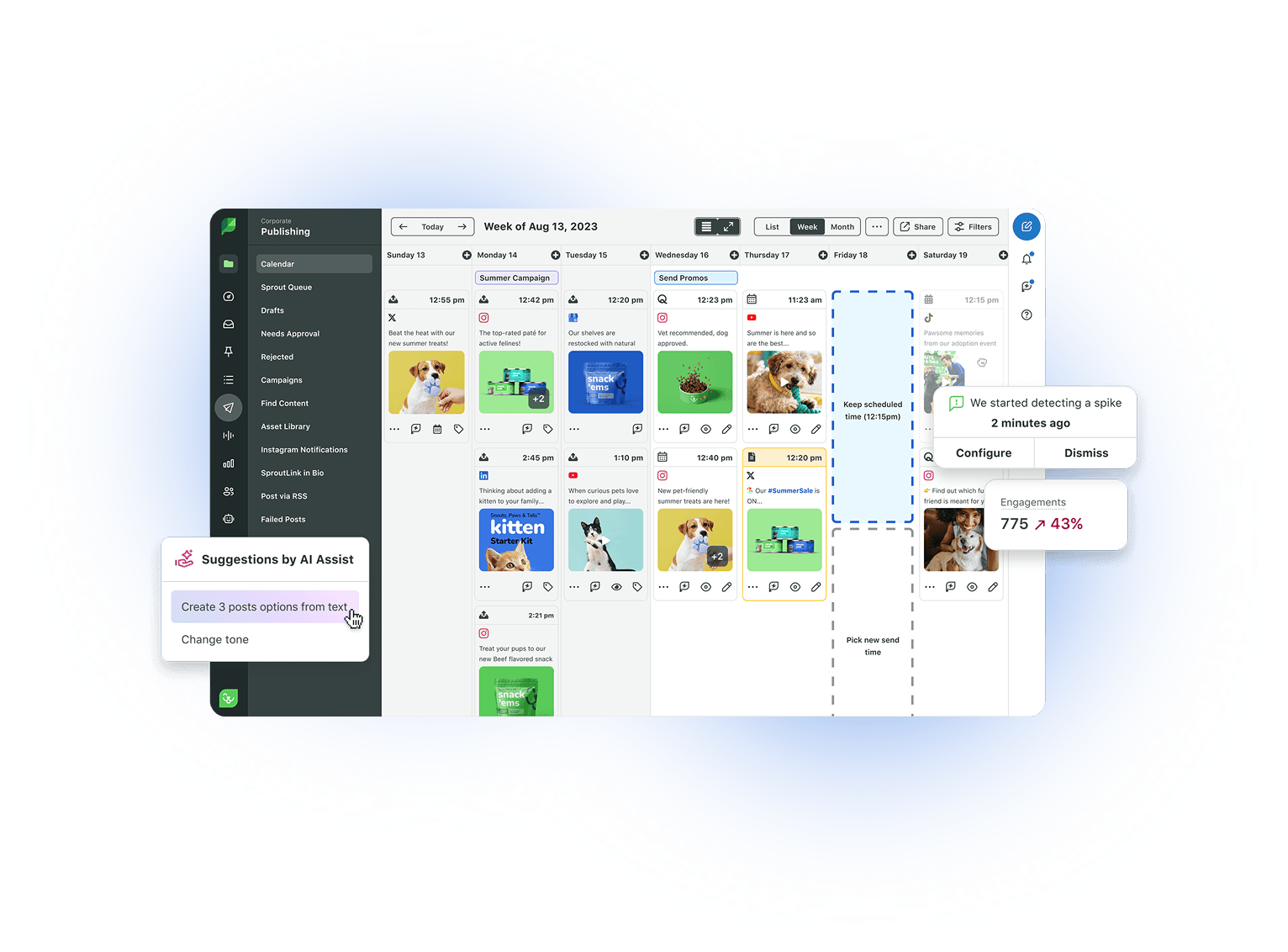
- Track reach-to-follower ratio and new audience percentage in your analytics. These metrics tell you how well the interest graph is working in your favor. Use Sprout Social’s Premium Analytics to track audience growth and engagement spikes.
2. Facebook as a search engine
Social search has moved well past the buzzword stage. Gen Z and Gen Alpha increasingly turn to social platforms like Facebook to find products, read reviews and research local businesses.
In fact, Facebook is now the #1 network for product discovery, with nearly 40% of social users using it specifically to find new products, according to the Sprout Social 2026 Content Strategy Report.
This changes everything about how you think about content. Keywords in captions, alt text and on-screen text now matter more than hashtags ever did. Your Facebook Page needs to be optimized for Facebook SEO the same way you’d optimize a landing page, especially as search behaviors become one of the top trends on Facebook.
In an interest-based feed, the “first-mover” advantage belongs to those who see the narrative forming before it peaks. By utilizing predictive media intelligence, brands can move beyond simple discovery to proactive trend detection.
Sprout’s agentic AI, Trellis, clarifies the right content decisions by revealing hidden patterns in audience sentiment and trending topics. This allows your team to optimize for Social SEO and discoverability in real-time, ensuring your brand isn’t just participating in the conversation, but shaping it.
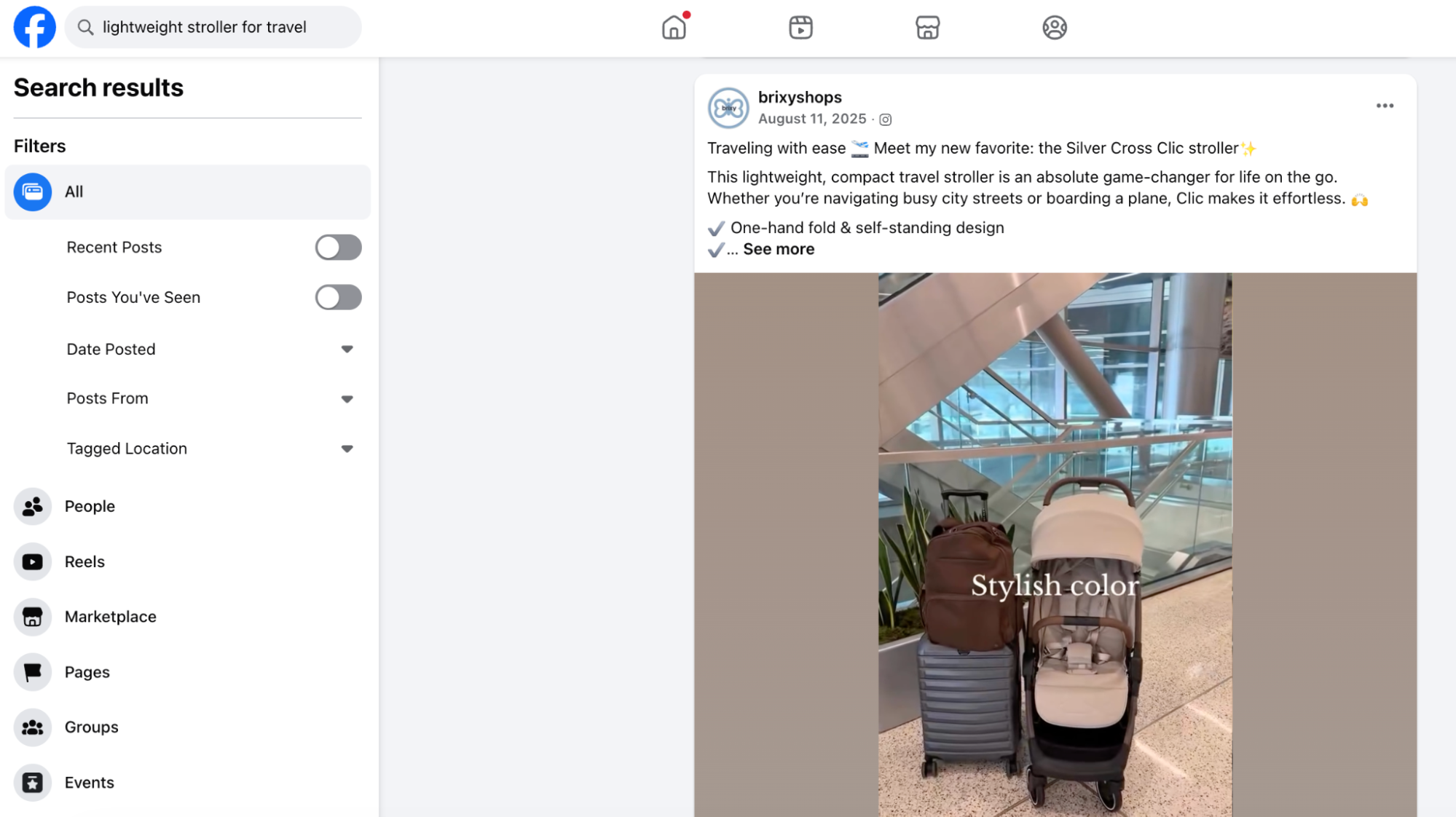
Example: Searching for “lightweight stroller for travel” on Facebook surfaces a mix of posts and Reels users can watch for research purposes. You can also narrow down your search using the filters on the left side.
What marketers can do
- Audit your “About” section and optimize it with local and intent-based keywords.
- Stop stuffing hashtags. Instead, focus on natural language queries that match how people actually search.
- Review your top-performing posts and identify which keywords are already driving organic traffic, then double down on those themes.
- Add descriptive alt text to every image and ensure on-screen text in Reels includes relevant search terms.
3. The “lo-fi” Reels revolution
Sprout’s research show that video still dominates on Facebook: 48% of consumers say short-form video (i.e., Reels) is the #1 content type they’re most likely to interact with on the platform.
But the type of video winning right now looks nothing like the polished productions of a few years ago. The trend has shifted decisively toward authentic, mobile-shot footage that feels like it was made by a real person at their desk, not a creative agency in a studio.
This is great news for lean marketing teams that have unique ideas but can’t afford to invest in expensive ads.
Example: Tarte Cosmetics shared this casual Reel of someone brushing snow off a balcony with the brand’s cult-favorite concealer. The video is low-effort, funny and has the product front and center without feeling like an ad.

What marketers can do
- Use native in-app editing tools rather than expensive post-production software. The slight imperfection shows authenticity, which works in your favor.
- Teach your audience something useful while keeping it entertaining. This type of content (“edutainment”) consistently outperforms salesy posts and videos.
- Experiment with longer Reels (up to 90 seconds) to capitalize on Facebook’s retention-based ranking, which rewards videos people actually watch through.
- Don’t ignore text posts entirely. They’re the second-most engaging content type at 32%, making them a strong complement to your video strategy.
4. Agentic commerce and AI shopping assistants
Facebook shopping is becoming more intelligent. AI-powered agents now support users throughout the entire buying journey.
They can answer customer questions, make recommendations and even process transactions, directly within DMs or through Direct Offers that surface in search results.
The timing for this “agentic” commerce makes sense. Facebook is already the top channel for social customer service, with 45% of users seeking support there—more than any other network. Buying and support are often happening in the same conversation.
For brands, especially those using social media ecommerce, the boundaries between marketing, sales and service are dissolving on Facebook faster than anywhere else.
What marketers can do
- Ensure your product catalogs are fully up to date with accurate descriptions, pricing and images so AI assistants can show the right products.
- Set up messaging automations to handle high-intent queries like “Is this available in blue?” or “When will this be back in stock?” Streamline your customer conversations and agent hand-offs using Sprout Social’s Smart Inbox and message tagging.
- Use click-to-message ads to trigger AI-assisted sales conversations.
- Connect your customer service and sales teams so that the experience feels seamless when a shopper goes from browsing to buying to needing help.
5. The return of private communities
Sprout’s 2026 Content Strategy Report shows 52% of consumers say Facebook is their top network for “building community,” or connecting with others around shared interests.
But that community-building is increasingly happening away from the main feed. Engagement is migrating to “dark social” spaces like private Facebook Groups, Messenger threads and Broadcast Channels.
This matters because the most valuable brand conversations are often the ones you can’t see in your analytics dashboard.
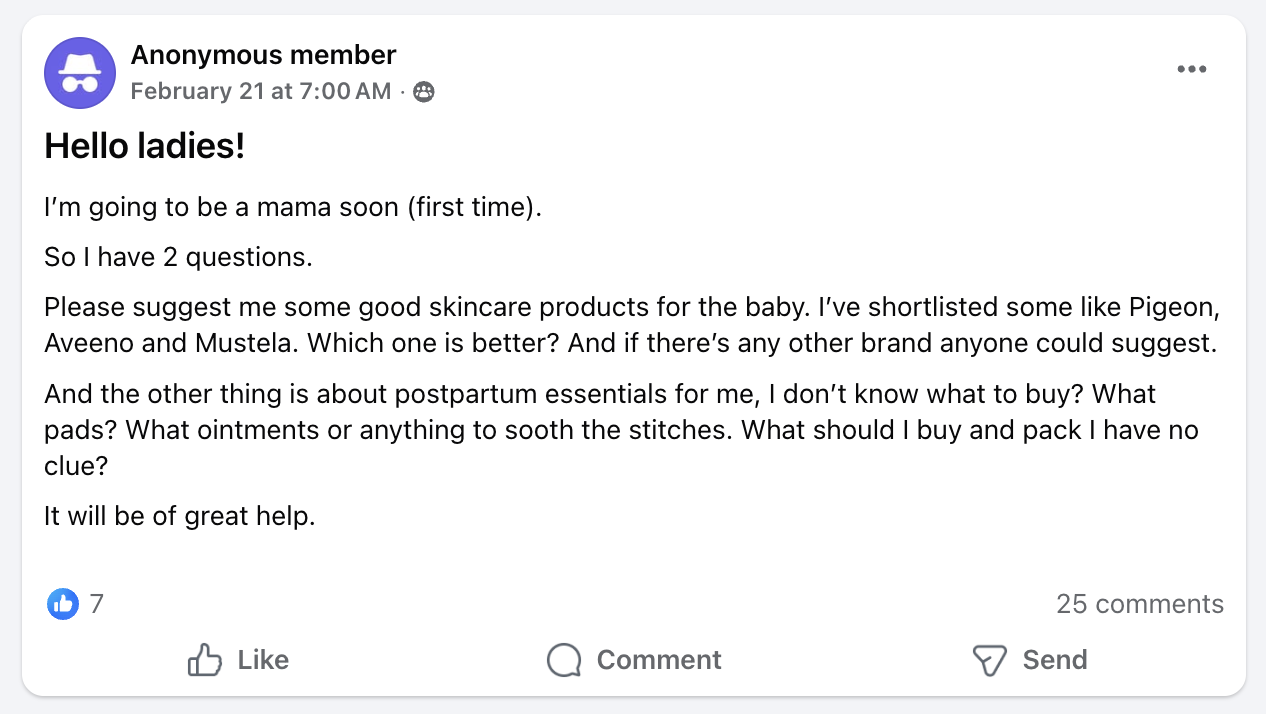
Example: An anonymous post in a private Facebook group asking for specific product recommendations after giving birth.
What marketers can do
- Launch a Broadcast Channel for VIP updates, product drops or exclusive offers that reward your most engaged followers.
- Nurture a niche Facebook Group for power users or superfans where they can connect with each other (and your team) on a deeper level.
- Alongside monitoring public comment sections, actively facilitate conversations in private spaces as part of your community management strategy.
- Track “dark social” sharing by using UTM parameters on links shared within Groups and Broadcast Channels.
6. High-quality “photo dumps”
Social media might be all about video, but carousels (or “photo dumps”) are silently making a comeback. As we evaluate top Facebook content trends, these multi-image posts are picking up engagement on Facebook because they offer something video can’t: stoppable moments in a fast-moving feed.
Users can pause, swipe at their own pace and spend more time with content that rewards closer attention. And because each swipe counts as an engagement signal, a good carousel can often outperform a flashy Reel in the algorithm.
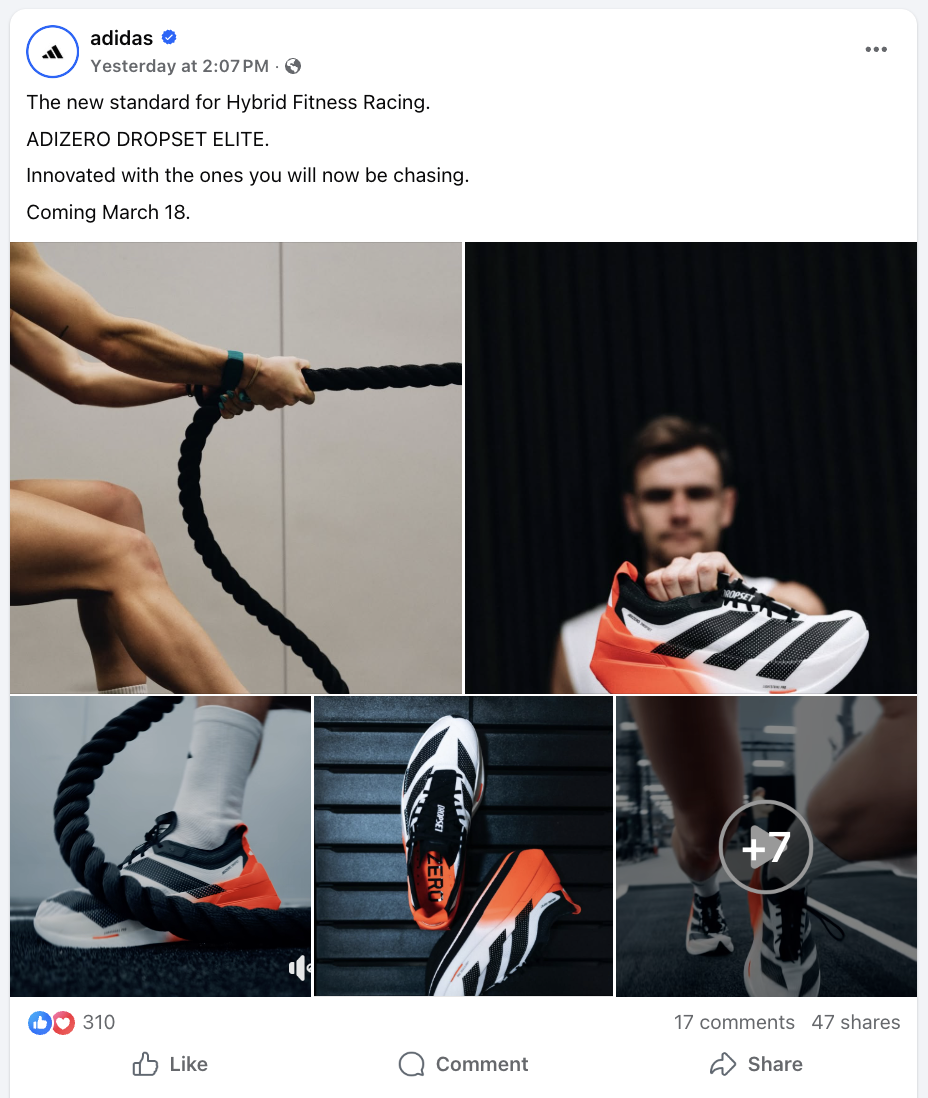
Example: Adidas’ carousel post about their new hybrid fitness shoes includes a mix of videos and photos that show the product from different angles, close up and in action.
What marketers can do
- Use carousels to tell a sequential story. Think formats like “before and after” and “step-by-step,” or close-up product shots from different angles.
- Mix memes or relatable content with high-value product shots within a single carousel to increase dwell time.
- Create educational slide carousels that distill complex topics into digestible, shareable frames (these tend to get saved and shared at high rates).
- Pay attention to your cover image. It needs to be compelling enough to stop the scroll and encourage users to swipe through.
7. Privacy-first targeting
Third-party cookies are long gone, and the ad targeting playbook has fundamentally changed. When looking at Facebook advertising trends, your ad performance now relies heavily on the quality of your data.
If you haven’t set up Meta’s Conversions API (CAPI) to send first-party data directly to Facebook, you’re flying blind compared to competitors who have.
The brands seeing the best results in 2026 treat their own customer data as a strategic asset. They also prioritize ad formats that collect data directly on Facebook, reducing friction. Revisit your Facebook advertising strategy with this privacy-first mindset.
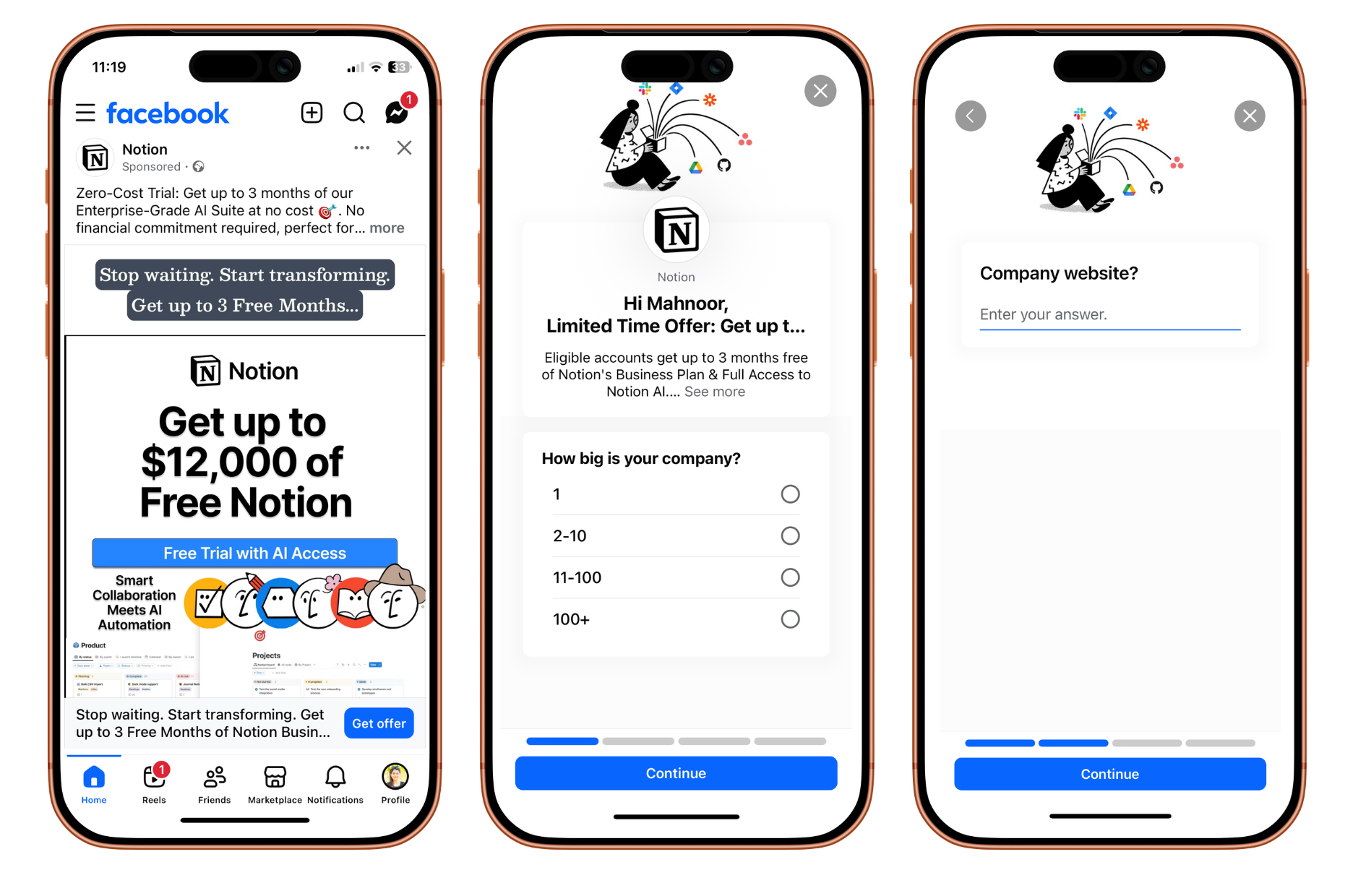
Example: Notion uses Facebook lead gen ads with a built-in form to capture company details directly in the app, making it easy to collect high-quality first-party data without sending users to an external landing page.
What marketers can do
- Implement the Conversions API (CAPI) if you haven’t already. It’s no longer optional for reliable attribution and optimization.
- Build Lookalike audiences from your best customers (high lifetime value, repeat purchasers) rather than broad website visitor pools.
- Prioritize lead-gen ads that collect zero-party data directly on Facebook, such as lead forms and Instant Experiences.
8. Creator ROI and employee advocacy
The influencer era is maturing, and brands are getting smarter about how they invest in it.
Teams are moving away from one-off celebrity posts and toward long-term partnerships with smaller creators who have genuine authority in their niche.
More importantly, one of the top Facebook trends for brands is discovering that their own employees are often the most credible voices they have.
Launching an employee advocacy program can be one of the highest-ROI moves you make on Facebook this year. People trust people, especially people they know work at a company, far more than they trust brand logos.
And with Facebook’s interest graph surfacing content based on relevance rather than follower count, even a mid-level employee’s thoughtful post can reach thousands.
Example: A L’Oréal employee shared a behind-the-scenes look at an in-store showcase in Manchester, promoting multiple brands through her own personal Facebook network.

What marketers can do
- Build an employee advocacy program that makes it easy for team members to share approved content (and create their own) without it feeling forced.
- Empower your team to amplify your brand’s reach with Employee Advocacy by Sprout Social.
- Shift creator partnership measurement from vanity metrics like reach and impressions to conversions and cost per acquisition (CPA).
- Invest in long-term creator relationships rather than one-off sponsorships. Consistency builds audience trust over time.
- Give both creators and employees creative freedom within brand guidelines. Overly scripted content defeats the purpose.
- Prioritize authentic brand amplification. Use AI-driven insights to identify the right trusted voices within your organization. By mobilizing employees to share authentic, on-brand stories, you move beyond market chatter and create meaningful connections that resonate.
9. Augmented Reality (AR) in ads
As Meta continues its push into mixed reality, AR ads (e.g. virtual try-ons, immersive product filters and “place it in your space” experiences) are becoming more accessible to brands of all sizes, including those without six-figure creative budgets.
So, what’s the appeal behind these emerging Facebook trends? AR ads reduce the hesitation people often face before buying online. When a customer can see how a pair of glasses looks on their face or how a couch fits in their living room, the path from consideration to conversion gets significantly shorter.
Example: Mini launched an AR campaign that let users place a life-size version of its two-door hardtop in their driveway or living room. The experience reached 890,000 people and drove higher brand recall, favorability and recommendation than standard Facebook ads.

What marketers can do
- Retail and ecommerce brands should test AR try-on ads, especially for products where fit, color or size are common purchase barriers.
- Track engagement metrics closely (time spent, interaction rate, share rate) to prove ROI and expand your AR investment.
Future-proof your strategy: How to act on these 2026 trends
If there’s a single theme running through all nine of these trends, it’s this: 2026 is the year of “smarter, not harder” marketing on Facebook. AI tools can handle the scale, but human creativity drives the strategy.
The brands that win will be the ones that embrace AI as infrastructure while investing in the things machines can’t replicate: authentic storytelling, community building and experimentation.
Moving at market speed is no longer aspirational—it’s a requirement for breakthrough brands. This is why we’ve built Trellis, Sprout’s agentic AI, to do more than just surface signals.
It helps your team act on them across every workflow. Whether you are optimizing for the interest graph or scaling social support, social media intelligence ensures your team is working from a single, trusted reality rather than siloed guesses.
Ready to go deeper? Explore our comprehensive guide to social media trends to see how Facebook fits into the bigger picture across every major platform.




Share