How Australian brands can use chatbots to improve customer care

Written by Olivia Carr
Published on December 29, 2025
Reading time 12 minutes
Table of Contents
Australian customer care teams are under more pressure than ever, managing rising ticket volumes, stretched resources and increasingly multilingual audiences.
Chatbots offer a smarter, more scalable way to handle that demand. By automating routine queries, they free your agents to focus on complex, high-value conversations that drive loyalty and retention.
Below, learn how Australian brands use chatbots to cut wait times, improve satisfaction and deliver faster, more personal support.
Why Australian customer care leaders are turning to chatbots
Customer expectations keep rising, but team sizes often don’t. Chatbots help Australian service leaders deliver fast, personalised support without adding headcount.
Instead of replacing agents, chatbots work alongside them. They take on the repetitive, high-volume queries that slow teams down, helping you deliver consistent, efficient and human support at scale.
Here’s why chatbot adoption is accelerating across Australian customer care teams.
1. Support customers at scale without expanding your team
When ticket volumes spike, chatbots act as your first line of support by handling FAQs, order tracking, booking confirmations and other repetitive tasks that eat up valuable agent time. Running 24/7, they keep your service responsive even after hours.
When integrated with your customer service workflows, chatbots also help your team track every query end-to-end, reducing missed tickets and improving visibility. That means your agents can focus where they add the most value: resolving complex issues and building relationships. All while avoiding burnout.
Sprout’s research on AI-driven customer engagement shows this hybrid approach works best. Automation handles the volume while humans handle the nuance so you can maintain a personal touch without overwhelming your team.
2. Meet expectations for faster, smarter service
Speed and intelligence now define good customer care. According to the Sprout Social Index™ 2025, three in four consumers in Australia and globally expect brands to reply within 24 hours—and many will switch to a competitor if they don’t get a timely response.
Chatbots make it possible to deliver on that expectation. They provide instant, accurate responses around the clock, without requiring 24/7 staffing.
But customers also want service that feels personal. Chatbots powered by conversational AI can interpret intent, remember context and adjust tone accordingly. This allows them to reference past interactions, loyalty status or preferences.
For Australian brands, multilingual support adds another layer of accessibility. And it’s not just customers who benefit. For your team, chatbots remove pressure, streamline workflows and help build capacity for proactive care.
3. Strengthen compliance and audit readiness
Chatbots help protect your brand by ensuring every message aligns with compliance standards and approved language.
In heavily regulated industries like banking, healthcare and telecom, every customer conversation carries additional legal and reputational risk, and the stakes are high. Studies show company share prices drop an average of 35.2% following a brand reputation crisis, so mitigating them before they happen is key.
Pre-approved chatbot responses reduce the risk of human error and maintain consistency. Plus, they automatically generate audit trails, providing the transparency regulators and executives expect. Analytics from bot interactions also surface recurring issues or compliance gaps, so you can act before they become risks.
By letting automation manage repetitive, high-risk interactions, your agents can stay focused on high-value conversations and deliver secure, compliant and trusted support at scale.
Why chatbot management belongs in your social care ecosystem
Even the most advanced customer service chatbot is only as effective as the system it operates in. To create meaningful customer experiences, automation can’t live in a silo. It needs to work seamlessly with your broader customer care strategy.
When chatbots, agents and data work together, service becomes faster, more personal and more consistent across every channel.
Here’s why Australian brands should integrate chatbot management into their social care strategy.
Centralised insights and collaboration
Fragmented data is one of the biggest barriers to customer satisfaction. When care, marketing and social teams each manage their own conversations, no one sees the full picture of customer needs.
Unifying chatbot and human interactions into one workflow changes that dynamic entirely. With shared visibility, teams can identify issues early, uncover trending questions and respond to changes in customer sentiment quickly.
This level of visibility also improves reputation and crisis management. According to BrightLocal’s 2025 survey, 89% of consumers say they’re likely to use a business when they see that it responds to reviews, both positive and negative.
More importantly, collaboration across departments helps shape better content, clearer policies and more human experiences. When everyone can see the same conversations, customers see a brand that listens.
Consistency that builds trust
A unified brand voice doesn’t happen by accident. In a landscape where customers interact with brands across multiple networks and languages, consistency is a competitive advantage.
Chatbots play a critical role in reinforcing tone, vocabulary and empathy at scale. But that alignment only holds if messaging guidelines are built into both the human and automated sides of your care operation. By using conversational AI and training chatbots on the same principles your agents use, you ensure customers always experience a coherent, trustworthy brand.
When automation reflects your company’s values as clearly as your people do, trust grows stronger, even through digital channels.
Smarter escalation and faster resolution
The best customer care strategies use chatbots to triage intelligently, not to deflect responsibility. Escalation should feel seamless to the customer: they move from automation to human support without friction, repetition or delay.
This requires designing workflows that preserve context and intent across every handoff. When chatbots pass complete conversation histories, customers don’t have to re-explain their problem and agents can deliver faster, more empathetic solutions.
Over time, analysing escalation trends also reveals where automation ends and human support adds the most value, helping leaders balance efficiency with connection. The result is happier customers and a smoother support experience.
Continuous improvement through shared intelligence
Chatbots aren’t “set and forget” tools—they’re living systems that learn. High-performing customer care teams treat every interaction as a data point: one that can inform future scripts, identify knowledge gaps or highlight shifting audience needs.
Analysing this feedback loop helps teams refine language, tone and process over time. It also reveals opportunities to blend automation and human expertise more effectively, whether that means adding proactive prompts, simplifying flows or redesigning the customer journey altogether.
The most mature organisations view chatbot management as an evolving discipline, not a fixed project. They understand that automation succeeds when it stays human-centred, data-driven and relentlessly iterative.
10 chatbot examples from leading Australian brands
Chatbots have several practical use cases in Australian customer care, from handling FAQs and appointment bookings to assisting with marketing and lead generation and personalised recommendations.
Below are 10 leading Australian brands using chatbots to elevate customer care.
Australian telecom chatbot examples
Telecom customers demand immediate answers for everything from network outages to billing questions. Providing instant, 24/7 support is essential for retention, and these brands use chatbots to manage routine inquiries at scale.
1. Optus Assistant
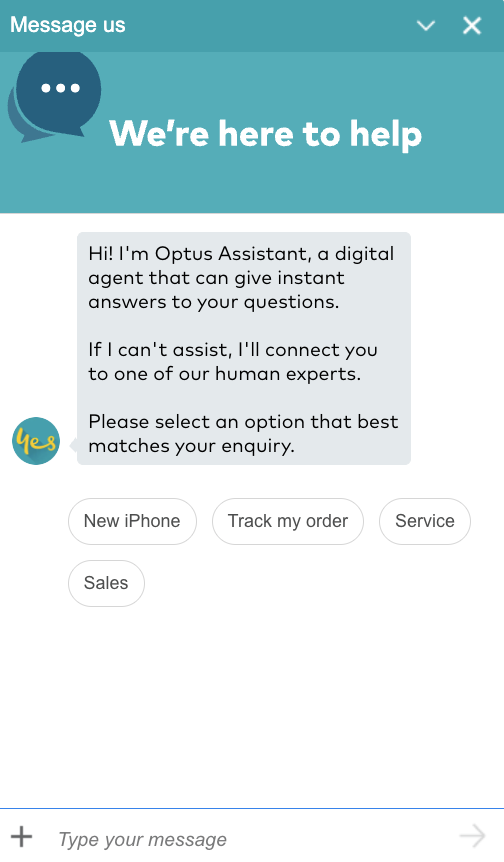
Optus Assistant, the telco’s AI-powered chatbot, operates across web, mobile and social channels to support customers 24/7. It helps users troubleshoot network issues, explore plan options and manage billing, all without waiting on hold.
Why it works: Optus positioned automation as a complement, not a replacement, for its human support. Its chatbot handles routine questions, freeing agents to focus on technical or account-specific inquiries that need empathy or nuance.
Source: Optus
2. Telstra Assistant
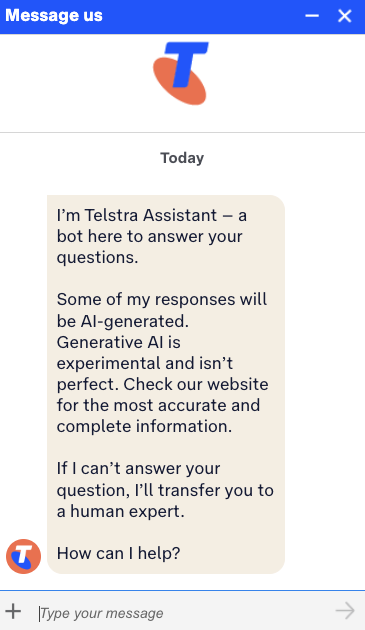
Telstra Assistant offers context-aware responses across the company’s app, web chat and social channels. It provides immediate help for common issues like payment queries and connection problems, and seamlessly hands off complex requests to human agents.
Why it works: Telstra’s chatbot succeeds because it integrates across multiple customer touchpoints. It’s not a standalone tool—it’s part of a broader omnichannel strategy that maintains context across platforms like WhatsApp and Messenger, ensuring customers never have to start their conversation over.
Source: Telstra
Australian banking chatbot examples
These Australian banks leverage chatbots to handle routine banking inquiries and provide secure, real-time support for customers.
3. CommBank Ceba
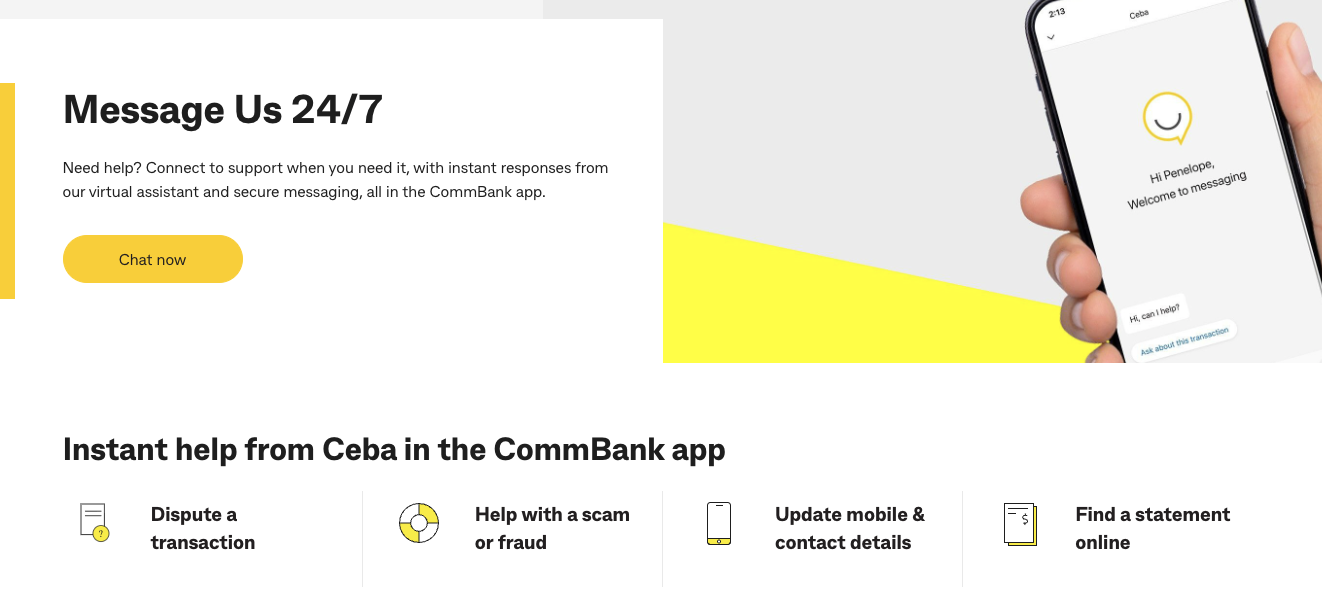
Ceba, Commonwealth Bank’s virtual assistant, is available through the CommBank app and online banking. It helps customers check balances, manage transactions, update personal details and report fraud, all within a secure environment.
Why it works: Ceba demonstrates how automation can meet both convenience and compliance. The assistant’s ability to process sensitive data while maintaining strict security protocols builds trust in a sector where accuracy and privacy are critical.
Source: Commonwealth Bank
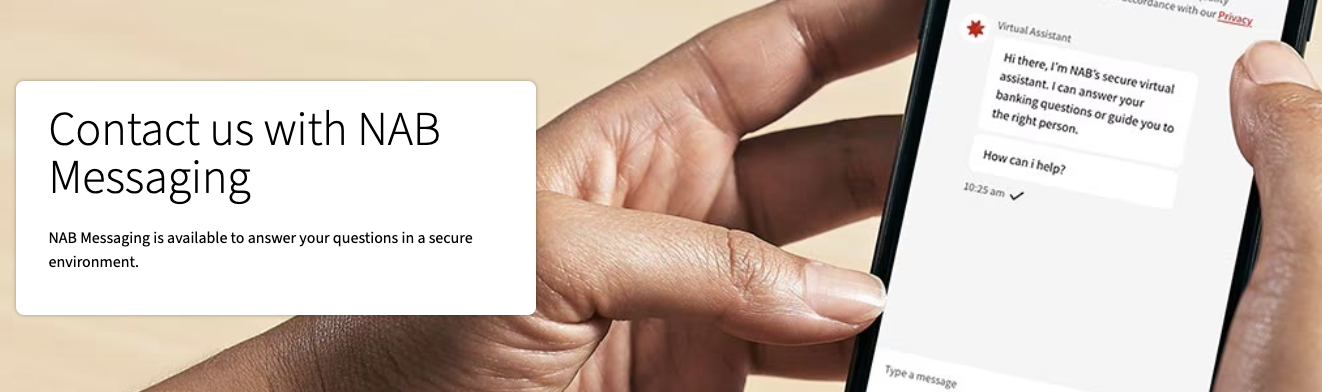
4. NAB Virtual Assistant
NAB’s chatbot supports customers with everyday banking tasks, from payments to card management. Available 24/7, it uses AI to interpret intent and direct complex queries to human specialists when needed.
Why it works: NAB’s focus is on proactive service. By using conversational prompts and predictive responses, its assistant anticipates needs before customers articulate them. This sets a new bar for responsive digital care in banking.
Source: NAB
Chatbot examples for Australian retail
These retail brands in Australia are using chatbots to improve ecommerce experiences and deliver tailored product recommendations. Chatbots even support lead generation by engaging prospects and qualifying them before they reach sales.
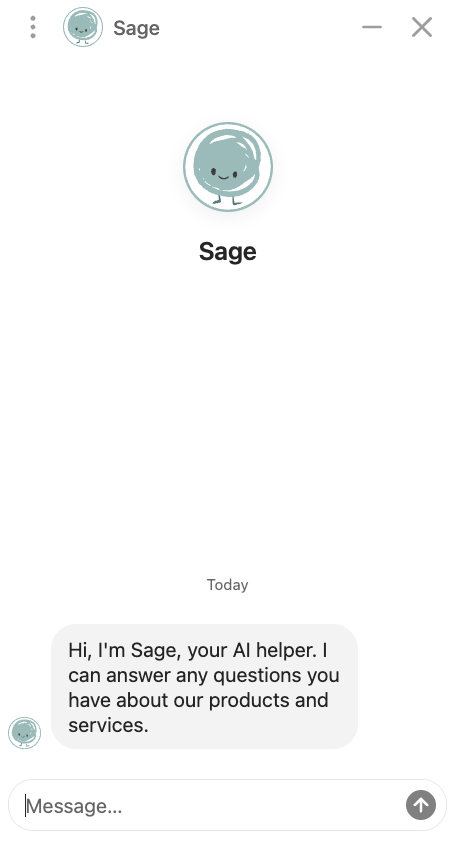
5. Temple & Webster Sage
Sage, Temple & Webster’s AI assistant, guides shoppers through product searches, order tracking and returns. It helps users find what they’re looking for in seconds, reducing dependency on call centres.
Why it works: Sage blends service and sales. It uses behavioural cues, like browsing history or cart activity, to deliver recommendations that feel helpful, not pushy. It’s a model for using chatbots to support both customer experience (CX) and conversion.
Source: Temple & Webster
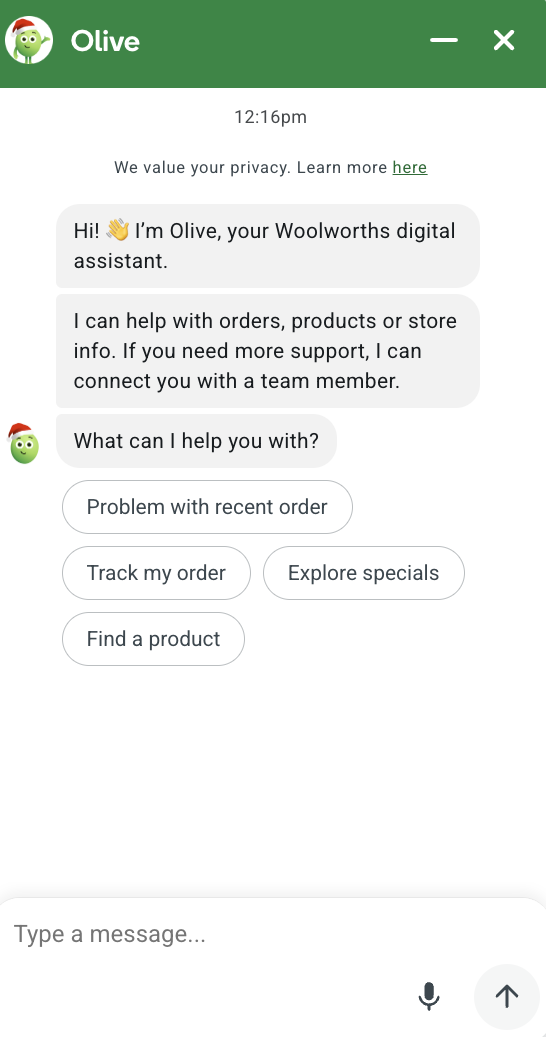
6. Woolworths Olive
Woolworths’ virtual assistant, Olive, provides instant help with order tracking, online shopping and loyalty rewards. It can also escalate issues to live agents when customer sentiment indicates frustration.
Why it works: Olive’s strength is emotional intelligence. Its AI uses sentiment detection to identify when a customer needs a human response. While a small detail, this makes a big impact in maintaining trust.
Source: Woolworths
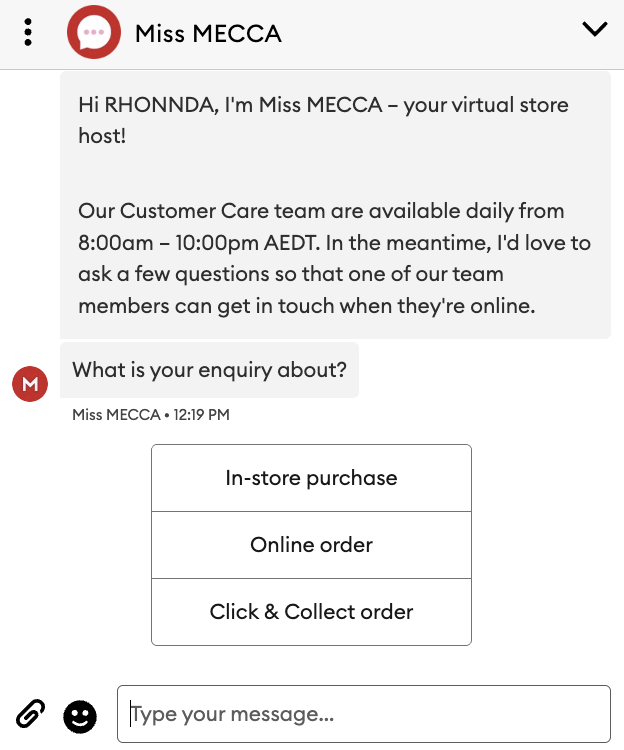
7. Miss MECCA
Miss MECCA, the cosmetics retailer’s chatbot, helps customers with product information, shade matching and order support. It can answer simple questions in seconds and escalate nuanced skincare or makeup queries to a beauty advisor.
Why it works: Miss MECCA succeeds because it mirrors the brand’s tone—friendly, helpful and inclusive. By blending conversational flair with expertise, it extends the in-store experience into digital channels seamlessly.
Source: MECCA
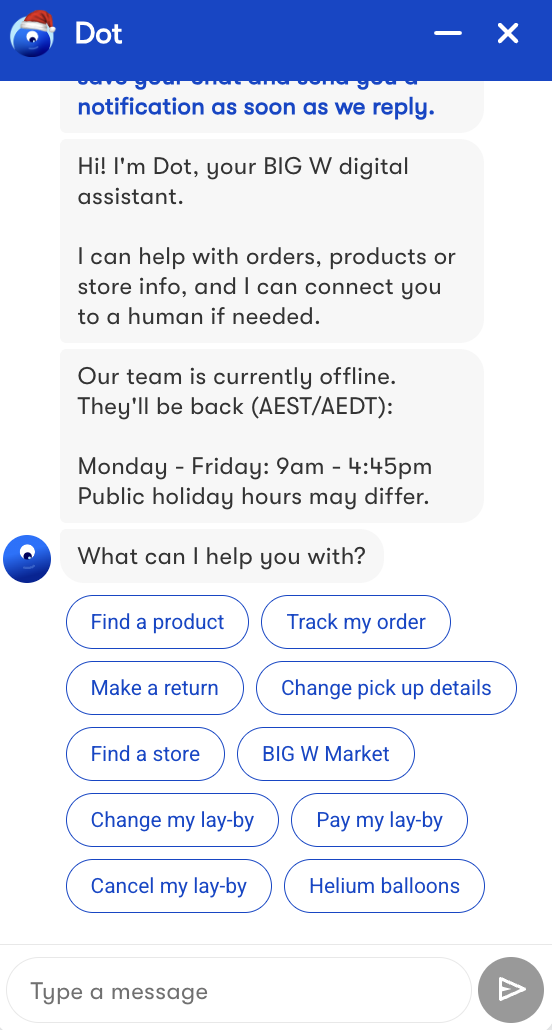
8. Big W Dot
Big W’s chatbot, Dot, supports customers across product searches, stock checks and online orders. It handles common requests autonomously while connecting customers to live agents for detailed or sensitive issues.
Why it works: Dot exemplifies operational efficiency at scale. Its design focuses on clarity, with structured menus, clear CTAs and frictionless escalation. This reduces repeat questions and keeps the experience smooth for shoppers.
Source: Big W
Chatbots for other Australian brands and services
Beyond banking, retail and telecom, chatbots are enhancing customer experiences across utilities, health and other sectors in Australia. Below are some examples.
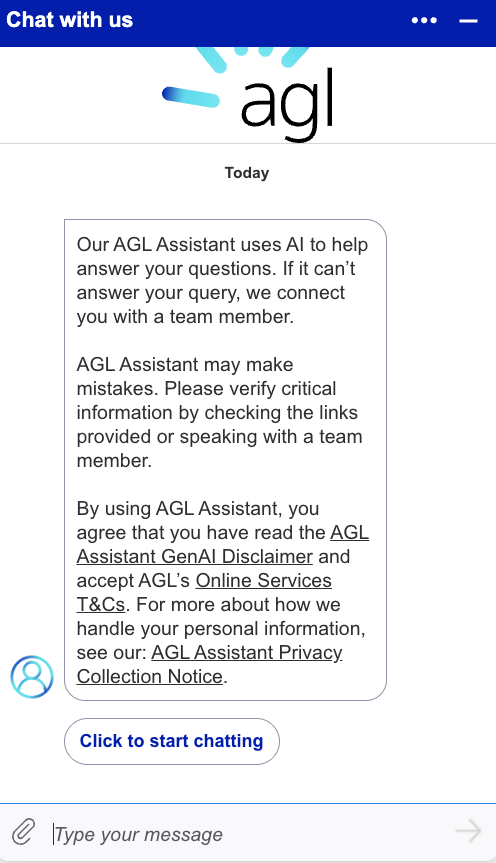
9. AGL Assistant
The AGL Assistant chatbot provides customers with account management, billing queries and energy-saving advice. It’s accessible through the company’s website and app, ensuring ‘round-the-clock support.
Why it works: AGL Assistant shows how automation can extend value beyond troubleshooting. By offering proactive tips, like efficiency reminders during peak periods, it transforms service interactions into brand-building opportunities.
Source: AGL
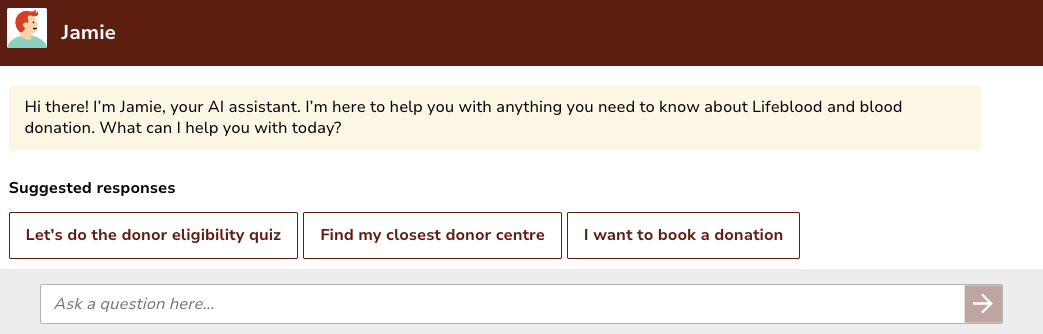
10. Lifeblood Jamie
Jamie, the Australian Red Cross Lifeblood chatbot, answers donor questions, checks eligibility and helps users book appointments. It also provides educational resources on blood types and donation processes.
Why it works: Jamie demonstrates how mission-driven organisations can use chatbots to educate as well as serve. Its conversational tone and accessible information design lower barriers to participation, making donation easier and more engaging.
Source: Lifeblood
What makes chatbots effective in Australian customer care?
The most effective chatbots aren’t defined by the technology they use but by the experiences they create. They blend precision, empathy and adaptability to meet customer needs while reflecting brand values in every interaction.
For Australian brands, chatbot success comes from integrating automation with thoughtful design and human oversight to deliver fast, reliable and personal service.
Here’s what separates high-performing chatbots from the rest.
Accuracy, context and human handoff
A good chatbot recognises intent and understands context. It remembers what’s been said, keeps track of customer preferences and knows when it’s time to involve a human.
That continuity makes all the difference. When conversations transfer smoothly between automation and agents, customers don’t have to repeat themselves or re-explain issues. For your team, that means less friction, faster resolution and fewer gaps in communication.
In Australia, where customers often interact across multiple channels and time zones, that context keeps communication clear and consistent. A chatbot that “remembers” your last order or conversation builds trust by making every interaction feel connected.
Integrations that create connected experiences
Chatbots reach their full potential when they’re part of a connected ecosystem. By integrating with customer data systems, such as CRMs, order platforms or loyalty databases, they can personalise interactions in real time.
Imagine a customer checking an order status. A connected chatbot doesn’t just say “Your order is on the way.” It can reference delivery timelines, anticipate follow-up questions and flag potential delays before they happen. For brands, this turns automation from a reactive tool into a proactive customer experience driver.
When chatbots have access to the same insights as your human teams, every conversation becomes an opportunity to deepen understanding and build loyalty.
Personalisation at scale
Automation shouldn’t feel automated. The most sophisticated chatbots use data thoughtfully, acknowledging a customer’s loyalty tier, preferences or previous interactions without feeling intrusive.
Finding this balance between efficiency and empathy is what keeps customers satisfied. A chatbot that remembers you cancelled an order last week and asks if you’d like to reorder today doesn’t just save time; it shows attentiveness.
For Australian audiences, that personalisation must also reflect tone and culture. A friendly, conversational approach always outperforms robotic precision.
Service optimisation through feedback and analytics
Chatbots don’t reach excellence overnight—they evolve through learning. Leading brands treat every conversation as a learning opportunity to refine scripts, measure satisfaction and identify intent gaps.
When you track metrics like completion rate, sentiment and customer drop-off points, you understand where conversations stall and where they succeed. Regularly reviewing this data helps you improve content design and tone while anticipating customer needs.
The strongest teams build these insights into an iterative process, adjusting chatbot language and logic with the same care they’d give to any customer-facing campaign.
Compliance and brand alignment
For regulated sectors like finance, healthcare and telecommunications, consistency is non-negotiable. Chatbots help mitigate compliance risks by delivering accurate, approved responses every time. This ensures customers receive the right information no matter when or how they reach out.
But compliance isn’t just about risk avoidance, it’s also a brand trust strategy. When customers see the same level of accuracy, empathy and transparency in every interaction, that reliability reinforces confidence in your brand.
The goal is balance: automation that safeguards standards while empowering teams to handle the complex, sensitive or emotionally charged conversations that only humans can.
How to get started with Sprout’s Bot Builder
Today’s consumers expect support on their schedule, not yours. Chatbots make that possible by providing instant, 24/7 service and managing thousands of routine queries at once.
Sprout Social’s Bot Builder simplifies the process. With guided bot templates, intuitive workflows and unified data insights, you can design chatbots that enhance—not replace—human care.

Here’s how to scale customer care automation strategically with Sprout.
Identify high-volume, repeatable questions
The strongest chatbots are powered by data, not assumptions. Before scripting a single response, analyse your historical customer interactions to uncover the most common questions.
In Sprout, you can easily do this by tagging conversations by theme or question as they land in your Smart Inbox.
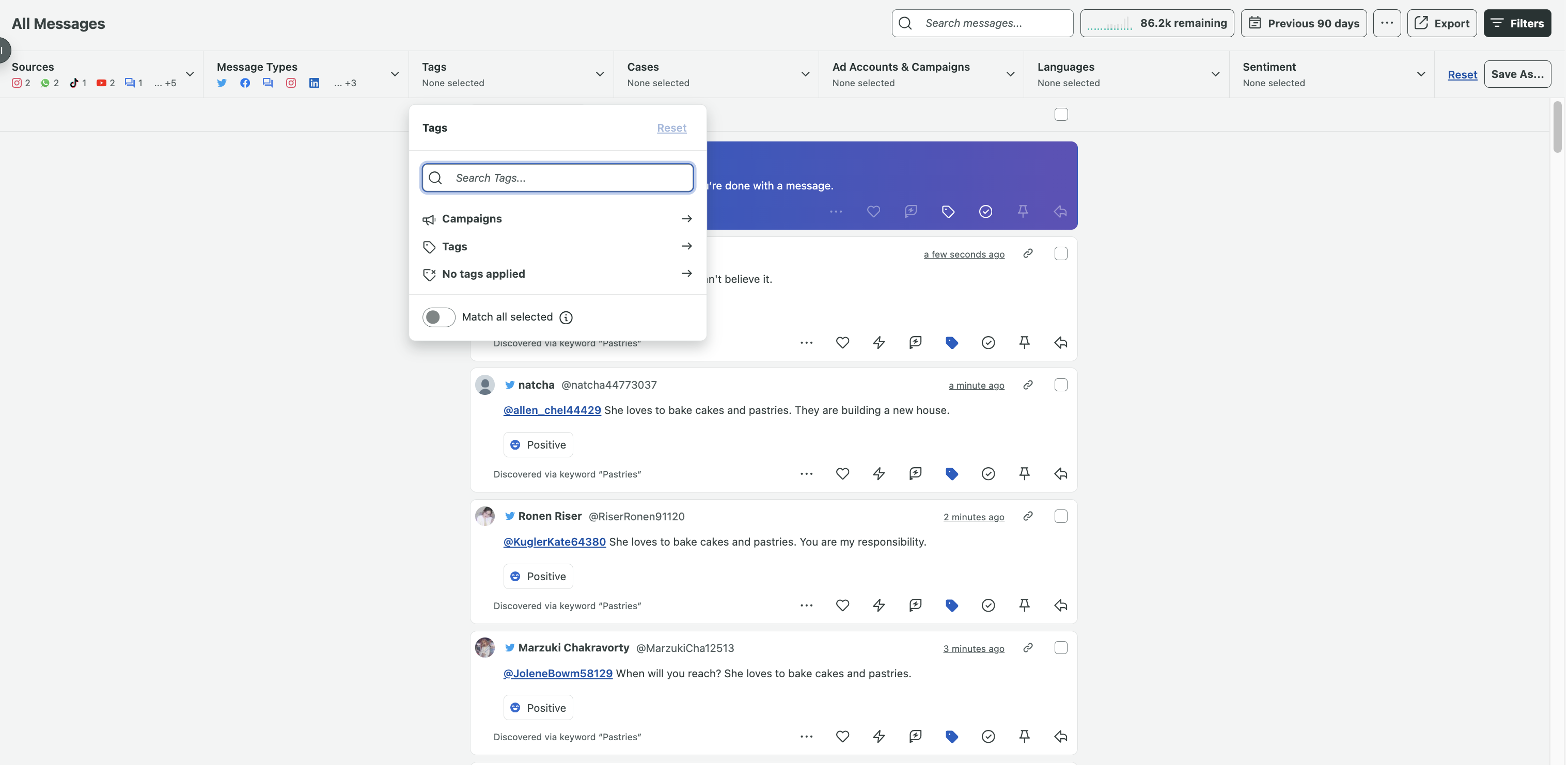
Queries like “Where’s my order?” or “How do I reset my password?” might seem small, but together they account for hundreds or even thousands of service tickets each month.
By automating answers to these repeat inquiries, you’ll immediately reduce response times and give your team back hours to focus on complex cases that require human judgment.
Start small. Tackle your top three to five recurring questions first, then expand as your confidence grows. This approach shows ROI quickly and keeps chatbot development lean and manageable.
Map your chatbot to your broader care strategy
A chatbot shouldn’t live in isolation. It should extend your customer care strategy. The key is knowing when automation adds value and when you need a human touch.
Design escalation flows based on customer context and intent. For example, an order-tracking inquiry might stay within the bot, while a complaint or VIP customer request should immediately route to a live agent. The transition should be invisible to the customer and maintain the full conversation history so no one ever has to start over.
Integrate your chatbot design with your team’s service goals, SLAs and workflows. That alignment ensures automation supports, rather than fragments, the customer experience.

Monitor and optimise bot performance
Like any member of your care team, your chatbot needs regular feedback, training and evaluation to stay helpful and on-brand.
Review conversation data regularly to spot friction points, such as repeated drop-offs, misunderstood intents or delayed escalations. Look at metrics like response time, completion rate, sentiment and how often chats get handed to a human. This will help you understand where automation adds the most value (and where it doesn’t).
Use those insights to refine your bot’s language, logic and tone so every exchange feels more intuitive and human over time. The goal isn’t perfection—it’s steady progress that keeps up with customer expectations, product updates and seasonal demand.
Turn AI-powered service into your team’s competitive edge
Chatbots aren’t just a customer service shortcut. They’re a long-term strategy for creating faster, smarter and more personal experiences.
Across Australia, brands from Lifeblood to Optus are proving what’s possible when AI and humans work together: 24/7 support that builds loyalty, boosts efficiency and strengthens every customer connection.
When you power your chatbot strategy with Sprout Social, you give your team the visibility, insights and control to make automation feel human and make every interaction count.
Start your free trial today and see how Sprout helps you design chatbots that not only resolve questions but build relationships.
37 free social media strategy templates that will elevate your workflows
Published on December 5, 2025 Reading time 15 minutes






Share