How to ace B2B brand storytelling through thought leadership

Written by Rebecca MacFarlane
Published on January 23, 2026
Reading time 14 minutes

Table of Contents
All too often, B2B brands treat social like a digital billboard for product features, data points and competitor comparisons, falling into the misconception that creative storytelling is solely for B2C brands. Hence, the perception that B2B brands are “boring” on social.
As marketing trends and practices evolve, B2B brands must adapt. One of the biggest shifts we’ve seen so far is that social isn’t for sterile product showcases anymore. Instead, these networks serve as vehicles for sharing insights, building relationships, and authentic storytelling. B2B brands have realized this potential, with many steering brand storytelling through thought leadership.
In this article, we dive into why B2B brands need to hone in on their brand narratives, and share key insights from Kara Redman, CEO and founder of brand strategy and activation agency, Backroom, on tips for mastering B2B brand storytelling through thought leadership. Over the course of her career, Redman has helped founders raise over $10M in funding, supported Fortune 500 mergers and worked with brands like DC United, Volo City and Maka Media.
Why B2B needs to tell better stories
B2B companies tend to lean on facts and stats in their social marketing. But oftentimes, hard figures alone don’t captivate or convert—emotional marketing and compelling narratives do.
That’s because humans are at the heart of every business, even B2B brands. Whether you’re marketing to small local businesses or multinational corporations, you’re talking to people. And on social, people want to be safe, seen and understood.
According to Redman, the best B2B brands “understand first what the pain, the emotional pain and the fear of their customers are. Then, they create experiences and stories that make those prospects feel safe enough to buy and for their customers to feel satisfied enough to stay.”
That’s why human-led storytelling and customer-centric social strategies are so effective: you’re conveying that you know who they are, what they struggle with and how to solve their problems.
“I personally reject the idea that B2B brands or B2B buyers are rational versus consumer brands. The reasoning is that people aren’t suddenly non-emotional because they’ve clocked into work,” explains Redman. “We make choices as humans that feel safe. At its most primal core, we want to feel safe and validated in the decisions that we make.”
By crafting brand stories, you’re appealing to decision-makers’ emotional and logical needs. For example, seeing these narratives play out on social could help reduce the anxiety or perceived risk of a high-ticket purchase. “While sales cycles tend to be longer, that storytelling component matters more earlier on in the long game because we’re setting the stage for what the customer is going to experience,” she notes.
Additionally, as AI-generated content becomes more prolific, human-driven storytelling can earn consumer trust.
While users don’t inherently trust AI bots, algorithms or logos, they do trust people—and they’re hungry for more person-to-person connection on social. Per the Q4 2025 Sprout Social Pulse Survey, the majority (32%) of respondents said they most want brands to prioritize human-generated content on social in 2026.
Effective storytelling humanizes your brand by showing the “why” and the “who” behind your solution. From there, you can bridge that trust gap, build a strong community and drive revenue.
Not to mention, building a consistent brand narrative framework is crucial for SEO and social media search. When you repeatedly focus on the same themes, issues and messages, it’s easier for search engines and social algorithms to identify what your content is about. And when these platforms understand your content, it can show it to the right audiences in SERPs and social feeds alike.
Regularly publishing content about your niche also signals in-depth expertise, which is crucial for building topical authority. Over time, search engines and social networks learn that your brand isn’t a one-hit wonder—it’s a reputable voice in the industry.
Make B2B thought leadership a core part of your brand story
B2B thought leadership is vital for ensuring that your brand story is credible and compelling.
Sharing opinions, insights and predictions indicates that your brand truly understands what’s going on in your sector. With that said, it’s not enough to simply share a PDF or regurgitate statistics. You need to provide unique perspectives on industry opportunities and challenges.
Rather than simply recapping industry news, emphasize why these updates are important. Instead of reflecting on trends of the past, forecast what’s to come.
No one is better positioned to deliver these kinds of insights than leadership. When founders, executives and subject-matter experts show up on social, the brand is seen as reputable. More importantly, it’s seen as relatable. It reassures users that there are real people who understand their problems behind the curtain.
As Redman shares, that sense of relatability can bolster your B2B brand storytelling strategy.
“When you see a thought leader, a CEO or a head of marketing building a personal brand through the lens of their company, and you think, ‘They’re really cool; I want them in my sphere,’ or ‘She’s just like me,’ you’ve found a thread of relatability,” she explains. “Whether it is lateral relatability or aspirational, that’s where we start to follow and build trust.”
Most importantly, Redman adds, continue your brand storytelling even after a purchase is made.
“After the purchase, we have to continue telling that story through the product, the experience and the service. Storytelling is perhaps longer-tail with B2B, but it is still very much tied into an emotional decision point,” she emphasizes.
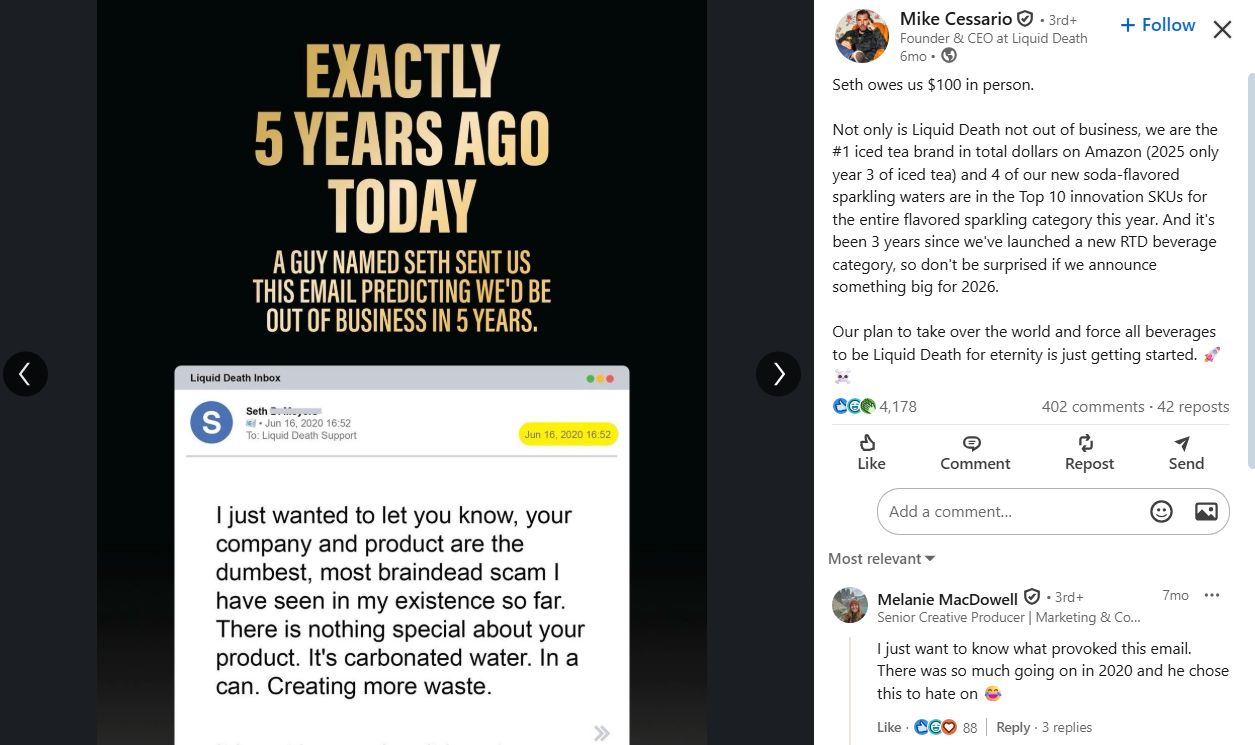
Founder and CEO of Liquid Death, Mike Cessario, is proof that humor and edge can be effective tools in cultivating that sense of relatability. While Cessario often shares promotional materials and industry insights on LinkedIn, healso lets his cheeky side shine through, particularly when exploring the trials of starting and growing a business. This brand storytelling approach reinforces the human side of the business.
In one LinkedIn post, he shared an email that he received in 2020 from an unhappy customer claiming that, if Liquid Death was still operational in five years, he would pay the owners $100. Five years later, Cessario highlighted key business wins while lightheartedly sharing that email with his LinkedIn community.
5 ways to build a B2B storytelling framework on social media
While it’s crucial to understand the importance of B2B storytelling, it’s even more vital to know how to execute it. Below, we explore key tactics for crafting a brand narrative framework on social media, complete with best-in-class examples.
1. Adopt classic story arcs
It’s the arc that guides every great story. The protagonist embarks on a life-changing adventure, faces a series of trials and ultimately finds a way forward. And if you thought these narratives were exclusively for the movie screen, think again, because they’re incredibly effective for B2B brand storytelling.
Here’s how it works: Your customer is the hero and your solution is the tool they use to surmount their challenges. This approach highlights the tangible value of your product or service while building an emotional connection with your audience.
In Wix’s social media stories, their “heroes” are small business owners. The restaurateurs eager to share the joy of great food. The personal trainers motivating people to become their healthiest selves. The bookworms turning their love of literature into a brick-and-mortar business.
The challenge they all face is getting noticed. Having a great product or service isn’t enough if people don’t know you exist. And without a marketing background, figuring out how to spread the word can feel daunting.
That’s where the hero’s solution comes in: a website. One that’s easy to build, simple to maintain and visible to the right audiences.
Wix doesn’t frame itself as the main character. Instead, it plays a supporting role. It proves that it understands the challenges entrepreneurs face. Then, it gives them the tools they need to connect with customers, drive revenue and make their dreams a reality.

That customer-centric storytelling approach is ideal for building relatability and driving sales, says Redman.
“People are people, whether they are buying a Voice over IP service or paper towels. We buy what requires the least amount of effort and feels safest, all centered around a true problem we have,” she highlights. “At the core, if you do not know what your people are suffering from and you cannot talk about it in a relatable, useful way, nothing else matters.”
2. Leverage employee advocates as primary storytellers
Odds are, your staff is already online, so why not leverage that digital presence for your own B2B storytelling?
Amplifying the voices of senior leaders and C-suite executives is a proven social media strategy that can elevate your brand. That’s because these higher-ups are ideally positioned to provide expert insights and conduct thought leadership storytelling. Think behind-the-curtain knowledge, industry predictions, quick wins and interesting anecdotes.
Deloitte uses this strategy on LinkedIn. The consulting giant recently rounded up its leaders’ predictions on the AI shifts that will define 2026. In its post about the predictions, Deloitte tagged the leaders, prompting them to share the insights with their own networks.

But great employee advocacy doesn’t end with leadership. Interns, graduates and other junior staff can also play a role in brand storytelling on social.
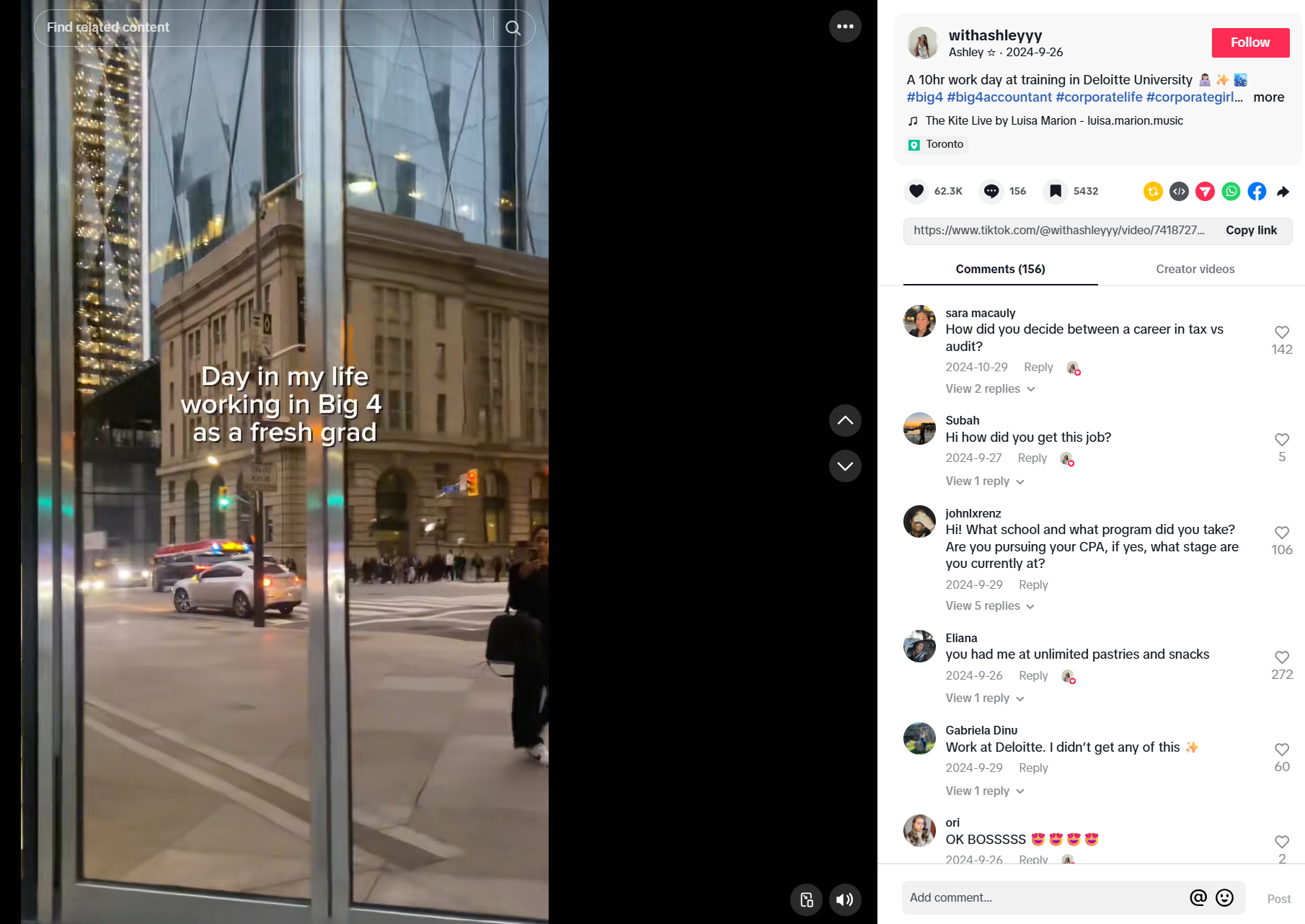
An example is day-in-the-life content, which is particularly popular on platforms like TikTok and Instagram. For instance, TikTok user @withashleyyy shared a day in her life as a new graduate starting her career at Deloitte. In the video, she gives viewers a behind-the-scenes look at working for a “Big Four” firm, including collaborative training sessions, free meals and professional headshots.
Whether it’s the CEO or an intern, on LinkedIn or TikTok, employee-led content needs to feel natural. The priority should be sharing authentic, relatable experiences, not corporate jargon or contrived scenarios. With that in mind, avoid putting strict rules in place; instead, let your staff’s creativity guide them.
“Freedom with guardrails—that is [employee advocacy] in its simplest form,” says Redman. “We talk a lot about relatability, but you can’t force relatability through a framework. What you can do is say, ‘Hey, anytime you’re posting about our company, here are the guardrails for what’s approved and what’s not. Have fun with it.’“
It feels scary because, as leaders, we can’t control what goes out, but that is kind of the point. You are building so much social currency, social proof and trust in your brand if you allow employees to truly be themselves while carrying the right brand message,” she adds.
Achieving the right brand message is made easier with the appropriate tools. For example, Employee Advocacy by Sprout Social empowers employees to share brand content with a few clicks, while staying compliant with pre-approved copy.
You can also use it to compile content in newsletters or broadcasts and send them to specific team members. They can then explore and follow topics relevant to their roles, ideate content and post across networks like LinkedIn and X.
3. Use social listening to meld industry commentary with online culture
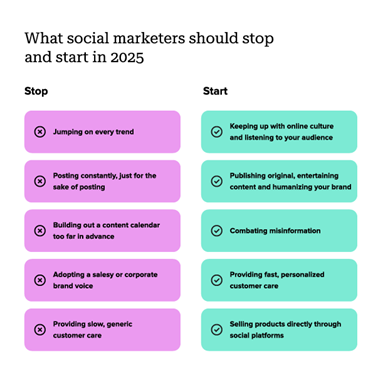
A core component of B2B brand storytelling strategy is keeping up with online culture and participating in it.
Per the 2025 Sprout Social IndexTM, this was the #1 priority users wanted from social marketers.
So, ask yourself: what are people talking about on social? What pain points are plaguing your industry? What cultural events or moments could you capitalize on in your content?
Use social listening tools to find the answers to these questions. For instance, Sprout Listening uses AI-powered technology to track millions of conversations on key topics. Say you run a SaaS company offering a social media management tool; you might track queries around specific platforms, algorithm updates or policy changes.
Rather than sifting through the data yourself, you can send Trellis, Sprout’s AI agent, questions or prompts, such as “Explore sentiment spikes in under-16 social media bans”. Trellis will then provide contextual answers in plain language to inform business decisions.
Similarly, NewsWhip by Sprout Social enables your business to anticipate trends with the help of predictive intelligence. This real-time media monitoring tool detects changes, decides what matters to your business and delivers those alerts directly to you.
Once you’ve put your ear to the digital ground, you’ll know what your audience is talking about. Then it’s time to contribute to the conversation.
This is what Amazon does on LinkedIn, using the platform to discuss one of the most prolific, transformative and controversial topics in the global workforce: artificial intelligence (AI). In its posts, the brand explores things like innovation, infrastructure and education in the AI space, often in creative formats.
For instance, one “This or That” style of video saw Amazon’s Senior Vice President of Devices and Services, Panos Panay, try to distinguish AI-generated content from human-generated content.

Incorporating the topic into its social strategy is undoubtedly a direct response to the AI boom, specifically the emergence and widespread adoption of tools like ChatGPT, CoPilot and more. As these tools have become mainstream, so too have discussions about their use, ethics and impacts on productivity.
Put simply, Amazon didn’t have to invent the story; its audience was already telling it. The company simply tuned into those conversations and found ways to contribute that felt timely and impactful.
4. Master zero-click content
Every brand wants to provide value to its audience. But oftentimes, the user has to work too hard to actually reap that value. Think clicking through to a blog post, downloading an eBook or subscribing to a newsletter just to get to the point.
That’s where zero-click content can help you stand out.
As the name suggests, zero-click content delivers the “aha!” moment up front. Instead of teasing social users, you tell the whole story right where they are: in their social feeds. That could be in the form of an image carousel, in-feed video or long-form caption.
“Zero-click content is the most important content, in my opinion,” says Redman. “Because I think we have to move away from this obsession with attribution modeling and click relationships. It is very short-sighted to put content out simply to get immediate revenue.”
Australian workforce management brand, Deputy, regularly embraces no-click content on LinkedIn. To promote the data from its “Better Together: How AI and Human Connection Will Transform Frontline Work” report, the company posted a series of carousels showcasing its most salient statistics.
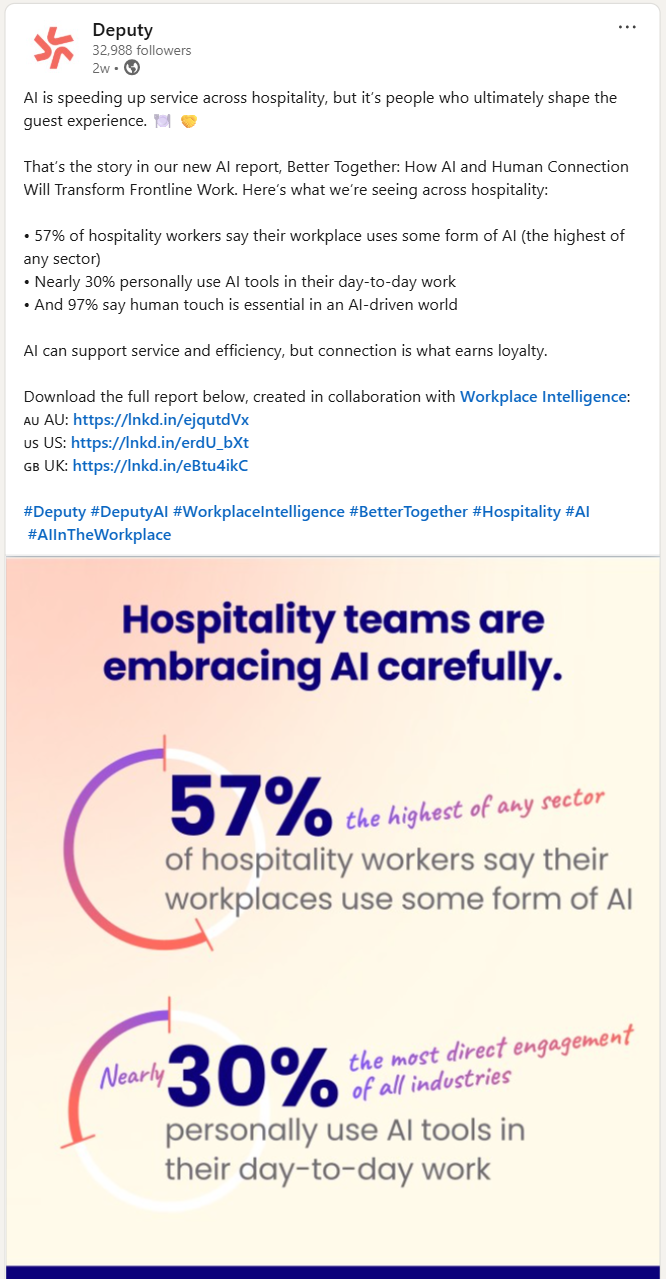
While each post gives users the option to click through to the full report, the key is that they don’t have to. The carousels themselves provide meaningful, bite-sized takeaways so users can pinpoint relevant findings in a matter of seconds. In sharing this content, Deputy proves that it respects users’ need for in-depth insights and their time.
Zero-click content can also have a more playful twist. As Redman highlights, “entertaining, highly relatable, ‘oh, that’s so me’ shareable content” is integral to building trust over time.
“That [trust] leads to higher ticket sales, less churn and a shorter sales cycle because it amplifies the brand voice,” she says.
“Even among people who are never going to buy from you—perhaps they just want to work there or they just like your content—you are building social proof. Social proof makes people feel safe. [And] feeling safe as a customer is what it’s all about.”
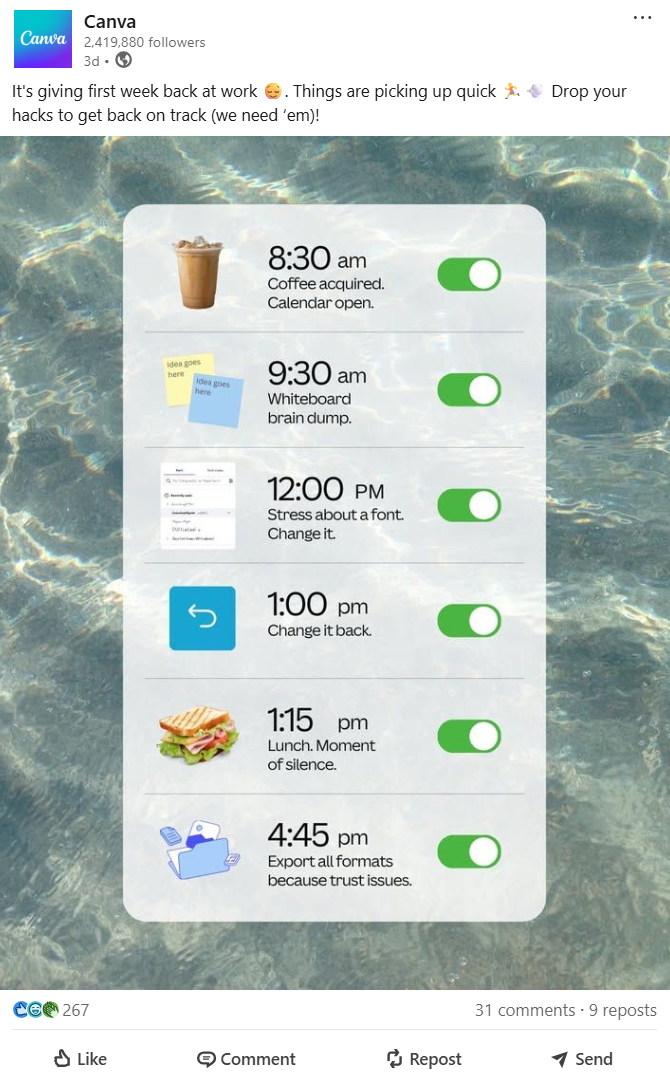
Graphic design tool Canva often shares funny and relatable posts aimed at corporate workers. Tapping into those recognizable moments humanizes Canva’s brand and grabs users’ attention—without asking for a single click.
5. Partner with external thought leaders
Collaborating with outside creators, influencers or brands can help build credibility and expand reach.
As with any form of B2B influencer marketing, the key is to partner with people and organizations complementary to your brand. That is, those who actually use your product or service, have direct access to a shared target audience or share similar values. Doing so will result in collaborations that feel seamless, authentic and honest.
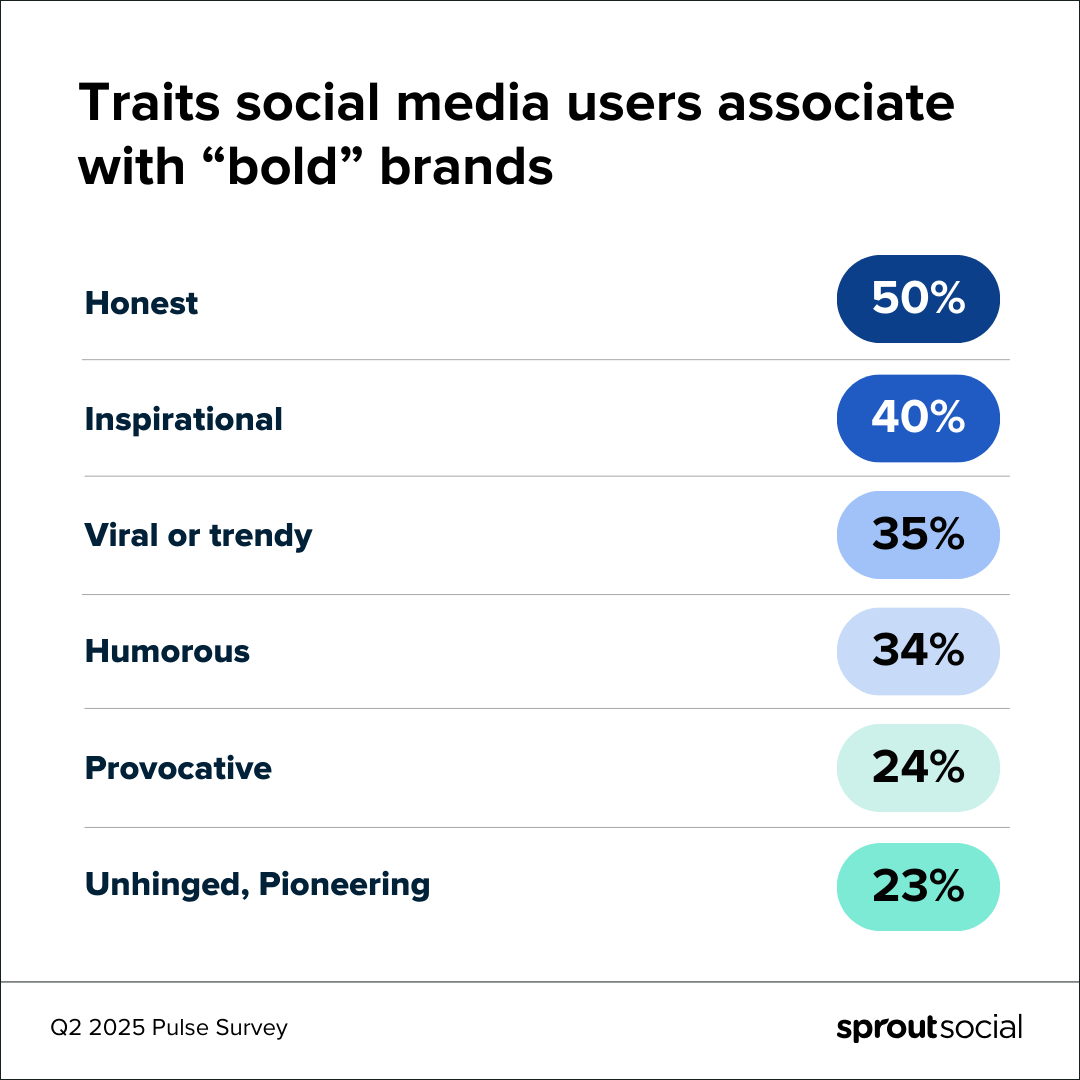
Per the Q2 2025 Sprout Social Pulse Survey, honesty is a top-of-mind trait among consumers; they associate it as the top trait for “bold” brands.
With that said, collaborations can take many different formats across many different platforms—meaning B2B brands should think outside the box.
“Content partnerships can be between an influencer and a brand, but they can also be between two influencers or two thought leaders. It could even be a head of sales and an incumbent CEO talking about upcoming changes in a company.”
“Doing content partnerships with them can be a lateral move, such as a LinkedIn Live with a high-profile client or appearing on a podcast with a peer to talk about industry problems,” explains Redman.
Thinking outside the box is exactly what Slack did in its recent partnership with social media giant MrBeast. Known for his extravagant competition shows and giveaways, MrBeast is a slightly unexpected partner for a corporate communication tool like Slack.
But with over 665 million social followers, MrBeast is running a mammoth content business that specializes in large-scale productions. As a result, his teams must collaborate constantly—which is where Slack comes in.

For Slack, the collaboration achieves two things. Firstly, it enables the brand to tap into MrBeast’s enormous, highly engaged audience that it may not have reached otherwise. Secondly, it showcases its product in a fresh context. Instead of positioning itself as a corporate tool, it’s framed as the communication pillar for fast-moving, larger-than-life businesses in any industry.
The result is storytelling that feels natural, not promotional. In the video, MrBeast isn’t overexplaining the product or forcing a sales message. He’s simply highlighting how it fits into his professional ecosystem and the value it provides.
According to Redman, that subtlety is essential in B2B brand storytelling.
“Ultimately, it is about how you build a community with peers, thought leaders and media personalities to create an ecosystem. If you are selling something all the time, no one is going to listen to you. It is annoying, whether you are at a party, a networking event or online. People can intuit it right away and they shut down,” she says.
“Relationship building is much more important, and you achieve that through partnerships and thought leaders tapping into each other’s networks to amplify a shared message.”
3 key B2B thought leadership takeaways for leaders
Kara sums up her biggest takeaways for leaders in these three key insights.
- Lean into empathy marketing: Redman says, “[Customers] do not care if your product has three more features than your competitor’s. Using brand storytelling and thought leadership as a tool to better understand customers and insert yourself into existing conversations is the whole point. If you’re doing it just to be famous, you won’t be.”
- Engage in community forums and conversations: “If you’re obsessed with what’s happening in the market and the conversations people are having around your solution, you’ll never have to write a single post asking people to buy from you. People will trust you and realize on their own, ‘Wait, what do they do? Oh, they can solve my problem.’ They will find it. If you are looking to start a personal brand or thought leadership in a B2B space, be obsessed with the conversations already happening, participate in them and learn from them. That is what makes people feel safe and related,” Redman advises.
- Don’t be afraid to get your hands dirty: “‘Roll up your sleeves’ is a great term here. Our best clients are leaders who will load up their own cars to drop something off at a client’s location because it has to get done. I don’t see authority as a means to do less work; I see it as more responsibility and a privilege to be of service to the market. If that’s who you are, you’re going to do well with this strategy,” Redman concludes.
Start writing your B2B brand story
Armed with these expert tips and strategies, you’re ready to write the first chapter of your brand story.
In doing so, remember that the focus of B2B brand storytelling should be less on business and more on people. Humanize your brand by empathizing with your customers’ pain points, sharing leadership’s expert insights and encouraging your employees to share authentic content on their profiles.
When done well, humanizing your brand doesn’t just create a more compelling social story; it accelerates sales cycles, boosts loyalty and drives long-term revenue impact.
Take the first step in crafting your B2B brand storytelling strategy with Sprout’s LinkedIn business worksheet. Use it to refine your brand voice, map your content pillars and brainstorm ideas for employee involvement to help your brand show up on social with clarity, cohesion and confidence.
Download our LinkedIn for Business Worksheet.
37 free social media strategy templates that will elevate your workflows
Published on December 5, 2025 Reading time 15 minutes









Share