Trendjacking: How to get it right (by doing it less)

Written by Rebecca MacFarlane
Published on April 23, 2026
Reading time 8 minutes

Table of Contents
Like them or not, trends are an integral part of social media’s makeup. But for brands, their efficacy can be hit and miss.
According to The 2025 Sprout Social Index™, social users are split: 40% think it’s cool for brands to jump on trends, while 33% think it’s embarrassing. Another 27% say it’s only effective if a brand reacts within 24–48 hours.
With that said, brands need to be fluent in online culture—and understanding trends is a core part of it. Per The 2026 Social Media Content Strategy Report, 70% of social users believe brands already do a good job of keeping up with trends and cultural moments. On the other hand, 43% say brands don’t publish truly original content.
These figures mean that brands are walking a fine line: keep up with online trends but don’t rely on them so much that you abandon originality.
We’ll explore the tactics you can use to strike that balance in your trendjacking strategy, as well as some of the brands already nailing it.
What is trendjacking?
On social media, trendjacking is the act of partaking in real-time, viral trends, such as memes, sounds, challenges or hashtags.
Trendjacking can help boost awareness and engagement because trends create a shared point of reference that plugs you into an already-engaged audience. Plus, it embeds you in culturally relevant conversations, which is especially crucial for brands in the B2C and CPG industries.
The most effective trendjacking examples go beyond copying the format, putting a brand‑specific spin on the trend. It’s not enough to simply mimic the formula and slap your logo on it. You have to make the content relevant and resonant to your industry, products or services.
For instance, several brands capitalized on one of the biggest cultural moments of 2025: the release of Taylor Swift’s album, The Life of a Showgirl. The trend saw businesses meme-ify the album cover on social, incorporating glitter and sequins, and hues of mint and orange.
Beloved game show Wheel of Fortune did the same thing while putting its own spin on it: celebrating its very own showgirl, Vanna White.

How to perfect a trendjacking strategy
While trendjacking can be an artform, mastering it doesn’t have to be complex. By following these tactics, you can create a balanced trendjacking strategy that enables timely production, marries trending and original content, and builds a distinct brand identity.
Create a newsroom
A social media newsroom is a digital one-stop shop where a brand compiles all its news, announcements and multimedia content for easy access and distribution.
To adopt this framework, build a cross-functional team, gather diverse news and data sources, and create a process for developing content fast. The latter is especially important because trend lifecycles are typically short; wait too long, and you’ll miss the boat.
Fortunately, a centralized hub makes it easier to move at pace. Additionally, there are many other tactics you can use to accelerate content production and approval timelines. Things like shared templates, asynchronous communication channels like Slack and flexible editorial calendar space can make a huge difference.
Balance trending and original content
It’s time to settle a debate as old as social media itself: it’s not trending vs. original content—the best strategies have both.
While you can absolutely leverage trends, you still need to create original content, including series. For example, some of National Geographic’s Epic Food Journeys with Mark Wiens YouTube series is among its most popular content on the platform.
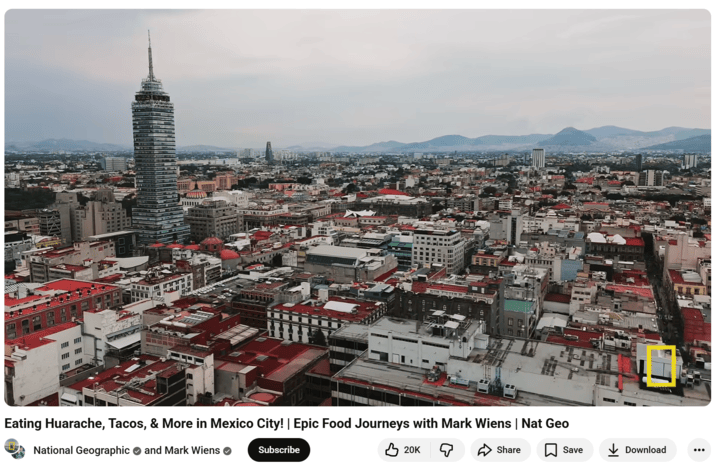
Original content lays the groundwork for a unique and recognizable brand identity. Trending content then becomes the timely layer that sits atop that foundation, fostering both relevance and reach.
Together, these two content types build a balanced ecosystem that keeps your brand consistent and culturally relevant.
Add something to online culture
Trendjacking is the perfect opportunity to not only draw from online culture but contribute to it. Look at how the best brands on Instagram refine their trendjacking approach.
According to Dejaih Smith, social media trend analyst and writer for Silence, Brand! and Senior Social Community Manager at Sony Pictures Entertainment for Jeopardy! & Wheel of Fortune, 2026 is the Year of the Tastemaker on social media. And contrary to popular belief, it’s not celebrities and mega influencers who shape trends in their infancy—it’s micro-creators and communities.
“Before a trend reaches the masses, it usually begins as a whisper inside niche communities—an aesthetic experiment, a fandom reference or a meme circulating without context,” writes Smith on Substack. “These early signals rarely appear in trend reports.”
Case in point, after the TV series Heated Rivalry captured the hearts of viewers worldwide, Jeopardy! referenced the fandom on its show and its Instagram.
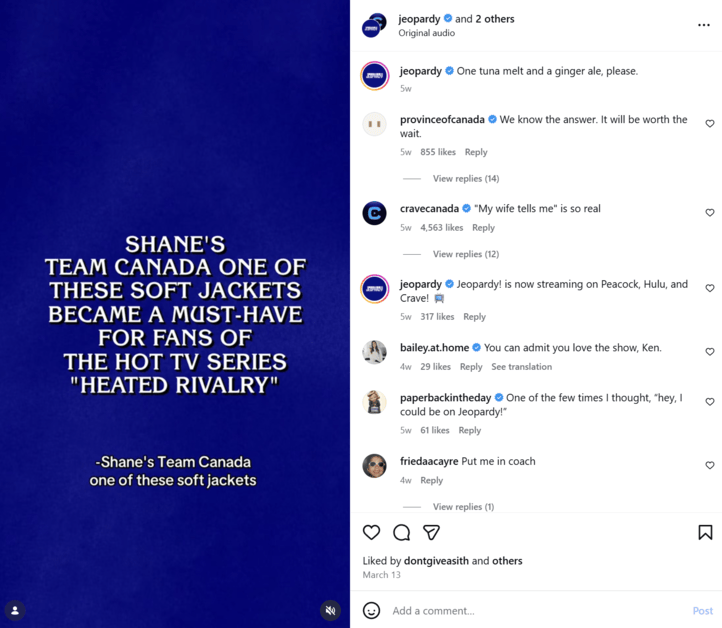
To stay ahead of the trends—and potentially even start your own—research these niche communities. Take a close look at the ones most resonant with your target market. Smith recommends focusing on psychographics rather than demographics.
“Age, gender and location reveal very little about why someone chooses one product over another. Understanding the communities they participate in, the references they recognize, the aesthetics they gravitate toward and the creators they trust reveals the cultural logic behind their decisions.”
With this knowledge, you can turn social insights and newsroom headlines into social intelligence that harnesses those raw, real-time audience insights, and embed them into your strategies).
Stay true to your brand identity
We’ve said it already, and we’ll say it again: you can’t just recycle trends—you need to tailor them to your brand values.
Think of it this way: if you post the same meme as every other brand in your sector, you won’t stand out. To avoid this, infuse your trendjacking content with personal elements unique to your brand. This will ensure that your content is tied to your industry, product or service while simultaneously providing substance to your audience.
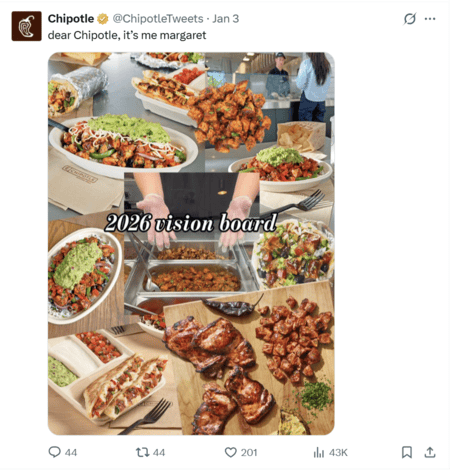
Trendjacking examples from brands that have mastered it
For many businesses, trendjacking is an integral part of their social strategy. Let’s take a look at four brands that haven’t just embraced the tactic but aced it:
IKEA
If anyone knows how to respond to cultural moments, it’s IKEA’s Responsive Project Team. Per Elissa Wardrop, Social Media Specialist and Content Creator at IKEA Global, the team was developed to “create content in response to news, trends, pop culture moments and key calendar dates (like April Fools’ or Valentine’s Day)—quickly, creatively and in a cost-efficient way with what we call the IKEA ‘twinkle in the eye.’”
So far, the team has leveraged some of the most iconic online trends and pop culture moments worldwide, including Netflix’s beloved show Bridgerton.
When the show’s fourth season was released, one scene in particular sparked a lot of online conversation: the bathtub scene (IYKYK).
IKEA inserted itself into the discourse with a cheeky post promoting one of its affordable bathmats. Since it was shared so quickly after the release of season four, part two, audiences thought that the brand was acting fast.
The reality? The Responsive Project Team planned it for weeks, despite many of its members never having seen the program.
“I’ve never watched a single episode. So off I went to watch the trailer and spent some time in the comments section (a goldmine for context), and quickly understood that the ‘bathroom scene’ was highly anticipated by book fans. And that insight was enough to shape a relevant, culturally aware post,” said Wardrop.
“Reading the comments on the IKEA posts, the outside world seems to think we acted at lightning speed after the season had aired. The reality in this situation is we’d pre-empted the moment using signals from the trailer and fan conversation.”
The campaign was a success, even catching the eye of Sophie herself. The actress who plays her, Yerin Ha, commented on the original post and shared the content to her Instagram Story.


Monzo Bank
Finance is often a tricky sector for brands making their name on social. Businesses in this industry have to navigate strict regulations, taboos and steep learning curves to connect with audiences. With so many obstacles, crafting a social strategy can feel impossible.
With that said, Monzo Bank makes it work. Instead of using social to discuss or promote its products, Monzo uses it as a brand-building tool. No matter what kind of content it posts—be it a street-style interview or a meme—the British bank prioritizes relatability, accessibility and relevance to stand out on social.
This approach also informs the trends that Monzo jumps on. For instance, to usher in the new year, many social users shared their “ins” and “outs” for 2026. Brands were quick to partake in the trend, including Monzo.
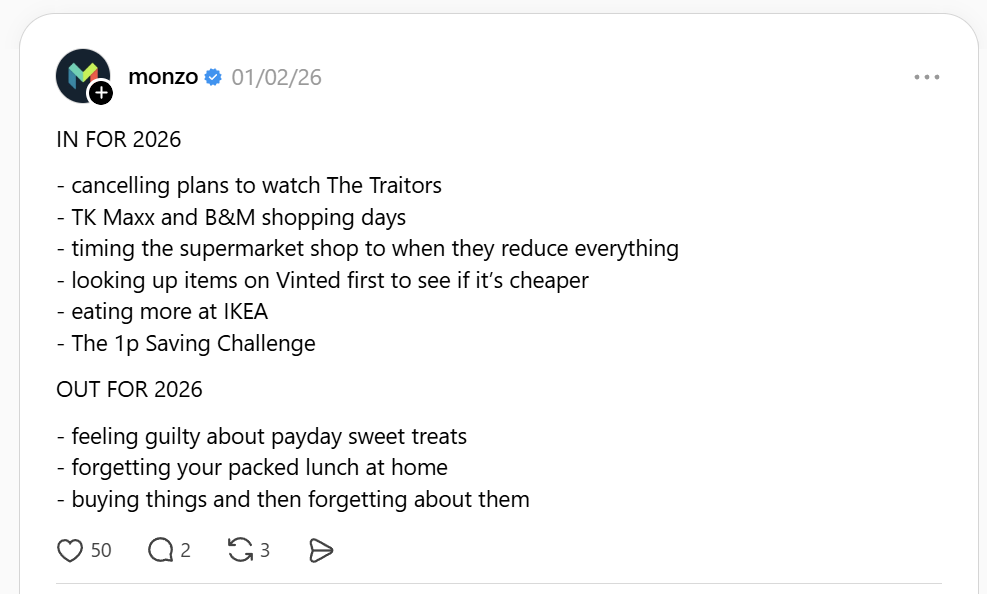
Rather than focusing on financial themes—which could be confusing for everyday users and risky for Monzo—the brand cast a wider net. In addition to using human language, the business made pop culture and lifestyle references that nearly anyone could relate to.
By embracing an irreverent tone and trending content types, Monzo is breaking free from banks’ “safe and stuffy” reputation on social. Instead, it’s carving its own space, one that feels culturally fluent, timely and likeable.
Slate
As a dedicated image and video-editing tool for social media marketers, Slate is ideally positioned to monitor and repurpose social trends.
On LinkedIn, the brand doesn’t adopt traditional corporate speak; instead, it flips the professional network on its head by leaning into timely and trending moments.
One of these trends is 2016 nostalgia. Ten years on, it seems that social users are yearning for 2016 more than ever. Per the BBC, searches for “2016” on TikTok surged by 452% in January. Plus, more than 55 million videos have been created using the app’s filter named after the year.
Slate capitalized on the trend by highlighting the evolution of social media and, more specifically, the roles of social media managers.
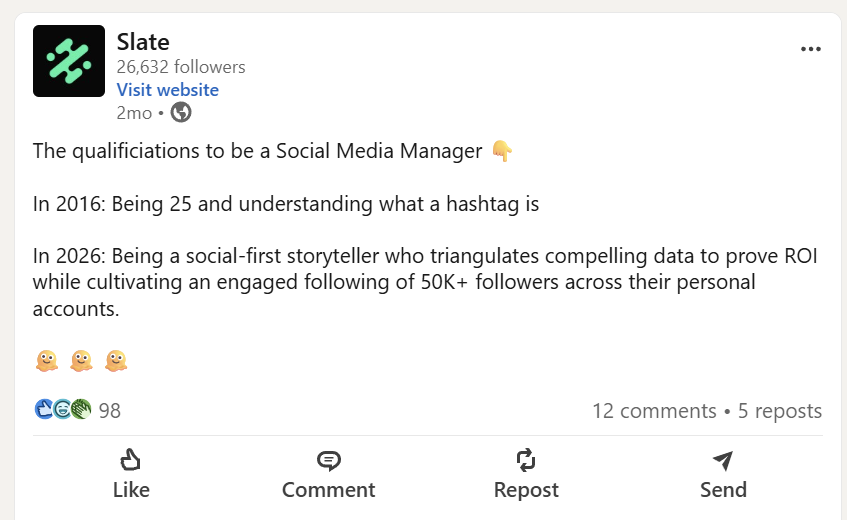
With this contrast, Slate turns nostalgia into an in-depth understanding of the social media marketing sector and the professionals who work within it. It’s a simple yet effective way to not only stay relevant but to reinforce its industry expertise as well as its connection to and understanding of its core audience: social media managers.
Popeyes
Undeniable experts in trendjacking, Popeyes is known for its timely and disruptive social media presence. The American fast food chain uses cultural moments to create trending content.
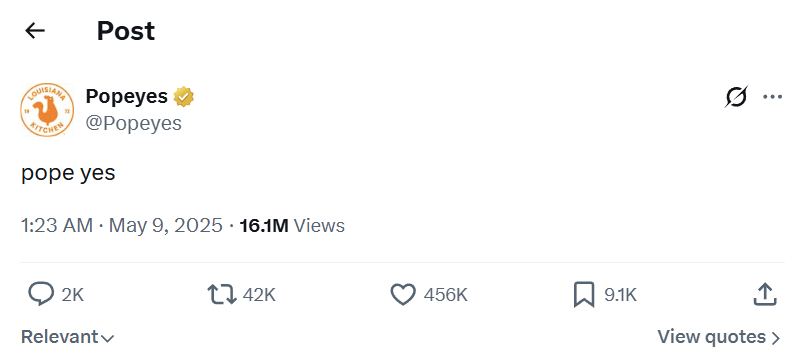
One of its most notable trendjacking examples is its “pope yes” post on X, published after the selection of Pope Leo XIV. Simple but highly clever, the wordplay married brand identity with cultural relevance, much to the delight of consumers and brands alike.
Grubhub declared it “Tweet of the year” while another user replied that, “This person who posted this needs an absolute raise. This is genius.”
But the brand didn’t stop there. Popeyes has also commented on a range of other cultural moments, including Taylor Swift’s engagement and the return of McDonald’s Chicken Snack Wrap.
Jack the trends, reap the rewards
While trendjacking has a place in every brand’s social strategy, balance is key.
Blend trendjacking with original content so your content feels topical and true to your brand identity. You must also be discerning in the trends you embrace and how you leverage them. Remember to prioritize quality over quantity. Rather than jumping on every single trend, pick the ones most relevant to your audience. Then, make sure you inject your brand values in a way that directly links to your industry, products or services.
For more insights on what social media users want from brands, so you can build your best social strategy, download The 2026 Content Strategy Report.
Frequently asked questions
How is trendjacking different from newsjacking?
Newsjacking involves providing editorial coverage of current affairs as well as your thoughts and opinions on these breaking news stories. While trendjacking involves iterating on the latest trends in online culture, especially on social media.
Although the two can overlap, their objectives are different. Newsjacking is primarily intended to educate, while trendjacking aims to entertain.
Does original content perform better than trendjacking?
Original and trendjacking content serve distinct purposes. So, it’s not a matter of one type outperforming the other; it’s about understanding how each can bolster your overall social strategy.
Trendjacking can help spike awareness and brand recognition. But original content is what helps your brand stand out and foster a unique identity for long-term engagement.
39 free social media strategy templates that will elevate your workflows
Published on August 20, 2026 Reading time 15 minutes








Share