How to build a LinkedIn dashboard that proves your social ROI

Written by Kimberly Steele
Published on February 26, 2026
Reading time 7 minutes

Table of Contents
You know that your team’s work on LinkedIn drives results, but the native LinkedIn analytics dashboard makes proving it an arduous, manual process. With it, your team may spend hours exporting siloed data and stitching together reports that offer limited insight into your true business impact.
It’s time to stop reporting and start strategizing.
A unified social media analytics dashboard moves your team from simply tracking posts to visualizing performance and proving a clear social media ROI. Here’s how to build a LinkedIn dashboard that transforms your team into a strategic business unit.
What is the native LinkedIn dashboard?
Every administrator of a LinkedIn Company Page gains automatic access to the native LinkedIn analytics dashboard. The platform provides this foundational reporting tool to all users.
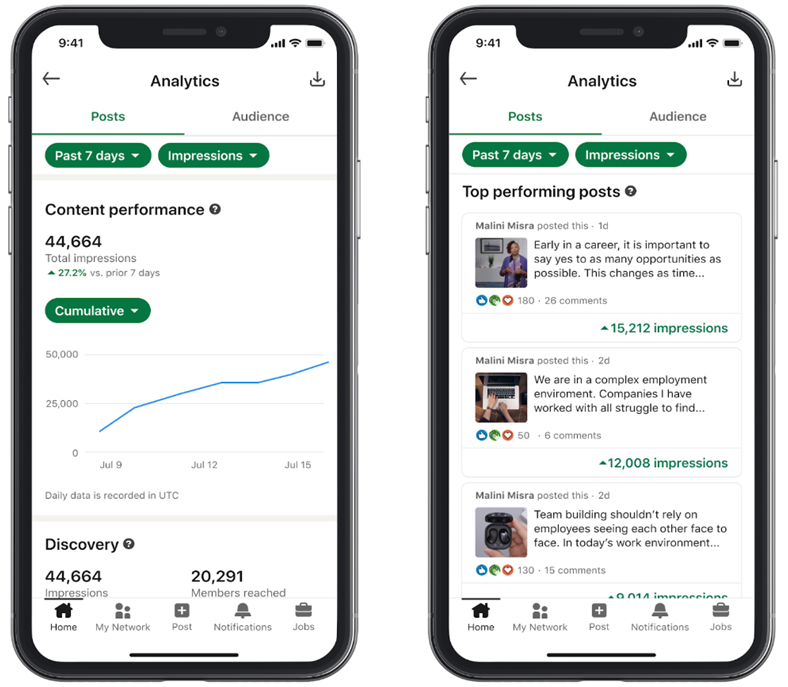
(Source: LinkedIn Help)
To find the native dashboard: Go to your Admin view and select the Analytics tab in the top navigation bar.
This built-in tool provides basic metrics across these three main categories:
- Visitors: Insights into page views and unique visitors
- Followers: Basic demographics and follower growth trends
- Content: Performance data on your most recent LinkedIn posts, including impressions, reactions and comments
While helpful for a quick check-in, the native dashboard is not a strategic decision-making tool. It provides raw numbers but lacks the historical context and cross-channel comparison needed to define a long-term content strategy.
Native LinkedIn analytics limitations and how to fix them
The native LinkedIn dashboard’s limitations become clear the moment you try to elevate your reporting. Teams often face three distinct roadblocks:
- Short data retention: Native data is often limited to specific time windows, making year-over-year analysis difficult.
- Siloed reporting: You cannot view LinkedIn metrics side-by-side with X (formerly Twitter) or Facebook data without manual exports.
- Manual effort: Building a monthly report requires exporting spreadsheets and building charts from scratch every time.
When you’re learning how to use LinkedIn, the goal is to move beyond simple post-level reporting. You need a centralized LinkedIn analytics dashboard that unifies your data, automates the busywork of reporting and provides competitive benchmarks.
This shift turns you from a data collector into an insight storyteller. A unified dashboard transforms numbers into meaning, allowing you to prove social ROI on LinkedIn and drive decisions.
Why your LinkedIn dashboard is more than just a report
Your LinkedIn dashboard isn’t just a data repository. It’s also a decision-making tool that drives your overall social media marketing strategy. When you centralize your data in a social media dashboard like Sprout Social, you unlock the ability to:
- Prove ROI: Connect specific LinkedIn campaigns to measurable outcomes, such as website traffic and conversions.
- Align with business goals: Shift the conversation from vanity metrics (likes) to key performance indicators (KPIs) that leadership cares about (engagement rate, click-throughs).
- Democratize data: Share secure, read-only links with stakeholders so they can view performance without needing Admin access to your LinkedIn Page.
How to build your LinkedIn dashboard in Sprout Social
The fastest way to access your data is to leverage Sprout’s pre-built LinkedIn Pages Report.
For teams that need to tell a specific story to leadership, Sprout’s Premium Analytics enables you to build a custom LinkedIn dashboard from scratch.
Here’s a step-by-step guide to setting up your own LinkedIn dashboard in Sprout:
Step 1: Connect your LinkedIn Company Page
To get started, connect your LinkedIn account to Sprout Social. The platform will immediately begin syncing your historical data and will then capture all future activity. This automatic data sync solves the native tool’s short retention issue, ensuring your reporting is always audit-ready.
(Source: LinkedIn)
Step 2: Choose your reporting path
Once connected to Sprout, navigate to the Reports tab. You have two options:
- For instant insights: Select the LinkedIn Pages Report, found under Profiles by Network. This pre-built template gives you a comprehensive overview of your performance immediately—no setup required.
- For custom dashboards: Select Custom Reports, available to Premium Analytics customers, to build a dashboard tailored to your specific KPIs.
Step 3: Select the right metrics for Custom Reporting
If you’re a Premium Analytics user building a custom dashboard, hand-pick the key metrics that matter most to your stakeholders. We recommend tracking:
- Audience growth: Track total follower growth and net add to measure the momentum of your brand awareness.
- Content performance: Break down performance by format (Video vs. Image vs. PDF) to understand what drives attention.
- Top performing posts: A visualization of your posts with the highest impressions, reaction counts and click-through rate (CTR).
- Engagement rate: Monitor the percentage of the audience that interacts with your content.
Step 4: Customize views for your audience
Your dashboard’s goal should be to inform action. Custom Reports allows you to build different LinkedIn dashboards for different stakeholders:
- For leadership: Create a high-level view that focuses on KPIs like follower growth, total impressions, web traffic and conversion rate.
- For practitioners: Create a tactical view that focuses on specific engagement metrics, such as post-level engagement rate, ideal posting times, as well as content format trends.
Step 5: Enrich with qualitative context
Data points alone don’t tell the whole story—you need context too. For example, the conversations happening on-profile will help you explain why certain posts resonated, raised questions or sparked reactions.
In a Custom Report, add Tag Performance widgets. By tagging incoming messages in Sprout’s Smart Inbox with your own tags (e.g., “Positive Sentiment,” “Product Questions,” “Pricing Feedback”), you can visualize qualitative feedback directly in your dashboard. This proves to leadership that you aren’t just counting likes and that you’re listening to the customer voice.
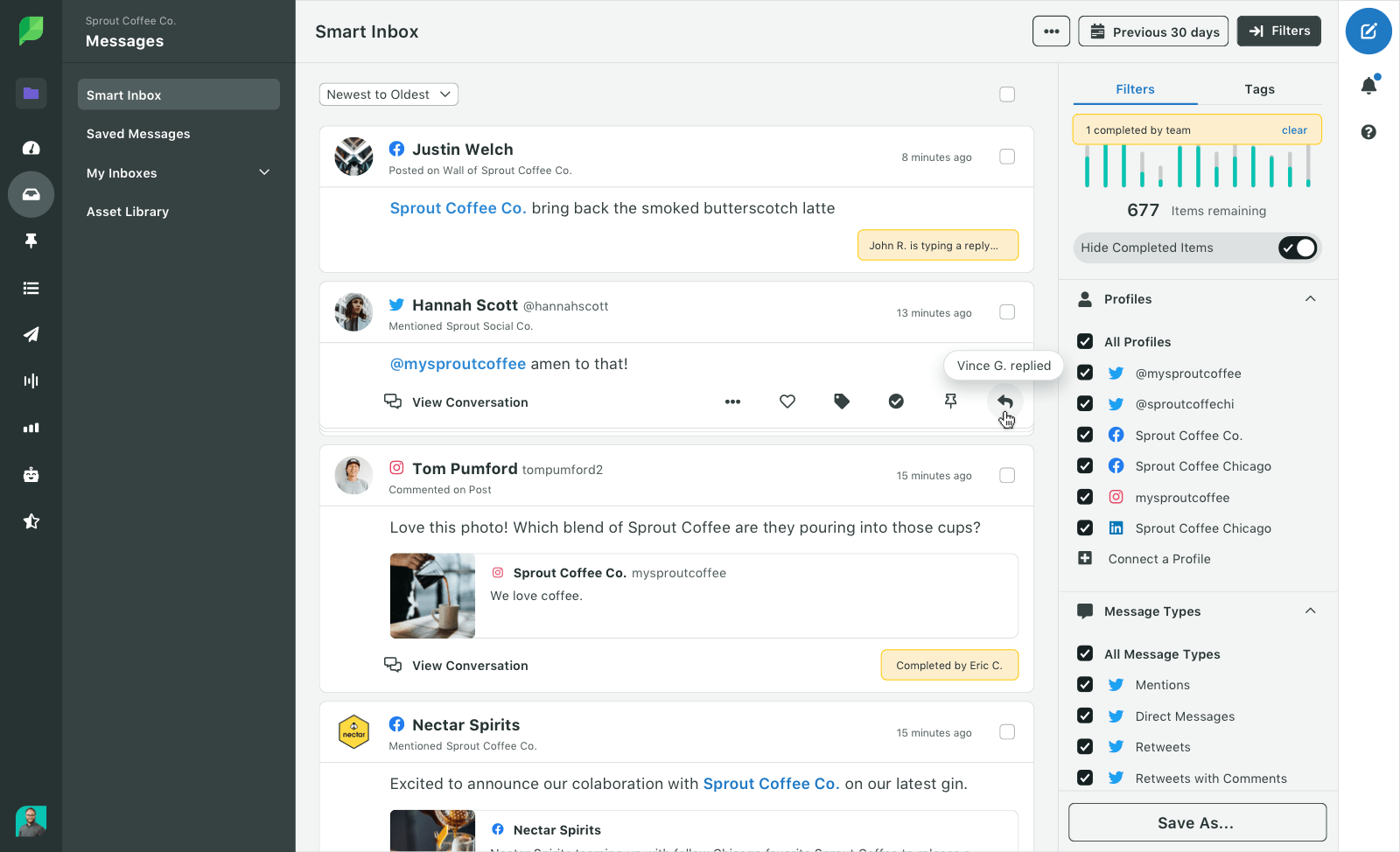
What’s inside a Sprout Social LinkedIn Pages Report
Once you’ve connected your company page to Sprout and your data is live, you need to interpret it.
Here’s how to use the specific tabs in Sprout’s LinkedIn Pages Report to extract actionable insights:
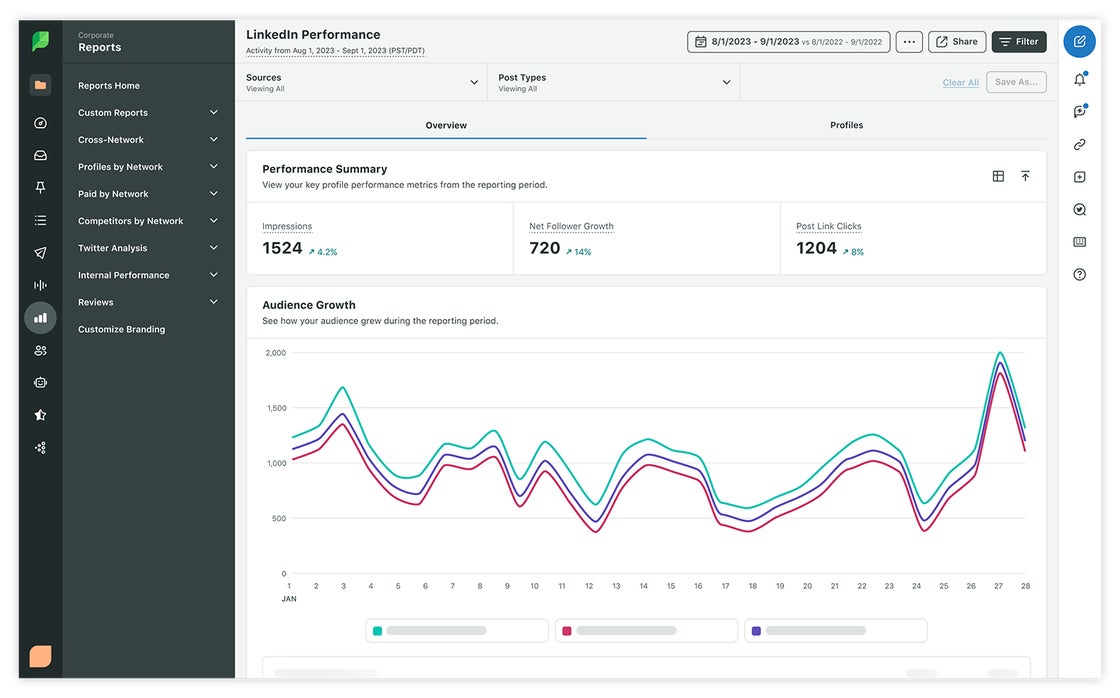
Overview
Think of the Overview tab as your morning health check. It aggregates your critical health metrics—Audience Growth, Publishing Behavior, Impressions and Engagement—into a single, high-level view.
Use this section to answer big questions quickly: Are we growing? Are we consistent? And, most importantly, is the audience caring? Analyzing your Engagement Rate alongside your Top Posts allows you to immediately spot which content types are resonating and distinguish between vanity reach and actual audience interest.
Post performance
The post performance section of the LinkedIn Pages Report highlights your top-performing post by metrics, including impressions, CTR and video views. With it, quickly see which topics, formats or types of calls to action drive the highest response rates.
Alternatively, use the Cross-Network Post Performance Report, filtered for your LinkedIn Company Page, to sort your content by type, tag and specific metrics.
Try sorting your last quarter’s posts by shares to see what content was viral enough to be reposted, and then sort by click-through rate (CTR) to see what content actually drove traffic. You will often find that “viral” content and “converting” content are two different formats.
Benchmarking
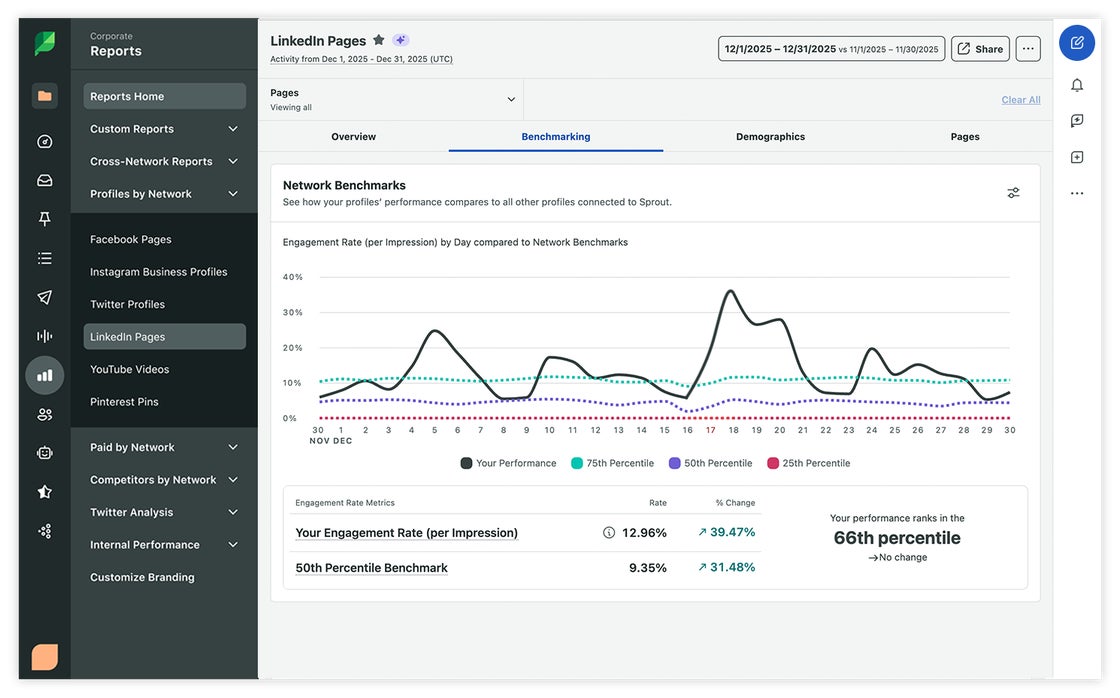
Context is everything. Sprout’s Premium Analytics customers often use data in the Benchmarking tab to answer the question, “Is this good?”
Benchmarking helps you visualize your Engagement Rate per Impression compared against all LinkedIn pages connected to Sprout. If your engagement rate is 2% and the average for Sprout-connected pages is 1.5%, you can confidently report to leadership that you’re outperforming the broader Sprout LinkedIn network.
Demographics
Your audience data is the key to successful targeting. Don’t just look at your total follower count. Consider who those followers are. Use the Demographics tab to view breakdowns by Job Function and Seniority Level.
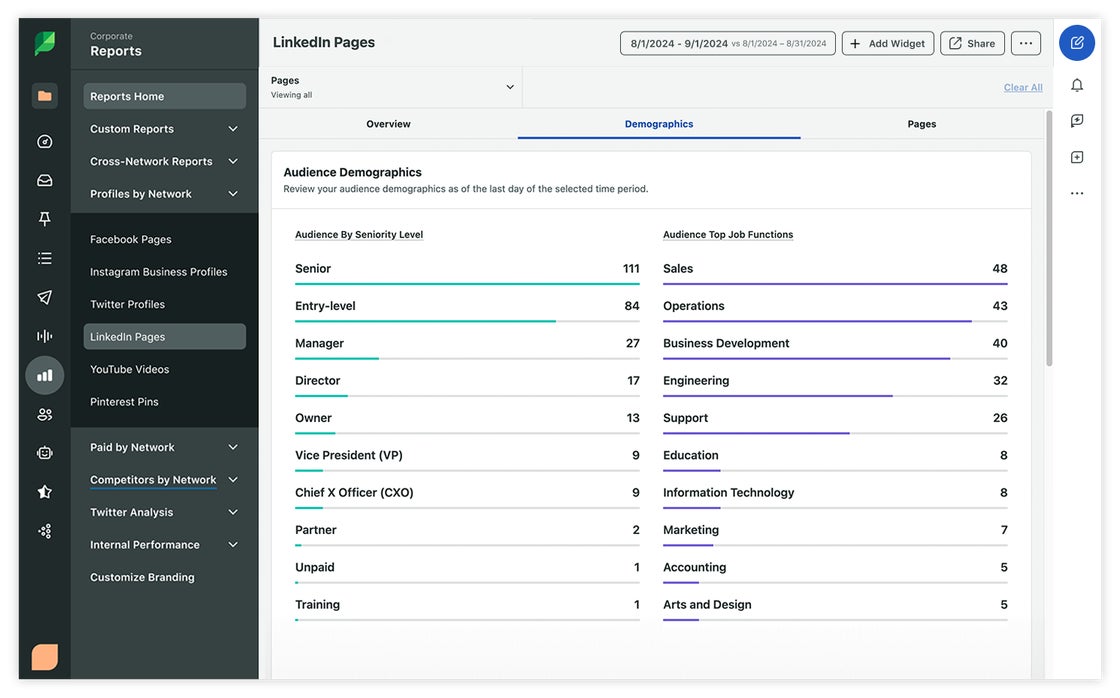
This is essential for B2B alignment. If your marketing messaging is technical, but your audience’s job function is mostly “Sales” or “Business Development,” you are speaking the wrong language to the wrong room. Use these insights to pivot your LinkedIn content strategy to appear to the decision-makers you actually want to reach.
Pages
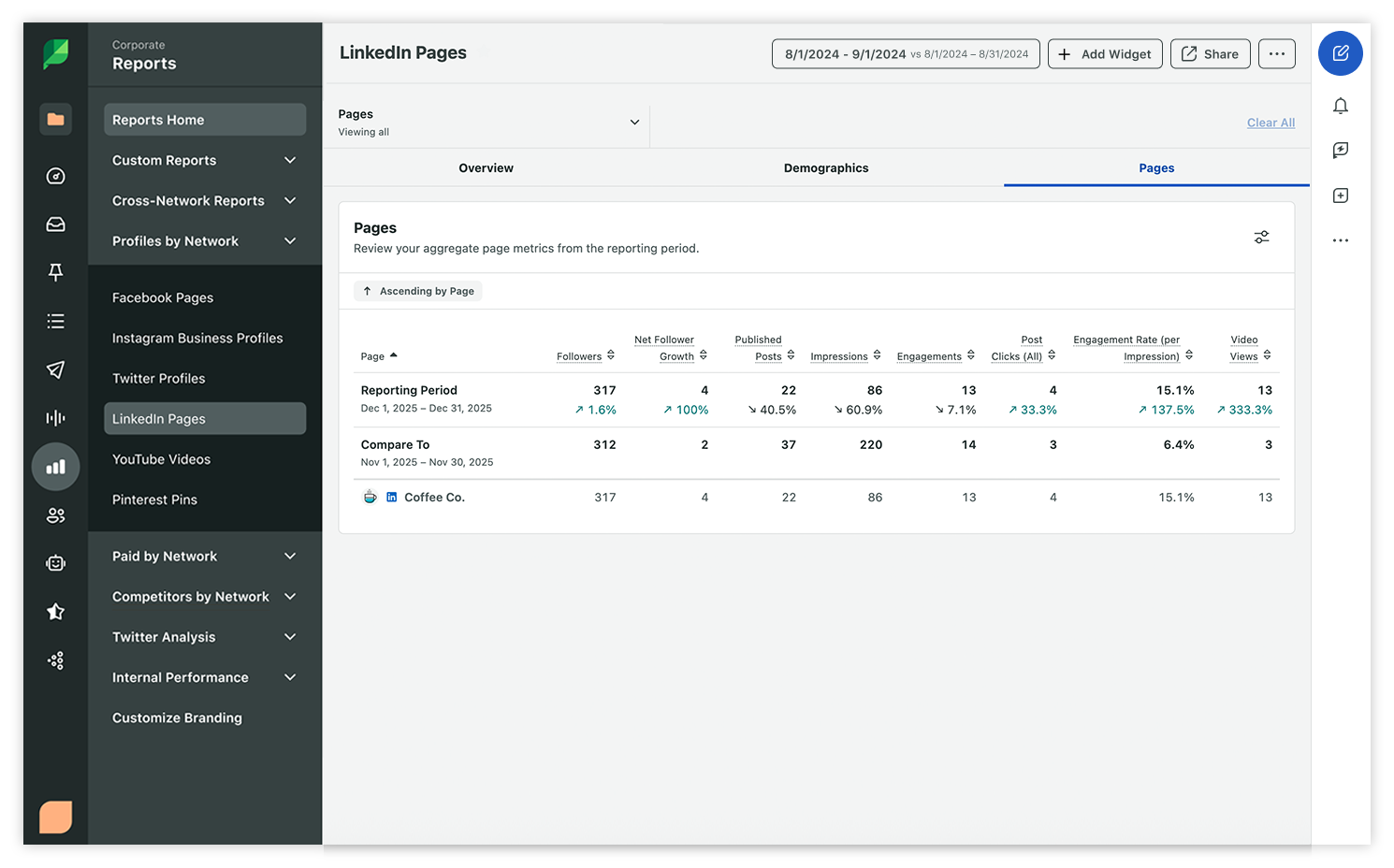
For agencies or enterprise brands managing multiple LinkedIn Company Pages—like global brands with regional pages or franchises—the Pages tab is essential. It provides a roll-up view that lists every connected page in a single table.
Instead of manually toggling between Admin views to gather data, sort the list by any metrics, such as Total Followers, Net Growth or Impressions, to instantly compare performance across all your accounts.
Bonus: Traffic and conversion data with GA4 integration
While this data doesn’t live in the native LinkedIn API, Sprout’s integration with Google Analytics 4 is a game-changer.
By pairing Sprout’s URL tracking functionality with GA4, you can use your LinkedIn dashboard to connect your posts directly to website clicks, form fills and campaign tags.
Presenting this hard conversion data moves your social team to a revenue driver, especially when you can say, “This LinkedIn campaign drove 500 leads.”
Go from LinkedIn dashboard to decisions
You no longer have to settle for the limitations of manual spreadsheets or the basic native LinkedIn dashboard.
By centralizing your LinkedIn analytics dashboard in Sprout Social, you automate the time-consuming parts of reporting, allowing you to focus on the story your data is telling. This capability positions you as a strategic leader, not just a publisher.
Ready to automate your reporting and prove your team’s impact? Start your free trial today and build your LinkedIn dashboard.
39 free social media strategy templates that will elevate your workflows
Published on August 20, 2026 Reading time 15 minutes









Share