Bluesky growth: Is your brand ready for decentralized social media?

Written by John Paul Hernandez
Published on February 20, 2026
Reading time 13 minutes

Table of Contents
Bluesky is growing fast—but is it a measurable, strategic channel or just another distraction in an already crowded social landscape?
As you reevaluate your platform mix, the rise of decentralized networks demands a closer look. You’ll get the social media statistics on Bluesky, its user behavior and its strategic fit for your brand. This guide gives you a leader-approved framework to decide whether Bluesky belongs in your 2026 roadmap.
Key Bluesky statistics: Top 2026 facts
The Bluesky app isn’t built for mass visibility; it’s built for community. Similar to Reddit culture, Bluesky users gravitate toward passionate spaces and expect you to contribute value and connect with them.
Before diving into strategy, here’s a clear, at-a-glance view of the metrics that matter most. These figures highlight Bluesky’s current scale, who’s using it and why the platform behaves differently from traditional social networks.
- Bluesky has roughly 40.2 million total users, making it a niche but expanding network.
- The platform sees an estimated 1.5–3 million daily active users, creating a small but engaged audience where about 8–9% of registered users show up daily.
- The United States leads with 50.13% of users, with Japan and Brazil also emerging as core growth markets.
- About one-third of users are under 24, and the audience skews male at roughly 61%.
- The average session lasts 10 minutes and 35 seconds, signaling that users come to participate rather than passively scroll.
- Discovery happens primarily through custom, community-built feeds rather than hashtags.
Bluesky user growth and milestones
Bluesky’s growth hasn’t followed the slow, steady arc of a traditional network. Instead, its trajectory has been shaped by sharp spikes from cultural moments, platform migrations and geopolitical events. The result is a social media network that expanded from 10 million users in September 2024 to 40.2 million by November 2025, a 302% increase in just over a year.
User growth over time
Here’s a timeline of the moments that reshaped the network:
- February 2024. Public launch (after invite-only period) earns almost 800k new users in a day.
- September 2024. Brazil’s X ban drives 2.6 million new users in one week (the ban has since been lifted).
- November 2024. The US presidential election triggers a jump from 15 million users on November 13 to 22.5 million 12 days later.
- August 2025. User count reaches 38 million, with growth stabilizing at roughly 1.6 million per month.
- November 2025. Total users reach 40.2 million.
Bluesky has grown through events, and each surge reflects a deeper theme: people are actively choosing spaces where they can participate on their own terms. This event-driven growth has shaped the culture of Bluesky itself, giving it a strong sense of community and a preference for conversations that feel intentional rather than performative.
The decentralization model is driving the user surge
Bluesky’s growth comes less from traditional social capabilities and more from its underlying architecture. Built on the AT Protocol, it gives people control of their identity, Feed experience and moderation preferences. Instead of one company dictating what you see, Bluesky lets you choose from more than 50,000 community-built algorithms. Developers can port identity across services, keep content unlocked from any single provider and build new apps directly on the protocol.
This openness shifts how you must operate. There are no ads to buy and no central algorithm to optimize for. Navigating this shift from algorithmic control to user sovereignty requires a specialized Bluesky strategy that prioritizes building community equity over traditional reach metrics.
Visibility comes from earning trust in community-driven spaces and participating authentically in relevant feeds. The platform rewards real conversation and punishes overly polished or promotional content.
You’ll struggle here if you rely on a broadcast-style social media strategy. Bluesky favors those who show up as people, respond to community discussions and contribute value rather than volume.
Here’s what the custom feed discovery feature looks like when you search for “birds.” If a brand wants to target an audience who enjoys parks, trails and nature, these Feeds are some of the places they hang out online.
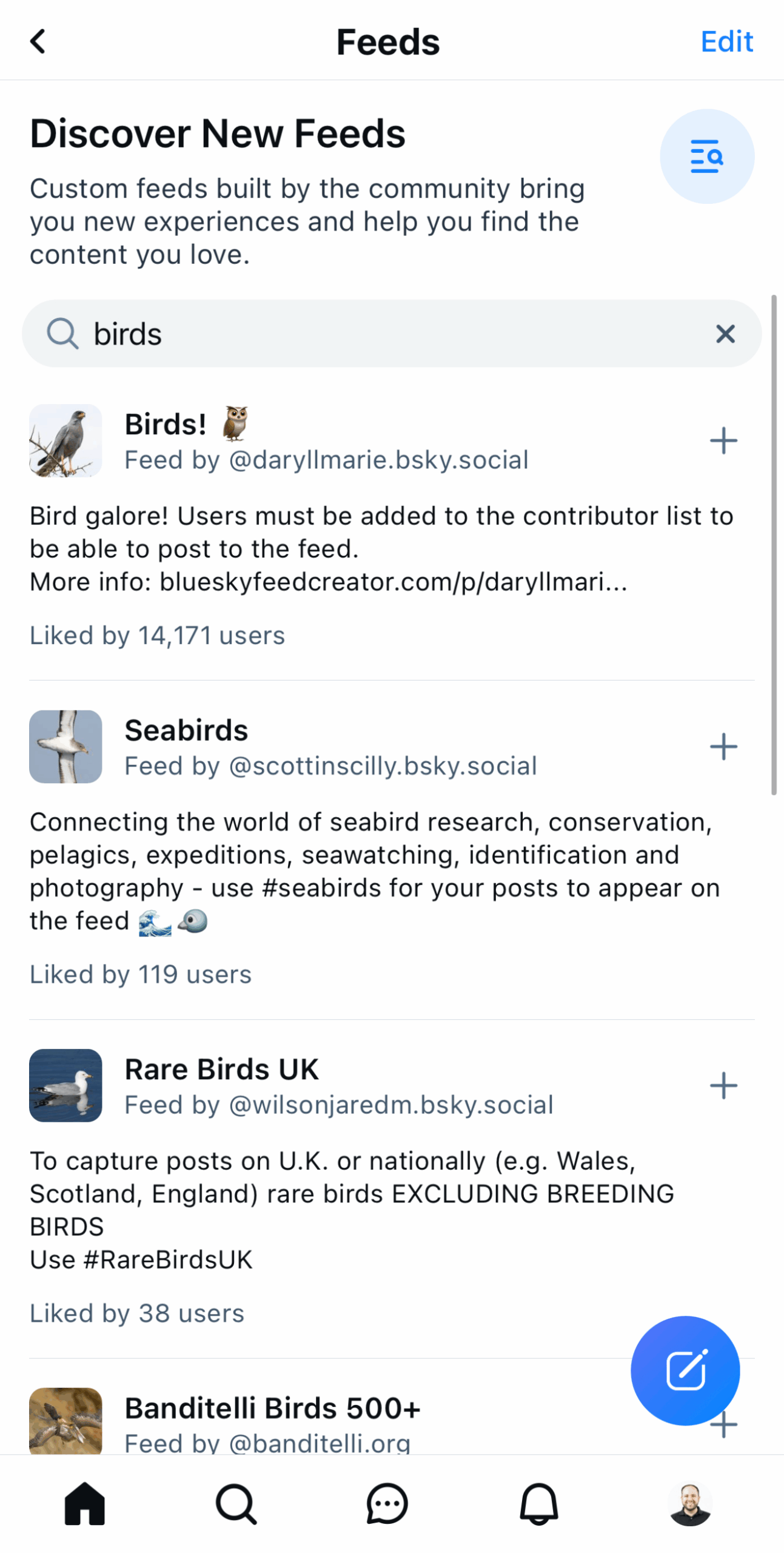
Source: Bluesky
Why Bluesky’s growth signals a larger market shift
Bluesky’s rise reflects a broader shift away from broadcast-style social platforms where algorithms and ads shape the user experience. People are seeking curated, community-driven spaces that give them more control over what they see, similar to the growth of Subreddits and Discord communities. Decentralized networks like Mastodon follow the same pattern, reinforcing that users want transparency and data ownership rather than black-box feeds.
The opportunity is real, but so is the risk. Platforms that surge early do not always sustain momentum.
Bluesky user demographics
Here are some key details about Bluesky users for your social media marketing strategy.
Age and gender breakdown
Bluesky’s user base skews young, male and tech-forward. Here are some statistics on the base:
Age distribution
While under one-third of Bluesky users are 18-24 years old, these statistics reveal visitors across older age groups.
- 25–34 years: 26.25%
- 35–44 years: 15.17%
- 45–54 years: 11.33%
Gender distribution
- Male: 60.61%
- Female: 39.39%
This is one of the more male-leaning social networks after Discord (67%) and beating Reddit (60%). While these demographics continue to evolve, the audience expects a human, mobile-first tone and is quick to call out anything that feels forced. This is especially true for Gen Z and younger millennials, who are often skeptical of traditional advertising. To reach them, your brand voice needs to feel real. Polished corporate language creates distance, while transparent communication from actual people on your team builds credibility.
Regional adoption: US, Japan and Brazil
Bluesky’s geographic distribution reveals both opportunities and constraints for global brands. These are the core statistics of the top countries using Bluesky.
United States
- Website visit share: 50.13% of visits come from the US.
- Strategic insight: If you’re a US-focused brand, Bluesky’s concentration makes targeting efficient. For international brands, US-centricity limits global reach, unless it’s from the top Bluesky countries.
Brazil: the surprise powerhouse
- Website visit share: 4.06% of Bluesky visits come from Brazil.
- Growth trigger: When Brazil banned X in September 2024, Bluesky gained 2.6 million Brazilian users in one week.
- Localization opportunity: Brazil represents one of Bluesky’s largest active markets, demanding Portuguese-language content and cultural adaptation.
Japan: the underreported market
- Website visit share: 6.03% of visitors come from Japan.
- Growth trajectory: Monthly active users on Android in Japan quintupled in 12 months through October 2024.
- Cultural fit: Japan’s privacy-conscious, tech-forward culture aligns with Bluesky’s decentralization ethos.
Other major markets
- United Kingdom: 4.68% of visitors
- Germany: 4.54% of visitors
Strategic insight for global brands: Bluesky demands regional strategies. A US-only approach misses high-engagement markets like Brazil and Japan. Brands should prioritize:
- US for volume
- Brazil for engagement intensity
- Japan for growth trajectory
Effective Bluesky presence requires multilingual content and cultural localization (not just translation).
Bluesky user engagement and behavior
Bluesky’s engagement patterns look different from mature networks, and leaders should plan with that in mind. The platform may report more than 40 million registered users, but only about 1.5-3 million show up daily. That’s roughly an 8-9% daily active users (DAU) ratio—low compared to established networks like X, but typical for a platform where user habits are still forming. The most active behavior comes from the US and UK, where engagement outperforms their share of total users.
Content activity follows a similar early-stage rhythm. Sessions average around 10 minutes, most people consume more than they post and there’s only about 1.4 million new posts daily. This creates a small but attentive audience where thoughtful conversations outperform sheer volume and where follower counts don’t always reflect true reach.
Brands that show up with relevance and intention stand out, while posting too frequently can feel out of step with Bluesky’s more intimate, chronologically driven environment.
How Bluesky behavior compares to X
Bluesky and X may look similar on the surface, but people use them in fundamentally different ways. X is built for scale and thrives on real-time news cycles, viral spikes and algorithmic reach. Bluesky behaves more like a network of niche communities. People show up to escape the noise, join thoughtful conversations and connect in ways that feel more intentional. That difference creates a content environment where authenticity carries more weight than amplification.
For social media marketers, the takeaway is simple: Bluesky rewards participation, not broadcasting. A copy-paste strategy from X will fail.
Because your team is likely already juggling multiple real-time feeds, finding ways to schedule Bluesky posts will ensure you maintain that “niche community” feel without needing to be manually logged in around the clock.
Content format and brand signals
Bluesky supports text, images and video, but the content that performs best reflects the platform’s culture. Conversational threads, behind-the-scenes insights and genuine team moments tend to stand out. Community participation, especially replies, often drives more visibility than original posts. You build trust faster by showing curiosity, asking questions and participating with intention.
From statistics to strategy: How to act on this data
Here are some practical ways you can grow on Bluesky.
Your audience is young and authentic
The Bluesky audience wants to connect with people, not a corporate logo. As a social media marketer, use Bluesky to make genuine connections using the following insight and strategy.
- The data: The majority of Bluesky users are under 35, and the platform skews male at about 60.61%, creating a younger, tech-forward audience that’s skeptical of corporate messaging. Average session durations of more than 10 minutes show that these users are engaged, intentional and selective about what they interact with.
- What it means for strategy: This demographic demands human voices, not brand voices. They’ve grown up with ads and can spot inauthenticity instantly. If your tone feels scripted, you’ll be ignored.
Action plan:
- Empower your team: Let social media managers post as themselves, not as “the brand.” Use first names, show personality and admit mistakes.
- Be conversational: Respond to replies, ask questions and join discussions in custom feeds. Think community member, not megaphone.
- Show the humans behind the brand: Post behind-the-scenes content, team spotlights and work-in-progress updates.
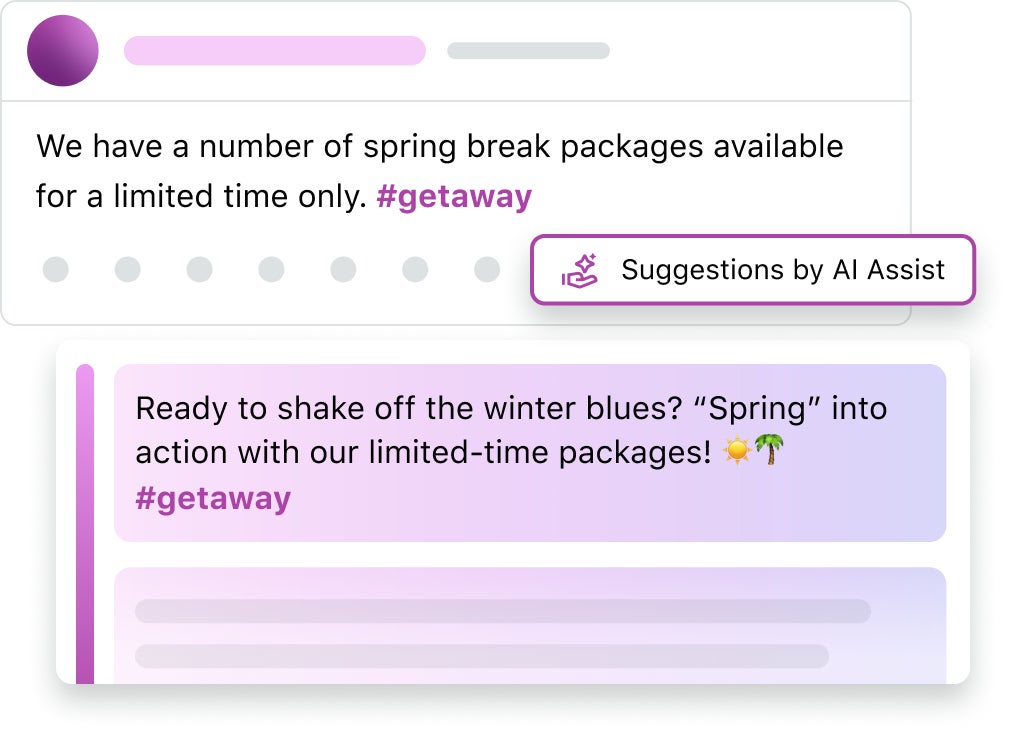
This is where Sprout Social’s Generate Posts by AI Assist becomes valuable. It helps teams craft engaging, on-brand posts that sound human while maintaining consistency. Use it to brainstorm conversational hooks, then edit for authenticity.
Use custom feeds to your advantage
Bluesky users want to control their experience. Your social media team can use this to their advantage by tapping into an already-existing user demand for specific content. Custom feeds surface content based on the keywords, topics or communities users choose to follow, which means discovery depends on relevance rather than algorithms. When brands post with the right keywords and participate in those niche conversations, their content naturally appears in the feeds where people are already paying attention.
Here’s how you can use the Feed feature to your advantage.
- The data: Bluesky has 50,000+ user-created custom feeds. Discovery happens through feed curation, not hashtags or algorithmic “For You” pages.
- What it means for strategy: Your content gets found when people subscribe to feeds where your posts appear. This is the network’s core discovery engine, distinct from hashtag strategies on Instagram or TikTok.
Action plan:
- Identify relevant feeds: Search for feeds your target audience follows (tech, culture, industry-specific).
- Feed your feeds: Use keywords and topics that custom feed creators track. For example, if a “sustainability” feed tracks certain terms, include them naturally.
- Create your own feed: Advanced brands can build custom feeds that aggregate content around their niche, positioning themselves as curators, not just creators.
- Engage with feed communities: Follow active participants, reply to their posts and contribute value before promoting.
Custom feeds reward community participation over brand broadcasting. You can’t buy your way into feeds. You earn placement by being useful, interesting or valuable to that community.
Because these feeds are community-curated, partnering with feed creators and micro-influencers who manage popular feeds gives brands access to highly targeted audiences. This is one of Bluesky’s versions of influencer marketing.
Your audience values consistency
Since Bluesky is community-centric, showing up daily is non-negotiable. Here’s the insight and strategy required to meet user expectations.
- The data: 1.5-3 million users log in daily, with average sessions over 10 minutes. DAU-to-total-user ratio of 8-9% shows a dedicated core audience forming habits.
- What it means for strategy: You can’t treat Bluesky as a “one-off” or occasional experiment. Users expect a consistent presence from accounts they follow. Sporadic posting signals low commitment.
Action plan: At first, you might be thinking, “I can’t have my team manually logging into another platform daily.” This is where workflow infrastructure matters. A publishing tool, like Sprout’s unified content calendar, lets you schedule and manage Bluesky content alongside all your other channels in one unified calendar. You can plan cross-platform campaigns, maintain consistency and avoid manual logins.
Pilot, measure and iterate
Here’s a 90-day pilot with clear success criteria to get started on Bluesky growth.
Phase 1: Setup (weeks 1-2)
- Secure branded handle
- Audit competitors and early-adopter brands in your space
- Identify 10-15 relevant custom feeds
- Draft content calendar with conversational posts
- Set baseline KPIs
Phase 2: Launch and learn (weeks 3-8)
- Post 1x daily, mixing original content with replies
- Engage in custom feeds that your audience follows
- Track engagement patterns: what content gets replies vs. likes vs. reposts
- Test tone variations: corporate vs. casual vs. personal
Phase 3: Evaluate and decide (weeks 9-12)
- Review KPIs against benchmarks
- Calculate cost per engagement vs. other channels
- Assess team capacity required for sustained presence
- Decide: scale up, maintain or pause
A 90-day Bluesky pilot works best when you focus on signals that show whether your presence is gaining traction. Track steady follower growth, reply-driven engagement and whether your content is sparking real conversations in the communities you want to reach. Because custom feeds power discovery, it also helps to watch how often your posts appear in those feeds and whether they generate meaningful clicks when traffic is part of your goal.
Budget needs stay low and there’s no ad spend. But plan for a few hours of weekly team time, light content adaptation and the social tools you already use to streamline publishing and monitoring. Bluesky fits best within your mix as an awareness and community-building channel, not a conversion engine.
Leaders should expect a small but highly invested audience within 90 days and recognize that the social media value comes from relationship depth rather than scale.
How to measure Bluesky ROI
As your team adopts Bluesky as a social media network to connect with audiences, it’s critical to tie your efforts to real business outcomes. You’ll find it’s not so straightforward. Here are some of the challenges and solutions to measure your ROI.
Identify measurement and the “black box” problem
Bluesky’s native analytics are minimal compared to mature platforms, creating a “black box” problem for brand leaders who need data to justify investment. For instance, it’s missing features like built-in dashboards. Unlike LinkedIn or Instagram, Bluesky doesn’t offer native analytics for business accounts. There’s also a limited demographic breakdown, no advanced attribution and minimal exportable data.
Without measurement, Bluesky becomes a “trust us, it’s working” channel, which is a non-starter for data-driven marketing teams. This gap must be filled with third-party tools. With a third-party solution, you can track mentions, sentiment and engagement trends.
Along with tracking, add UTM parameters to attribute your efforts with impact. Tag all links from Bluesky to measure website traffic and conversions in Google Analytics.
These steps don’t have to be in silos. Sprout, for example, helps you track and report in one place. Its Post Performance Report, for example, provides details such as Likes, replies, reposts, link clicks and more across Bluesky posts.
Solve the measurement gap with post-level performance
A reliable post-level analytics tool helps close the measurement gap on Bluesky by giving you a clear view of how each post performs. Tracking Likes, replies, reposts, link clicks and long-term follower growth shows what truly resonates and where conversations take shape.
You can set internal benchmarks, compare engagement rates across your other channels, spot patterns in posts that spark replies and monitor how fast your audience grows week to week. Over time, these insights help you gauge reply rate, click-through strength and overall engagement per follower so you can judge whether your Bluesky presence outperforms other platforms and adjust your strategy with confidence.
Prepare for early-stage investment and risk modelling
Bluesky requires a different kind of early-stage investment mindset. Because the platform is still small, traditional ROI calculations will almost always look underwhelming, especially when compared to mature networks like Instagram or Facebook.
Rather than judging it through a performance-marketing lens, it helps to view Bluesky as a community investment and one that builds long-term affinity with a niche, influential audience. The returns will come from the depth of the relationship, not from immediate conversions.
Alternative ROI models can give you a more accurate sense of progress. One option is to focus on engagement quality instead of sheer volume. The question shifts from “How many people did we reach?” to “How many meaningful conversations did we create?”
Another model emphasizes influence over follower count by tracking whether industry micro-influencers, creators or journalists are part of your audience. A third lens looks at earned media value by paying attention to how Bluesky conversations translate into opportunities like press mentions, collaborations or speaking invitations. These models give you a clearer, more realistic picture of the platform’s impact.
Use this dashboard to help leaders understand how Bluesky performance aligns with long-term community and brand goals.
| Metric | Target | Why it matters |
| Engaged followers added per month | 50–100 | Shows whether you’re building a small but committed audience that cares about your content. |
| Replies to brand posts | 10–20% of posts | Helps you measure conversation quality, which is the core value of Bluesky. |
| Custom feed followers | 5–10 relevant feeds | Indicates how well your brand is integrated into key communities rather than relying on individual follower growth. |
| Click-throughs to website | 50–100 per month | Tracks how effectively your posts drive traffic toward your content marketing goals. |
| Brand sentiment | 80%+ positive | Helps you understand how people feel about your brand, informed by sentiment analysis tools. |
Bluesky requires a modest investment: usually a few hours with the tools you already use. The financial risk is low, and most brands can expect to build a small but engaged community within the first few months, making the main tradeoff more about team capacity than budget.
If engagement stays strong and replies show up consistently, it’s worth leaning in. Steady but quiet performance often calls for maintaining a light presence, while consistently low engagement after 90 days signals it may be time to redirect resources. The core question is whether you can afford not to test an emerging space; early movers often gain influence long before a platform reaches scale.
Ready to turn growth into measurable impact?
Bluesky’s 40 million users and consistent growth signal a platform that can’t be ignored, but also can’t be treated like Facebook or Instagram. Success demands a community-first strategy, authentic engagement and measurement tools that fill the analytics gap. For brand leaders evaluating resource allocation, the question isn’t “Is Bluesky big enough?” It’s “Can we engage authentically with a niche, influential audience?”
Start with Sprout Social. Manage Bluesky alongside your existing channels, schedule content efficiently and track post performance with real data. Turn the hype into measurable impact—or make an informed decision to invest elsewhere. Explore Sprout’s Bluesky integration.
FAQs about Bluesky growth
How fast is Bluesky growing?
Bluesky grew from 10 million users in September 2024 to 40.2 million by November 2025—a 302% increase driven by major events like Brazil’s X ban and the US presidential election. However, growth has slowed from 5 million users/month at peak to ~1.6 million/month by mid-2025. Daily active users sit around 3.09 million (8-9% of registered users), indicating a dedicated but still forming user base.
What is the most important metric on Bluesky?
Replies, not likes or reposts, are the most important metrics on Bluesky. The platform values conversation quality over content volume, so prioritize engagement for social media metrics. A post with 50 replies and 10 likes signals more community engagement than a post with 100 likes and 2 replies. Track your reply rate (replies per post) and prioritize content that sparks discussion. Follower count matters less than follower engagement.
What kind of content performs best on Bluesky?
On Bluesky, conversational, authentic, human content outperforms polished brand messaging. Effective formats include:
- Behind-the-scenes updates and work-in-progress posts
- Questions that invite community input
- Thoughtful threads on industry topics
- Replies to others’ posts (often more visible than original content)
- High-quality images and short videos that feel human, not stock
Be sure to avoid press releases, over-promotion, corporate jargon or content that feels like a marketing team wrote it, rather than an individual.
What are the biggest risks or considerations for brands on Bluesky?
There are two main risks and considerations for brands on Bluesky, including:
- Small scale: With fewer daily active users globally, there’s limited reach. Don’t expect a mass audience.
- Measurement challenges: Lack of native analytics means you must rely on third-party tools to analyze your growth rate.
37 free social media strategy templates that will elevate your workflows
Published on December 5, 2025 Reading time 15 minutes







Share