Social media for healthcare: Strategies for Australian providers

Written by Emily Jenkins
Published on December 22, 2025
Reading time 12 minutes
Table of Contents
Healthcare providers in Australia face unique challenges online, including strict AHPRA compliance rules and small teams with limited time.
Social media is the tool to bridge those gaps. With the right strategy and platform, you can effectively connect to your local community, share credible health education and strengthen patient trust. Plus, a strategic approach to social media for healthcare can reduce daily workloads.
This is how Australian healthcare providers can extend the reach of their social media customer service to educate, engage and build trust with patients, even in remote locations.
Why social media matters for rural healthcare
In Australia, residents already turn to digital sources for health advice. The government’s Healthdirect site logged over 24 million visits in 2024, while Victoria’s Better Health Channel draws more than 2 million unique visitors each month.
The takeaway? There’s enormous demand for credible health information online, especially in rural areas where access to in-person care is limited.
But for rural and remote communities, the challenge isn’t just digital—it’s geographic. Fewer clinics, longer travel times and limited preventative services mean many people still go without timely care.
This is where social media steps in and extends your reach to include rural communities. Healthcare teams can use social to share health reminders, educational posts and reliable updates online, closing part of the distance that geography creates. And with most Australians relying on mobile internet, social networks aren’t just convenient. They’re already in people’s hands, making social media one of the most effective delivery channels to reach rural communities.
But reach alone isn’t enough. To turn that digital connection into real impact, rural providers need a social media strategy that builds trust at every touchpoint.
With the right social media tools, healthcare professionals can listen for what people need, spot community queries and respond quickly with accurate, useful information. That strategic consistency transforms social into a trusted extension of healthcare delivery.
Building trust: How social humanises healthcare
In healthcare, trust is everything. For rural and remote communities in Australia, including many Indigenous communities, providers must often earn that trust through consistent, authentic dialog. Distance, limited services and a history of unequal access make it harder for people to feel seen, heard and informed.
Social media helps re-establish those connections. It gives healthcare providers a way to show up consistently, share credible information and actively listen to community voices in real time. When health updates are accurate, culturally relevant and easy to access, they become proof of reliability—a cornerstone of trust.
This is how an effective social media strategy can resonate with your audience to build trust.
Makes reliable health information easier to trust and access
Healthcare professionals can use social media to share accurate health information at no cost to the audience. Short posts about clinic hours, a blood donation reminder or chronic disease tips mean even people who aren’t regular patients feel more connected to credible sources of care.

Source: Facebook
This kind of proactive communication builds familiarity and confidence over time. When people know they can count on your updates, they begin to trust your voice as a reliable source of information in their daily lives.
Strengthens connection and belonging
For those living outside major cities, isolation often impacts mental health and overall well-being. A 2024 study found that around 35% of Australians in rural areas experience loneliness, which affects their emotional, social and physical health.
By linking people to online communities, local programs or mental health resources, healthcare providers show they understand what their audiences need most: connection. When communities see healthcare professionals participating in those conversations and not just posting updates, they begin to view them as trusted allies instead of distant authorities.
Builds confidence during emergencies
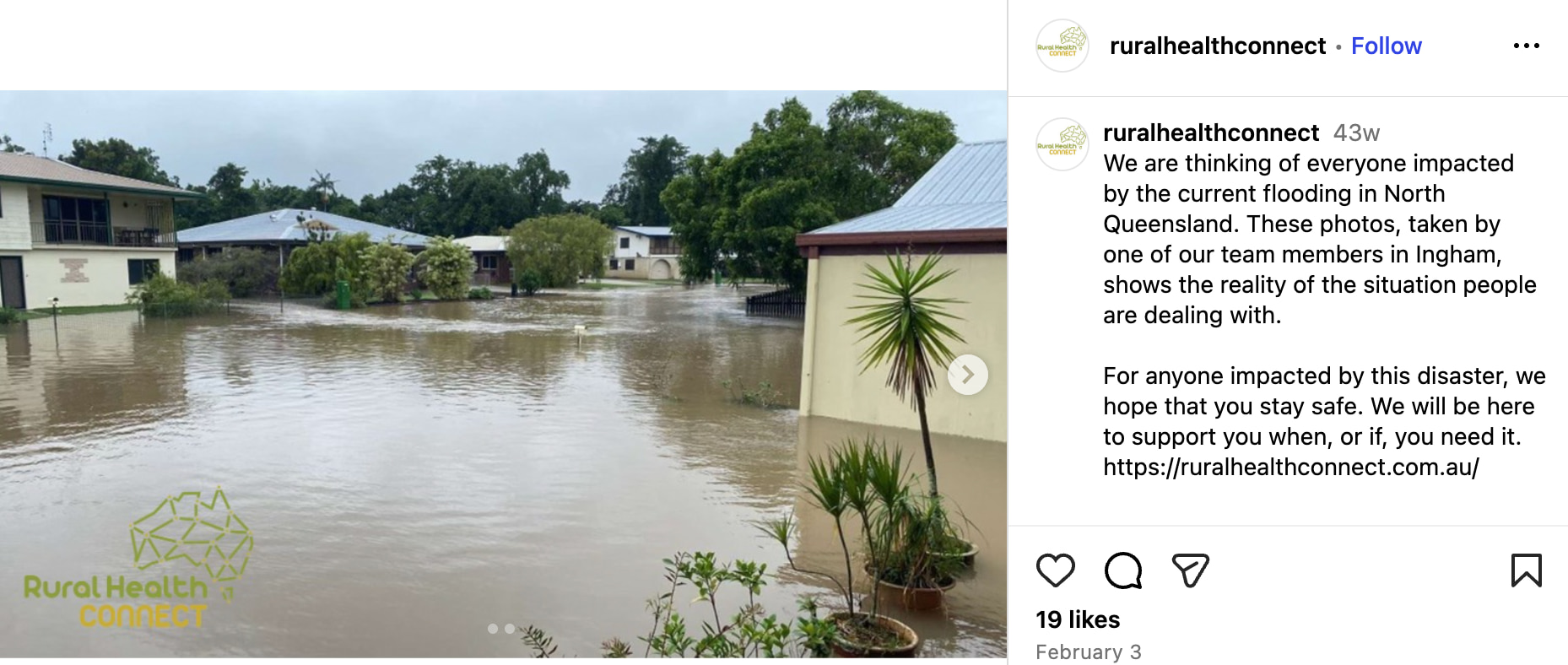
Natural disasters like bushfires and floods cut off communities quickly, blocking access to clinics, pharmacies and emergency services.
Source: Instagram
In these moments, social media becomes a lifeline. When providers post clear, verified information and respond quickly to community questions, they demonstrate reliability under pressure. This is a powerful driver for long-term trust.
Promotes transparency and awareness
Social networks give providers an opportunity to highlight rural-specific health risks—like farm accidents, zoonotic diseases or wildlife encounters—and share the preventive steps required.
Visual formats such as infographics or short videos make these insights easier to understand and share. Social listening tools help teams identify the hashtags, language and community concerns that matter most, ensuring every message reflects what people genuinely care about.
This kind of transparency earns respect. It shows you’re not just broadcasting to your community, you’re actively learning from it.
Strengthens credibility through storytelling and recruitment
Trust extends beyond patient relationships. It also shapes how future staff and volunteers perceive rural practice.
Sharing stories about life in rural healthcare, like celebrating local successes, spotlighting community resilience and showcasing lifestyle benefits, builds credibility and pride. When people see the human side of healthcare teams, they’re more likely to engage, apply or reach out.
How to follow AHPRA and TGA rules on social media
Trust on social media starts with compliance. For Australian healthcare professionals, that means understanding and following the standards set by the Australian Health Practitioner Regulation Agency (AHPRA) and the Therapeutic Goods Administration (TGA).
These regulations exist to protect patients’ privacy, prevent misinformation and maintain the public’s confidence in healthcare communication. Staying compliant doesn’t just help you avoid penalties, it also strengthens your community’s trust that the information you share is credible, responsible and safe.
This is a quick overview of what you can—and can’t—post under current guidelines. Always consult your compliance officer or legal adviser for formal direction.
You can post:
- General health promotion (tips on healthy living, reminders for vaccines, seasonal health risks)
- Neutral educational content about your services without claiming superiority
- Community updates like clinic hours, staff introductions or event notices
- Links to reputable sources such as peer-reviewed research or government health pages
You cannot post:
- Testimonials or patient case studies about clinical outcomes
- Misleading, unverifiable or exaggerated claims about treatments
- Any promotion of therapeutic goods (e.g., medicines, devices) without TGA approval
- Claims your service is better than others unless supported by solid evidence
- Language using protected titles (e.g., “specialist”) if you’re not legally registered
- Anything that shares identifiable patient information as this raises concerns about patient privacy and social media security standards
Transparent boundaries like these protect your reputation and show that patient privacy always comes first.
Always include disclaimers and risk information
Posts that audiences may consider as advertising must include clear disclaimers. For example, you might add something like:
This information is general in nature and not a substitute for advice from your healthcare professional.
On top of this, ads for therapeutic goods must include risk warnings and other mandatory callouts as specified in the TGA code.
Adding disclaimers signals professionalism and reinforces the integrity behind your communication.
How to build a compliant social media content strategy
Compliance in healthcare social media isn’t only about what you say. It’s also about how you govern the process behind every post. Treating compliance as a strategic discipline, not a checklist, helps your team balance accuracy, efficiency and trust.
Here’s how to move beyond surface-level compliance and create a structure that supports ethical, transparent communication at scale.
1. Make compliance part of your culture
Compliance works best when it’s woven into daily workflows rather than seen as a final hurdle before publishing. Start by setting clear standards for tone, accuracy and accessibility that everyone, from marketing to clinical staff, understands.
Mandate collaboration early in the content planning stage. When subject-matter experts weigh in on topics before drafts begin, posts are more accurate, approvals are faster and teams feel collectively accountable for quality.
Plus, audiences can sense when content feels “checked by committee” versus created with purpose. A proactive compliance culture helps you sound more human, not less.
2. Build traceability into every step
In regulated industries, the process behind a post matters as much as the content itself. Teams should be able to show who drafted, reviewed and approved each piece of communication and when.
That traceability not only protects your organization during audits but also builds internal confidence that your public-facing messages are accurate and safe.
3. Centralize knowledge and reusable assets
One of the most common compliance risks comes from fragmented communication and teams using outdated templates, inconsistent disclaimers or off-brand visuals.
Use a single, centralized library to store:
- Pre-approved disclaimers and captions for common topics (e.g., vaccination reminders, mental health awareness or seasonal flu updates)
- Current logos, image assets and accessibility-checked graphics
- Approved responses for recurring questions (e.g., appointment reminders or referral instructions)
4. Align measurement with compliance and trust
Many organizations stop at “approved and published.” But the next question should be: Did this post build trust?
Track not only engagement metrics but also indicators of reliability. These include sentiment trends, response times to patient inquiries and community questions that signal knowledge gaps.
True compliance isn’t just silence after publishing. It’s clarity in conversation. If people respond with more questions, that’s a cue to refine your educational approach.
Practical social media strategies for Australian healthcare teams
For healthcare organisations, social media can be one of the most powerful tools for education, prevention and patient connection. But success depends on more than simply posting. It’s about building a sustainable, compliant and community-informed strategy.
This is how social media can work harder for your healthcare organisation.
Choose the right channels for your audience and capacity
Not every network fits every organisation or audience. Datareportal shows that Facebook and Instagram remain the most used social sites in Australia, but those networks may not be suitable for every demographic you want to reach.
The key isn’t to be everywhere. It’s to be intentional.
To best work out where to invest your social media efforts, use data to understand your social media demographic and where your audience is already engaging online. Identify which networks are most active in your region or among your patients, and match that insight to your team’s bandwidth and the depth of engagement you can realistically maintain.
For many regional or rural providers, the best strategy is to own one or two networks deeply rather than scatter effort across five. Depth of presence builds recognition and trust faster than breadth of posting.
Keep messaging clear, human and culturally informed
Healthcare communication succeeds when it’s human. Overly clinical language, abbreviations or medical jargon can alienate audiences, especially those with limited health literacy or for whom English is a second language.
Clarity builds trust. When people understand your message, they’re more likely to act on it and share it.
Here’s how to craft content that connects:
- Write at an everyday reading level (years 7–8 literacy).
- inboxUse warm, conversational phrasing instead of a clinical tone.
- Avoid talking down to audiences. Instead, focus on shared goals and collective well-being.
- Pair key messages with visuals or examples to make complex topics easier to grasp.
- Respect cultural perspectives, especially when addressing Indigenous communities. Partner with local Aboriginal Community Controlled Health Organisations (ACCHOs) to ensure language and imagery feel authentic.
- Analyse your social data to see when your audience engages most and post at those times (Sprout’s data says Thursday is the best day to post).
Establish a consistent posting rhythm
When it comes to social media for healthcare, consistency builds reliability, and reliability builds trust. Patients and communities notice when you show up regularly with timely, useful information.
Sprout’s Healthcare Social Media Benchmarks show that healthcare providers post an average of eight times a day. But volume isn’t the goal. Your posting cadence should match your audience’s expectations and your team’s capacity.
After all, consistency isn’t about quantity, it’s about predictability. A smaller number of well-timed, relevant posts can spark more social engagement than a high-frequency schedule that lacks focus.
Respond to patient questions and feedback
Timely replies build trust. So when people message you, you need to respond promptly. Quick, empathetic replies show that your team values communication as part of patient care.
To make it easier to respond to patients, prepare a response framework for:
- General enquiries like clinic hours and vaccination reminders.
- Sensitive or clinical questions so your team can acknowledge and move the conversation offline, which is required by privacy regulations.
Use visuals to educate, include and engage
Visuals make information easier to digest, especially for multilingual audiences and those with low literacy.
Popular ways to include visuals in your social posts include:
- Explainer videos: Demonstrate healthy habits, safety steps or new clinic processes.
- Infographics: Summarise data, like vaccination rates or mental health tips, in a clear, visual form.
- Photo stories: Showcase your community outreach or staff profiles to humanise your services.
Make sure every visual follows accessibility guidelines and cultural respect principles:
- Add alt text for images
- Use high-contrast colors and legible fonts
- Avoid imagery that could be culturally insensitive or medicalised in tone
Examples of effective healthcare content in Australia
Here’s how healthcare providers are using networks like Instagram, Facebook and WhatsApp to connect with people online..
Street Side Medics
Street Side Medics uses Instagram to highlight its mobile clinics for people experiencing homelessness.
A recent post promotes a community event in Waterloo, NSW, during Homelessness Week, pairing clear event details with strong visuals of its branded van.
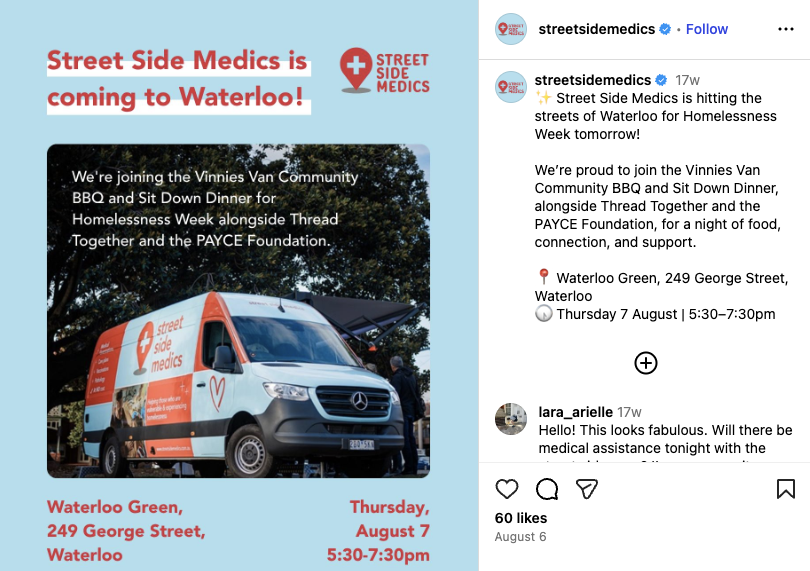
Like all of Street Side Medics’ posts, this example is accessible, community-focused and reinforces trust by giving people clear information about how to access their services.
Beyond Blue
Beyond Blue is one of Australia’s leading mental health organisations. It uses social media to share practical wellbeing tips and promote open conversations about mental wellbeing.
Beyond Blue shares a carousel with advice on coping with distressing media coverage, linking followers to free 24/7 support.
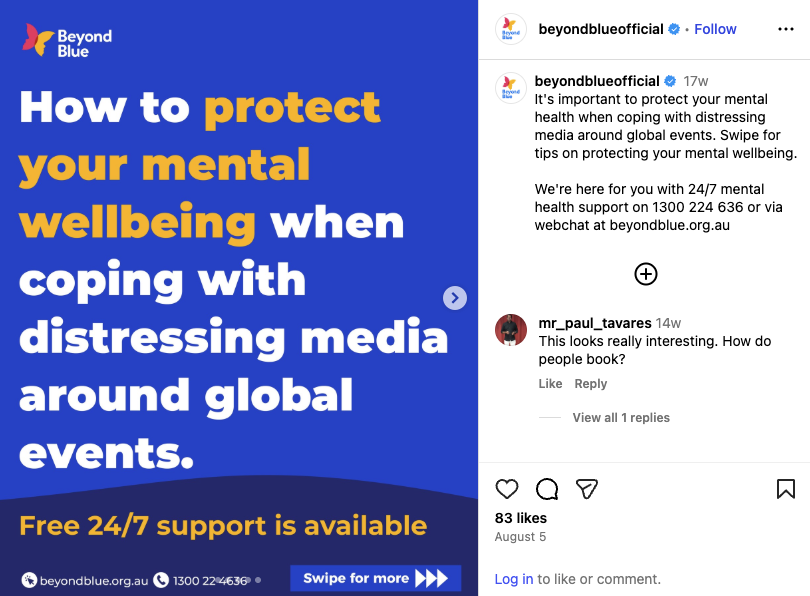
This is a strong example of how a provider combines education with direct access to resources, showing how social offers providers the capability to be both supportive and action-oriented.
Ovarian Cancer Australia
Ovarian Cancer Australia uses social media to highlight the vital role of cancer nurses while also inspiring future recruits.
In this Cancer Nurses Day post, the organisation spotlights its Teal Support Nurses by sharing stories about what motivates them and what their work means to them.
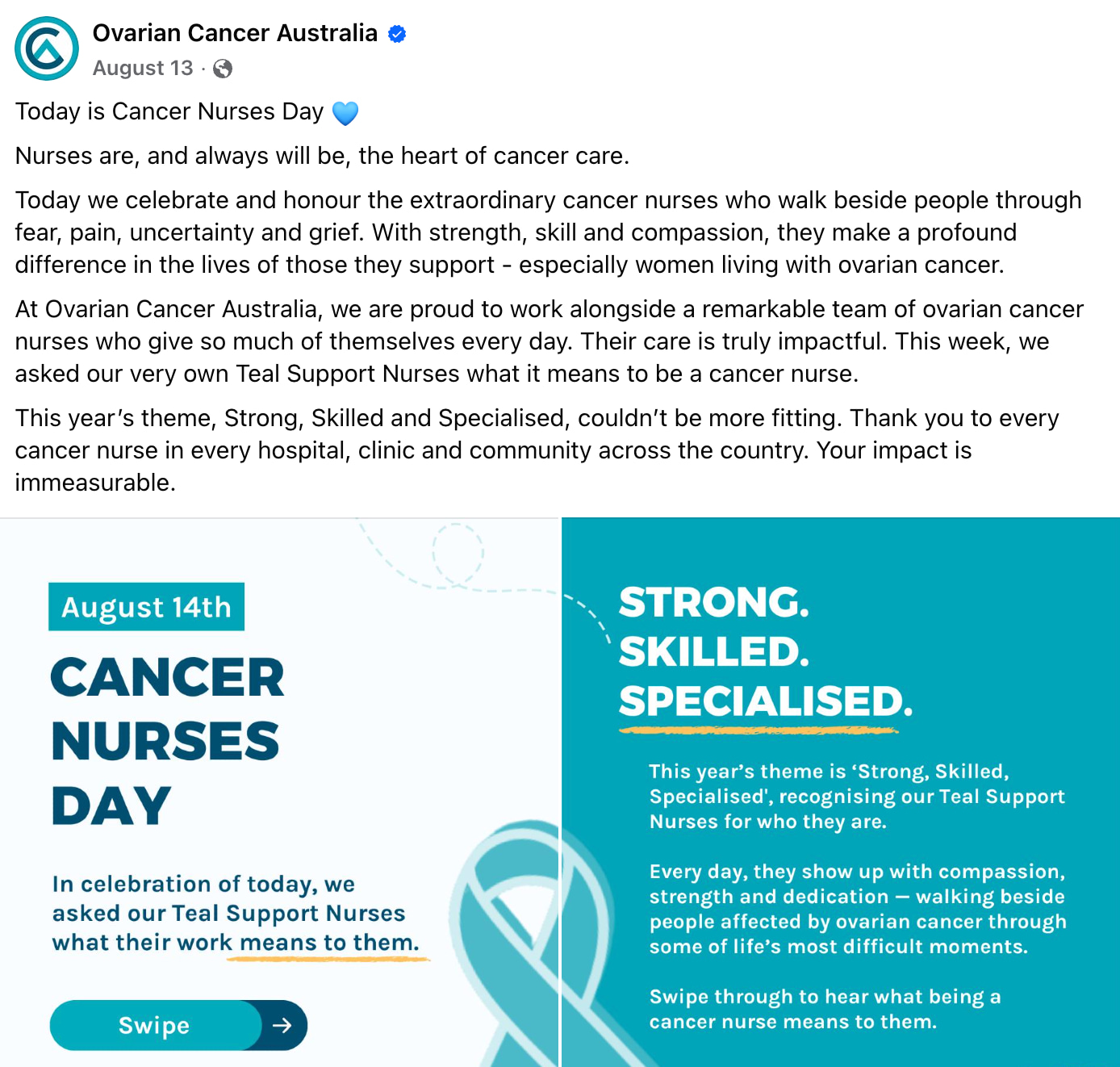
It’s both a celebration and a subtle recruitment tool, demonstrating how rewarding and impactful the role is.
How Sprout streamlines compliant healthcare communication
For healthcare providers in Australia, balancing patient engagement with compliance is a constant challenge. Small teams often juggle limited staff time, multiple approvals and the growing demand for timely, trustworthy communication.
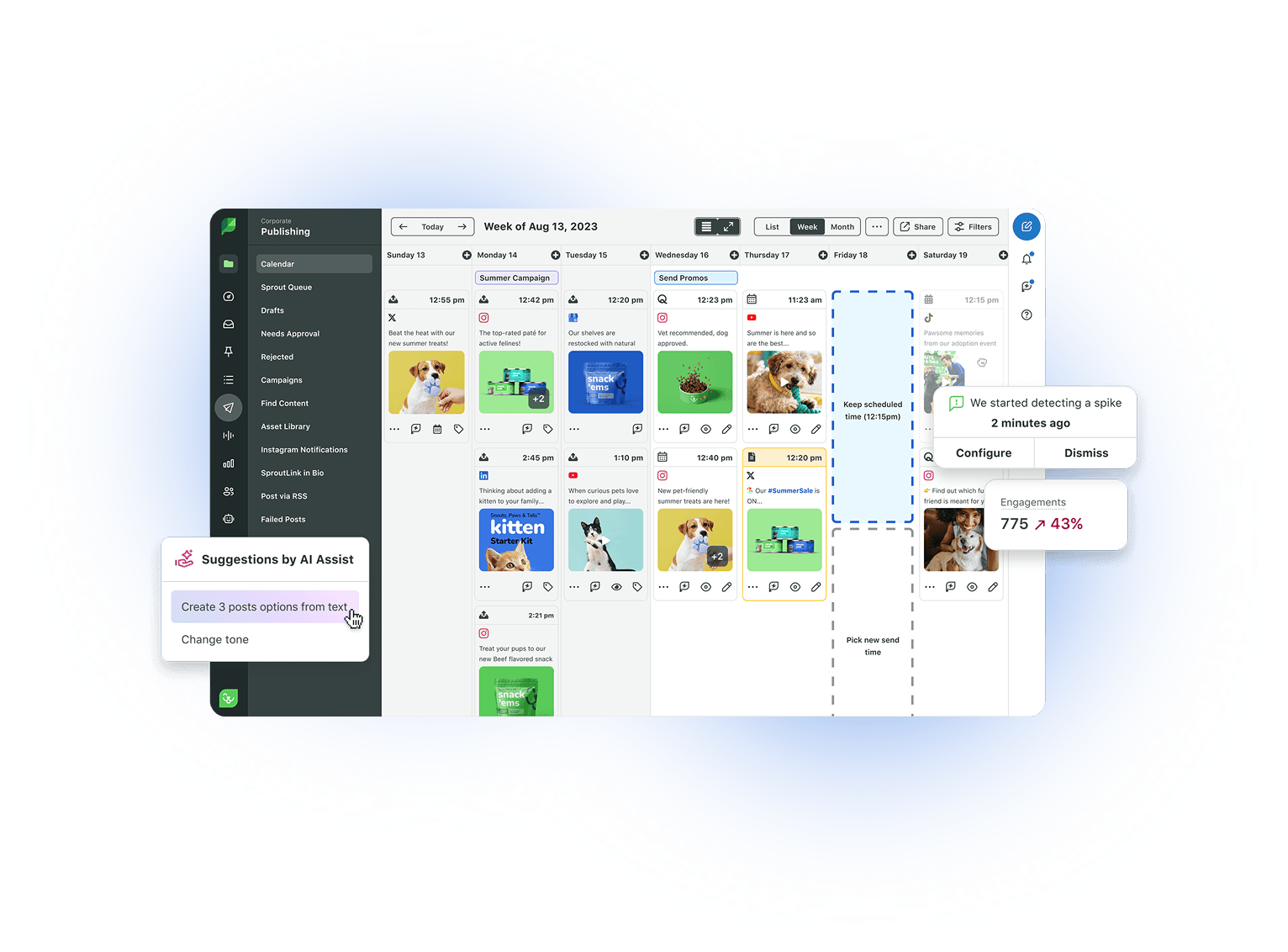
Sprout simplifies this process. Its unified platform brings publishing, engagement, listening and analytics into one place. Here’s how Sprout helps healthcare organisations collaborate securely, stay compliant and build community trust at scale.
Manage cross-team approvals with ease
Healthcare communication relies on accuracy and accountability. Sprout’s Approval Workflows ensure the right experts review every message before it goes live without slowing your team down.
Here’s how it works:
- Draft a post in Compose
- Assign it to a clinician or compliance officer for review
- Route it to a manager for final sign-off
Each step is automatically logged, creating a complete audit trail showing who approved what and when.
This transparent workflow helps your organisation stay aligned with AHPRA’s expectations for responsible communication while empowering teams to publish confidently and on time.
Accountability is more than compliance, it’s credibility. When your approval process is visible and consistent, you build internal confidence that translates to public trust.
Tag content for better reporting and transparency
Routing matters for healthcare teams. After all, a vaccine inquiry isn’t the same as a job application.
Sprout’s Message Tagging feature helps you triage conversations efficiently and accurately, ensuring they get to the right person faster.
- Define custom tags such as Appointments, Medication or Recruitment.
- Route messages to the right team automatically.
- Use tags to identify recurring questions and patient concerns.
Those same tags feed into Premium Analytics, a paid add-on that measures trends and helps you understand patient sentiment.
Plan campaigns around key moments and events
Healthcare runs on calendars, from flu season to R U OK Day. This helps in planning content, since healthcare communication earns the most trust when it’s both proactive and predictable.
Sprout’s Campaign Planner helps you map content around these moments, align posts with clinic priorities and keep every team on the same page.
It allows you to manage the following tasks:
- Planning campaigns by season or theme
- Assigning tasks and collaborators
- Tracking campaign progress against measurable outcomes
As a result, you’ll have more consistent outreach that feels timely, relevant and directly connected to patient needs.
Monitor conversations and stay ahead of misinformation
False claims and misinformation can spread fast—especially around vaccines, chronic illness or emerging health issues.
Sprout’s Listening Topics give healthcare organisations real-time visibility into online discussions. By tracking keywords, hashtags and sentiment, teams can:
- Identify emerging health trends before they peak
- Spot misinformation early and prepare evidence-based responses
- Understand patient sentiment to refine communication tone and timing
By combining listening with the Smart Inbox, your team has the tools to monitor all inbound messages, respond efficiently and keep every reply accurate, transparent and on record.
Build a long-term social media presence in rural Australia
In rural and remote Australia, social media consistency matters more than scale. Every post is an opportunity to strengthen connections and show patients you’re there.
The most sustainable approach is to start small and build intentionally. Choose platforms your community already uses, create an approval process and commit to a steady posting rhythm. Even a single, well-planned awareness campaign will grow trust over time.
Ready to build a smarter, safer social presence? Sprout Social helps healthcare providers simplify content planning, stay compliant and connect with patients online. Start your trial now.
39 free social media strategy templates that will elevate your workflows
Published on August 20, 2026 Reading time 15 minutes








Share