Instagram Story ads: Rules and best practices for impressive results

Written by Jacqueline Zote
Published on July 22, 2026
Reading time 8 minutes

Table of Contents
Summary
- Instagram Story ads are full-screen vertical ads that appear between organic Stories, built to drive clicks, conversions, app installs and views at scale.
- The format supports four ad types: single image, video, carousel and collection, each serving a distinct campaign goal.
- To set up a Story ad, you must choose an objective, build your creative, use the correct specs, target the right audience and hand-pick your placements.
- The most effective Story ads hook viewers in the first two seconds, carry minimal text and feature prominent branding throughout.
- Measuring performance means tracking metrics that match your objective, from reach and view-through rate for awareness to tap-through rate and conversions for traffic campaigns.
Instagram Story ads give brands a full-screen, immersive format to reach audiences where they’re already spending time. Data from our 2025 Sprout Social Index™ shows 81% of consumers say social media compels them to make spontaneous purchases multiple times per year or more. Instagram is one of the primary stages where those decisions happen.
This guide covers everything you need to run Instagram Story ads that convert, from technical specs and placement rules to the creative tactics that drive real results. Story ads are one piece of a broader Instagram marketing strategy—the piece built for conversion at scale. You’ll leave with a strategy, not just a checklist.
What are Instagram Story ads?
Instagram Story ads are full-screen vertical ads that appear between organic Stories as people tap through Instagram. They carry clear paid promotion labels, strong calls to action and are built to drive clicks, conversions, app installs and views.
The format is built for attention. Story ads take over the entire screen, remove every distraction and give your creative a direct line to your audience in a mobile-first environment.
The critical distinction from organic Stories: Story ads are built for scale. Organic Stories engage your existing audience. Story ads reach new audiences, retarget warm ones and convert attention into measurable business results.
Why Instagram Story ads are worth your budget
Instagram Story ads deliver full-screen, immersive placements that match how people already consume content on mobile: fast, vertical and distraction-free. That alignment between format and behavior drives real results.
Higher engagement rates
Story ads place your message inside a format people actively choose every day. When creative feels native to the platform, viewers watch, tap and convert. That translates to more than impressions; it builds momentum that feed placements rarely match.
Full-screen reach that commands attention
Feed ads compete with every other element on the screen. Story ads own the entire frame. That makes them the strongest placement for product launches, promotions and brand awareness campaigns that demand instant clarity.
Data from our 2026 Social Media Content Strategy Report shows 65% of social users have an Instagram profile and 60% of consumers engage with brand content on Instagram at least multiple times per week. Short-form video drives the highest interaction rates on the platform. Story ads are built for that behavior, meeting people inside the format they already choose every day.
If your creative needs to stop the scroll and drive action, Instagram Story ads belong in your media mix.
Instagram Story ad formats
Each Instagram Story ad format serves a distinct purpose. Match the format to your campaign goal before you build anything.
| Format | Best for | When to use it |
|---|---|---|
| Single image | Focused, high-impact messaging | Simple promotions, product highlights and direct calls to action |
| Video | Demonstration and storytelling | Product walkthroughs, behind-the-scenes clips and creator-led content |
| Carousel | Multi-step or multi-product narratives | Showing multiple products, features or steps across tappable cards |
| Collection | Ecommerce and social commerce | Pairing visual storytelling with product browsing to accelerate purchase decisions |
Single image ads
Single image ads deliver a clean, focused message with zero distraction. Use them for simple promotions, product highlights and direct calls to action where one strong visual does the work.
Video ads
Video ads are built for movement, demonstration and creator-driven storytelling. Product walkthroughs, behind-the-scenes clips and influencer content consistently outperform static formats here, and with short-form video dominating Instagram engagement, this format carries serious reach potential.
Carousel ads
Carousel Story ads give viewers multiple cards to tap through, making them ideal for showcasing product lines, feature sets or sequential steps. Use them when one frame cannot carry the full story.
Collection ads
Collection ads compress the path from discovery to purchase. They pair visual storytelling with in-ad product browsing, making them the strongest format for ecommerce and social commerce campaigns.
Pick the format that sharpens your message. One format cannot do every job, and forcing it to try costs you conversions.
Getting started with Instagram Story ads
Creating Instagram Story ads starts with mastering the technical requirements and setup steps. Follow this process to build ads that reach the right audience and drive real results.
1. Decide on your objective
Define what you want your ad campaign to achieve before you build anything. Instagram Story ads support objectives including reach, brand awareness, traffic, engagement, app installs, video views, lead generation and conversions. Your objective shapes every creative and targeting decision that follows.

2. Develop your ad creative
Build ad content that directly serves your objective, whether that’s a static image, a video or a combination of both with a headline and copy.
Read on for best practices that make Stories creative stop the scroll.
3. Use the recommended dimensions
Instagram Story ads require specific dimensions to display correctly. Use the specs below to avoid cropping, distortion or disapproval.
For image ads:
- Recommended resolution: 1080 x 1920 pixels
- Minimum resolution: 600 x 1067 pixels
- Aspect ratio: 9:16
- Accepted formats: JPG or PNG
- Maximum file size: 30MB
For video ads:
- Recommended resolution: 1080 x 1920 pixels
- Aspect ratio: 9:16
- Accepted formats: MP4 or MOV
- Maximum file size: 4GB
- Minimum resolution: 720p
4. Set your target audience
Narrow your audience by location, gender, language, interests, behaviors and age. Include or exclude people based on their connection to your brand, such as existing followers, friends of followers or custom audiences built from your own data.
Story ads are brief by design, so precision targeting is non-negotiable. Use Meta Pixel data, lookalike audiences and retargeting to make every impression count.
The sharpest targeting decisions start before you open Ads Manager. Social listening surfaces what your audience cares about—the topics, language and pain points driving real conversations about your brand and category. Feed those insights directly into your audience build and your Story ad messaging will resonate on both sides of the equation: the right people seeing the right message.

5. Select your ad placement
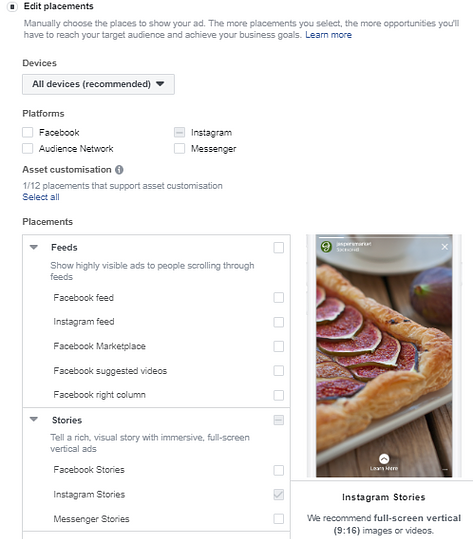
Hand-pick your placements rather than relying on default automation. Your Instagram audience and your Facebook audience behave differently, and serving them identical ads wastes budget and dilutes performance. Select Instagram Stories as a dedicated placement to ensure your creative reaches the right context.
6. Develop a compelling call to action
Every Instagram Story ad needs a well-defined call to action that tells viewers what to do next. Use direct action words like learn, shop, discover and get, and test multiple CTAs to identify what drives the strongest response from your specific audience.
Best practices for Instagram Story ads
These Instagram Story ad best practices turn passive scrollers into active buyers. Apply them to every campaign you run. For a deeper look at what makes Instagram content perform across formats, explore our guide to Instagram Stories best practices.
1. Make the first few seconds count
Your Instagram Story wins or loses in the opening frame. Brands experience their biggest audience drop-off between the first and second frames, but after this initial dip, retention stays above 75% through seven frames per day, which means you must focus on a first frame that hooks viewers instantly.
Experiment with bold colors, distinctive fonts and striking imagery that speaks directly to your target audience. Visually arresting creative from frame one is non-negotiable.
NUXE France created a short stop-motion video highlighting their products. It used a soft background color to match their product packaging, which created an eye-catching effect. This resulted in a 6.2X return on their ad spend.

2. Create clear and concise messaging
Instagram Story ads give you minimal screen real estate for text. Your visual carries the weight and your audience has seconds to absorb your message. Write copy that is punchy, direct and impossible to misread.
Overstock launched a video ad that asked the audience a short question about a common brand perception and compelled them to “think again.” What followed was a series of product photos with two-word messages relaying their value proposition.

3. Maintain brand visibility
Every Instagram Story ad is a brand impression, so make sure viewers know who sent it. Your logo must be prominently visible and free from obstruction by other design elements.
Use these tactics to reinforce brand recognition throughout your ad:
- Overlay your brand name or logo without obstructing other elements
- Focus on your product, especially if it carries your brand name or logo
- Use minimal colors, fonts and design elements so your brand name stands out
Waterdrop’s ad focuses entirely on the product, clearly displaying the brand name on the bottle and including the product name at the bottom of the image for a clean, confident and unmistakable look.

4. Position your text strategically
Text placement in Instagram Story ads is as important as the words themselves. Place text over white space whenever possible and always choose highly legible fonts, even when layering over visual elements.
Position copy in the middle of the screen or near your call-to-action link to draw attention away from the “Sponsored” tag at the top. Never crowd text against the top edge of the frame.
Batch Organics executed this well: their video ad opened with product visuals, then added text overlays using a clean, legible font and closed with an offer positioned just above the “Shop Now” link.


5. Feature influencers in your ads
Integrating your influencer marketing strategy with your Instagram Story ads amplifies reach and builds instant credibility. Repurpose sponsored content influencers already created for your brand. It saves production time and delivers creative that feels native to the platform.
Influencers understand their audiences inside and out. Bring them into your creative process early and let their insight shape how your story gets told.
Finding the right creator for the job is where most brands stumble. Sprout Social’s Influencer Marketing solution helps you identify creators whose content, audience and tone align with your brand before you brief anyone—so the content you put into your Story ads already has built-in resonance.
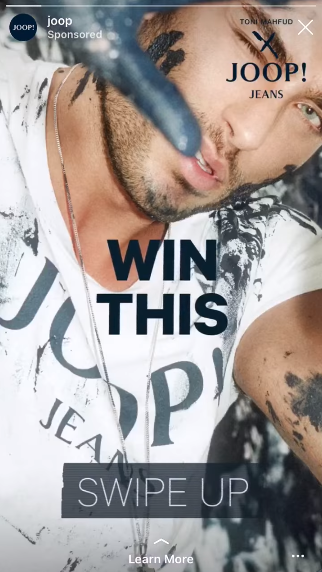
JOOP! placed German artist and influencer Toni Mahfud at the center of their Instagram Stories campaign, featuring a video that gave audiences the chance to win a t-shirt he designed and signed. The campaign increased ad recall by 60% and reduced cost per reach by 27%.
How to measure Instagram Story ad performance
Launching your ad is only the beginning. The real work is understanding what drove action and what caused drop-off.
Match your metrics to your campaign objective. Awareness campaigns call for reach, impressions and view-through rate. Traffic and conversion campaigns demand tap-through rate, landing page performance and downstream conversions. For a full breakdown of the Instagram metrics that matter most across both paid and organic, that guide covers everything.
Watch your creative signals closely. Exit rate, skip rate and completion rate reveal whether your hook landed fast enough, whether your visual hierarchy guided the eye and whether your call to action earned the tap.
- Segment your results: Break performance down by creative type, audience segment and offer to surface the strongest patterns.
- Act on the gaps: When one version wins on reach and another wins on conversions, use that contrast to sharpen your next creative round—not to declare a tie.
- Zoom out: Measure Story ad performance within your broader paid social strategy to identify what deserves more budget, what needs a refresh and what to cut.
Transform scattered data into actionable social intelligence with Sprout Social’s Cross-Network Paid Performance Report. By consolidating campaign performance across Facebook, Instagram, LinkedIn, X and TikTok into a single workflow, you can stop toggling between native ad managers and start making faster, more confident budget decisions. Compare reach and conversion metrics side by side, segment by campaign and creative type, and evaluate specific placements—like Instagram Story ads—within your broader paid strategy to instantly surface the patterns that move the needle.
Most brands use data to see where their budget went. With true social intelligence, you dictate where your strategy goes next.
Start a free trial to see it in action.
Put your Instagram Story ads strategy into action
Instagram Story ads deliver results when format, message and measurement align. Start with one clear objective, build creative that looks native to Stories, keep your copy tight, then measure performance and improve fast.
The goal isn’t more ads. It’s sharper ads that earn attention and drive action.
Sprout brings your Instagram reporting, campaign data and engagement metrics into one place, so you make faster decisions backed by real insight. Stronger creative starts with stronger intelligence.
Start a free 30-day trial to see how Sprout Social’s analytics streamline Instagram Story ad performance tracking from day one. Or request a demo to see how enterprise teams use Sprout Social to manage paid and organic Instagram strategy from a single platform.
FAQs about Instagram Story ads
Are Instagram Story ads worth the budget?
Yes. Instagram Story ads deliver a full-screen, immersive format built for how people already consume content on mobile. Clear, fast creative drives strong awareness, traffic and conversions.
What is the difference between boosting an Instagram Story and running a Story ad?
Boosting turns an existing Story into a promotion quickly but with limited controls. Running a Story ad through Ads Manager gives you full control over targeting, placements, testing, optimization and reporting.
How long is an Instagram Story ad?
Length depends on your format and Meta’s current ad requirements. Regardless of the limit, lead with your message in the first two seconds and make every frame earn attention.


Share