Breaking social out of the marketing silo

Written by Benedict Nicholson
Published on May 21, 2026
Reading time 9 minutes
Table of Contents
Social data is often the most undervalued asset in a business. When it stays siloed in the marketing department, it’s like having a world-class radar system and only using it to check the weather. You miss the deeper shifts in consumer behavior that determine if your next big move will resonate.
According to our 2026 Social Intelligence Report, only 36% of professionals say that social data regularly informs decisions outside of marketing. To elevate marketing to a core business driver, organizations must bridge the gap between social media management and social intelligence. Doing so allows you to influence the entire business with a sharper, broader understanding of the market.
Organizations that integrate social insights across the enterprise see the benefits everywhere:
- Product: Instead of spending months planning and managing focus groups, teams use real-time data to identify product friction and market gaps.
- Customer care: Teams shift from reactive troubleshooting to proactive service.
- Strategy: Decisions start moving at the speed of social, rather than the speed of a quarterly report.
This transformation starts by building a framework that breaks down marketing silos so your entire business can act on the social data you already have.
Why breaking down marketing silos requires social intelligence
Social intelligence moves social teams away from being a megaphone for the rest of the business and toward being an active signal, transitioning from pure output to a two-way conversation with your audience. This completely changes the strategic approach of the company from reactive to proactive. Instead of leadership waiting on monthly or quarterly reports to review what’s already happened, you can use the real-time sentiment of the market to see consumer shifts as they’re happening. And the speed is the value, with 74% of people agreeing that social data provides insights faster than traditional research methods. This gives you the agility to adjust messaging or operational plans in hours, not weeks.
While many marketing teams already use social insights to refine their campaigns, the real opportunity is realized when it’s no longer treated as an isolated metric. When you align social interactions with long-term goals like customer loyalty and retention, you see the bigger picture. A single meaningful conversation on Reddit or TikTok can be a leading indicator of brand trust, while a candid comment about a competitor’s friction point gives you a head start on product development. Social intelligence allows you to tie all that together and take the action needed to influence business decisions.
Ultimately, this intelligence is only as powerful as it is accessible. Creating pathways to ensure social data is turned into actionable insights used across the business means the voice of the customer is a shared resource for every department, from marketing to customer care to R&D. When the whole organization uses and acts on the same insights, it creates a stronger business and better customer experience.
Here are some of the ways you can use social insights across the wider business.
Bringing social intelligence to customer care
Integrating social intelligence into customer care transforms the care function from a reactive ticket-answering system to a proactive driver of brand loyalty. It’s also one of the functions where social already has some influence, as 45% say that social insights have had an impact outside of marketing through customer care—but that number should be much higher.
By monitoring social sentiment and gathering real-time feedback, marketing can help care teams spot subtle shifts in customer mood long before they become widespread issues or escalate into active problems. This early warning system allows your brand to detect product friction or emerging PR concerns early, giving you the time needed to address the issue publicly, privately or operationally, before it escalates.
Beyond risk management, social intelligence provides the depth and personalization that traditional support channels often lack. When social data is connected to the broader customer journey, your agents gain the context and history of a customer’s previous interactions across various platforms. Linking social profiles with your CRM reveals past interactions and purchase history for whoever you’re talking to.
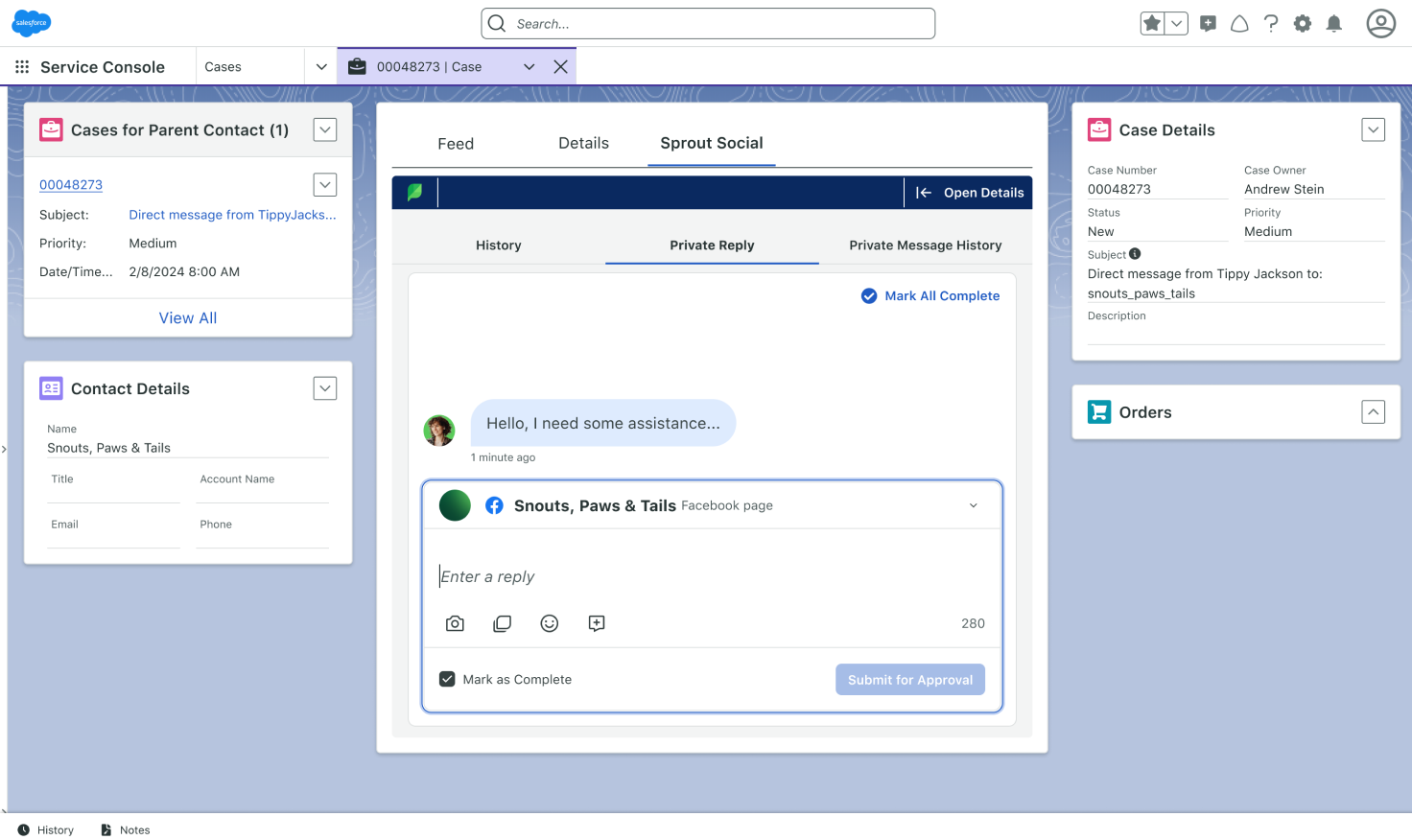
This view enables marketing- and care-led growth: where support feels like a seamless continuation of a long-term relationship rather than a repetitive set of hoops that customers have to jump through every time. By understanding their history and current sentiment, you can tailor your tone and solutions to the individual, turning a potentially negative experience into a moment of genuine connection.
And that’s just the immediate value; true social intelligence provides long-term value through its ability to drive efficiency through action at the business level. By analyzing social data to identify recurring pain points, teams can fix problems at their source before customers even know they exist. For example, the insights you get from social could be used to:
- Create more intuitive self-service resources.
- Build targeted knowledge-base articles.
- Fix known issues with products before there is wider market awareness.
This enables self-serve problem-solving and lowers the volume of direct support tickets, freeing up your team to focus on the complex cases that truly require a personal touch. The use of social intelligence in customer care turns the marketing silo into a collaboration between marketing and care teams that regularly works together to interpret audience data in real time.
Driving social-powered product development
According to our report, social insights make it to product teams only 28% of the time, and to R&D even less frequently (18%). Siloing this marketing data means these teams are missing out on a high level of unfiltered input on product development from the broader market.
Traditional product development has often relied on historical data and closed-room brainstorming to predict what the market might want next, along with customer and prospect interviews. By integrating social intelligence, R&D teams transform this process into an always-on feedback loop that begins the moment a product reaches the public, vastly expanding the sample size.
Social insights provide a real-time stream of user experiences, allowing brands to identify bugs, usability hurdles or unexpected use cases within hours. And that agility enables teams to deploy rapid iterations that align with actual consumer behavior rather than internal assumptions or limited qualitative feedback. This closes the gap between the initial launch and a polished product that resonates.
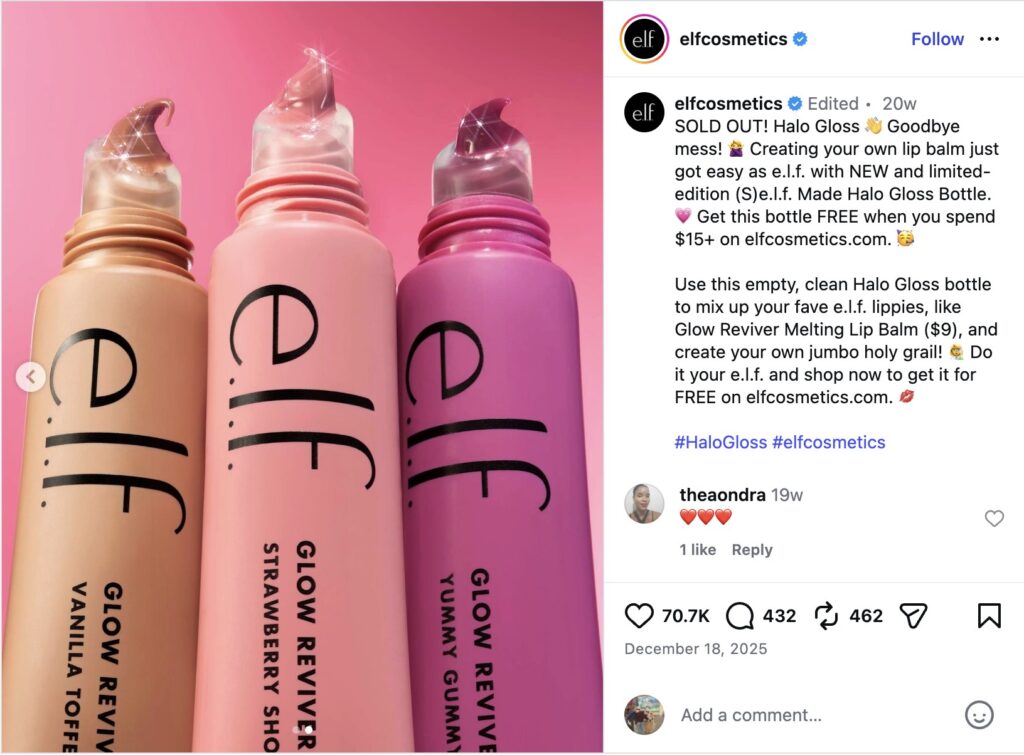
A recent example of this was e.l.f. Cosmetics leaning into an audience behavior identified through social, where TikTok users were sharing hacks to empty out lip balm bottles to mix their own. Instead of simply acknowledging the trend, the company launched a limited-edition (S)e.l.f Made Halo Gloss Bottle that came free with any $15 purchase to encourage the behavior. The bottle quickly sold out, proving the business impact of acting on social insights.
Ideally, social intelligence moves even further upstream, and should be the roadmap long before a single prototype is ever built. By monitoring organic market conversations where consumers share their daily frustrations or wish list items, R&D teams can identify white spaces that traditional surveys might miss. This moves beyond tracking your brand mentions to monitoring the broader industry landscape and shifts in what people actually value. This ensures that the R&D budget is invested in creating genuine value, rather than chasing trends that have already peaked or features that don’t solve a core need.
This level of listening also serves as a powerful engine for competitive intelligence. By analyzing the conversations surrounding competitor products, R&D teams can identify specific gaps where the market is currently falling short. Whether that’s a recurring technical complaint or a key feature a competitor doesn’t have, the data provides a clear roadmap for differentiation.
The most advanced application of social intelligence in product development is the transition to a true two-way conversation where the consumer becomes an active partner in the creation process. Before committing to a full-scale launch, brands can use these insights to pressure test concepts with specific audience segments. By gauging interest in pilot programs or hypothetical new features, companies can validate their strategic direction while the stakes are still relatively low. This acts as a safety net, enabling teams to refine their value proposition and messaging based on audience reaction. This in turn creates a feedback loop between customers and the entire organization, wherein marketing is the source of social data that can inform strategy and product development, be tested swiftly and then tweaked accordingly.
Amplifying employer branding and HR
Social media has become the primary lens through which job seekers view a company’s culture. A strong social presence that moves beyond scripted posts to showcase the daily realities of the workplace allows a brand to stand out to high-quality candidates. By highlighting the team and the company’s values in action, HR departments can build a brand that naturally attracts people whose personal goals match the company’s direction. Candidates arrive with a clear understanding of the culture because they’ve been engaging with the brand’s story long before the first interview.
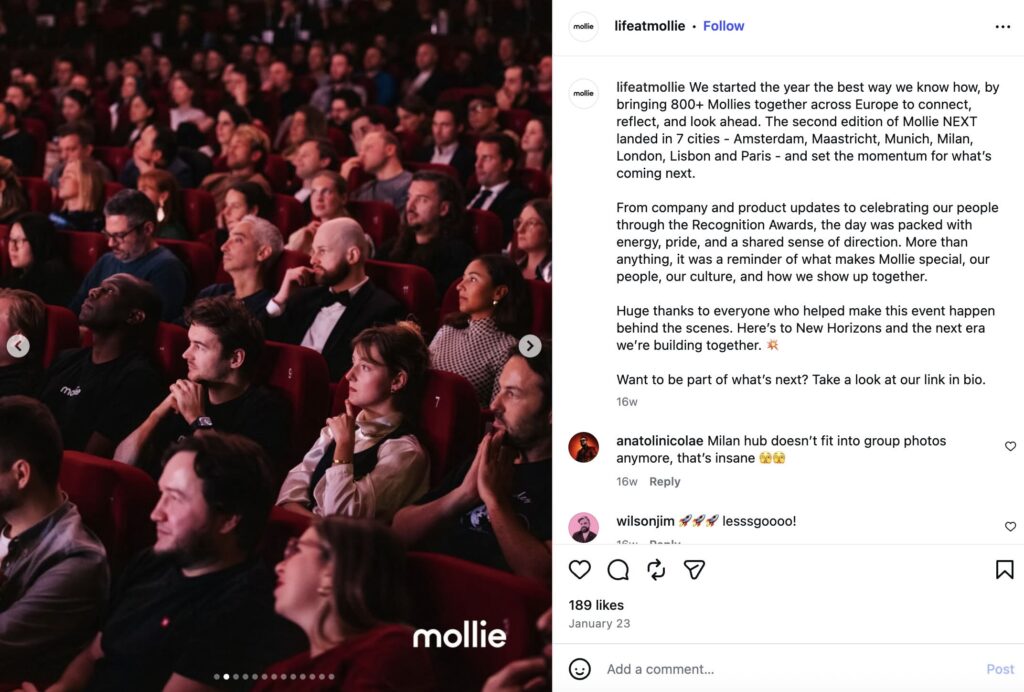
Fintech company Mollie is a great example of this, showcasing the annual summit that they run across different European hubs on their @lifeatmollie account. The posts celebrate employees while also making space for them to celebrate the brand publicly.
The impact is often even more powerful when the storytelling moves from official brand accounts to the people who actually do the work. Empowering your team to share their professional wins, technical challenges and personal experiences on social media builds a level of trust that corporate messaging simply can’t reach. When employees share their own stories, they lend their personal credibility to the organization, showing that the company is a community of experts rather than just a logo. This kind of employee advocacy does more than help with hiring; it strengthens your overall reputation.
Social intelligence also gives HR teams a vital tool for maintaining the health of the organization from within. While internal surveys have their place, social signals often provide a more honest, unfiltered look at what truly matters to people, whether that’s shifting expectations around work-life balance to real-time reactions to new internal initiatives. This proactive listening allows leadership to identify and address culture gaps before they lead to turnover.
Using social intelligence for HR helps the department understand the heartbeat of the company. You create a culture of feedback spanning departments that supports and retains the employees you already have, as well as attracting new ones. This transformation ensures that every decision, from recruitment to policy-making, is informed by the most current and honest version of the employee experience.
Achieving cross-functional social success
The ultimate measure of success in breaking down marketing silos is the moment social media is no longer viewed as a specialized marketing tool, but as the shared pulse of the entire organization. Achieving this requires a shift in perspective where social insights are treated as a shared resource to be actioned by the wider business. When more departments start making decisions from the same pool of real-time insights, the company gains a unified vision of the customer.
The implementation of social intelligence is the key to unlocking marketing silos and even business data silos. And it has to be something that the whole organization commits to, otherwise the insights risk remaining trapped within marketing. It is not enough for social to be visible; it must be connected to the outcomes that matter. By establishing a common language for success, every team can see exactly how social intelligence contributes to their specific goals. For example, when the leadership team understands how a decrease in negative social sentiment directly correlates to a reduction in customer churn, or when HR sees how an increase in employee advocacy reduces the cost of hiring, marketing proves itself as an indispensable driver of growth. That builds trust and reinforces the value of social intelligence.
To succeed, the systems your organization implements should be capable of removing the friction that typically slows a company down. You need to ensure that a critical data point captured on social can be instantly shared with a CRM, a product management tool or an HR dashboard. By building this connected ecosystem, you eliminate the delays that prevent social data from informing major decisions. This can only happen when these insights have a clear path to be shared beyond the marketing team, transforming the entire business into a faster, smarter and more human-centric organization.
Becoming a social-first enterprise without marketing silos is about the culture of connection you build. It’s about recognizing that the most valuable information your business possesses is sitting in the open, waiting to be shared. Now make sure everyone can get to it.
Learn more about how social intelligence can unlock growth for the enterprise by downloading our 2026 Social Intelligence Report.
39 free social media strategy templates that will elevate your workflows
Published on August 20, 2026 Reading time 15 minutes


Share