How to use AI for social media to build stronger brand connections

Written by Annette Chacko
Published on December 15, 2025
Reading time 15 minutes

Table of Contents
Social media has evolved into a constant conversation, one that’s happening across networks, with trends, audience behaviors and competitor activity changing by the hour. For brands, keeping up with this pace can feel impossible. AI in social media offers a way to make sense of the noise, acting as a silent partner. It helps teams identify what matters for their brand, spot opportunities early and prioritize actions that drive real impact for a competitive edge.
AI gives you the tools to work more efficiently and strategically. In this article, we break down how—and why—it’s become a core part of today’s social media marketing engine. You’ll find nine practical ways to use AI to strengthen your social efforts, from uncovering audience insights and tracking sentiment to optimizing posting times and automating routine tasks. We also highlight common mistakes to avoid so you can get the strongest return on your AI investment.
Why using AI for social media marketing is a competitive necessity
AI in social media marketing has evolved beyond drafting and posting. Today, it also acts as an intelligent operational engine that automates tasks, like social media listening, analyzes sentiment, manages influencer workflows and surfaces priority inquiries. In a fast-paced environment where social volumes are rising, and expectations for instant replies are the norm, teams that rely solely on manual processes simply can’t keep up.
AI-driven platforms like Sprout Social make it much easier for teams to stay on top of customer engagement and detect audience sentiment in real time. They flag messages your social team needs to act on, and even handle customized quick replies so conversations don’t stall even when your team is offline.
This is a critical benefit, given that 73% of consumers say they will buy from a competitor next time if a brand doesn’t respond on social, according to The 2025 Sprout Social Index™.
Similarly, Sprout’s Q2 2025 Pulse Survey revealed 49% of social users only sometimes attempt to reach out again on traditional channels, and 19% never, if a brand is unresponsive to customer service questions on social.
As brands prioritize how to use AI in social media workflows and strategies, maintaining real-time responsiveness is no longer optional; it’s a direct competitive advantage. Not only that, you’re able to deliver a customer-centric, personalized experience at scale.
AI tools can automatically surface the trends that matter, giving social teams more time to focus on strategy, creativity and cross-functional work that moves the business forward. They also help ensure you’re not falling behind competitors already using AI to move faster and capitalize on real-time opportunities.
9 Core ways to use AI for social media marketing
According to The 2025 Impact of Social Media Report, business leaders want teams like digital marketing, customer experience and success, customer care and business development to be driven by social insights.
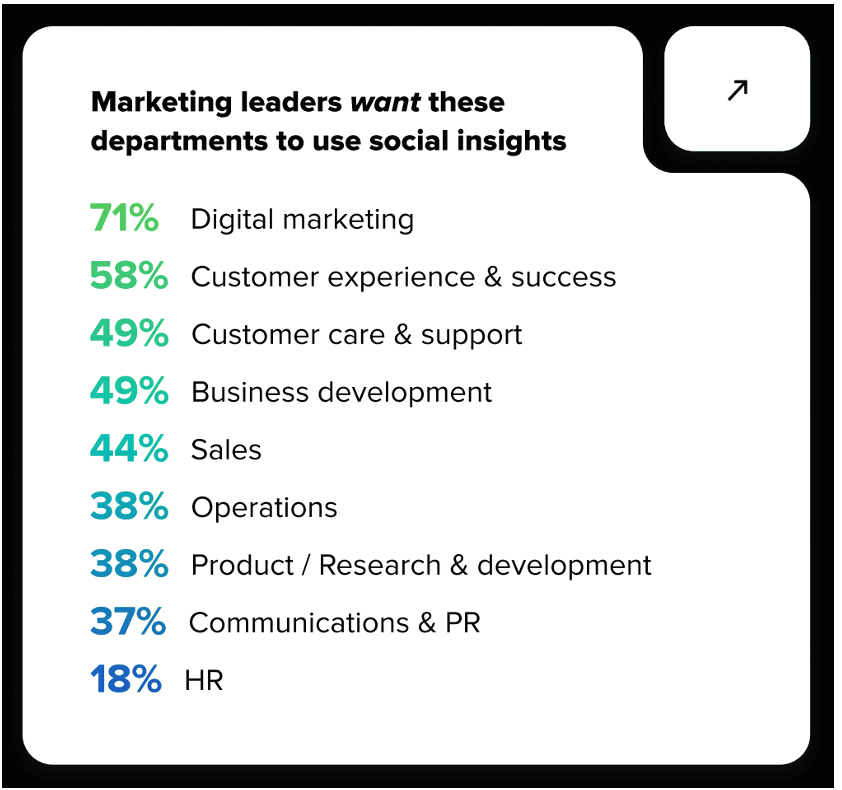
Here are nine ways AI can help your brand use social media to gather deeper audience insights, streamline workflows, and make data-driven decisions that drive engagement, growth and measurable business impact.
1. Content ideation and creation
Using AI for content creation and ideation can streamline how social teams brainstorm, plan and produce content. Acting as a creative partner, AI tools help teams spot what audiences care about, turn half-formed ideas into solid concepts and build drafts faster. It also takes the pressure off the ideation process, so teams can focus on refining the work instead of starting from scratch. This includes customized copy for posts as well as image alt texts optimized for social search and accessibility.
Customized content
AI tools help generate customized content for different social networks, instead of one-size-fits-all posts. For instance, with Sprout’s AI Assist tool, you can create content that feels relevant, timely and genuinely tailored. The result is a more connected audience and a brand experience that feels uniquely personal at every touchpoint.
Customers agree the tool keeps large content portfolios impactful, relevant and easier to manage.
Bianca Shaw, Head of Social Media & Digital Reputation, Caesars Entertainment, notes, “AI Assist in Sprout Social is so helpful, especially when it comes to generative text. As you can imagine, managing a portfolio of brands as large as Caesars, copy redundancy can happen—so having the AI Assist functionality to generate variations is a great tool for workflow efficiency and keeping our content feeling fresh across channels.”
Alt texts for optimized search and accessibility
As audiences reel from social media fatigue, it takes more than great content to stand out on social networks; it requires being discoverable and accessible. Sprout’s Generate by AI Assist for Alt text helps you achieve this by automatically creating clear, accurate alt text for your images. This strengthens your search visibility, so your content reaches more of the audience you want to engage.
Plus, it improves accessibility for visually impaired users.
Here’s accessibility advocate and @RNIB’s social media manager, Holly Tuke, sharing why inclusive content matters for brands and audiences alike.

Reliable, efficient and time-saving AI capabilities create advantages that social teams across industries benefit from.
As an example, Rahul B. Digital Marketing Specialist at payments recovery solutions company, Vindicia, says, “I really like the AI-powered tools, especially the automatic ALT text suggestions for images, which save time and improve accessibility without extra effort.”
2. Social listening and trend analysis
One of the most impactful ways of using AI for social media marketing is social listening. Case in point, Sprout Social Listening enables in-depth consumer research, trend discovery, campaign analysis and industry benchmarking. It also helps spot market gaps and understand competitor strategies through side-by-side comparisons of metrics like share of voice, engagement and impressions.
Sprout’s social listening tool analyzes data across networks such as X (formerly Twitter), Facebook public pages, Instagram hashtags, YouTube titles and descriptions, LinkedIn mentions and Reddit. This enables you to uncover trends more accurately and get better insights so you can use them strategically.
For instance, Sprout’s marketing team used social listening insights to create landing pages based on events and trends to ramp up lead generation and conversions.
Here’s one based on the 2025 Holiday shopping trends.
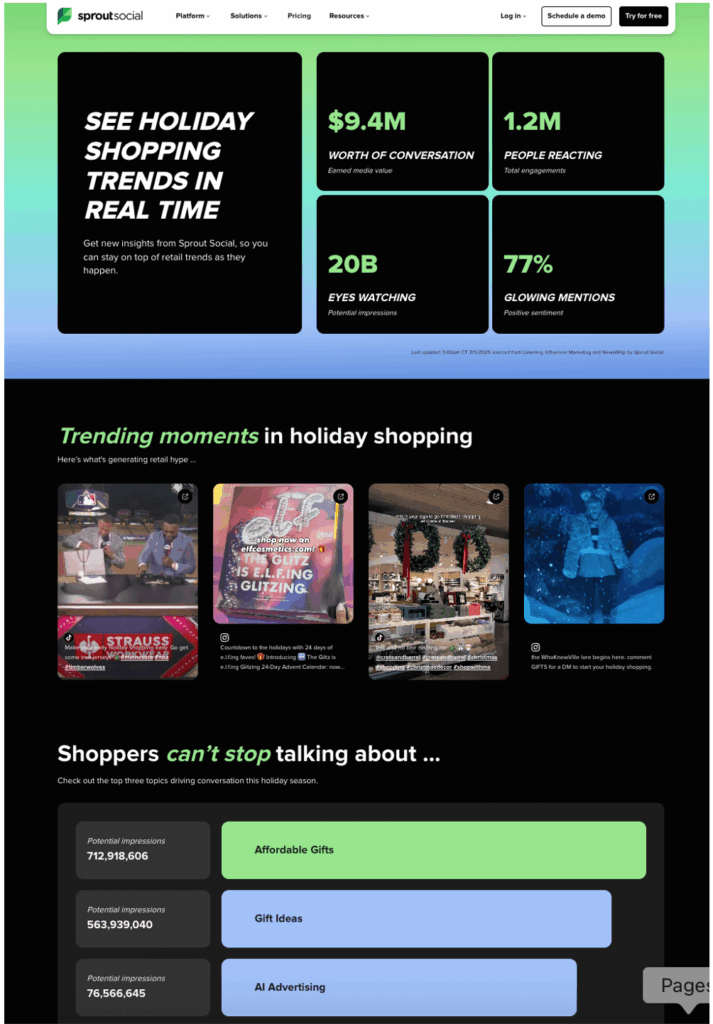
In addition, with news monitoring tools like Newswhip by Sprout Social, you spot emerging stories before they go mainstream, giving your brand a competitive edge. Teams move from data to action quickly, including departments like sales and customer service so they can respond to audience preferences and market shifts quickly.
Here’s a quick breakdown of Sprout’s AI capabilities within Listening that make it easier to research with intention, create targeted queries and streamline workflow.
- Analyze by AI Assist: Finds significant insights from social data and displays them in clear sentences so you can modify and perfect your social listening strategy. It shows key metrics, hashtags, keywords, Smart Categories and emojis.
- Summarize by AI Assist: Gives you quick insight into your longer Listening messages.
- Recommend by AI Assist: Helps generate keyword suggestions for listening queries to make your queries more precise and provide better insights to power your social strategy.
- Spike Alerts in Listening: This tool helps notify shifts in conversation activity around your Listening Topics so teams stay tapped into your audience.
- Smart Categories: Automatically classifies and groups nouns within your Listening Topics, such as persons, places and products, to surface core conversation drivers.
- Industry Themes: Cuts through the noise and automatically marks social listening aspects for different industries that matter for your brand.
- Sentiment listening: Automatically classifies messages as positive, negative or unclassified so you can easily determine which messages require a response.
3. Scheduling and workflow automation
AI tools streamline the day-to-day mechanics of social publishing so your social teams can focus on strategy instead of repetitive tasks. For scheduling, AI can identify and suggest the best times to publish content based on past performance to get you more visibility without manual guesswork.
Consider Sprout’s Optimal Send Times capability, which determines the optimal times to publish content based on when your audience is most active. This makes it easier to plan content in batches and maintain a steady presence even when workloads spike or teams are stretched thin.
“What I appreciate most about Sprout Social is how seamlessly it helps us manage and schedule content across multiple social platforms. The post scheduling feature is incredibly intuitive and allows us to plan our content calendar weeks in advance, which keeps our team organized and aligned,” Rahul shares.
Workflow automation is another advantage of using AI in social media. The AI tool can automatically route posts to the right stakeholders, flag missing components and surface potential issues before content goes live. This reduces back-and-forth, minimizes errors and keeps everyone aligned without adding extra work.
In Sprout, features like automated approval flows and smart task routing help teams stay organized without forcing them into rigid processes.

Marketing Outreach Coordinator at the Center for Innovation, Haylee B. agrees.
“I use Sprout Social every day to manage the Center for Innovation’s social media, and it’s been a game-changer. The platform makes it easy to schedule posts and check reporting across multiple channels, giving me the insights I need to share results with my team,” she says.
Sprout’s AI tools also help simplify content management across multiple channels. You’re able to categorize assets, recommend content for repurposing and identify gaps in your publishing calendar so you’re not scrambling for ideas at the last minute.
Light-touch enhancements like Sprout’s AI recommendations or smart labeling systems support better planning without overwhelming your team. Plus, AI Assist enables teams to come up with quick captions when needed. The result is a more efficient workflow where effort goes toward creativity and strategy.
“I especially love the AI assist for captions, which helps me quickly generate engaging post ideas, and the smart scheduling feature that recommends the best times to post based on audience activity. These tools save me time while ensuring our content reaches more people. Overall, Sprout Social is an essential tool for anyone looking to streamline their social media management and maximize impact,” Haylee points out.
4. Audience targeting and personalization
AI helps social teams understand audience segments on a deeper level to deliver content that resonates with them. You can analyze engagement patterns, interests and behaviors easily to tailor messages to what different audience groups care about.
This is especially useful for niche marketing. Sprout’s AI-powered insights highlight sentiment trends, recurring themes and what’s driving engagement in subsets of audiences, giving you a clearer picture of consumer needs and preferences in near real time.
Similarly, personalization at scale becomes much more achievable with AI in social media. AI tools suggest content variations so you can customize messaging for different audiences. This makes your posts feel genuine and relevant.
Considering that audiences are becoming more and more skeptical about brands using AI-generated content and not disclosing it, as the Q3 2025 Pulse Survey showed, the ability to personalize at scale is a much-needed benefit to social teams.
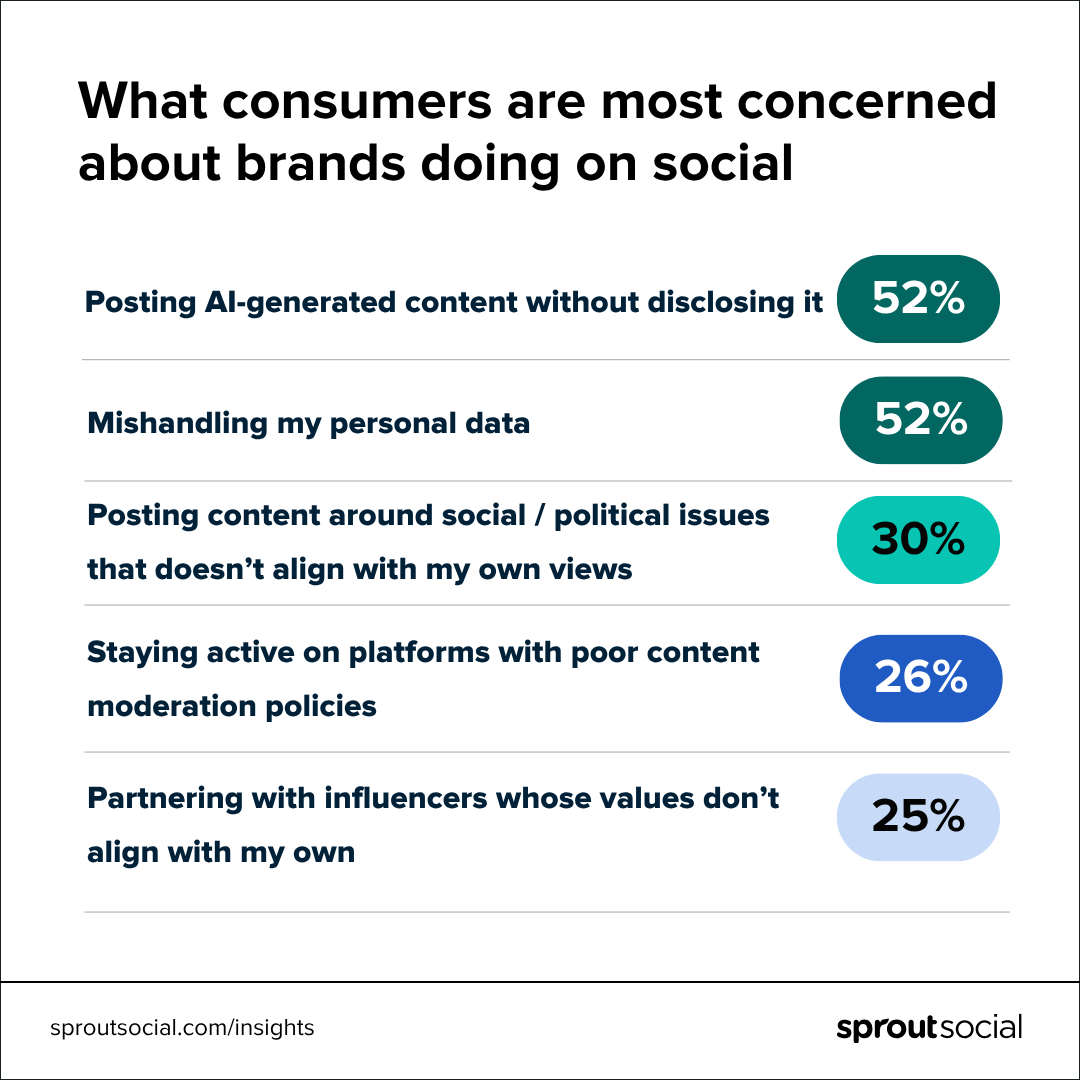
The sentiment was also reflected in a Q&A session where Sprout’s Arboretum community members were asked about what they loved or disliked about AI in social media.
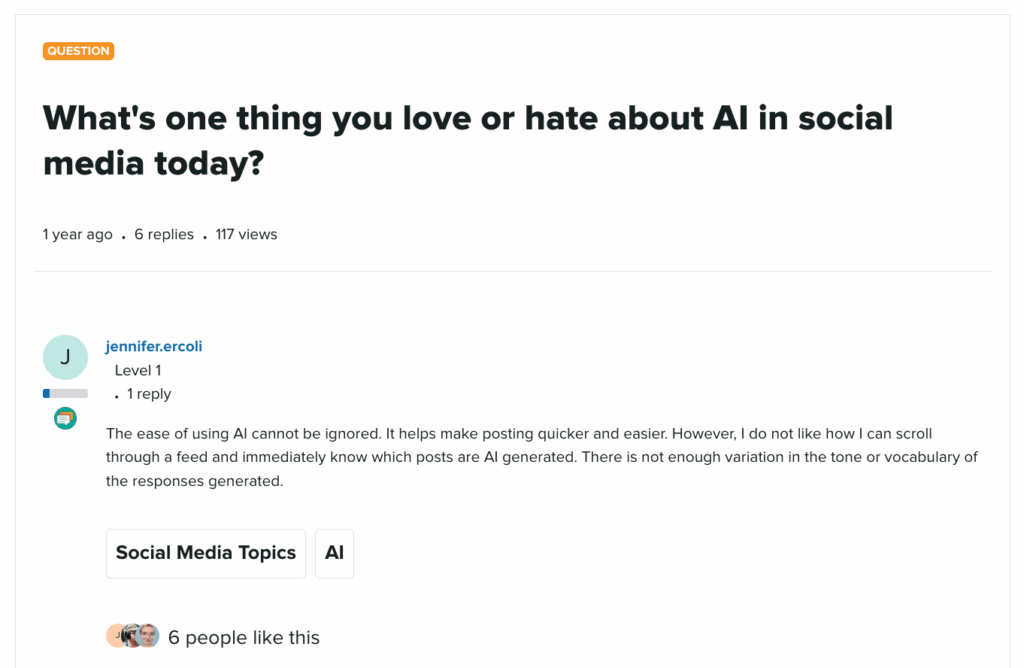
With Sprout, you can see how audiences respond to your content across campaigns and use those insights to refine targeting and adjust content direction. This will ensure every message feels purposeful and connected to the people you’re trying to reach.
5. Performance tracking and optimization
AI tools make performance tracking, reporting and optimization much easier because they automatically surface key trends, shifts in engagement and content patterns that matter to your brand.
Sprout’s analytics and reporting tools make it easier to consolidate data and unlock deep insights to identify market shifts, learn what matters to your customers and prove social ROI. Take, for example, the Analyze Chart by AI Assist capability, which processes numeric values from charts in My Reports and summarizes them for a digestible view. If it notices a sudden jump in activity, it also reviews the top posts from that day to explain what caused the spike.
The best part is that the intuitive interface enables teams to access, digest and share data without requiring extensive technical training. Plus, it enables you to present your findings in a format that decision makers and the C-suite can immediately understand.
Rebecca M., Senior Member Communications Manager at healthcare performance analytics company, Sg2, says, “What I like best about Sprout is its intuitive and user-friendly interface. It makes it easy to navigate the platform, plan content and view upcoming social media posts. I also find the reporting features especially valuable for tracking key metrics and comparing performance year over year.”
Sean Anderson, Communications Specialist at Chicago’s economic development agency, World Business Chicago, also uses Sprout Reporting regularly to share insights with leaders.
“Our team provides the C-suite with the typical monthly metrics—impressions, engagement, new followers, etc. But it’s the Potential Reach we provide quarterly that really shows them the extent of our social media messaging and proves the power and value of social media versus traditional press and advertising,” he says.
AI also strengthens the optimization workflow by turning complex analytics into practical next steps. It can recommend ideal posting times, highlight top-performing formats and flag areas where content is underdelivering. With AI guiding these adjustments, teams can iterate quickly and base their decisions on evidence rather than intuition.
Combined with smart recommendations and flexible reporting dashboards, social teams can build a more consistent, insight-driven optimization loop that improves performance with every campaign.
6. Advanced customer service automation
AI in social media has transformed customer care. By taking on routine tasks and automatically surfacing messages that need to be prioritized, Al tools enable support teams to respond faster, remain consistent across channels and deliver a better experience without added strain.
For instance, Sprout’s AI-powered message prioritization and alerts baked on sentiment in the Smart Inbox and reviews feed enable teams to immediately see urgent issues, high-value customers and rising complaints before they escalate. Social teams can also create custom views based on sentiment and automated rules to route your messages and reviews for optimized customer care.
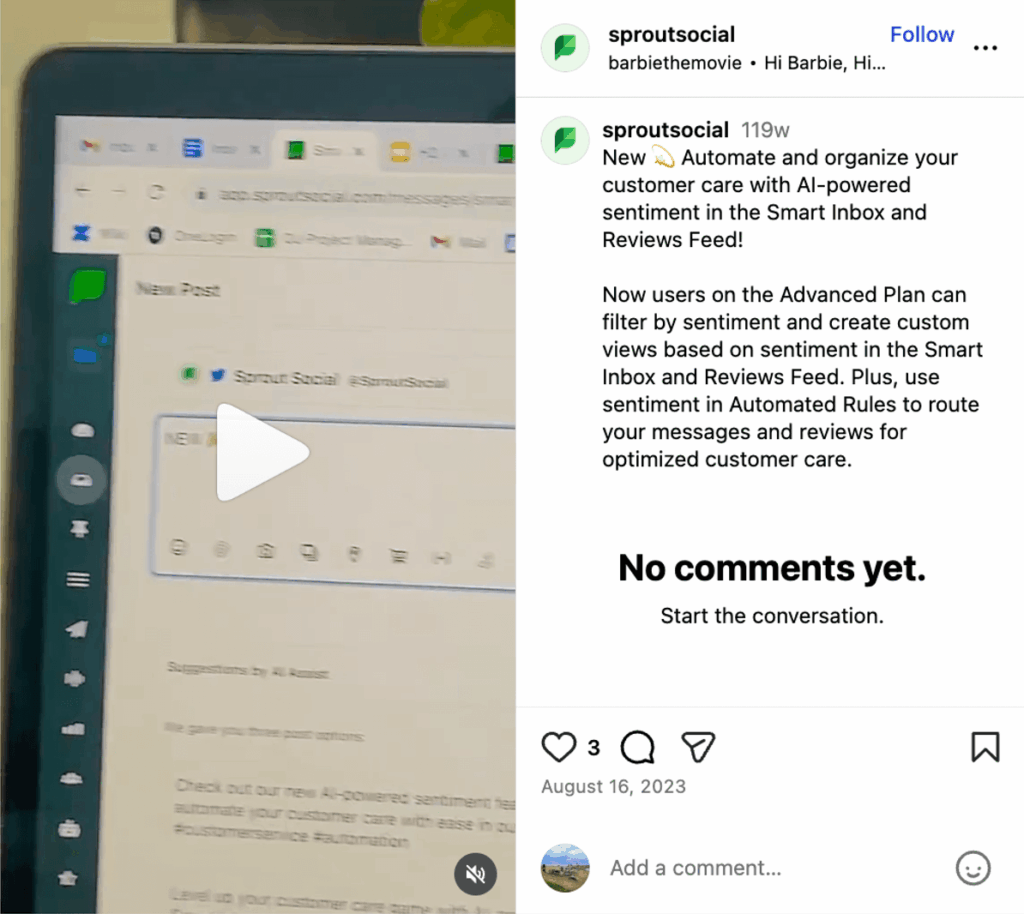
By removing the manual work of monitoring inboxes, AI tools enable your team to focus on conversations where human understanding matters most. Plus, real-time triage ensures critical messages don’t get buried.
Take a look at how our social team was able to resolve an issue with minimal downtime and win customer love.
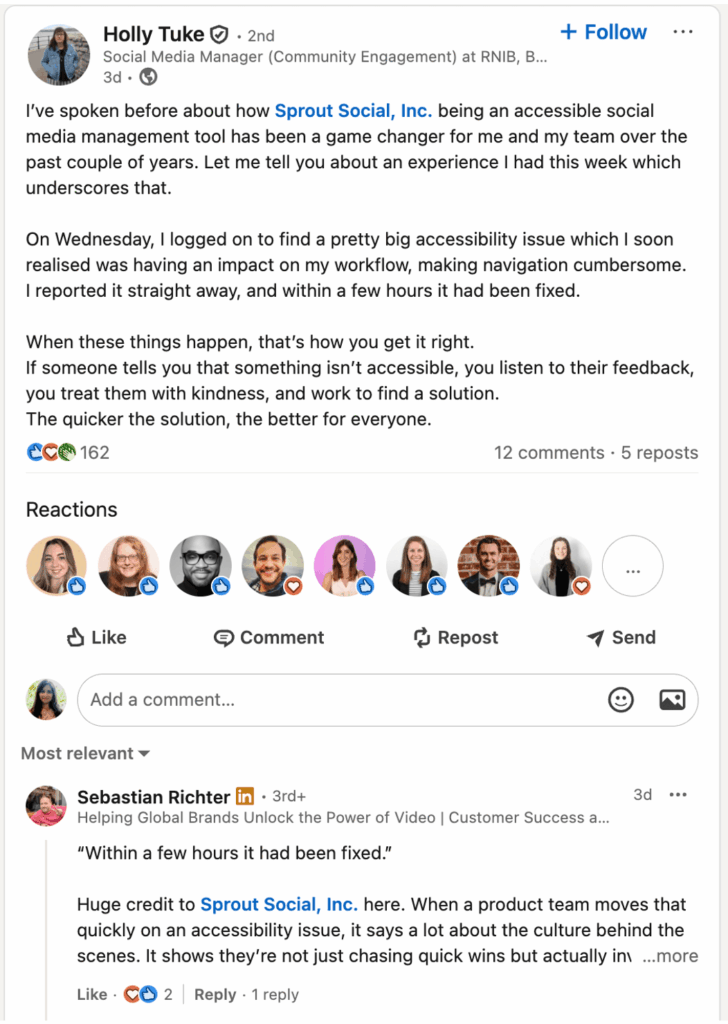
Once inquiries are routed and prioritized, AI tools help accelerate resolution by suggesting contextual replies, predicting intent and automating repetitive workflows, while still giving your agents full control when nuance is required.
This balance of automation and human intervention shortens resolution times and improves the consistency of every interaction. Customers get answers when they need them, agents spend their time solving meaningful problems and your organization maintains high-quality service at scale.
7. Competitive benchmarking and market insights
AI in social media marketing streamlines competitive analysis by surfacing real-time signals you can act on. Instead of manually checking competitor feeds or guessing at market shifts, AI tools like Sprout’s AI-powered Listening Topic Templates give you a continuous pulse on competitor performance, messaging and audience engagement. This enables you to spot shifting market expectations and whitespace faster than traditional research cycles allow.

With richer, automated insights, teams can move from reactive to strategic. Benchmarking features in Sprout make it easier to understand where your brand leads, where you’re lagging and how to adjust your content, campaigns or positioning. When you have this level of clarity, you’re better equipped to refine your strategy, differentiate your voice and stay competitive in crowded markets.
8. Visual and creative asset enhancement
AI enables faster creative production so teams can produce high-quality assets at scale. Whether you’re repurposing existing visuals or generating new concepts, AI tools reduce time spent on manual edits so creative teams can focus on the storytelling that drives real connection. Sprout’s Asset Library supports this workflow by making it easier to organize, refine and use creative assets across channels.
With automated recommendations and smart tagging in Sprout, teams can quickly find the right assets, adapt them for different formats and ensure every piece aligns with brand standards. This combination of speed and cohesion empowers social teams to deliver polished, on-brand creative without bottlenecks.
9. Risk detection and crisis monitoring
AI plays a critical role in identifying risks before they escalate. AI-driven news monitoring tools like Newswhip, and capabilities like social listening and sentiment analysis, detect unusual spikes in conversation, tone shifts or emerging issues tied to your brand or industry and alert teams. These early warning signals give social teams and the broader communications teams the visibility they need for social media risk management.
Proactive monitoring supports cross-functional collaboration during high-stakes moments. With centralized dashboards and automated insights, PR, legal and support teams stay aligned on what’s happening and how to act. Instead of reacting after the fact, you can get ahead of potential crises, protect your brand reputation and maintain trust with your audience.
How to implement AI into your social media strategy: 7 practical tips
Bringing AI into your social media strategy is all about making smarter, faster decisions with the data and workflows you already have. When used intentionally, AI can help your team move from reactive to proactive, uncover insights you’d otherwise miss and produce stronger content with less effort.
1. Integrate AI into your daily workflows
Start by automating tasks that slow your team down. These include drafting posts, generating alt text, summarizing conversations or prioritizing messages. Use tools like Sprout’s Generate by AI Assist to quickly produce on-brand captions, rewrite copy and brainstorm variations. Similarly, automate tagging and sentiment analysis to reduce the time you spend sorting and interpreting inbound messages. Integrating AI into existing steps, rather than adding new ones, keeps adoption simple.
2. Choose the right AI tools with clear criteria
Look for solutions that support your core goals: better content, deeper insights, faster response times or stronger customer care. A unified social media management platform, like Sprout, gives teams an advantage because AI features sit alongside publishing, engagement and reporting. This removes the friction of switching back and forth, saving time and effort. Also, prioritize tools that fit your workflow, maintain strong data governance and give you control over tone and accuracy.
3. Keep your content authentic with ethical and creative guardrails
AI can help you ideate and produce content faster, but authenticity still depends on human intervention. Set guidelines for tone, messaging boundaries, brand safety and accessibility. This can help you easily refine drafts to ensure they sound like your brand instead of a generic template. And as always, review AI-generated content for nuance, accuracy and inclusivity before publishing.
4. Encourage experimentation and iterative improvement
AI works best when teams stay curious. Treat AI as a creative partner that helps you continually refine your approach based on real audience behavior. Test different prompt styles, post formats and workflows, then track what resonates. Sprout’s AI-powered analytics tools make it easier to identify patterns in performance so you can improve your content strategy with each iteration.
5. Use AI insights to inform cross-functional collaboration
AI tools surface trends, competitor movements, emerging conversations and sentiment shifts in real time. Share these insights with teams across the business, like PR, product, sales or customer support, to inform launches, refine messaging and react faster to industry changes. When AI insights flow across teams, your organization becomes more aligned and responsive.
6. Build trust with transparent and responsible AI use
Your audience still expects a human experience. Use automation thoughtfully, especially for customer care. Tools like Sprout’s Smart Inbox and AI-powered message prioritization help teams respond to what matters most while still adding human warmth where needed. Avoid sharing sensitive data with AI tools and refer to your company’s AI policy when in doubt. Also make transparency part of your brand’s approach to AI-powered interactions and include an AI disclaimer where necessary.
7. Document your AI playbook as you scale
As your AI use matures, create a shared internal playbook that outlines your best prompts, brand guidelines, approval steps and standards for responsible AI use. This keeps the team aligned, speeds up onboarding and ensures consistency across all channels, especially as more team members begin relying on AI-powered workflows.
Common mistakes to avoid when using AI for social media
While AI can be a huge time-saver for social teams, to get real value from it and avoid pitfalls, brands need to use it with intention. Most issues arise when teams over-automate, skip over compliance checks or ignore the fact that AI needs clear human guidance. Keeping these things in mind helps you use AI confidently and responsibly across your social channels.
Below are some common mistakes to avoid when using AI for social media marketing.
- Over-automation: Relying too heavily on AI for responses or content can make your brand feel robotic or disconnected. Use automation to support your team while keeping real human interaction intact where it matters.
- Lack of human oversight: AI still needs human review to ensure tone, accuracy and brand alignment. This means you need to build in checkpoints for human editing and approvals.
- Ignoring privacy and compliance: Feeding sensitive data into AI tools without understanding data privacy rules or network policies can create compliance risks. To avoid this mistake, ensure you’re following all policies and compliance rules.
- Using generic prompts: Weak or vague prompts lead to irrelevant or low-quality output, making more work for your team. Give your AI tool clear context, audience details and goals to work from.
- Not reviewing for bias: AI can unintentionally reinforce stereotypes or biased language if not monitored. While this could be because of the preset training, reviewing results can help you overcome this challenge.
- Automating without strategy: Using AI for the sake of it, without a clear purpose or workflow, often leads to inefficiency and inconsistent results. To avoid this, define where AI fits into your workflow and what it should meaningfully improve.
- Neglecting accessibility: Not checking AI-generated content such as captions or alt text, for accuracy can compromise accessibility and user experience. A quick review to ensure your content stays accessible and user-friendly can help minimize this risk.
Make social media a true driver of business impact with AI
AI isn’t just a tool for social teams, it’s a way to work smarter, respond faster and create more meaningful connections with your audience. From crafting content and personalizing messages to streamlining workflows, tracking performance and uncovering audience insights, AI helps teams do more with less while keeping strategy and creativity front and center.
When used thoughtfully, with human oversight and ethical practices in place, AI enables brands to turn insights into action, stay ahead of the curve and make social media a true driver of business impact. Try Sprout Social to see how you can use AI in social media marketing to derive your social impact faster.
37 free social media strategy templates that will elevate your workflows
Published on December 5, 2025 Reading time 15 minutes









Share