The complete guide to social media campaigns [+ 4 examples for 2026]

Written by Aubree Schaefer
Published on May 29, 2026
Reading time 18 minutes

Table of Contents
Summary
- A social media campaign is a time-bound, goal-driven set of coordinated actions across one or more social platforms, distinct from everyday posting.
- The five core campaign types are product launch, brand awareness, contests and giveaways, seasonal and UGC.
- Every high-performing campaign starts with audience research, competitive analysis and well-defined KPIs set before launch.
- Measurement connects campaign activity to business outcomes. Engagement, reach, sentiment and conversions are the metrics that matter most.
- Sprout's campaign management tools, from AI-powered Listening to cross-platform Analytics, support every stage from brief to post-campaign report.
A social media campaign transforms your brand’s goals into coordinated, measurable action across social media platforms. Every successful campaign starts with a well-defined understanding of your audience, your brand objectives and the competitive landscape. From there, you must track performance from launch through analysis.
Publishing is just the beginning. Tracking, listening and analyzing campaign results proves your team’s impact on business goals and sharpens every future social media marketing strategy.
This guide covers the essential steps to running a social media campaign, four standout real-world examples and 20 tips for building a campaign that drives real results.
Before you dive in, download our social media campaign brief template to start strong.
What is a social media campaign?
A social media campaign is a coordinated set of marketing actions executed across one or more social media platforms within a defined timeframe to achieve measurable business objectives. Unlike one-off posts, campaigns unify every tactic—organic, paid and earned—around a single goal.
A social media campaign isn’t a siloed effort—it’s the engine of your omnichannel strategy.
Key elements of a successful social media campaign
A comprehensive campaign draws from these building blocks:
- Organic posts
- Paid promotions
- Contests and giveaways
- Branded hashtags
- User-generated content
- Creator and influencer partnerships
- Accurate reporting

What is the purpose of a social media campaign?
A social media campaign gives your brand a structured way to pursue a specific business goal—whether that’s launching a product, growing an audience or driving revenue—within a defined window. Everyday social posting builds presence. Campaigns build momentum. Every tactic, asset and metric points in the same direction, which is what turns social activity into measurable business impact.
Types of social media campaigns
Every social media campaign falls into one of a few core categories, and choosing the right type determines whether your campaign drives real business impact or just generates noise. Match your campaign type to your goal before you build anything else.
Product launch campaigns
Product launch campaigns build anticipation for a new product or feature release. They run in three phases: a teaser to generate buzz, a launch-day push to drive conversions and sustained post-launch promotion to maintain momentum.
Brand awareness campaigns
Brand awareness campaigns introduce your brand to new audiences and reinforce your values to existing followers. The primary goal is increasing visibility and share of voice rather than driving immediate conversions. Data from our 2025 Sprout Social Index™ shows overall engagement is the top metric marketing leaders use to measure social success. This makes awareness campaigns a direct investment in that outcome.
Contests and giveaways
Contests drive rapid audience growth by incentivizing participation with prizes. They expand your reach fast and generate a surge of user-generated content your team can repurpose across platforms.
Seasonal or holiday campaigns
Seasonal campaigns tap into cultural moments, holidays and time-sensitive trends to drive relevance and sales. Speed matters here. The 2025 Sprout Social Index™ found that more than a quarter of consumers say trendjacking only works if a brand acts within one to two days of a trend emerging.
User-generated content (UGC) campaigns
UGC campaigns activate your community to create content featuring your brand or products. This builds social proof, fuels authentic storytelling and gives your team a library of real content to amplify without the production overhead.
| Campaign type | Primary goal | Duration | Best For | Key metric |
|---|---|---|---|---|
| Product launch | Drive sales and adoption | 4-8 weeks | New products/features | Conversions, reach |
| Brand awareness | Increase visibility and share of voice | 3-6 months | New brands/markets | Impressions, engagement |
| Contests and giveaways | Grow audience and generate UGC | 1-4 weeks | Follower growth, entries | Participation, shares |
| Seasonal or holiday | Drive timely relevance and sales | 2-6 weeks | Retail/ecommerce | Engagement rate, revenue |
| UGC | Build social proof and content volume | Ongoing | Community building | Submissions, repurposed content |
4 creative social media campaign examples to inspire you in 2026
The best social media campaigns don’t just go viral. They build lasting brand equity, drive measurable business results and create genuine connections with audiences. These four examples show exactly how it’s done.
Study these social media campaign examples and pull the strategic principles into your own work.
1. LEGO’s Botanicals Challenge
LEGO leaned into their “adults welcome” positioning with a social media campaign built around their Botanicals Collection, a range of flower-building sets timed for Valentine’s Day.
On TikTok, they ran a weekly LEGO Botanicals Challenge where florist creators built creative displays using the sets. On Instagram, they featured a former Bachelor contestant constructing Valentine’s-themed LEGO arrangements.

Bryce is bringing the outside in this week on the LEGO Botanicals Challenge. Watch the whole thing: @FLOWER BOY #flowertok #flowersareforever #legobotanical #lego

@lego
What do you call a florist who builds LEGO flowers? Le Florist 🤌 #LEGO #LEGOFlowers #LEGOBotanicals
♬ original sound – LEGO
The takeaway: LEGO’s campaign works because it connects product to emotion—celebration, creativity and community. Involve creators and customers in a challenge format, tie your campaign to a cultural moment and give your audience a reason to participate, not just watch.
2. Duolingo’s “Unhinged Owl” TikTok takeover
If there is a masterclass in how brands should behave on TikTok, it’s Duolingo. The language-learning app abandoned traditional, polished corporate marketing in favor of chaotic, native and entertaining content.
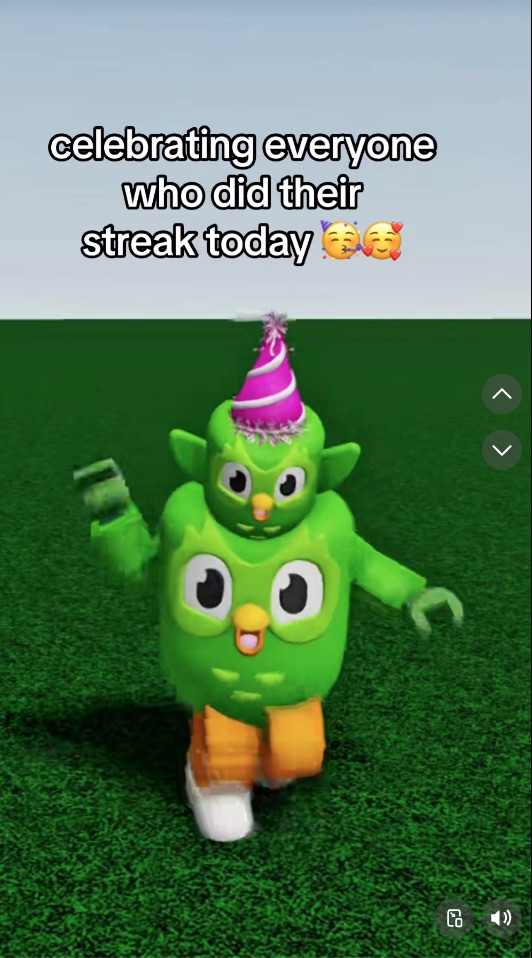
Centering their strategy around their mascot, Duo the Owl, the brand leaned into a long-standing internet joke: that Duo is relentless about making you finish your daily lessons. By participating in trending audio, breaking the fourth wall and playfully roasting their own users in the comment section, Duolingo transformed a utilitarian app into a viral sensation. They proved that people don’t want to be marketed to on TikTok—they want to be entertained.
The takeaway: Don’t be afraid to loosen the reins on your brand guidelines, especially on platforms like TikTok or Instagram Reels. Develop a distinct brand persona that speaks the native language of the platform. If you can make your audience laugh and feel like they are in on the joke, the engagement and brand loyalty will naturally follow.
3. #ShotOniPhone and #YourShotPhotographer
While the #ShotOniPhone campaign is a legacy initiative, it remains the gold standard for user-generated content. It has incredible staying power because it continuously adapts to showcase the latest product features through the eyes of real customers.
Instead of letting the hashtag collect dust, the brand encourages users to highlight the specific capabilities of their newest lenses—most recently pushing tags like #ShotOniPhone17Pro to showcase stunning macro photography and cinematic video.
Similarly, #YourShotPhotographer by National Geographic is a legacy hashtag that unites Nat Geo’s sprawling community of photographers. They’ve leveraged Instagram to build a dedicated space for their Nat Geo Your Shot audience, amassing millions of followers who are eager to have their work validated and featured by the iconic publication.
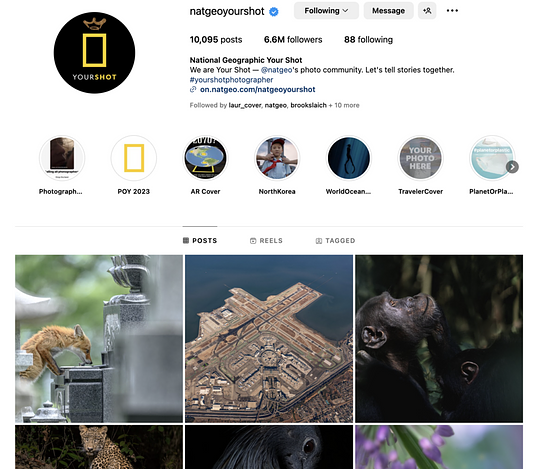
The takeaway: A branded hashtag shouldn’t just be a one-off gimmick—it can be a long-term strategy that grows and evolves alongside your product. Sourcing UGC directly from your community not only celebrates your loyal audience, but it fuels your content calendar and brings your brand to life through authentic, customer-driven perspectives.
4. Adidas “Originals” campaign
Adidas’ “Originals” campaign honored both sports icons and everyday people who embody the brand through a series of short films named after their most iconic shoes: Gazelle, Superstar and Samba.

They distributed the films on YouTube and drove discovery through Instagram Reels previews, anchored by the hashtags #WeGaveTheWorldAnOriginal and #AdidasOriginals.
The takeaway: You don’t need a Hollywood budget—you need a story worth telling. Find the human truth behind your brand and product, then build your campaign around it. Adidas honored their history and their audience simultaneously. That’s the formula.
More social media campaign examples by network
The strongest social media campaigns span multiple platforms and extend beyond social entirely. If you’re building a network-specific campaign or tailoring content to platform specifications, these resources give you the tactical detail you need.
- 5 brilliant Facebook campaigns (and why they worked)
- Instagram campaigns failing? Learn from these highly-successful brands
- 9 tips for designing TikTok campaigns (plus examples)
- The essential guide to YouTube ad campaigns
How to plan the best social media campaigns
The strongest social media campaigns start with research. You have to listen to what your audience and competitors are saying before a single creative brief is written. Three research inputs shape every high-performing campaign: a deep understanding of your target audience, a well-defined competitive analysis and a review of past campaign performance.
1. Understand your target audience
Campaigns built without audience intelligence miss the mark, and audiences notice. Social listening surfaces the exact topics, language and concerns your target audience cares about, so your campaign messaging connects from the first impression.
Sprout Social’s AI-powered Social Listening analyzes global conversations about your brand, products and competitors in real time, giving you the raw material to build campaigns that speak directly to what your audience wants to hear.

2. Do a competitive analysis to set yourself apart
A competitive analysis reveals exactly where your brand leads and where competitors fall short. That intelligence sharpens your campaign goals before you spend a dollar.
Use social listening to track metrics like share of voice, which shows how your brand stacks up in the broader conversation and where you need to close the gap. That data becomes the foundation for setting campaign goals and objectives that are ambitious and achievable.

3. Choose the right platforms for your campaign
Not every campaign belongs on every platform. The right platform mix depends on three things: where your audience spends their time, the content format your campaign requires and the objective you’re trying to hit.
Use these questions to guide your platform selection before you build a single asset:
- Where does your target audience have the highest concentration? Use Sprout Social’s audience demographic reports to validate this with data, not assumption.
- What content format does your campaign idea require? Short-form video campaigns belong on TikTok and Instagram Reels. Long-form thought leadership belongs on LinkedIn or YouTube. Don’t force a format into the wrong environment.
- What is your campaign objective? Awareness campaigns maximize reach on high-volume platforms. Conversion campaigns perform best on platforms with strong native commerce tools or link-click capabilities.
- What does your historical performance data show? Your best-performing platforms from past campaigns are your baseline. Build from evidence, then test into new social media platforms.
4. Analyze campaign performance
AI-powered social listening goes beyond vanity metrics. It tells you how audiences feel about your campaigns through real-time sentiment analysis.
Track sentiment as a campaign runs so you course-correct immediately, not after the damage is done. Past campaign sentiment data also feeds directly into future campaign strategy, turning every launch into a learning opportunity.

How to run a successful social media campaign
Running a high-impact social media campaign requires five focused steps: brainstorm themes, set your budget, build content, choose metrics and use the right technology to manage it all.
1. Brainstorm social campaign themes
Generate social media campaign ideas by asking your team—and teams outside of social—these questions:
- What are your target audience’s challenges?
- How does your brand support overcoming them?
- What do we want to accomplish with this social media campaign?
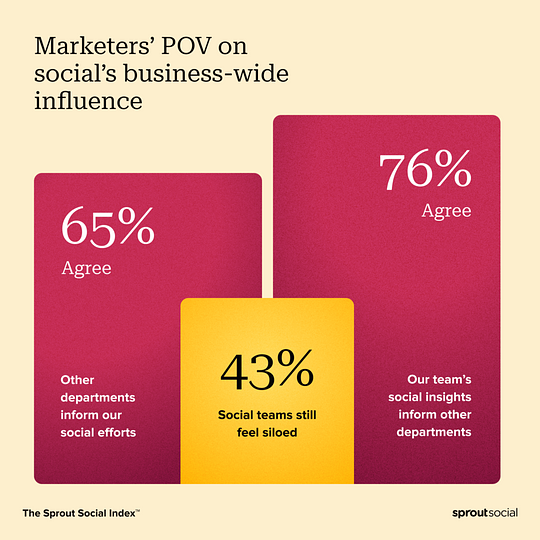
Cross-functional input sharpens your campaign. Data from our 2023 Sprout Social Index™ shows 65% of marketers agree other departments inform their social efforts—so bring in product, sales and customer care early.
The success of campaigns like Nike‘s #MambaDay tribute proves that emotionally resonant ideas—grounded in audience truth—drive the biggest results.
2. Set your campaign budget
Budget shapes every downstream decision in your campaign, including creative scope, platform mix, influencer tier and paid amplification. Set it before you build anything else.
Four cost categories make up the total investment for most social media campaigns:
- Content production: Design, video production, copywriting and any external creative resources you bring in.
- Paid distribution: Paid social spend across the platforms you’ve selected. Even a modest paid budget extends organic reach significantly on most networks.
- Creator and influencer partnerships: Fees vary by creator tier. Nano, micro and macro influencers carry very different costs and different return profiles. Use your campaign objective to determine which tier fits your goal.
- Tools and technology: Your social media management platform, analytics tools and any campaign-specific software.
Start with your campaign goal, then build your budget around the minimum resources required to reach it. A lean organic campaign built around UGC looks very different from a multi-platform launch with paid amplification and creator activations, and both are valid. The variable is your objective, not an arbitrary spend floor.
3. Build out your creative and content
Great campaign content is specific, audience-driven and built for the stage of the buying journey it targets. These strategies consistently produce memorable social campaigns:
- Partner with influencers and creators. Data from our 2025 Influencer Marketing Report shows influencers bring built-in trust and authenticity—which our 2023 Sprout Social Index™ notes consumers don’t see enough of from brands on social. Their content resonates because it’s real.
- Map content to the funnel. Awareness-stage content should grab attention first. Edutainment formats—infographics and how-to videos—work especially well here because they educate without hard-selling.
- Repost user-generated content (UGC). UGC saves your team time, satisfies audience expectations and delights the brand advocates who created it.
- Prioritize short-form video. Short-form video drives the highest engagement rates across all major social platforms. Make it a cornerstone of every campaign.
- Study your competitors. Analyze where their social efforts win share of voice and where they fall short. Use those gaps as creative fuel, not a copy template.
Always validate your content choices against your own historical data. Your audience’s preferences are the benchmark that matters most.
4. Choose your metrics and measure success
The right social media metrics connect campaign performance directly to business goals—so choose them before you launch, not after. For a comprehensive walkthrough, watch this video on the 17 most important social media metrics.
Engagement metrics, including clicks, likes, comments and shares, give you the most well-defined read on campaign effectiveness. Data from our 2025 Sprout Social Index™ shows overall engagement is the primary metric marketing leaders use to measure social success.
Measure performance throughout the campaign, not just at the end. Real-time social media analytics let you adjust your strategy while there’s still time to improve results.
5. Use technology to manage your campaign from start to finish
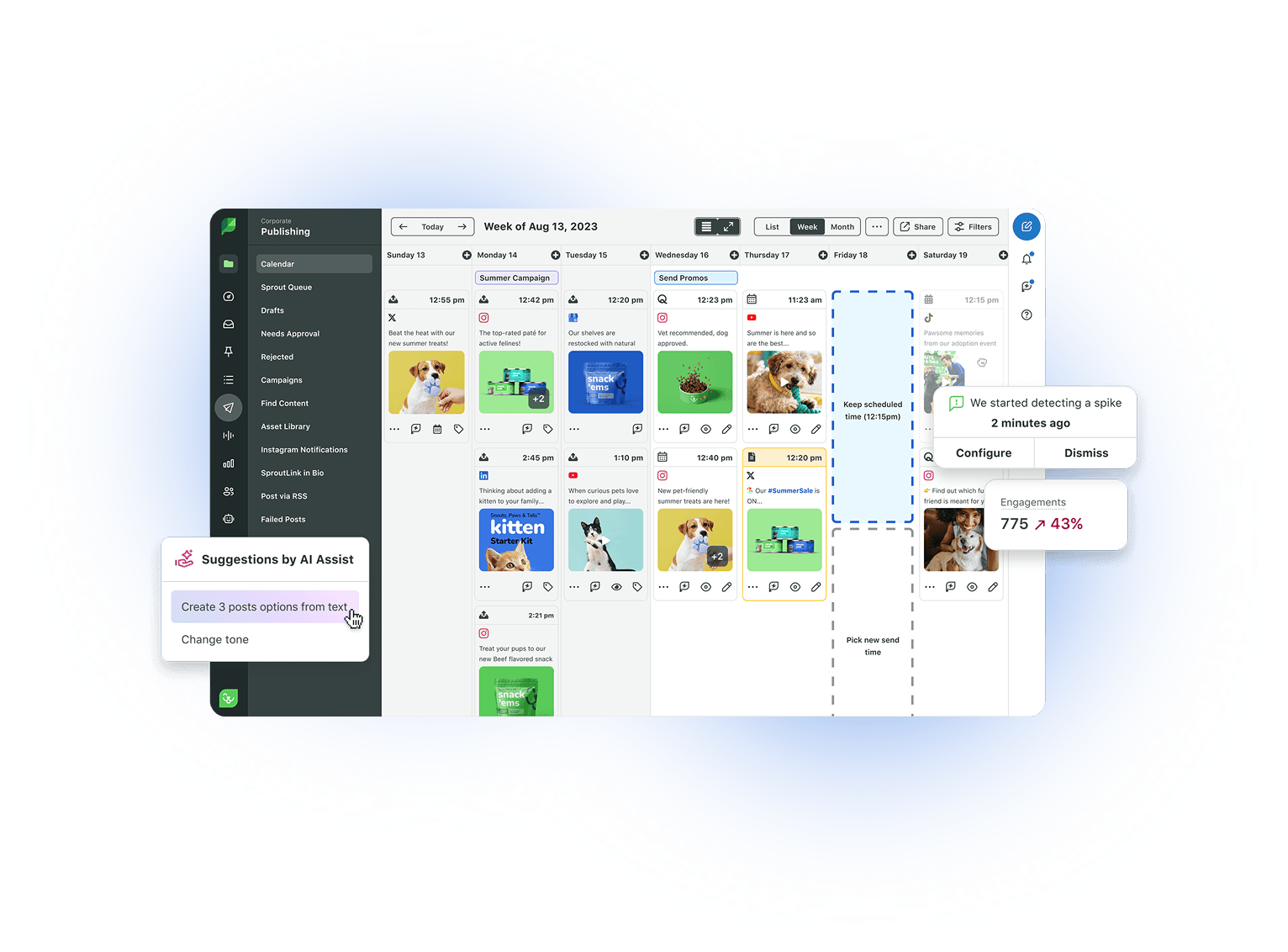
A social media management platform like Sprout Social keeps every campaign element, including briefs, creative assets, scheduling and analytics, in one place. Sprout Social’s Campaigns feature gives your team a single source of truth from ideation through reporting, so nothing falls through the cracks and every decision is backed by data.
How to create KPIs and benchmarks for a social media campaign
Setting the right KPIs and benchmarks is what separates a social media campaign that drives business results from one that just generates activity. Strong measurement connects your campaign to revenue, justifies budget and gives stakeholders the proof they need to invest more.
Here are the steps to set KPIs and benchmarks that actually move the needle for your social media campaigns.
Identify the “why” behind your campaign
Your campaign goal determines your KPIs. Full stop. Match your metrics to your objective from the start.
- Awareness: Track impressions, reach, share of voice and video views.
- Traffic and conversions: Track leads, clicks, trials, downloads and website traffic. Use UTMs to track these in Google Analytics.
- Brand perception: Track sentiment shifts over time using social listening data.
Pro tip: Three engagement metrics apply across every major social platform:
- Clicks: High click-through rates signal that your content earns attention and drives intent.
- Likes: Strong like counts confirm your content resonates and build organic momentum.
- Shares: When people share your content, you’ve achieved the highest form of audience validation, and your reach multiplies without additional spend.
See how you stack up against competitors
Once you know your “why,” put a number to it by benchmarking against your industry, your competitors and your own past performance. Data from our 2025 Sprout Social Index™ shows marketing leaders cite overall engagement and audience growth as their top metrics for measuring social success, so know where you stand on both before your campaign launches.
Start with share of voice: how does your brand’s presence compare to competitors across social platforms? Sprout Social’s competitive analysis listening tool automates this with real-time share of voice tracking, sentiment analysis and engagement benchmarking across all major social platforms—no manual calculations required.
Layer in industry benchmarks from Sprout Social’s 2025 Content Benchmarks Report to contextualize your goals. Then benchmark against your own historical performance to set goals and objectives that are ambitious and grounded in reality.
Set SMART goals
Every campaign goal must be Specific, Measurable, Achievable, Realistic and Time-sensitive. This framework removes ambiguity from goal-setting and makes it straightforward to evaluate success when the campaign ends. Apply it to every KPI you set. No exceptions.
Report on success
Campaign results belong in front of your entire organization, not just your social team. Share findings with senior leaders, customer care teams and cross-functional stakeholders to demonstrate social’s direct contribution to business outcomes. Data from our 2025 Impact of Social Media Marketing Report shows 56% of marketing leaders say social media drives revenue for their businesses and reporting is how you prove it.
Campaigns span multiple platforms, content types and paid vs. organic posts. Sprout Social consolidates all of it—social media platforms, posts and content performance—into one robust suite of analytics and reporting tools so you spend less time pulling data and more time acting on it.

20 factors the most successful social media campaigns have in common
The most successful social media campaigns share five core characteristics: they’re research-driven, cross-functional, sustained over time, technology-enabled and performance-focused.
Here are the 20 specific factors that separate campaigns that convert from campaigns that disappear.
1. Talk to customers
Customer insights are the foundation of every high-performing social media campaign. Partner with your sales and success teams to learn what customers think about your products and industry.
How to do this: Join a customer call, send a survey or consult your internal team. Frame customer intel as a direct driver of better campaigns and more revenue.
2. Learn from people outside your business function
The most unexpected campaign ideas come from outside the marketing department. Consult sales, R&D, product development and HR to break out of your echo chamber.
How to do this: Regularly convene with cross-functional teams to strengthen your strategy. Host a “social media council” where key stakeholders bring ideas to the table.
3. Give it a sustained effort
Abandoning a campaign within the first week or month doesn’t give your content enough time to saturate the market. Pivoting too quickly dilutes your brand story and hands your competitors an advantage.
How to do this: Run campaigns for at least three months and break your campaign strategy into distinct phases. At the end of each phase, evaluate the data and define actionable next steps. Sprout Social’s analytics tools make regular reporting fast and efficient.

4. Bring in the music (and trending sounds)
Music and trending sounds are creative fuel for social media campaigns. In some cases, you build an entire campaign around the right track.
How to do this: Use the TikTok Creative Center to browse sounds currently trending in your country and identify what fits your campaign’s tone.
5. Think beyond social
The most effective campaigns have an omnichannel component. Your audience wants to engage with your content and your product across multiple touchpoints, not just their feed.
How to do this: Bring in teams responsible for event planning, advertising and product design during your campaign brainstorm to build business-wide impact.
6. Inspire on social, close in store
Even digital-native audiences respond to in-person experiences. Social drives discovery; real-world moments drive conversion.
How to do this: Whether you have a brick-and-mortar location, a pop-up shop or a conference booth, build a face-to-face component into your campaign wherever possible.
7. Maximize opportunities to create content
Real-life experiences are your most underused content pipeline. Every event, activation and customer engagement is a production opportunity.
How to do this: Capture content of people engaging with your products, team members and spaces. A meet the team series works especially well when it aligns with your campaign goals.
8. Make conversions a focus
Brand awareness without a conversion strategy is an incomplete campaign. Design content and distribution to move people from discovery to decision.
How to do this: Use strong call to action phrases and add UTMs to every link so you track clicks, conversions and website traffic. Monitor performance metrics daily, especially for paid content.
9. Use AI and automation
AI and automation make your workflows and ideation processes faster without replacing the human judgment that makes campaigns resonate. Use these tools to accelerate your campaign from start to finish.
How to do this: Before launch, use AI-powered social listening to understand your audience. During the campaign, use AI to generate customer care responses faster and monitor sentiment in real time. After, measure results with analytics automation. Sprout Social’s suite of AI and automation capabilities covers every stage.
10. Experiment with ephemeral content
Every major platform now has its own version of ephemeral content. Use these formats to inject personality and less-polished, more personalized moments into your campaign.
How to do this: Start with our comprehensive guide to Instagram Stories for inspiration and tactical guidance.
11. Identify the influencers and creators to partner with
Influencers and creators lend authentic voices to your campaign and extend your reach into audiences that already trust them. When evaluating partners, focus on three criteria: reach, resonance and relevance.
How to do this: Read more about how to find and vet creators for your next campaign. Don’t overlook internal influencers—employee brand advocacy supercharges campaign reach. Sprout Social Influencer Marketing makes finding influencers and managing partnerships faster—learn more about Sprout Social Influencer Marketing.
12. Make customer care a priority
A campaign without a customer care strategy leaves conversion opportunities on the table. Data from our 2025 Sprout Social Index™ shows 73% of social media users expect brands to respond on social within 24 hours.
How to do this: Brief your customer support team on the campaign before launch, especially if it’s likely to drive a spike in incoming messages.
13. Look to innovators
Study the marketers and campaigns you admire most, and don’t hesitate to reach out to them directly. The fastest way to raise your campaign standards is to understand exactly how the best in the business operate—and often, they’re willing to share what worked.
How to do this: Reach out to marketers behind campaigns that impressed you and ask specific questions. Subscribe to blogs and newsletters that feature advice from leading execs. Sprout Social’s team is also available to discuss how our comprehensive suite of social media tools supports you in turning data into campaign ideas.
14. Partner up
Brand partnerships expand your reach with audiences who are already primed to care about what you offer. The right partner shares your target audience but doesn’t compete with your product.
- Overlap with your brand’s target audience
- Don’t overlap with your product offerings
How to do this: Build a co-marketing strategy to grow awareness with your target audience through shared campaigns and content.
15. Plan for retention and acquisition
Retention and acquisition require different content tracks. Some posts appeal to both existing customers and prospects, but each segment also needs content built specifically for them.
How to do this: In your content calendar, dedicate posts and mini-campaigns to each objective. Use Sprout Social’s internal tagging feature to group posts by retention and acquisition goals so you track performance and maintain the right balance.

16. Understand the digital customer journey
Every follower moves through your marketing funnel differently. Map how people engage with your content at each stage and across every social platform you operate on.
How to do this: Build a customer journey map to guide your campaign’s content creation from awareness through conversion.
17. Better understand cultural norms on social
Social media has its own culture, language and expectations. Campaigns built by marketers who are immersed in that culture consistently outperform those that aren’t.
How to do this: Subscribe to industry newsletters, spend time on the platforms where your audience lives and learn to speak their language fluently, not just observe it from a distance.
18. Use SEO to inform content themes
The terms you want your brand to rank for on search engines directly overlap with the topics you want to own on social. SEO research is campaign research.
How to do this: Read our guide to YouTube SEO strategy to apply search best practices to your content development across platforms.
19. Stay on brand
A consistent brand voice across platforms builds recognition and trust. Jump on trending conversations only when they genuinely connect to your brand and your campaign, not just because everyone else is doing it.
How to do this: Define your brand’s core values and use them as a filter for every piece of social content you create.
20. Conduct a post-campaign analysis
The campaign doesn’t end when the content stops publishing. A post-campaign analysis is where your next campaign begins, turning performance data into a strategic brief that makes every future launch sharper.
How to do this: After each campaign, document what worked, what didn’t and why. Review your KPIs against the benchmarks you set before launch. Pull your Sprout Social analytics reports to compare performance across platforms and content types. Then build a one-page summary that your team references when planning the next campaign so institutional knowledge compounds instead of disappearing when the campaign ends.
Design an industry-leading social media campaign
Building a standout social media campaign means pulling insights from across your organization and turning them into content that earns attention and drives measurable business results.
This guide equips you to conduct meaningful research, create compelling content and report on metrics that prove impact. These are the three pillars of every successful social media campaign.
To stay organized and launch on time, use our social media campaign brief template to align stakeholders and keep your brand on budget. Or explore our comprehensive library of social media templates.
Ready to run campaigns that move the needle? Start your free Sprout Social trial and access every campaign management tool covered in this guide.
FAQs about social media campaigns
What's the difference between a social media campaign and a social media strategy?
A social media strategy is your long-term strategy for how your brand shows up, engages with your audience and drives business results on social. A social media campaign is a focused, time-bound push inside that strategy, with a specific goal, a well-defined timeline and a defined creative theme.
How long should a social media campaign run?
Most social media campaigns need at least four to six weeks to build meaningful momentum, and campaigns tied to major business goals benefit from a three-month runway.
Short campaigns (one to two weeks) work for time-sensitive moments like product launches or seasonal promotions, but they require a higher content cadence and a well-defined paid amplification strategy to compensate for the compressed timeline.
Whatever your duration, break the campaign into distinct phases: pre-launch, active and post-campaign. Review performance data at each stage so you can adjust in real time, not after the window closes
How much does a social media campaign cost?
Costs depend on your creative needs, paid media, influencer partnerships, tools and team time. A lean organic campaign looks very different from a multi-platform effort with creator activations. Start with your goal, then build a budget around the resources required to reach it.
What's the difference between organic and paid social media campaigns?
Organic campaigns rely on free content distribution to your existing followers and their networks, focusing on community building and long-term engagement. Paid campaigns use advertising budget to target specific demographics outside your current following, accelerating reach and driving immediate conversions.
How do I know if my social media campaign is working?
You know your campaign is working when you track performance against specific KPIs and benchmarks you set during the planning phase. Monitor metrics like engagement rates, click-through rates and conversions in real-time to optimize your content and strategy immediately.





Share