Instagram engagement rate: The ultimate guide to calculation, benchmarks and best tips

Written by Jacqueline Zote
Published on April 8, 2026
Reading time 13 minutes

Table of Contents
When people see an Instagram post they like, they engage with it by liking, commenting, sharing and saving. These actions tell you if your Instagram strategy is paying off. Monitor your engagement rate and you understand exactly how your content is landing.
Whether you’re evaluating your own account or vetting a potential influencer partnership, social media engagement rate is the metric that tells the real story. This guide covers how to calculate your Instagram engagement rate, what benchmarks to measure against by industry and post type and the strategies that move the needle.
What is an Instagram engagement rate?
Instagram engagement rate is the percentage of your audience that actively interacts with your content through likes, comments, saves, shares and other actions, calculated with the formula: (Total Engagements ÷ Total Followers) × 100.
It’s the clearest signal of how well your content resonates with your target audience, and one of the most important metrics for benchmarking content performance, evaluating influencer partnerships and proving the business value of your Instagram strategy.
Why a good Instagram engagement rate matters
A good engagement rate indicates that people are enjoying your content. It shows that your Instagram marketing efforts are paying off.
Improve platform visibility
The Instagram algorithm uses several factors to rank and display content. While relevance is one crucial element, engagement is another major consideration. Higher engagement signals to the platform that your content is valuable, which significantly increases your organic reach and ensures your posts appear in front of a wider audience without relying on paid spend.
Even among relevant content, posts that see high engagement are more likely to show up in a user’s Explore feed. A good engagement rate is essential to improve your visibility on Instagram.
Attract a new audience
Higher visibility brings new audiences directly to your content. Instagram surfaces posts to people most likely to engage with them, and when those people connect with what they see, they follow. A strong engagement rate is one of the most reliable organic paths to growing your Instagram following.
Increase credibility
To the average Instagram user, a post with high engagement means other people are enjoying it. Good engagement serves as social proof and reflects positively on your brand authenticity.
Which engagement types carry the most weight?
Not all engagement actions are equal. Instagram’s algorithm weights each type differently, and understanding that hierarchy changes how you measure success and build content.
- Saves: The strongest signal of intent. When someone saves your post, they tell the algorithm your content is worth returning to; one save outweighs dozens of likes in algorithmic value.
- Shares: High-value distribution. When followers share your content to their Stories or DMs, you reach entirely new audiences without paid spend. The algorithm treats off-network sharing as a strong quality signal.
- Comments: Active, two-way engagement. A comment takes deliberate effort, which signals to the algorithm that your content sparked a genuine reaction worth amplifying.
- Likes: The most common action, but the lowest algorithmic weight. A post with 500 comments outperforms one with 5,000 likes in terms of reach and visibility.
Optimize for saves and shares, not just likes, to build an engagement rate that moves the algorithm in your favor.
How to calculate your Instagram engagement rate
To calculate Instagram engagement rate, you need two details:
- Total interactions
- Total followers
The total follower count is easy to see on your Instagram profile. Follow the steps below to access your total interactions:
- Go to your Instagram Insights.
- Choose the date range you want to track.
- Tap on Interactions from the Overview section.
- Scroll down to the By interaction section and add up the total interactions for your posts. Also add the interactions in your Stories to include them in your calculation.
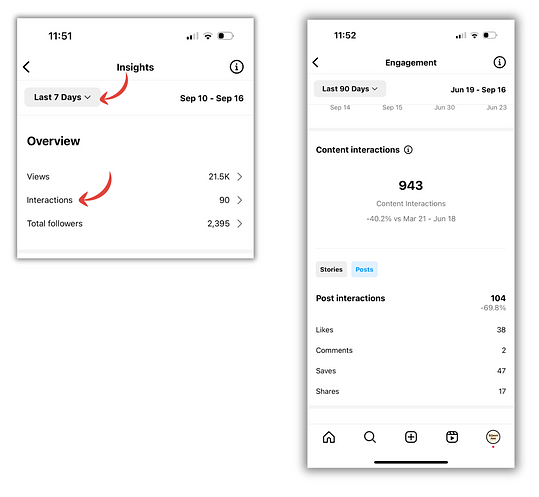
Once you have these two numbers, here’s how to check engagement rate on Instagram:
Engagement rate = (Total interactions/Total followers) x 100
Alternatively, automatically calculate your Instagram engagement using an Instagram analytics tool. Skip manual calculations entirely with Sprout Social’s automated engagement rate tracking. The platform calculates your rate instantly and tracks performance trends over time.
Different methods to calculate Instagram engagement rate
Your calculation method shapes your insights. Choose the formula that aligns with your measurement goals.
| Method | Formula | Best for |
|---|---|---|
| By followers | (Total Engagements ÷ Total Followers) × 100 | Measuring how your core audience responds to content |
| By reach | (Total Engagements ÷ Total Reach) × 100 | Understanding content effectiveness with actual viewers |
| By impressions | (Total Engagements ÷ Total Impressions) × 100 | Gauging content’s repeat engagement power per view |
What is the average Instagram engagement rate?
The median Instagram engagement rate across all industries is 0.36%—the platform-wide benchmark tracked by RivalIQ. According to the 2025 Sprout Social Index™, brands that successfully elevate their engagement above these baselines do so not through sheer posting frequency, but by prioritizing content originality, relatability, and rapid audience responsiveness.
That number shifts significantly by industry, content format and audience size. A sports brand with a passionate fan base sees different numbers than a financial services company. A creator posting Reels daily sees different numbers than a retailer posting static images twice a week.
Start by establishing your own baseline. Track your engagement rate over 30, 60 and 90-day windows. That historical trend tells you more than any single post and gives you a foundation to compare against industry benchmarks and competitors.
What is a good Instagram engagement rate?
A good Instagram engagement rate is 1% or higher. That threshold places you in the top 25% of brand accounts on the platform, according to RivalIQ. Use these ranges to benchmark where you stand:
- Below 0.43%: Below the platform median—audit your content mix and posting cadence
- 0.43%–1%: At or near average for most brand accounts
- 1%–3%: Strong—top-tier performance across most industries
- 3%+: Exceptional—common in niche communities with highly active audiences
These thresholds are starting points, not finish lines. A 2% rate in financial services is exceptional. A 2% rate in sports is average. Always benchmark against brands that share your audience size, industry and content type.
Run an Instagram competitors report to see the exact rates your direct competitors are earning—data that’s more actionable than any platform-wide average.
Instagram engagement rate benchmarks by industry
Industry context changes everything. An engagement rate that looks flat for a sports brand looks exceptional for a B2B software company. Use these benchmarks to orient your performance against brands in a similar space.
| Industry | Average Instagram engagement rate |
|---|---|
| Higher education | 2.1% |
| Sports teams | 1.3% |
| Nonprofits | 0.56% |
| Health and beauty | 0.44% |
| Media | 0.44% |
| Food and beverage | 0.40% |
| Financial services | 0.26% |
| Retail | 0.16% |
| All industries (median) | 0.36% |
| Top 25% of brands | 1.05% |
Source: RivalIQ
Industries with passionate, community-driven audiences such as sports, education and nonprofits consistently outperform those with more transactional follower relationships. Posting more does not increase your engagement rate; it dilutes it when the content isn’t connecting.
Your strongest competitors are your most relevant benchmark. Use Sprout Social’s Instagram Competitors Report to compare your engagement rate against specific brands in your space, not just a static industry average.
How to measure Instagram engagement with Sprout Social
Manually calculating your Instagram account’s engagement rate is a time-consuming process. But a social media management tool like Sprout Social centralizes your Instagram data, making it easier to track, analyze and report on your engagement metrics.
Sprout Social’s AI-powered analytics provide a clear view of your Instagram performance, supporting your move beyond manual calculations to gain actionable insights.
Step 1: Log into your Sprout Social account. Don’t have an account yet? Sign up for a free 30-day trial with your business email.
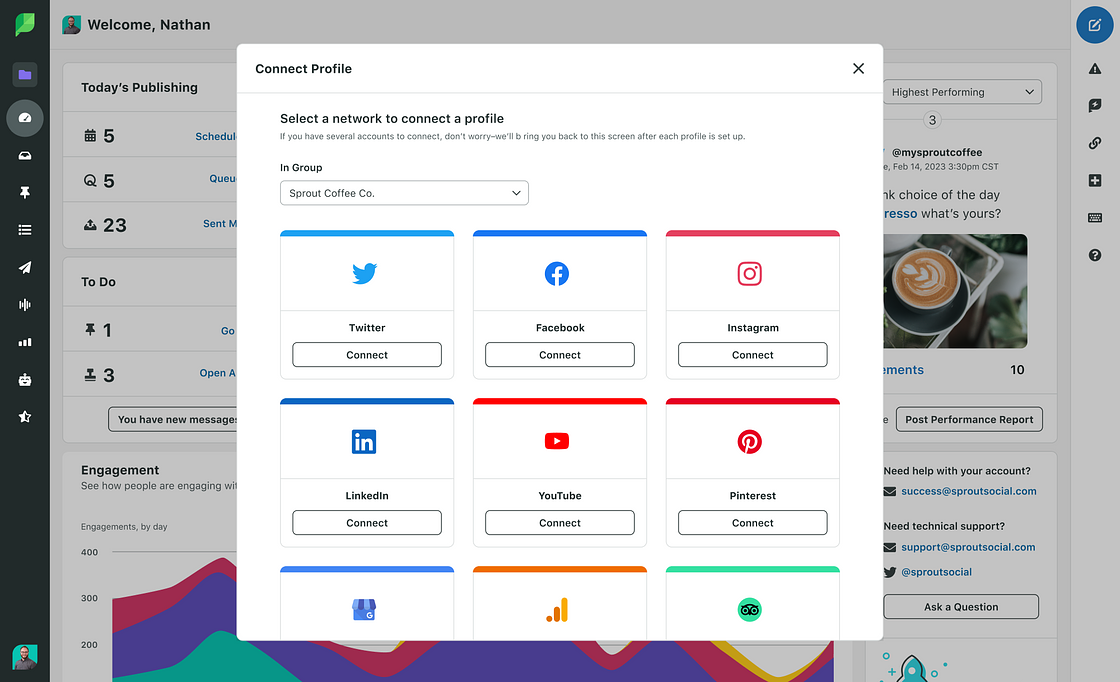
Step 2: Add a Profile. Click on Connect under Instagram and select which type of Instagram you want to connect, whether it’s a Creator profile or Business profile.
Step 3: Authorize Sprout Social. Instagram (or Facebook, if your Instagram Business Profile is connected to a Facebook Page) redirects you to grant Sprout Social permissions to manage your account. Ensure you authorize all required permissions.
Step 4: Navigate to Instagram Business Profiles Report. Once your profile is connected, you’ll see an overview of your Instagram performance. Gain insights into key metrics like impressions, engagements and engagement rate, audience growth and publishing behavior, including your top posts and hashtag performance.
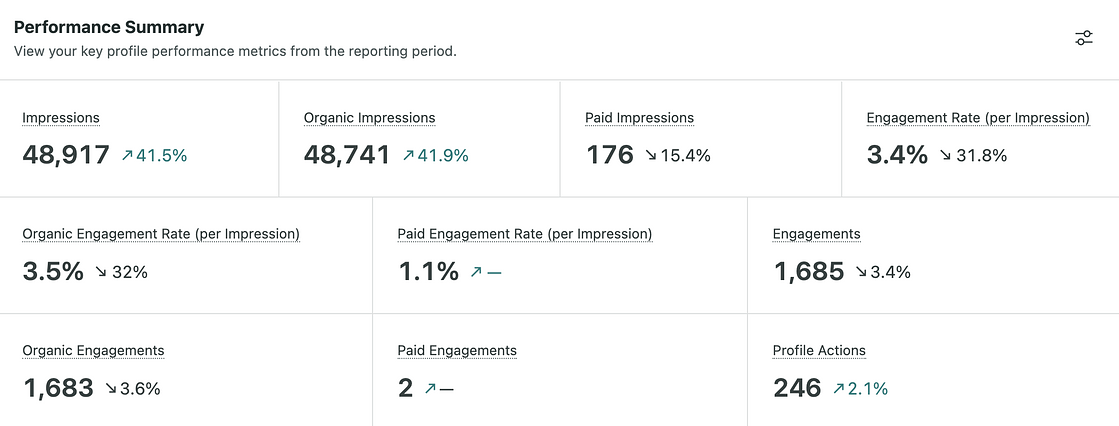
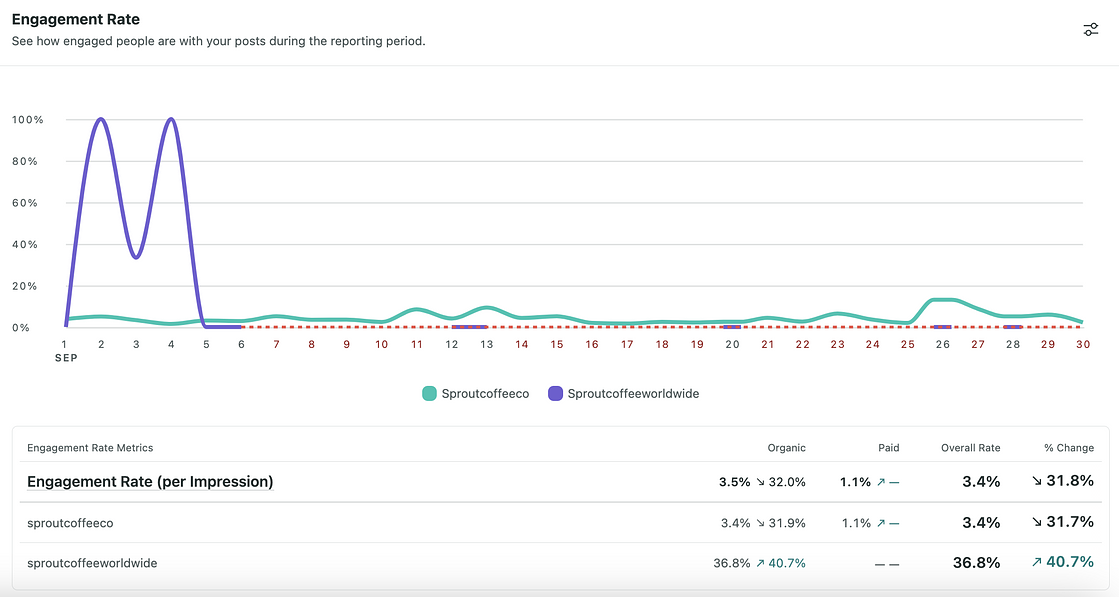
You’ll see what content your audience engages with and which strategies are more effective. This translates into quick, actionable data for refining content strategies, optimizing ad spend and ensuring that every piece of content drives measurable results.
What is a good influencer engagement rate on Instagram?
A good influencer engagement rate on Instagram is one that beats the global average of 1.59%, according to Statista. Rates vary significantly by follower count and niche, so use the table below to benchmark the influencers you’re evaluating.
| Influencer tier / Niche | Follower range | Average engagement rate |
|---|---|---|
| Nano-influencers | 1K–10K | 2.19% |
| Micro-influencers | 10K–50K | 0.99% |
| Macro-influencers | 50K–500K | 0.86% |
| Mega-influencers | 500K–1M | 0.87% |
| Celebrity influencers | 1M+ | 0.94% |
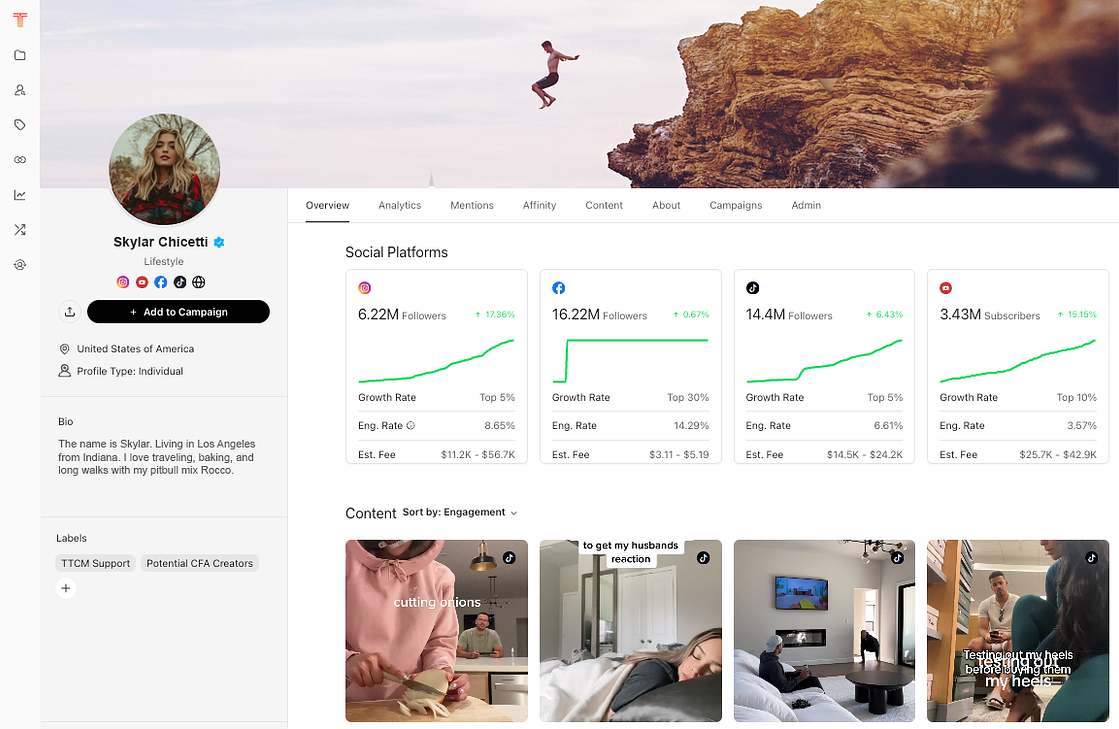
Nano-influencers earn the highest rates because their audiences are tighter and more responsive. That rate advantage narrows as follower counts grow, but reach scales in the opposite direction. Choose your influencer tier based on your campaign goal, not just engagement rate alone.
Use the Sprout Social Influencer Directory to find engagement rates by niche, then use Sprout Social Influencer Marketing‘s AI-powered natural language search and Brand Fit Score to identify the right creators for your brand.
Instagram engagement rate benchmarks by influencer post type
Post format shapes engagement as much as the content itself. Different formats drive different audience behaviors, and understanding which formats perform best in your category is one of the fastest ways to improve your rate.
Below are average Instagram engagement rates by post type from an influencer.
| Post type | Average engagement rate | Primary engagement driver |
|---|---|---|
| Reels | 1.24% | Views, shares, saves |
| Carousels | 1.36% | Saves, swipe-throughs, comments |
| Images | 1.04% | Likes, comments |
Source: Instagram stats
Reels lead on engagement. According to The 2026 Social Media Content Strategy Report, short-form video under 60 seconds is the brand content format audiences are most likely to interact with on Instagram. Making Reels a central part of your content mix is a proven starting point for improving your engagement rates
Here’s how each format stacks up strategically:
- Reels: Highest reach and share potential. The algorithm surfaces Reels to non-followers, making them your best tool for expanding beyond your existing audience.
- Carousels: Built for saves and multiple taps—two higher-weight engagement signals. Use them for educational content, step-by-step guides or any story that benefits from multiple frames.
- Static images: Lower algorithmic reach but effective for brand consistency and announcement content where simplicity is the point.
Post-type benchmarks are directional, not prescriptive. Audit your own content mix using Sprout Social’s Instagram Business Profiles Report to identify which formats your specific audience engages with most, then build more of what’s already working.
13 tips to improve your Instagram engagement rate
Knowing your benchmark is step one. Improving it is where the real work begins. These 13 tactics cover the full range, from content strategy and community management to platform features and scheduling, so you can increase engagement rate systematically, not by chance.
1. Actively engage with your audience
Social media demands two-way conversation. Drive engagement by actively participating in your community.
Essential engagement actions:
- Respond promptly: Reply to comments within hours, not days
- Ask questions: Include conversation starters in captions and Stories
- Engage externally: Comment on and like posts from your audience and industry peers
- Use interactive features: Deploy polls, quizzes and question stickers regularly
With comment threading, it’s even easier to know which ones you’ve missed on your posts. Not to mention, Sprout Social’s Smart Inbox unifies all your incoming messages from Instagram, including comments, DMs and mentions—preventing missed engagement opportunities.
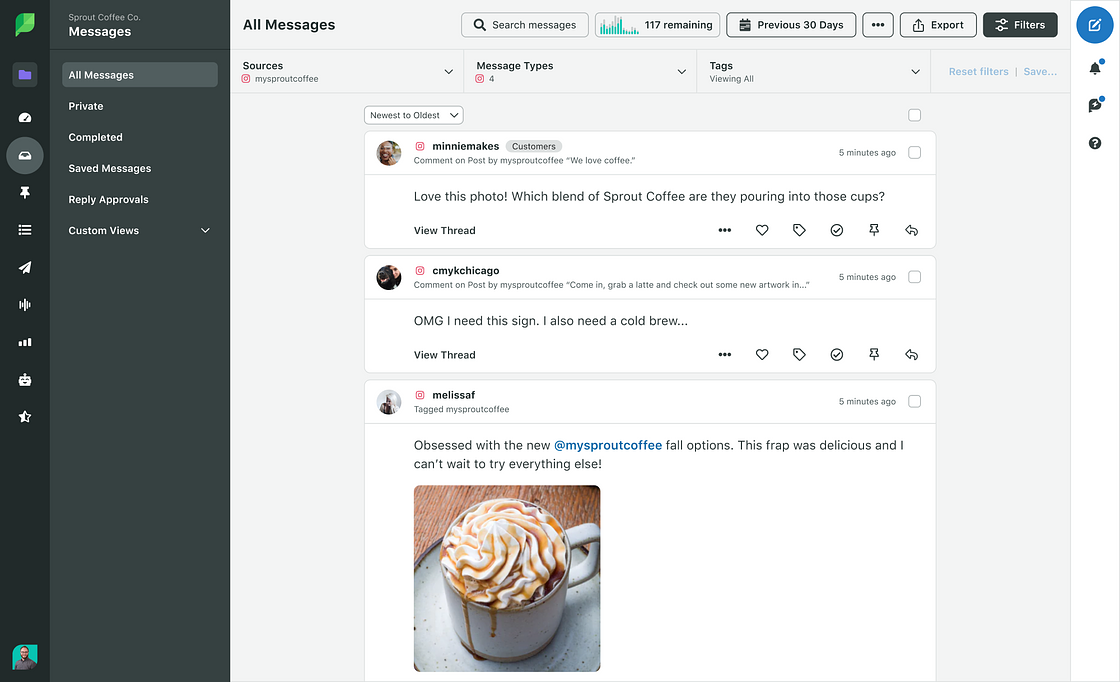
As your account starts to grow and you get more comments, you might not be able to respond to everyone. But that doesn’t mean you should give up entirely. You can still Like comments or just try to reply to as many as possible.
For instance, GoPro has over 20 million followers on Instagram. The brand deals with 100+ comments on its posts, so it’s not always viable to reply to every single one. But it takes time to respond to comments that ask questions or bring up an important feature.

Source: GoPro on Instagram
2. Replicate your top-performing posts
An excellent post idea doesn’t always drive the desired impact in the real world. It’s important to see what types of posts work with your audience and use this to inspire your Instagram content strategy.
Which posts are your followers engaging with the most? Review your Instagram metrics to see your past months’ best-performing posts.
Sprout’s Instagram Business Profiles Report surfaces your top-performing posts and provides in-depth analytics for your content. You’ll be able to quickly identify which content formats, topics or posting times generate the most engagement.
3. Make use of interactive features
Instagram is constantly improving to introduce new features that enhance user engagement. For instance, you can add interactive stickers to your Stories to conduct polls and quizzes. Question stickers and emoji sliders are also a great way to get people to interact with your Instagram Stories.
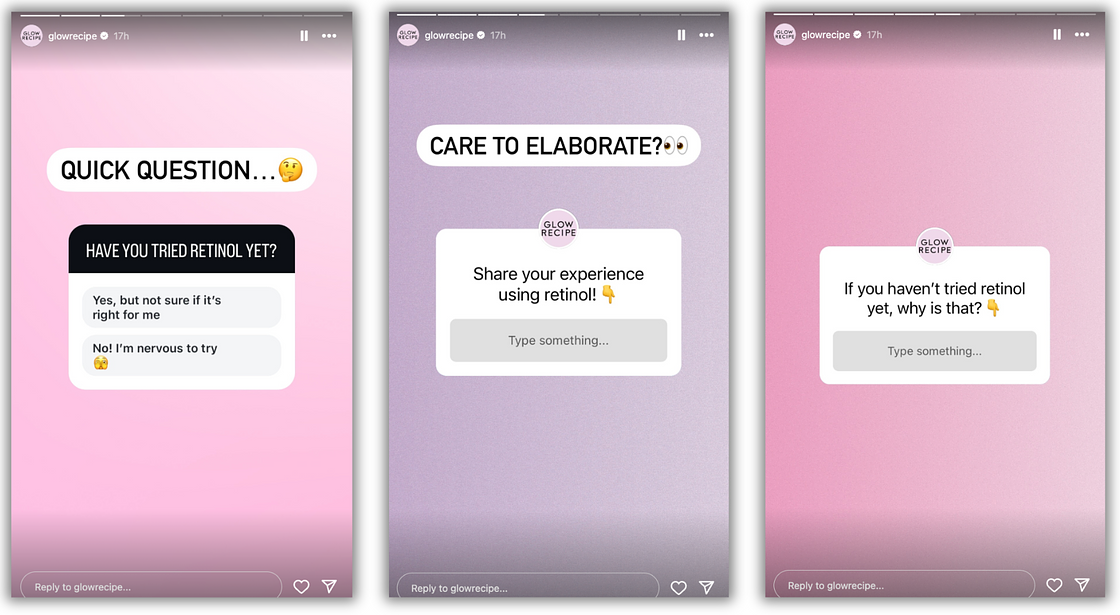
Glow Recipe shared a series of Stories with interactive stickers to engage its followers in a discussion about retinol. It started off with a poll asking people if they’ve tried retinol. The next two Stories included question stickers asking people to share their experience using it or why they haven’t tried it.
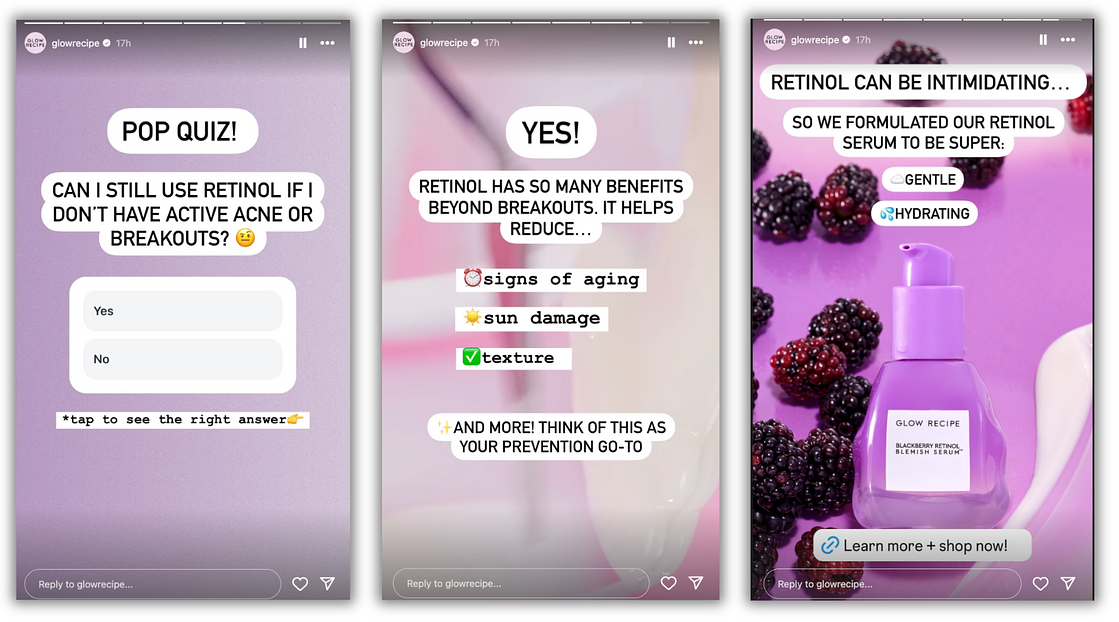
The next Story continued with a pop quiz and a poll where people could cast their votes. It encouraged followers to tap to the next Story to see the right answer. This all culminated to a Story explaining how retinol can be intimidating so the brand formulated it to be gentle and hydrating.
One of the latestInstagram trends involves using the “Add Yours” sticker. Use this sticker to start a challenge and get people to engage with your brand. Share a prompt and encourage people to participate in your challenge by adding their own content.
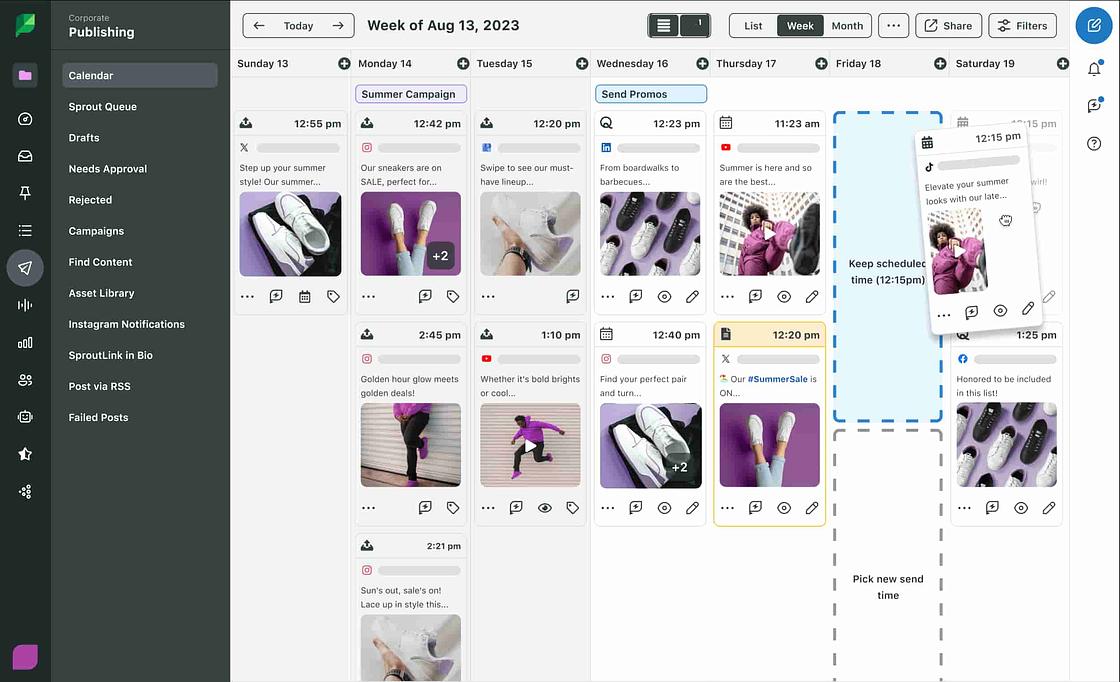
Sprout supports direct publishing for feed posts, Reels and Stories. Use Sprout Social’s Publishing calendar to plan and schedule your interactive content in advance so you maintain a consistent cadence without scrambling for ideas in the moment.
4. Take advantage of your Instagram Stories
Make sure to use Stories to promote your latest posts. This is a great way to ensure better visibility for your Feed posts as Stories show up prominently at the top of the user’s Feed.
Penguin Books regularly shares its latest Feed post in Stories to ensure that people don’t miss it.

5. Promote across platforms
Your Facebook audience and your Instagram audience overlap, but they’re not the same. Cross-promote your Instagram content on Facebook, LinkedIn and other platforms you’re active on to pull existing fans into your Instagram community. A single cross-promotional post costs nothing and converts audiences you’ve already earned.
6. Create more short-form video content
Guess what we found in The 2026 Social Media Content Strategy Report? Short-form video (under 60 seconds) is the brand content format audiences are most likely to interact with on Instagram.
That means your Instagram content strategy needs to change direction. And the focus should shift to creating more short-form videos.
In other words, Reels are your best friend for increasing your Instagram engagement. Who knows? It might even be just the thing you need to go viral on Instagram.
Grove Collaborative relies heavily on user-generated Reels to keep its Feed fresh and engaging. These short videos feature relatable humor and household hacks from its community.
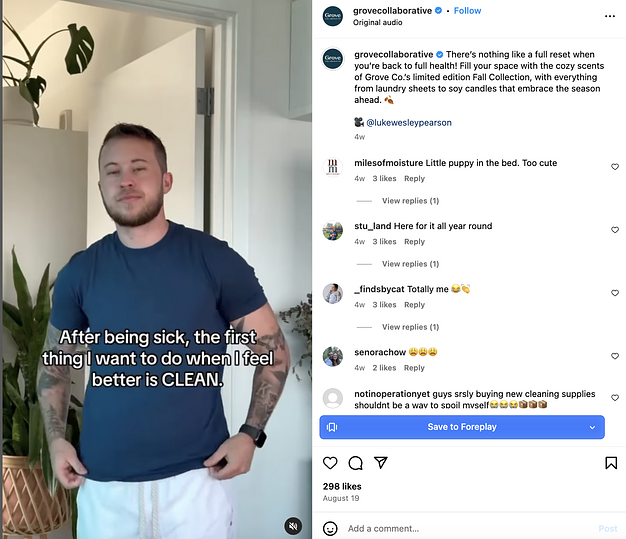
Source: Grove Collaborative on Instagram
7. Create Collab posts with influential accounts
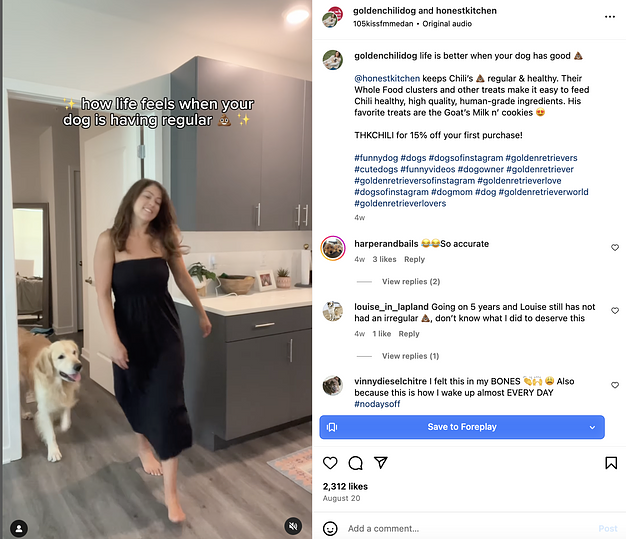
Instagram now has a feature enabling users to create Collab posts with other users. A Collab post shows up in the Feeds of both of your followers, meaning a chance to garner higher engagement.
The Honest Kitchen regularly creates Collab posts with pet influencers to promote its human-grade pet food. This allows the brand to get its products in front of a massive and relevant audience, IE the pet influencer’s followers.
8. Give sneak peeks and hints to drive curiosity
Followers love it when you let them in on a secret. Even if they’re public posts, giving sneak peeks and hints of new releases makes the audience think they’re part of a special group.
Check out how Fabletics Scrubs shares a teaser for an upcoming color drop without giving too much away. The Reel features turquoise waves and a text overlay that reads “May.” In the caption, the brand explains that the May color drop is arriving soon and encourages followers to “give us your best guess.”

Source: Fabletics Scrubs on Instagram
9. Write captions that drive engagement
On a related note, your Instagram captions give you the perfect opportunity to include a call for action. In this case, the action would involve some type of engagement.
For example, Spoonflower shares a Reel showing different wallpaper styles. In the caption, it asks followers which style matches their vibe. The Reel generated tons of comments from enthusiastic followers choosing their favorite collection.

Source: Spoonflower on Instagram
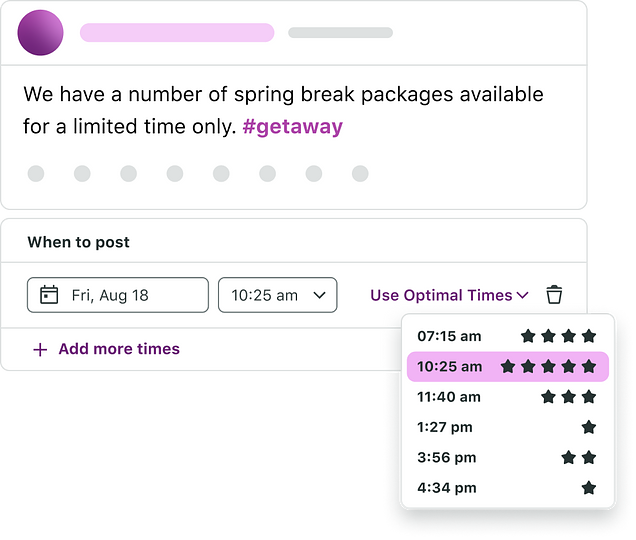
10. Post your content at the best times
Timing plays a role in how much engagement you get on your posts.
You want to post when most of your followers are online and engaging on the app. Even with the best photo and wittiest caption, you’ll miss out on engagement if you’re posting at the wrong hour.
We did some research into the best times to post on Instagram and here’s what we found.
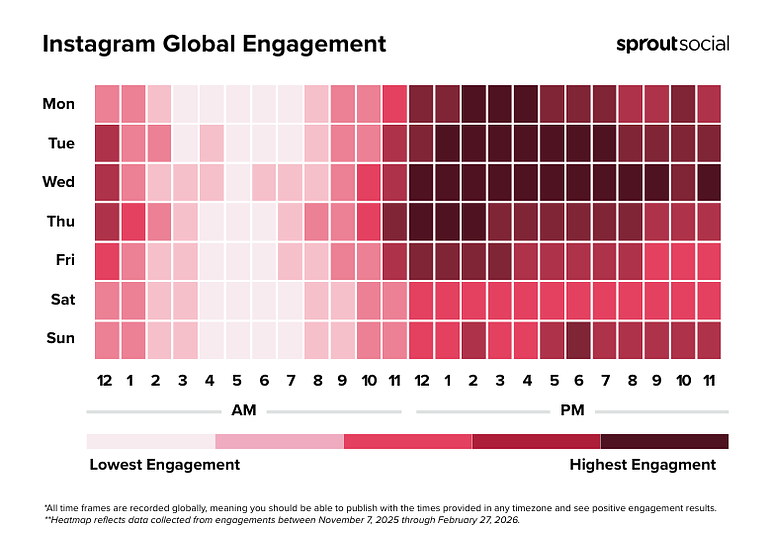
But keep in mind that the specific timing may be different for your account. Instagram business accounts offer analytics that tell you when your followers are most active.
Alternatively, Instagram automation supports you by saving time and improving the scheduling process.
Use Sprout Social’s ViralPost® feature to automatically schedule your posts at the optimal time. This feature removes the guesswork and ensures that your Instagram posts go out at a time when you receive the most engagement.
11. Encourage customer and employee posts
Use branded Instagram hashtags to support how you organize user-generated content.
If you engage in these hashtags and incorporate a UGC strategy, more people will take notice and begin using the hashtags, too.
Your employees are your strongest advocates as well. Their accounts give a more personal, unfiltered perspective of the company.
12. Host a giveaway contest
Giveaways work because they attach a specific action, such as commenting, sharing or posting a Story to the reward. That action requirement is what makes them effective for engagement, not just reach.
Design your contest rules around your engagement goal. The entry mechanic should be the engagement action you want: if you want more comments, make commenting the entry. The prize needs to be worth the effort, relevant to your audience and genuinely valuable.
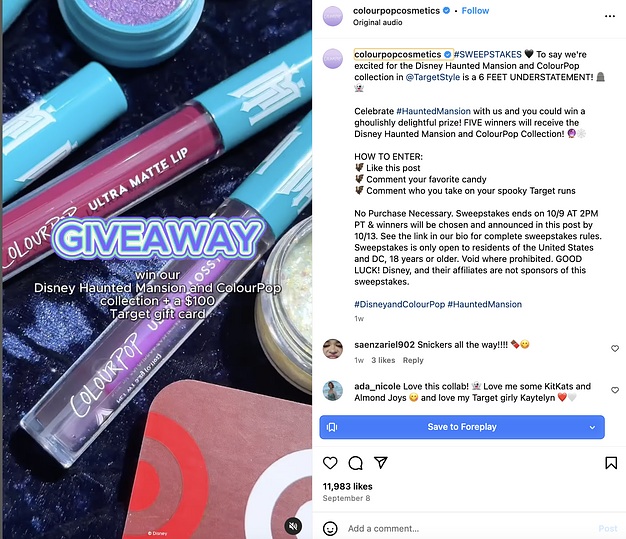
For example, ColourPop Cosmetics hosted a giveaway to promote its Disney’s “Haunted Mansion” collection. To enter the sweepstakes, all you had to do was like the post and comment your favorite candy and who to take on your spooky Target runs.
Source: ColourPop on Instagram
13. Improve your Instagram hashtags
It’‘s a known fact that using the right hashtags can support your reach by helping Instagram understand what your content is about. But with that increased reach comes a greater chance of boosting engagement.
Use relevant and niche hashtags that will let you tap into the right audience. The goal is to get Instagram to show your content to users who have shown an interest in topics related to that hashtag.
Turn your Instagram engagement data into action
Instagram engagement rate is a signal. What you do with that signal is what drives growth.
Track your rate over time, compare it against the benchmarks that matter for your industry and use those insights to shape stronger content decisions, from format selection to posting cadence to the topics your audience wants to engage with.
Sprout Social’s Instagram Business Profiles Report tracks your engagement rate automatically, surfaces your top-performing content and benchmarks your performance against direct competitors. Use the Smart Inbox to turn every comment and DM into a response opportunity. Use ViralPost® to publish at the exact moment your audience is most active. Start your free 30-day trial to put all of it to work.
FAQs about Instagram engagement rate
How do I calculate the average engagement rate on Instagram?
Add total engagements across a set of posts, divide by the number of followers to get average engagements per post and then divide that figure by your follower count and multiply by 100.
(Total Engagements ÷ Total Followers) × 100
What is the 5-3-1 rule on Instagram?
The 5-3-1 rule is a community engagement habit: leave five thoughtful comments on other accounts, respond to three Stories or posts and start one direct conversation to keep your brand active and signal genuine engagement to the algorithm.
Why does engagement rate decrease as follower count grows?
As your audience expands, a smaller percentage of followers responds to every post, which is why nano-influencers consistently outperform celebrity accounts on engagement rate, and why you should benchmark against accounts with a similar follower count, not just the platform average.
37 free social media strategy templates that will elevate your workflows
Published on December 5, 2025 Reading time 15 minutes










Share